第12章メンデルの実験と遺伝
Codominance共優性
A variation on incomplete dominance is codominance, in which both alleles for the same characteristic are simultaneously expressed in the heterozygote. An example of codominance is the MN blood groups of humans. The M and N alleles are expressed in the form of an M or N antigen present on the surface of red blood cells. Homozygotes (LMLM and LNLN) express either the M or the N allele, and heterozygotes (LMLN) express both alleles equally. In a self-cross between heterozygotes expressing a codominant trait, the three possible offspring genotypes are phenotypically distinct. However, the 1:2:1 genotypic ratio characteristic of a Mendelian monohybrid cross still applies.
英語のヒント
不完全優性の変形として共優性があり、同じ特徴の両方の対立遺伝子がヘテロ接合体で同時に発現する。ヒトのMN式血液型がその例である。M、N対立遺伝子は赤血球表面のM抗原、N抗原として発現する。ホモ接合体(LMLM、LNLN)はいずれか一方を、ヘテロ接合体(LMLN)は両方を等しく発現する。共優性形質を示すヘテロ接合体どうしの交配では、子に可能な三つの遺伝子型は表現型でも異なる。しかしメンデルの一遺伝子雑種交配に特徴的な1:2:1の遺伝子型比は、なお成り立つ。
Multiple Alleles複対立遺伝子
Mendel implied that only two alleles, one dominant and one recessive, could exist for a given gene. We now know that this is an oversimplification. Although individual humans (and all diploid organisms) can only have two alleles for a given gene, multiple alleles may exist at the population level such that many combinations of two alleles are observed. Note that when many alleles exist for the same gene, the convention is to denote the most common phenotype or genotype among wild animals as the wild type (often abbreviated “+”); this is considered the standard or norm. All other phenotypes or genotypes are considered variants of this standard, meaning that they deviate from the wild type. The variant may be recessive or dominant to the wild-type allele.
英語のヒント
メンデルの説明は、一つの遺伝子には優性と劣性の二つの対立遺伝子しか存在しないことを示唆していた。現在では、これは単純化しすぎだと分かっている。ヒトの個人、そしてすべての二倍体生物は、一つの遺伝子について二つしか持てないが、個体群には複数の対立遺伝子が存在し、二つずつの多くの組み合わせが見られる。同じ遺伝子に多くの対立遺伝子がある場合、野生動物で最も普通の表現型または遺伝子型を野生型と呼び、しばしば「+」で略記する。これを標準と考え、それ以外は野生型からずれた変異型とする。変異型は、野生型対立遺伝子に対して劣性の場合も優性の場合もある。
An example of multiple alleles is coat color in rabbits (Figure 12.8). Here, four alleles exist for the c gene. The wild-type version, C+C+, is expressed as brown fur. The chinchilla phenotype, cchcch, is expressed as black-tipped white fur. The Himalayan phenotype, chch, has black fur on the extremities and white fur elsewhere. Finally, the albino, or “colorless” phenotype, cc, is expressed as white fur. In cases of multiple alleles, dominance hierarchies can exist. In this case, the wild-type allele is dominant over all the others, chinchilla is incompletely dominant over Himalayan and albino, and Himalayan is dominant over albino. This hierarchy, or allelic series, was revealed by observing the phenotypes of each possible heterozygote offspring.
英語のヒント
複対立遺伝子の例はウサギの毛色である(図12.8)。c遺伝子には四つの対立遺伝子がある。野生型C+C+は褐色の毛、チンチラ型cchcchは毛先が黒い白毛、ヒマラヤン型chchは体の末端が黒く、ほかは白い毛として現れる。最後のアルビノ、つまり「無色」型ccは白毛となる。複対立遺伝子では優性関係に順位があることがある。この例では野生型がすべてに優性で、チンチラ型はヒマラヤン型とアルビノ型に不完全優性、ヒマラヤン型はアルビノ型に優性である。この順位、すなわち対立遺伝子系列は、可能な各ヘテロ接合の子の表現型を観察して明らかになった。
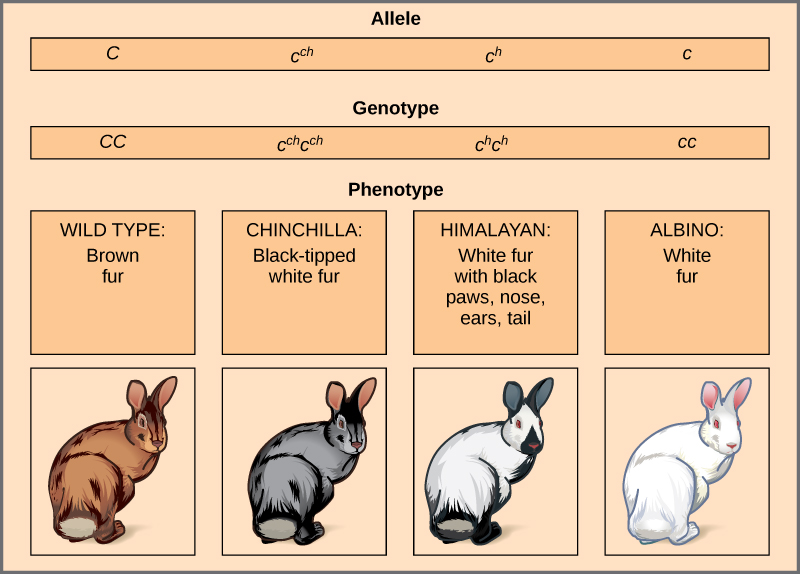
Figure 12.8図 12.8
Four different alleles exist for the rabbit coat color (C) gene.
ウサギの毛色(C)遺伝子には、四つの異なる対立遺伝子がある。
The complete dominance of a wild-type phenotype over all other mutants often occurs as an effect of “dosage” of a specific gene product, such that the wild-type allele supplies the correct amount of gene product whereas the mutant alleles cannot. For the allelic series in rabbits, the wild-type allele may supply a given dosage of fur pigment, whereas the mutants supply a lesser dosage or none at all. Interestingly, the Himalayan phenotype is the result of an allele that produces a temperature-sensitive gene product that only produces pigment in the cooler extremities of the rabbit’s body.
英語のヒント
野生型の表現型がほかのすべての変異型に完全優性となるのは、特定の遺伝子産物の「量」によることが多い。野生型対立遺伝子は適切な量の産物を供給できるが、変異型にはできない。ウサギの対立遺伝子系列では、野生型が一定量の毛の色素を供給し、変異型はより少量か、全く供給しない可能性がある。興味深いことに、ヒマラヤン型の対立遺伝子は温度に敏感な遺伝子産物を作り、体の低温の末端部でだけ色素を作る。
Alternatively, one mutant allele can be dominant over all other phenotypes, including the wild type. This may occur when the mutant allele somehow interferes with the genetic message so that even a heterozygote with one wild-type allele copy expresses the mutant phenotype. One way in which the mutant allele can interfere is by enhancing the function of the wild-type gene product or changing its distribution in the body. One example of this is the Antennapedia mutation in Drosophila (Figure 12.9). In this case, the mutant allele expands the distribution of the gene product, and as a result, the Antennapedia heterozygote develops legs on its head where its antennae should be.
英語のヒント
反対に、一つの変異対立遺伝子が野生型を含むすべての表現型に優性となる場合もある。変異対立遺伝子が何らかの形で遺伝情報の働きに干渉し、野生型を1コピー持つヘテロ接合体でも変異表現型が現れる場合である。干渉の方法には、野生型の遺伝子産物の働きを強めたり、体内の分布を変えたりするものがある。例はショウジョウバエのアンテナペディア変異である(図12.9)。この変異対立遺伝子は産物の分布を広げ、その結果、ヘテロ接合体では頭の触角があるべき位置に脚ができる。
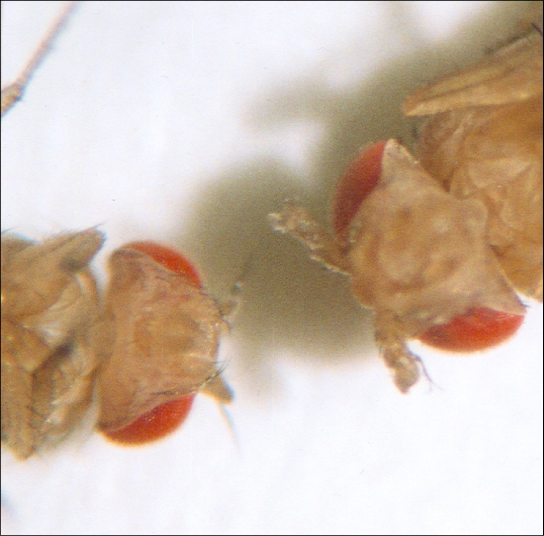


Figure 12.9図 12.9
As seen in comparing the wild-type Drosophila (left) and the Antennapedia mutant (right), the Antennapedia mutant has legs on its head in place of antennae.
野生型ショウジョウバエ(左)とアンテナペディア変異体(右)を比べると、変異体では頭の触角の代わりに脚ができている。