第34章グローバル化と保護貿易主義
Demand and Supply Analysis of Protectionism保護主義の需要・供給分析
To the non-economist, restricting imports may appear to be nothing more than taking sales from foreign producers and giving them to domestic producers. Other factors are at work, however, because firms do not operate in a vacuum. Instead, firms sell their products either to consumers or to other firms (if they are business suppliers), who are also affected by the trade barriers. A demand and supply analysis of protectionism shows that it is not just a matter of domestic gains and foreign losses, but a policy that imposes substantial domestic costs as well.
英語のヒント
経済学者でない人には、輸入制限は、外国生産者から売上を奪い、国内生産者へ与えるだけのことに見えるかもしれない。しかし、企業は真空の中で活動するわけではないので、他の要因も働いている。企業は製品を、消費者、または(企業向け供給者であれば)他の企業に売り、その相手も貿易障壁の影響を受ける。保護主義の需要・供給分析は、それが国内の利益と外国の損失だけの問題ではなく、国内にも大きな費用を課す政策であることを示す。
Consider two countries, Brazil and the United States, who produce sugar. Each country has a domestic supply and demand for sugar, as Table 34.1 details and Figure 34.2 illustrates. In Brazil, without trade, the equilibrium price of sugar is 12 cents per pound and the equilibrium output is 30 tons. When there is no trade in the United States, the equilibrium price of sugar is 24 cents per pound and the equilibrium quantity is 80 tons. We label these equilibrium points as point E in each part of the figure.
英語のヒント
The Sugar Trade between Brazil and the United Statesブラジルとアメリカの砂糖貿易
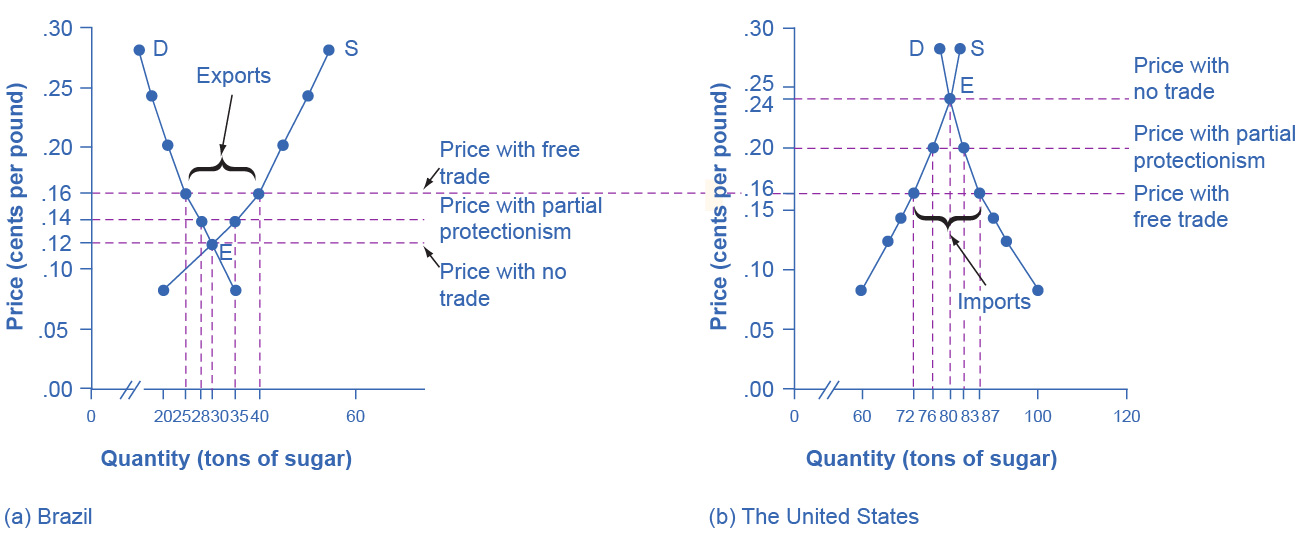
Figure 34.2図 34.2
Before trade, the equilibrium price of sugar in Brazil is 12 cents a pound and it is 24 cents per pound in the United States. When trade is allowed, businesses will buy cheap sugar in Brazil and sell it in the United States. This will result in higher prices in Brazil and lower prices in the United States. Ignoring transaction costs, prices should converge to 16 cents per pound, with Brazil exporting 15 tons of sugar and the United States importing 15 tons of sugar. If trade is only partly open between the countries, it will lead to an outcome between the free-trade and no-trade possibilities.
英語のヒント
貿易前の砂糖の均衡価格は、ブラジルでは1ポンド12セント、アメリカでは1ポンド24セントである。貿易が認められると、企業はブラジルで安い砂糖を買い、アメリカで売る。その結果、ブラジルの価格は上がり、アメリカの価格は下がる。取引費用を無視すれば、価格は1ポンド16セントへ収束し、ブラジルは砂糖15トンを輸出し、アメリカは15トンを輸入するはずである。両国の貿易が部分的にしか開かれていないなら、結果は自由貿易と貿易なしの間になる。
Price 価格 |
Brazil: Quantity Supplied (tons) ブラジル:供給量(トン) |
Brazil: Quantity Demanded (tons) ブラジル:需要量(トン) |
U.S.: Quantity Supplied (tons) アメリカ:供給量(トン) |
U.S.: Quantity Demanded (tons) アメリカ:需要量(トン) |
|---|---|---|---|---|
8 cents 8セント |
20 |
35 |
60 |
100 |
12 cents 12セント |
30 |
30 |
66 |
93 |
14 cents 14セント |
35 |
28 |
69 |
90 |
16 cents 16セント |
40 |
25 |
72 |
87 |
20 cents 20セント |
45 |
21 |
76 |
83 |
24 cents 24セント |
50 |
18 |
80 |
80 |
28 cents 28セント |
55 |
15 |
82 |
78 |
If international trade between Brazil and the United States now becomes possible, profit-seeking firms will spot an opportunity: buy sugar cheaply in Brazil, and sell it at a higher price in the United States. As sugar is shipped from Brazil to the United States, the quantity of sugar produced in Brazil will be greater than Brazilian consumption (with the extra production exported), and the amount produced in the United States will be less than the amount of U.S. consumption (with the extra consumption imported). Exports to the United States will reduce the sugar supply in Brazil, raising its price. Imports into the United States will increase the sugar supply, lowering its price. When the sugar price is the same in both countries, there is no incentive to trade further. As Figure 34.2 shows, the equilibrium with trade occurs at a price of 16 cents per pound. At that price, the sugar farmers of Brazil supply a quantity of 40 tons, while the consumers of Brazil buy only 25 tons.
英語のヒント
いま、ブラジルとアメリカの間で国際貿易が可能になると、利潤を求める企業は、ブラジルで砂糖を安く買い、アメリカで高く売る機会を見いだす。砂糖がブラジルからアメリカへ運ばれると、ブラジルの砂糖生産量は国内消費量を上回り(余分な生産分が輸出される)、アメリカの生産量は国内消費量を下回る(余分な消費分が輸入される)。アメリカへの輸出はブラジルの砂糖供給を減らし、価格を上げる。アメリカへの輸入は砂糖供給を増やし、価格を下げる。砂糖価格が両国で同じになると、それ以上貿易する誘因はなくなる。図34.2が示すように、貿易を伴う均衡は1ポンド16セントで生じる。その価格で、ブラジルの砂糖農家は40トンを供給するが、ブラジルの消費者は25トンしか買わない。
The extra 15 tons of sugar production, shown by the horizontal gap between the demand curve and the supply curve in Brazil, is exported to the United States. In the United States, at a price of 16 cents, the farmers produce a quantity of 72 tons and consumers demand a quantity of 87 tons. The excess demand of 15 tons by American consumers, shown by the horizontal gap between demand and domestic supply at the price of 16 cents, is supplied by imported sugar. Free trade typically results in income distribution effects, but the key is to recognize the overall gains from trade, as Figure 34.3 shows. Building on the concepts that we outlined in Demand and Supply and Demand, Supply, and Efficiency in terms of consumer and producer surplus, Figure 34.3 (a) shows that producers in Brazil gain by selling more sugar at a higher price, while Figure 34.3 (b) shows consumers in the United States benefit from the lower price and greater availability of sugar. Consumers in Brazil are worse off (compare their no-trade consumer surplus with the free-trade consumer surplus) and U.S. producers of sugar are worse off. There are gains from trade—an increase in social surplus in each country. That is, both the United States and Brazil are better off than they would be without trade. The following Clear It Up feature explains how trade policy can influence low-income countries.
英語のヒント
ブラジルの需要曲線と供給曲線の水平の間隔で示される、余分な砂糖生産15トンは、アメリカへ輸出される。アメリカでは、16セントの価格で農家が72トンを生産し、消費者は87トンを需要する。価格16セントでの需要と国内供給の水平の間隔で示される、アメリカ消費者の超過需要15トンは、輸入砂糖で供給される。自由貿易は通常、所得分配への影響をもたらすが、大事なのは、図34.3が示す貿易全体の利益を認識することである。「需要と供給」と「需要、供給、効率性」で概説した消費者余剰と生産者余剰の概念に基づき、図34.3(a)は、ブラジルの生産者が、より高い価格でより多く砂糖を売ることで利益を得ることを示し、図34.3(b)は、アメリカの消費者が、低い価格と砂糖の供給増加から利益を得ることを示す。ブラジルの消費者は不利になる(貿易なしの消費者余剰と自由貿易の消費者余剰を比較しよう)。アメリカの砂糖生産者も不利になる。各国の社会的余剰が増えるという、貿易の利益がある。つまり、アメリカもブラジルも、貿易がない場合より豊かになる。次の「疑問を解こう」では、貿易政策が低所得国にどう影響しうるかを説明する。
Free Trade of Sugar砂糖の自由貿易
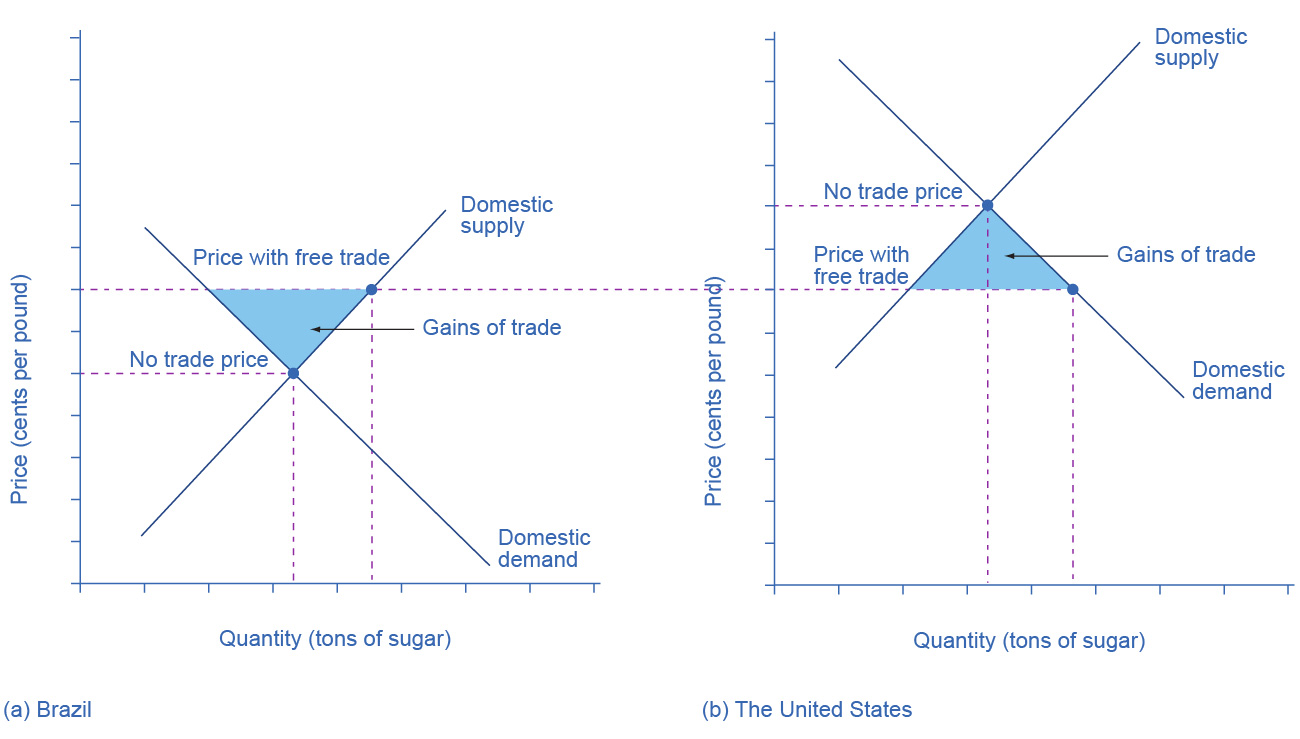


Figure 34.3図 34.3
Free trade results in gains from trade. Total surplus increases in both countries, as the two blue-shaded areas show. However, there are clear income distribution effects. Producers gain in the exporting country, while consumers lose; and in the importing country, consumers gain and producers lose.
英語のヒント
自由貿易は貿易の利益をもたらす。二つの青い領域が示すように、両国で総余剰が増える。しかし、所得分配への影響は明確である。輸出国では生産者が利益を得て消費者が損をし、輸入国では消費者が利益を得て生産者が損をする。
Additional Resources追加教材
Now, let’s look at what happens with protectionism. U.S. sugar farmers are likely to argue that, if only they could be protected from sugar imported from Brazil, the United States would have higher domestic sugar production, more jobs in the sugar industry, and American sugar farmers would receive a higher price. If the United States government sets a high-enough tariff on imported sugar, or sets an import quota at zero, the result will be that the quantity of sugar traded between countries could be reduced to zero, and the prices in each country will return to the levels before trade was allowed.
英語のヒント
さて、保護主義では何が起こるか見てみよう。アメリカの砂糖農家は、ブラジルから輸入される砂糖から守られさえすれば、アメリカの国内砂糖生産が増え、砂糖産業の雇用も増え、アメリカの砂糖農家はより高い価格を受け取れると主張しそうである。アメリカ政府が輸入砂糖に十分高い関税を設定するか、輸入割当てをゼロにすれば、両国間で取引される砂糖の量をゼロまで減らせ、各国の価格は貿易が認められる前の水準へ戻る。
Blocking only some trade is also possible. Suppose that the United States passed a sugar import quota of seven tons. The United States will import no more than seven tons of sugar, which means that Brazil can export no more than seven tons of sugar to the United States. As a result, the price of sugar in the United States will be 20 cents, which is the price where the quantity demanded is seven tons greater than the domestic quantity supplied. Conversely, if Brazil can export only seven tons of sugar, then the price of sugar in Brazil will be 14 cents per pound, which is the price where the domestic quantity supplied in Brazil is seven tons greater than domestic demand.
英語のヒント
貿易の一部だけを阻止することも可能である。アメリカが砂糖の輸入割当てを7トンと決めたと仮定しよう。アメリカは7トンを超えて砂糖を輸入せず、それはブラジルがアメリカへ7トンを超えて輸出できないことを意味する。その結果、アメリカの砂糖価格は20セントとなる。これは、需要量が国内供給量を7トン上回る価格である。逆に、ブラジルが砂糖を7トンしか輸出できないなら、ブラジルの砂糖価格は1ポンド14セントとなる。これは、ブラジルの国内供給量が国内需要を7トン上回る価格である。
In general, when a country sets a low or medium tariff or import quota, the equilibrium price and quantity will be somewhere between those that prevail with no trade and those with completely free trade. The following Work It Out explores the impact of these trade barriers.
英語のヒント
一般に、国が低い、または中程度の関税や輸入割当てを設定すると、均衡価格と数量は、貿易なしで成立するものと、完全な自由貿易で成立するものの間になる。次の「解いてみよう」では、こうした貿易障壁の影響を検討する。