第22章インフレーション
Introduction to Inflationインフレへの導入
Big Bucks in Zimbabweジンバブエの大金
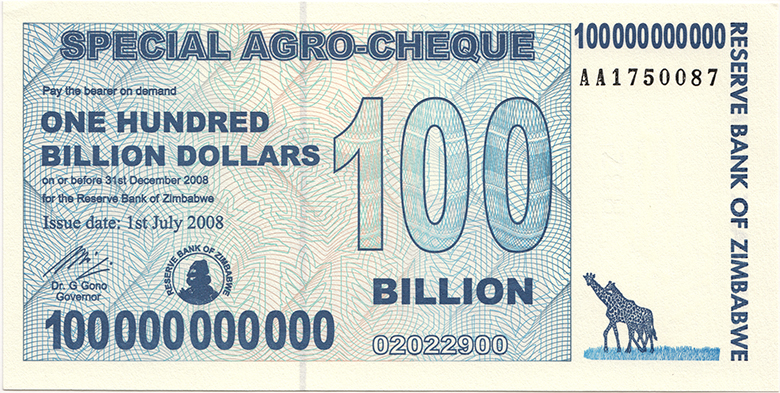
This bill was worth 100 billion Zimbabwean dollars when issued in 2008. There were even bills issued with a face value of 100 trillion Zimbabwean dollars. The bills had $100,000,000,000,000 written on them. Unfortunately, they were almost worthless. At one point, 621,984,228 Zimbabwean dollars were equal to one U.S. dollar. Eventually, the country abandoned its own currency and allowed people to use foreign currency for purchases. (Credit: modification of "100 Billion Dollars" by Peat Bakke/Flickr, CC BY 2.0) · CC BY 2.0 · Source出典

Figure 22.1図 22.1
This bill was worth 100 billion Zimbabwean dollars when issued in 2008. There were even bills issued with a face value of 100 trillion Zimbabwean dollars. The bills had $100,000,000,000,000 written on them. Unfortunately, they were almost worthless. At one point, 621,984,228 Zimbabwean dollars were equal to one U.S. dollar. Eventually, the country abandoned its own currency and allowed people to use foreign currency for purchases. (Credit: modification of "100 Billion Dollars" by Peat Bakke/Flickr, CC BY 2.0)
英語のヒント
この紙幣は、2008年の発行時に1000億ジンバブエ・ドルの価値があった。額面100兆ジンバブエ・ドルの紙幣さえ発行された。紙幣には$100,000,000,000,000と書かれていた。残念ながら、ほとんど価値はなかった。ある時点では、6億2198万4228ジンバブエ・ドルが1米ドルに等しかった。最終的にこの国は自国通貨を放棄し、人々が買い物に外国通貨を使うことを認めた。(クレジット:Peat Bakke/Flickrによる「100 Billion Dollars」を改変、CC BY 2.0)
Learning Objectives学習目標
Inflation is a general and ongoing rise in the level of prices in an entire economy. Inflation does not refer to a change in relative prices. A relative price change occurs when you see that the price of tuition has risen, but the price of laptops has fallen. Inflation, on the other hand, means that there is pressure for prices to rise in most markets in the economy. In addition, price increases in the supply-and-demand model were one-time events, representing a shift from a previous equilibrium to a new one. Inflation implies an ongoing rise in prices. If inflation happened for one year and then stopped, then it would not be inflation any more.
英語のヒント
インフレとは、経済全体における物価水準の全般的かつ継続的な上昇である。インフレは相対価格の変化を指さない。授業料が上がり、ノートパソコンの価格が下がるときに見られるのは、相対価格の変化である。それに対してインフレは、経済の大半の市場で価格の上昇圧力があることを意味する。また、需要・供給モデルの価格上昇は、以前の均衡から新しい均衡への移行を表す、一度きりの出来事だった。インフレは物価の継続的な上昇を意味する。もしインフレが1年間起きて、その後止まったなら、それはもはやインフレではない。
This chapter begins by showing how to combine prices of individual goods and services to create a measure of overall inflation. It discusses the historical and recent experience of inflation, both in the United States and in other countries around the world. Other chapters have sometimes included a note under an exhibit or a parenthetical reminder in the text saying that the numbers have been adjusted for inflation. In this chapter, it is time to show how to use inflation statistics to adjust other economic variables, so that you can tell how much of, for example, we can attribute the rise in GDP over different periods of time to an actual increase in the production of goods and services and how much we should attribute to the fact that prices for most items have risen.
英語のヒント
この章は、個々の財・サービスの価格を組み合わせて、全般的なインフレの指標をつくる方法から始める。米国と世界の他の国々における、歴史的および最近のインフレの経験を論じる。他の章では、図表の下の注や本文の括弧書きで、数値がインフレ調整済みだと注意を促すことがあった。この章では、インフレ統計を使って他の経済変数を調整する方法を示す。これにより、たとえば異なる時期のGDP上昇のうち、どれだけが財・サービスの生産の実際の増加によるもので、どれだけが大半の品目の価格上昇によるものかを判別できるようになる。
Inflation has consequences for people and firms throughout the economy, in their roles as lenders and borrowers, wage-earners, taxpayers, and consumers. The chapter concludes with a discussion of some imperfections and biases in the inflation statistics, and a preview of policies for fighting inflation that we will discuss in other chapters.
英語のヒント
インフレは、貸し手と借り手、賃金稼得者、納税者、消費者としての役割を通じて、経済全体の人々と企業に影響を及ぼす。この章の最後では、インフレ統計の不完全さや偏りの一部を論じ、他の章で扱うインフレ対策を概観する。