第22章インフレーション
Blurred Price Signals不明瞭になる価格シグナル
Prices are the messengers in a market economy, conveying information about conditions of demand and supply. Inflation blurs those price messages. Inflation means that we perceive price signals more vaguely, like a radio program received with considerable static. If the static becomes severe, it is hard to tell what is happening.
英語のヒント
価格は市場経済の伝達者であり、需要と供給の状況について情報を運ぶ。インフレは、その価格のメッセージをぼやけさせる。インフレがあると、強い雑音の入るラジオ番組のように、価格シグナルを曖昧にしか受け取れなくなる。雑音がひどくなると、何が起きているか分かりにくい。
In Israel, when inflation accelerated to an annual rate of 500% in 1985, some stores stopped posting prices directly on items, since they would have had to put new labels on the items or shelves every few days to reflect inflation. Instead, a shopper just took items from a shelf and went up to the checkout register to find out the price for that day. Obviously, this situation makes comparing prices and shopping for the best deal rather difficult. When the levels and changes of prices become uncertain, businesses and individuals find it harder to react to economic signals. In a world where inflation is at a high rate, but bouncing up and down to some extent, does a higher price of a good mean that inflation has risen, or that supply of that good has decreased, or that demand for that good has increased? Should a buyer of the good take the higher prices as an economic hint to start substituting other products—or have the prices of the substitutes risen by an equal amount? Should a seller of the good take a higher price as a reason to increase production—or is the higher price only a sign of a general inflation in which the prices of all inputs to production are rising as well? The true story will presumably become clear over time, but at a given moment, who can say?
英語のヒント
1985年、イスラエルでインフレ率が年500%へ加速したとき、一部の店は商品への直接の値札表示をやめた。インフレを反映するには、数日ごとに商品や棚の値札を貼り替えなければならなかったからである。代わりに買い物客は、棚から商品を取り、レジでその日の価格を知った。この状況では、価格を比べて最も有利な買い物をするのがかなり難しいことは明らかである。価格の水準と変化が不確かになると、企業も個人も経済的シグナルに反応しにくくなる。インフレ率が高く、しかもある程度上下する世界では、ある財の値上がりは、インフレが高まったこと、その財の供給が減ったこと、あるいは需要が増えたことのどれを意味するのか。買い手は値上がりを、他の製品に代替し始めるべきだという経済的な合図と受け取るべきか。それとも代替品も同じだけ値上がりしたのか。売り手は値上がりを増産の理由と受け取るべきか。それとも、生産のすべての投入要素の価格も上がる、全般的なインフレのしるしにすぎないのか。いずれ真相は明らかになるだろうが、ある一時点で、誰に判断できるだろうか。
High and variable inflation means that the incentives in the economy to adjust in response to changes in prices are weaker. Markets will adjust toward their equilibrium prices and quantities more erratically and slowly, and many individual markets will experience a greater chance of surpluses and shortages.
英語のヒント
高く変動するインフレは、価格変化に対応して調整する経済の誘因が弱まることを意味する。市場は均衡価格と均衡量に向けて、より不規則に、よりゆっくり調整するようになり、多くの個別市場で余剰や不足が生じる可能性が高まる。
Problems of Long-Term Planning長期計画の問題
Inflation can make long-term planning difficult. In discussing unintended redistributions, we considered the case of someone trying to plan for retirement with a pension that is fixed in nominal terms and a high rate of inflation. Similar problems arise for all people trying to save for retirement, because they must consider what their money will really buy several decades in the future when we cannot know the rate of future inflation.
英語のヒント
インフレは長期計画を難しくしうる。意図しない再分配の議論では、名目額が固定された年金と高いインフレ率のもとで、退職後の計画を立てようとする人を考えた。退職に備えて貯蓄しようとするすべての人に、似た問題が生じる。将来のインフレ率が分からないなかで、数十年後に自分のお金で実際に何が買えるかを考えなければならないからである。
Inflation, especially at moderate or high levels, will pose substantial planning problems for businesses, too. A firm can make money from inflation—for example, by paying bills and wages as late as possible so that it can pay in inflated dollars, while collecting revenues as soon as possible. A firm can also suffer losses from inflation, as in the case of a retail business that gets stuck holding too much cash, only to see inflation eroding the value of that cash. However, when a business spends its time focusing on how to profit by inflation, or at least how to avoid suffering from it, an inevitable tradeoff strikes: less time is spent on improving products and services or on figuring out how to make existing products and services more cheaply. An economy with high inflation rewards businesses that have found clever ways of profiting from inflation, which are not necessarily the businesses that excel at productivity, innovation, or quality of service.
英語のヒント
インフレ、特に中程度以上のインフレは、企業にとっても計画上の大きな問題をもたらす。企業はインフレから利益を得ることができる。たとえば、収入はできるだけ早く集める一方、請求代金や賃金の支払いをできるだけ遅らせれば、インフレで価値の下がったドルで払える。また、多すぎる現金を抱え込んだ小売企業が、その価値をインフレに侵食されるように、損失を受けることもある。しかし、企業がインフレからどう利益を得るか、少なくともどう損害を避けるかに時間を費やすと、避けられないトレードオフが生じる。製品やサービスの改善や、既存の製品やサービスをより安く作る方法の検討に使う時間が減るのである。高インフレの経済は、インフレで利益を得る巧妙な方法を見つけた企業に報いる。しかし、その企業が生産性、革新、サービスの質に優れているとは限らない。
In the short term, low or moderate levels of inflation may not pose an overwhelming difficulty for business planning, because costs of doing business and sales revenues may rise at similar rates. If, however, inflation varies substantially over the short or medium term, then it may make sense for businesses to stick to shorter-term strategies. The evidence as to whether relatively low rates of inflation reduce productivity is controversial among economists. There is some evidence that if inflation can be held to moderate levels of less than 3% per year, it need not prevent a nation’s real economy from growing at a healthy pace. For some countries that have experienced hyperinflation of several thousand percent per year, an annual inflation rate of 20–30% may feel basically the same as zero. However, several economists have pointed to the suggestive fact that when U.S. inflation heated up in the early 1970s—to 10%—U.S. growth in productivity slowed down, and when inflation slowed down in the 1980s, productivity edged up again not long thereafter, as Figure 22.7 shows.
英語のヒント
短期には、低い、あるいは中程度のインフレは、企業の計画に圧倒的な困難をもたらさないかもしれない。事業費用と売上収入が同程度の率で増える可能性があるからである。しかし、短期から中期にインフレ率が大きく変動するなら、企業が短い期間の戦略にとどまることには意味があるかもしれない。比較的低いインフレ率が生産性を下げるかについての証拠は、経済学者の間で論争がある。インフレを年3%未満の穏やかな水準に保てれば、国の実体経済の健全な成長を妨げなくてよいことを示す証拠もある。年数千%のハイパーインフレを経験した国々には、年20~30%のインフレ率が、基本的にゼロと同じように感じられるかもしれない。しかし何人かの経済学者は、示唆的な事実を指摘してきた。図22.7が示すように、1970年代初めに米国のインフレ率が10%へ加熱すると生産性の伸びが鈍化し、1980年代にインフレが鈍化すると、その後ほどなく生産性が再び上向いたのである。
U.S. Inflation Rate and U.S. Labor Productivity, 1961–2020米国のインフレ率と労働生産性、1961–2020年
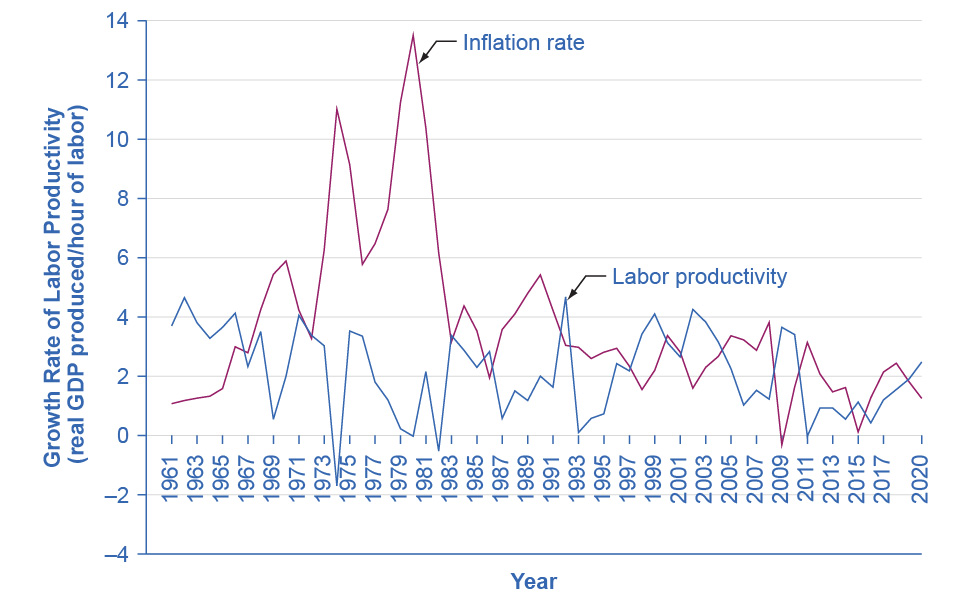

Figure 22.7図 22.7
Over the last several decades in the United States, there have been times when rising inflation rates have been closely followed by lower productivity rates and lower inflation rates have corresponded to increasing productivity rates. As the graph shows, however, this correlation does not always exist.
英語のヒント
過去数十年間の米国では、インフレ率の上昇のすぐ後に生産性の伸び率が低下した時期や、インフレ率の低下が生産性の伸び率の上昇と対応した時期があった。しかし図が示すように、この相関は常に存在するわけではない。