第22章インフレーション
22.4 The Confusion Over Inflation22.4 インフレをめぐる混乱
Learning Objectives学習目標
Learning Objectives学習目標
By the end of this section, you will be able to:
英語のヒント
この節を学ぶと、次のことができるようになる。
- Explain how inflation can cause redistributions of purchasing power
英語のヒント
インフレが購買力の再分配を引き起こす仕組みを説明する - Identify ways inflation can blur the perception of supply and demand
英語のヒント
インフレが需要と供給の認識を曖昧にする仕組みを特定する - Explain the economic benefits and challenges of inflation
英語のヒント
インフレの経済的便益と課題を説明する
Economists usually oppose high inflation, but they oppose it in a milder way than many non-economists. Robert Shiller, one of 2013’s Nobel Prize winners in economics, carried out several surveys during the 1990s about attitudes toward inflation. One of his questions asked, “Do you agree that preventing high inflation is an important national priority, as important as preventing drug use or preventing deterioration in the quality of our schools?” Answers were on a scale of 1–5, where 1 meant “Fully agree” and 5 meant “Completely disagree.” For the U.S. population as a whole, 52% answered “Fully agree” that preventing high inflation was a highly important national priority and just 4% said “Completely disagree.” However, among professional economists, only 18% answered “Fully agree,” while the same percentage of 18% answered “Completely disagree.”
英語のヒント
経済学者は通常、高インフレに反対するが、多くの非経済学者よりは穏やかに反対する。2013年のノーベル経済学賞受賞者の一人、ロバート・シラーは、1990年代にインフレへの態度について何度か調査した。質問の一つは、「高インフレの防止は、薬物使用の防止や学校の質の低下の防止と同じくらい重要な、国家の優先課題だということに同意しますか」だった。回答は1~5の尺度で、1は「全面的に同意」、5は「まったく同意しない」を意味した。米国民全体では、高インフレの防止は非常に重要な国家の優先課題だという考えに52%が「全面的に同意」と答え、「まったく同意しない」はわずか4%だった。しかし専門の経済学者では、「全面的に同意」は18%だけで、「まったく同意しない」も同じ18%だった。
The Land of Funny Money不思議なお金の国
What are the economic problems caused by inflation, and why do economists often regard them with less concern than the general public? Consider a very short story: “The Land of Funny Money.”
英語のヒント
インフレが引き起こす経済問題とは何か。また、経済学者はなぜ一般の人々ほど強く心配しないことが多いのか。「不思議なお金の国」という、とても短い物語を考えよう。
One morning, everyone in the Land of Funny Money awakened to find that everything denominated in money had increased by 20%. The change was completely unexpected. Every price in every store was 20% higher. Paychecks were 20% higher. Interest rates were 20 % higher. The amount of money, everywhere from wallets to savings accounts, was 20% larger. This overnight inflation of prices made newspaper headlines everywhere in the Land of Funny Money. However, the headlines quickly disappeared, as people realized that in terms of what they could actually buy with their incomes, this inflation had no economic impact. Everyone’s pay could still buy exactly the same set of goods as it did before. Everyone’s savings were still sufficient to buy exactly the same car, vacation, or retirement that they could have bought before. Equal levels of inflation in all wages and prices ended up not mattering much at all.
英語のヒント
ある朝、不思議なお金の国の全員が目を覚ますと、お金で表示されたものがすべて20%増えていた。まったく予想外の変化だった。どの店のどの価格も20%高かった。給料も20%高かった。金利も20%高かった。財布から預金口座まで、あらゆる場所のお金の量が20%増えていた。この一夜にして起きた物価のインフレは、国中で新聞の見出しになった。しかし、自分の所得で実際に買えるものという観点では経済的な影響がないと人々が気づくと、見出しはすぐに消えた。誰の給料でも、以前と完全に同じ財の組合せを買えた。誰の貯蓄も、以前と完全に同じ自動車、休暇、老後生活を買うのに十分だった。すべての賃金と価格で等しいインフレが起きても、結局ほとんど問題にならなかった。
When the people in Robert Shiller’s surveys explained their concern about inflation, one typical reason was that they feared that as prices rose, they would not be able to afford to buy as much. In other words, people were worried because they did not live in a place like the Land of Funny Money, where all prices and wages rose simultaneously. Instead, people live here on Planet Earth, where prices might rise while wages do not rise at all, or where wages rise more slowly than prices.
英語のヒント
シラーの調査で人々がインフレへの懸念を説明した際、典型的な理由の一つは、価格が上がると同じだけ買えなくなるのが怖いというものだった。言い換えると、人々が心配していたのは、すべての価格と賃金が同時に上がる不思議なお金の国に住んでいないからである。住んでいるのは地球であり、価格が上がっても賃金がまったく上がらなかったり、賃金が価格より遅く上がったりする。
Economists note that over most periods, the inflation level in prices is roughly similar to the inflation level in wages, and so they reason that, on average, over time, people’s economic status is not greatly changed by inflation. If all prices, wages, and interest rates adjusted automatically and immediately with inflation, as in the Land of Funny Money, then no one’s purchasing power, profits, or real loan payments would change. However, if other economic variables do not move exactly in sync with inflation, or if they adjust for inflation only after a time lag, then inflation can cause three types of problems: unintended redistributions of purchasing power, blurred price signals, and difficulties in long-term planning.
英語のヒント
経済学者は、大半の期間では物価のインフレと賃金のインフレはおおよそ似ていると指摘する。そのため、平均的に長い目でみれば、人々の経済状態はインフレによって大きく変わらないと考える。不思議なお金の国のように、すべての価格、賃金、金利がインフレに合わせて自動的かつ即座に調整されれば、誰の購買力、利益、実質的なローン返済額も変わらない。しかし、他の経済変数がインフレと完全には同期しない場合や、時間を置いてからしか調整されない場合、インフレは三つの問題を引き起こしうる。意図しない購買力の再分配、価格シグナルの不明瞭化、長期計画の難しさである。
Unintended Redistributions of Purchasing Power意図しない購買力の再分配
Inflation can cause redistributions of purchasing power that hurt some and help others. People who are hurt by inflation include those who are holding considerable cash, whether it is in a safe deposit box or in a cardboard box under the bed. When inflation happens, the buying power of cash diminishes. However, cash is only an example of a more general problem: anyone who has financial assets invested in a way that the nominal return does not keep up with inflation will tend to be affected by inflation. For example, if a person has money in a bank account that pays 4% interest, but inflation rises to 5%, then the real rate of return for the money invested in that bank account is negative 1%.
英語のヒント
インフレは、ある人を害し、別の人を助けるような購買力の再分配を引き起こしうる。害される人には、貸金庫であれベッドの下の段ボール箱であれ、多額の現金を持つ人が含まれる。インフレが起きると、現金の購買力は下がる。しかし現金は、より一般的な問題の一例にすぎない。名目収益率がインフレに追いつかない形で金融資産を投資している人は、誰でもインフレの影響を受けやすい。たとえば利息4%の銀行口座にお金を置き、インフレ率が5%に上がると、その口座に投じたお金の実質収益率は−1%である。
The problem of a good-looking nominal interest rate transforming into an ugly-looking real interest rate can be worsened by taxes. The U.S. income tax is charged on the nominal interest received in dollar terms, without an adjustment for inflation. Thus, the government taxes a person who invests $10,000 and receives a 5% nominal rate of interest on the $500 received—no matter whether the inflation rate is 0%, 5%, or 10%. If inflation is 0%, then the real interest rate is 5% and all $500 is a gain in buying power. However, if inflation is 5%, then the real interest rate is zero and the person had no real gain—but owes income tax on the nominal gain anyway. If inflation is 10%, then the real interest rate is negative 5% and the person is actually falling behind in buying power, but would still owe taxes on the $500 in nominal gains.
英語のヒント
見栄えのよい名目金利が見栄えの悪い実質金利に変わる問題は、税によって悪化しうる。米国の所得税は、インフレ調整をせず、ドル額で受け取った名目利息に課される。したがって、1万ドルを投資し、名目金利5%を得た人には、インフレ率が0%、5%、10%のどれでも、受け取った500ドルに政府が課税する。インフレ率が0%なら実質金利は5%で、500ドル全額が購買力の増加である。しかしインフレ率が5%なら実質金利はゼロで、実質的な利益はない。それでも名目利益に所得税を払わなければならない。インフレ率が10%なら実質金利は−5%で、実際には購買力が低下しているが、それでも500ドルの名目利益に税がかかる。
Inflation can cause unintended redistributions for wage earners, too. Wages do typically creep up with inflation over time, eventually. The last row of Table 22.1 at the start of this chapter showed that the average hourly wage in manufacturing in the U.S. economy increased from $3.23 in 1970 to $30.11 in 2021, which is an increase by a factor of close to ten. Over that time period, the Consumer Price Index increased by about a factor of eight. However, increases in wages may lag behind inflation for a year or two, since wage adjustments are often somewhat sticky and occur only once or twice a year. Moreover, the extent to which wages keep up with inflation creates insecurity for workers and may involve painful, prolonged conflicts between employers and employees. If the government adjusts minimum wage for inflation only infrequently, minimum wage workers are losing purchasing power from their nominal wages, as Figure 22.6 shows.
英語のヒント
インフレは、賃金を得る人にも意図しない再分配を引き起こしうる。賃金は通常、時間がたてば、最終的にはインフレとともに徐々に上がる。この章の初めの表22.1の最終行は、米国経済の製造業の平均時間給が、1970年の3.23ドルから2021年の30.11ドルへ、ほぼ10倍になったことを示した。この間、消費者物価指数は約8倍になった。しかし、賃金の調整は多少硬直的で、年に1、2回しか行われないことが多いため、賃上げはインフレに1、2年遅れることがある。また、賃金がどれほどインフレに追いつくかは労働者を不安にし、雇用主と従業員の間に、つらく長引く対立を引き起こすことがある。政府が最低賃金のインフレ調整をめったにしなければ、図22.6のように、最低賃金で働く人の名目賃金から得られる購買力は低下する。
U.S. Minimum Wage and Inflation米国の最低賃金とインフレ
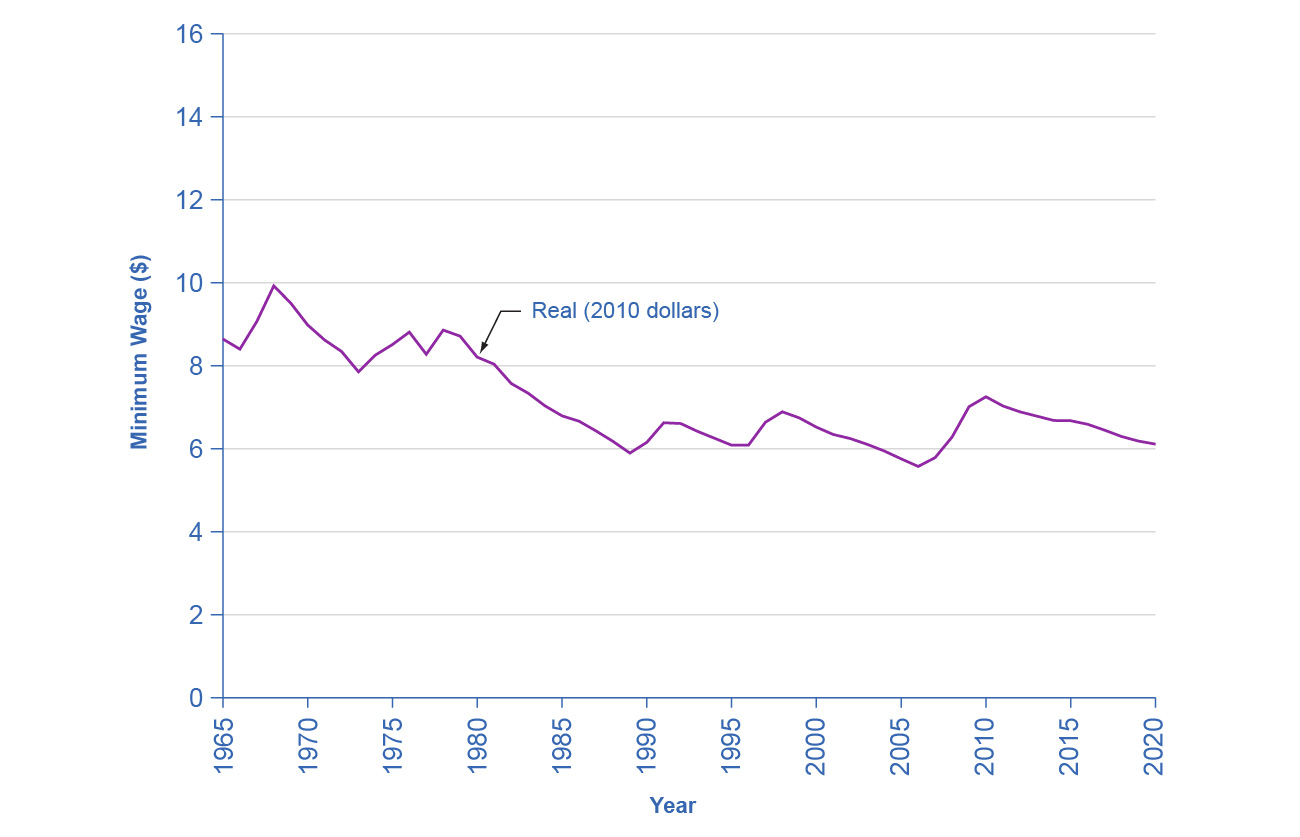

Figure 22.6図 22.6
After adjusting for inflation, the federal minimum wage dropped about 30 percent from 1965–2020, even though the nominal figure climbed from $1.40 to $7.25 per hour. Increases in the minimum wage in between 2008 and 2010 kept the decline from being worse—as it would have been if the wage had remained the same as it did from 1997 through 2007. Since 2010, the real minimum wage has continued to decline. (Sources: http://www.dol.gov/whd/minwage/chart.htm and http://data.bls.gov/cgi-bin/surveymost?cu)
英語のヒント
1965~2020年に、名目額は時給1.40ドルから7.25ドルへ上がったが、インフレ調整後の連邦最低賃金は約30%下がった。2008~2010年の最低賃金引上げによって、下落の悪化は抑えられた。1997~2007年のように同じ賃金が続いていたら、下落はもっと大きかったはずである。2010年以降、実質最低賃金は下がり続けている。(出典:http://www.dol.gov/whd/minwage/chart.htm および http://data.bls.gov/cgi-bin/surveymost?cu)
One sizable group of people has often received a large share of their income in a form that does not increase over time: retirees who receive a private company pension. Most pensions have traditionally been set as a fixed nominal dollar amount per year at retirement. For this reason, economists call pensions “defined benefits” plans. Even if inflation is low, the combination of inflation and a fixed income can create a substantial problem over time. A person who retires on a fixed income at age 65 will find that losing just 1% to 2% of buying power per year to inflation compounds to a considerable loss of buying power after a decade or two.
英語のヒント
所得の大きな割合を、時間とともに増えない形で受け取ってきた大きな集団がある。民間企業の年金を受け取る退職者である。従来、大半の年金は退職時に、年間の固定された名目ドル額として決められてきた。そのため経済学者は、年金を「確定給付」制度と呼ぶ。インフレが低くても、固定所得との組合せは、時間とともに大きな問題を生む。65歳で退職し固定所得を得る人は、インフレで毎年わずか1~2%の購買力を失うだけでも、10年、20年後には複利的に積み重なって、大きな購買力の損失になることを知るだろう。
Fortunately, pensions and other defined benefits retirement plans are increasingly rare, replaced instead by “defined contribution” plans, such as 401(k)s and 403(b)s. In these plans, the employer contributes a fixed amount to the worker’s retirement account on a regular basis (usually every pay check). The employee often contributes as well. The worker invests these funds in a wide range of investment vehicles. These plans are tax deferred, and they are portable so that if the individual takes a job with a different employer, their 401(k) comes with them. To the extent that the investments made generate real rates of return, retirees are not burdened by the inflation costs of traditional pensioners.
英語のヒント
幸い、年金やその他の確定給付型退職制度は次第に少なくなり、代わりに401(k)や403(b)のような「確定拠出」制度へ置き換わっている。これらの制度では、雇用主が定期的に、通常は給与支払いのたびに、一定額を労働者の退職口座へ拠出する。従業員も拠出することが多い。労働者はこの資金を、幅広い投資手段で運用する。課税は繰り延べられ、持ち運びもできるため、別の雇用主の仕事に移っても、自分の401(k)を引き継げる。投資が実質収益率を生む限り、退職者は従来型年金の受給者が負うインフレ費用を負わずに済む。
However, ordinary people can sometimes benefit from the unintended redistributions of inflation. Consider someone who borrows $10,000 to buy a car at a fixed interest rate of 9%. If inflation is 3% at the time the loan is made, then the borrower must repay the loan at a real interest rate of 6%. However, if inflation rises to 9%, then the real interest rate on the loan is zero. In this case, the borrower’s benefit from inflation is the lender’s loss. A borrower paying a fixed interest rate, who benefits from inflation, is just the flip side of an investor receiving a fixed interest rate, who suffers from inflation. The lesson is that when interest rates are fixed, rises in the rate of inflation tend to penalize suppliers of financial capital, who receive repayment in dollars that are worth less because of inflation, while demanders of financial capital end up better off, because they can repay their loans in dollars that are worth less than originally expected.
英語のヒント
しかし、普通の人々が、インフレの意図しない再分配によって利益を得ることもある。固定金利9%で1万ドルを借り、自動車を買う人を考えよう。借入時のインフレ率が3%なら、借り手は実質金利6%で返済しなければならない。しかしインフレ率が9%に上がれば、ローンの実質金利はゼロになる。この場合、インフレによる借り手の利益は貸し手の損失である。固定金利を払い、インフレから利益を得る借り手は、固定金利を受け取り、インフレで損をする投資家の裏返しにすぎない。教訓は、金利が固定されているとき、インフレ率の上昇は金融資本の供給者に不利益を与える傾向があるということである。インフレによって価値が下がったドルで返済を受けるからである。他方、金融資本の需要者は、当初の予想より価値の低いドルで返済できるため、最終的に利益を得る。
The unintended redistributions of buying power that inflation causes may have a broader effect on society. America’s widespread acceptance of market forces rests on a perception that people’s actions have a reasonable connection to market outcomes. When inflation causes a retiree who built up a pension or invested at a fixed interest rate to suffer, however, while someone who borrowed at a fixed interest rate benefits from inflation, it is hard to believe that this outcome was deserved in any way. Similarly, when homeowners benefit from inflation because the price of their homes rises, while renters suffer because they are paying higher rent, it is hard to see any useful incentive effects. One of the reasons that the general public dislikes inflation is a sense that it makes economic rewards and penalties more arbitrary—and therefore likely to be perceived as unfair – even dangerous, as the next Clear It Up feature shows.
英語のヒント
インフレによる意図しない購買力の再分配は、社会により広い影響を及ぼしうる。米国で市場の力が広く受け入れられているのは、人々の行動と市場の結果には合理的な結びつきがあるという認識に基づく。しかし、年金を積み立てたり固定金利で投資したりした退職者がインフレで苦しみ、固定金利で借りた人が利益を得るとき、その結果が何らかの意味で当然のものだったとは信じにくい。同様に、住宅価格の上昇で持ち家の人が利益を得る一方、借家人が高い家賃で苦しむとき、有益な誘因効果は見いだしにくい。一般の人々がインフレを嫌う理由の一つは、経済的な報酬や罰がより恣意的になり、そのため不公平と受け取られやすくなるという感覚である。次の「疑問を解こう」が示すように、危険でさえある。