第23章国際貿易と資本移動
Introduction to the International Trade and Capital Flows国際貿易と資本移動への導入
A World of Moneyお金の世界
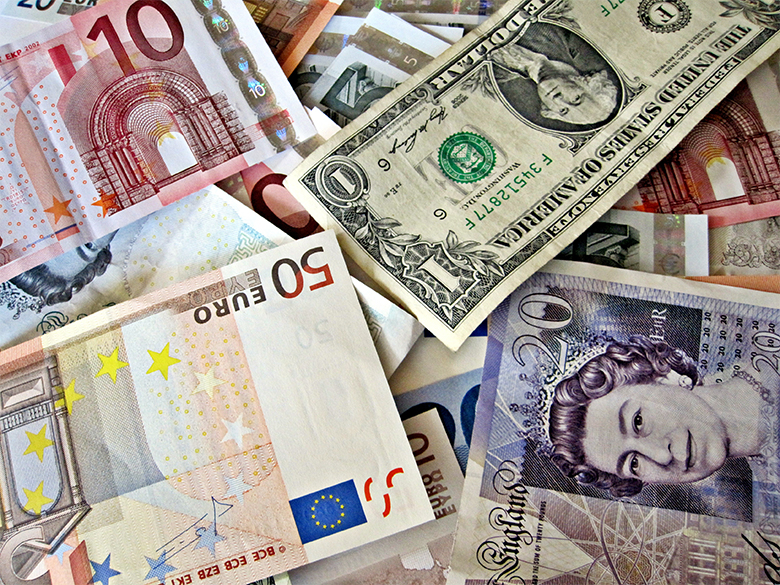
We are all part of the global financial system, which includes many different currencies. (Credit: modification of "Money from around the world" by Images Money/Flickr, CC BY 2.0) · CC BY 2.0 · Source出典

Figure 23.1図 23.1
We are all part of the global financial system, which includes many different currencies. (Credit: modification of "Money from around the world" by Images Money/Flickr, CC BY 2.0)
英語のヒント
私たちは皆、多くの異なる通貨を含む世界の金融システムの一部である。(クレジット:Images Money/Flickrによる「Money from around the world」を改変、CC BY 2.0)
Learning Objectives学習目標
The balance of trade (or trade balance) is any gap between a nation’s dollar value of its exports, or what its producers sell abroad, and a nation’s dollar value of imports, or the foreign-made products and services that households and businesses purchase. Recall from The Macroeconomic Perspective that if exports exceed imports, the economy has a trade surplus. If imports exceed exports, the economy has a trade deficit. If exports and imports are equal, then trade is balanced, but what happens when trade is out of balance and large trade surpluses or deficits exist?
英語のヒント
貿易収支とは、一国の輸出、すなわち国内の生産者が海外で売るもののドル価値と、輸入、すなわち家計や企業が購入する外国製の製品・サービスのドル価値の差である。「マクロ経済の視点」で見たように、輸出が輸入を上回れば貿易黒字、輸入が輸出を上回れば貿易赤字である。輸出と輸入が等しければ貿易は均衡している。しかし均衡せず、大きな貿易黒字や赤字が存在すると何が起こるのだろうか。
Germany, for example, has had substantial trade surpluses in recent decades, in which exports have greatly exceeded imports. According to the World Bank, in 2020, Germany ran a trade surplus of $242 billion. In contrast, the U.S. economy in recent decades has experienced large trade deficits, in which imports have considerably exceeded exports. In 2020, for example, U.S. imports exceeded exports by $651 billion.
英語のヒント
たとえばドイツは、ここ数十年、輸出が輸入を大きく上回る相当な貿易黒字を記録してきた。世界銀行によると、2020年のドイツの貿易黒字は2420億ドルだった。対照的に米国経済は、ここ数十年、輸入が輸出をかなり上回る大きな貿易赤字を経験してきた。たとえば2020年には、米国の輸入は輸出を6510億ドル上回った。
A series of financial crises triggered by unbalanced trade can lead economies into deep recessions. These crises begin with large trade deficits. At some point, foreign investors become pessimistic about the economy and move their money to other countries. The economy then drops into deep recession, with real GDP often falling up to 10% or more in a single year. This happened to Mexico in 1995 when their GDP fell 8.1%. A number of countries in East Asia—Thailand, South Korea, Malaysia, and Indonesia—succumbed to the same economic illness in 1997–1998 (called the Asian Financial Crisis). In the late 1990s and into the early 2000s, Russia and Argentina had the identical experience. What are the connections between imbalances of trade in goods and services and the flows of international financial capital that set off these economic avalanches?
英語のヒント
不均衡な貿易によって引き起こされる一連の金融危機は、経済を深い景気後退へ導きうる。こうした危機は、大きな貿易赤字から始まる。ある時点で外国の投資家が経済を悲観し、資金を他国へ移す。すると経済は深い景気後退に陥り、実質GDPが1年間で10%以上下がることも多い。これは1995年のメキシコで起き、GDPは8.1%下がった。東アジアのタイ、韓国、マレーシア、インドネシアも、1997~1998年に同じ経済的な病に倒れた。これはアジア金融危機と呼ばれる。1990年代後半から2000年代初めには、ロシアとアルゼンチンが同じ経験をした。こうした経済の雪崩を引き起こす、財・サービス貿易の不均衡と国際金融資本の流れの間には、どのような関係があるのだろうか。
We will start by examining the balance of trade in more detail, by looking at some patterns of trade balances in the United States and around the world. Then we will examine the intimate connection between international flows of goods and services and international flows of financial capital, which to economists are really just two sides of the same coin. People often assume that trade surpluses like those in Germany must be a positive sign for an economy, while trade deficits like those in the United States must be harmful. As it turns out, both trade surpluses and deficits can be either good or bad. We will see why in this chapter.
英語のヒント
まず、米国と世界の貿易収支のパターンをいくつか見ながら、貿易収支を詳しく検討する。次に、財・サービスの国際的な流れと、金融資本の国際的な流れの密接な関係を調べる。経済学者にとって、この二つは実際には同じ硬貨の両面にすぎない。人々は、ドイツのような貿易黒字は経済によいしるしで、米国のような貿易赤字は有害に違いないと思いがちである。しかし実際には、貿易黒字も赤字も、よい場合も悪い場合もある。この章では、その理由を見ていく。