第23章国際貿易と資本移動
The Balance of Trade as the Balance of Payments国際収支としての貿易収支
The connection between trade balances and international flows of financial capital is so close that economists sometimes describe the balance of trade as the balance of payments. Each category of the current account balance involves a corresponding flow of payments between a given country and the rest of the world economy.
英語のヒント
貿易収支と金融資本の国際的な流れの関係は非常に密接であり、経済学者は貿易収支を国際収支と表現することもある。経常収支の各分類には、その国と世界の他の経済との間の、対応する支払いの流れが伴う。
Figure 23.3 shows the flow of goods and services and payments between one country—the United States in this example—and the rest of the world. The top line shows U.S. exports of goods and services, while the second line shows financial payments from purchasers in other countries back to the U.S. economy. The third line then shows U.S. imports of goods, services, and investment, and the fourth line shows payments from the home economy to the rest of the world. Flow of goods and services (lines one and three) show up in the current account, while we find flow of funds (lines two and four) in the financial account.
英語のヒント
図23.3は、一国、この例では米国と、世界の他の地域との間の、財・サービスと支払いの流れを示す。最上段は米国の財・サービス輸出、第2段は他国の購入者から米国経済へ戻る支払いを示す。第3段は米国の財、サービス、投資の輸入、第4段は自国経済から世界の他の地域への支払いである。財・サービスの流れ(第1・第3段)は経常収支に表れ、資金の流れ(第2・第4段)は金融収支に表れる。
The bottom four lines in Figure 23.3 show the flows of investment income. In the first of the bottom lines, we see investments made abroad with funds flowing from the home country to the rest of the world. Investment income stemming from an investment abroad then runs in the other direction from the rest of the world to the home country. Similarly, we see on the bottom third line, an investment from the rest of the world into the home country and investment income (bottom fourth line) flowing from the home country to the rest of the world. We find the investment income (bottom lines two and four) in the current account, while investment to the rest of the world or into the home country (lines one and three) is in the financial account. This figure does not show unilateral transfers, the fourth item in the current account.
英語のヒント
図23.3の下の4本の線は、投資所得の流れを示す。下半分の第1段では、自国から世界の他の地域へ資金が流れる海外投資を示す。その海外投資から生じる投資所得は、逆向きに、世界の他の地域から自国へ流れる。同様に下半分の第3段では、世界の他の地域から自国への投資を、第4段では自国から世界の他の地域へ流れる投資所得を示す。投資所得(下半分の第2・第4段)は経常収支に、他国への投資と自国への投資(第1・第3段)は金融収支に表れる。この図には、経常収支の第4の項目である一方的移転は示していない。
Flow of Investment Goods and Capital投資財と資本の流れ
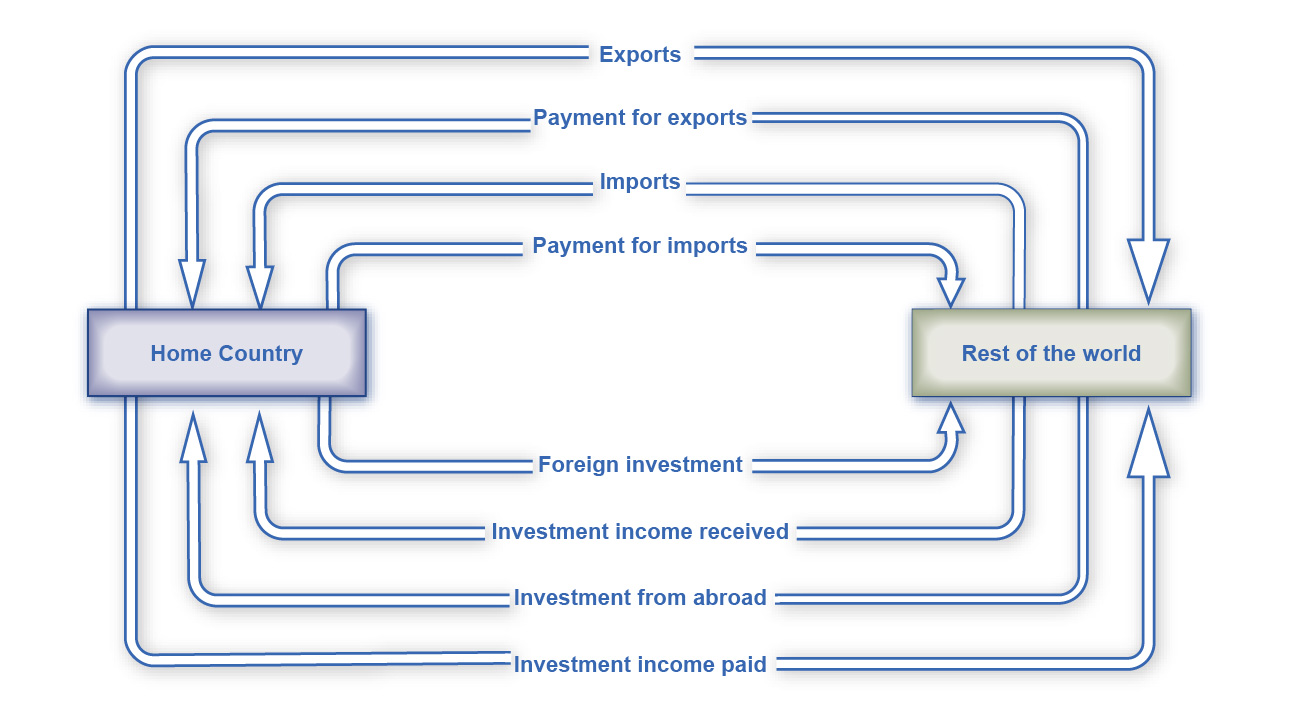

Figure 23.3図 23.3
Each element of the current account balance involves a flow of financial payments between countries. The top line shows exports of goods and services leaving the home country; the second line shows the money that the home country receives for those exports. The third line shows imports that the home country receives; the fourth line shows the payments that the home country sent abroad in exchange for these imports.
英語のヒント
経常収支の各要素には、国の間のお金の支払いの流れが伴う。最上段は自国から出る財・サービスの輸出、第2段は自国がその輸出に対して受け取るお金、第3段は自国が受け取る輸入、第4段はその輸入と引き換えに自国が海外へ送った支払いを示す。
A current account deficit means that, the country is a net borrower from abroad. Conversely, a positive current account balance means a country is a net lender to the rest of the world. Just like the parable of Robinson and Friday, the lesson is that a trade surplus means an overall outflow of financial investment capital, as domestic investors put their funds abroad, while a deficit in the current account balance is exactly equal to the overall or net inflow of foreign investment capital from abroad.
英語のヒント
経常赤字は、その国が海外からの純借り手であることを意味する。逆に経常収支のプラスは、その国が世界の他の地域への純貸し手であることを意味する。ロビンソンとフライデーの寓話と同じく、教訓は、貿易黒字は国内投資家が資金を海外に置くことによる金融投資資本全体の流出を意味し、経常赤字は海外からの外国投資資本全体の流入、すなわち純流入に正確に等しい、ということである。
It is important to recognize that an inflow and outflow of foreign capital does not necessarily refer to a debt that governments owe to other governments, although government debt may be part of the picture. Instead, these international flows of financial capital refer to all of the ways in which private investors in one country may invest in another country—by buying real estate, companies, and financial investments like stocks and bonds.
英語のヒント
外国資本の流入・流出は、必ずしも政府が他国政府に負う債務を指さないと理解することが重要である。政府債務が一部を占めることはあるが、そうではなく、一国の民間投資家が他国へ、不動産、企業、株式・債券などの金融投資対象を買うことで投資する、あらゆる方法を指す。
Key Concepts and Summary重要概念とまとめ
International flows of goods and services are closely connected to the international flows of financial capital. A current account deficit means that, after taking all the flows of payments from goods, services, and income together, the country is a net borrower from the rest of the world. A current account surplus is the opposite and means the country is a net lender to the rest of the world.
英語のヒント
財・サービスの国際的な流れは、金融資本の国際的な流れと密接に結びついている。経常赤字は、財、サービス、所得からの支払いの流れをすべて合わせると、その国が世界の他の地域からの純借り手であることを意味する。経常黒字はその反対で、その国が世界の他の地域への純貸し手であることを意味する。
Self-Check Questions理解度確認問題
Exercises 16–18練習問題 16–18
Exercise 16問題 16
State whether each of the following events involves a financial flow to the U.S. economy or away from the U.S. economy:
英語のヒント
次の各出来事が、米国経済への資金流入を伴うのか、米国経済からの資金流出を伴うのかを述べなさい。
- Export sales to Germany
英語のヒント
ドイツへの輸出販売。 - Returns paid on past U.S. financial investments in Brazil
英語のヒント
過去の米国のブラジルへの金融投資に対して支払われる収益。 - Foreign aid from the U.S. government to Egypt
英語のヒント
米国政府からエジプトへの対外援助。 - Imported oil from the Russian Federation
英語のヒント
ロシア連邦からの石油輸入。 - Japanese investors buying U.S. real estate
英語のヒント
日本の投資家による米国不動産の購入。
Solution解き方
- An export sale to Germany involves a financial flow from Germany to the U.S. economy.
英語のヒント
ドイツへの輸出販売は、ドイツから米国経済への資金の流れを伴う。 - The issue here is not U.S. investments in Brazil, but the return paid on those investments, which involves a financial flow from the Brazilian economy to the U.S. economy.
英語のヒント
ここでの対象は米国のブラジルへの投資ではなく、その投資に支払われる収益であり、ブラジル経済から米国経済への資金の流れを伴う。 - Foreign aid from the United States to Egypt is a financial flow from the United States to Egypt.
英語のヒント
米国からエジプトへの対外援助は、米国からエジプトへの資金の流れである。 - Importing oil from the Russian Federation means a flow of financial payments from the U.S. economy to the Russian Federation.
英語のヒント
ロシア連邦からの石油輸入は、米国経済からロシア連邦への支払いの流れを意味する。 - Japanese investors buying U.S. real estate is a financial flow from Japan to the U.S. economy.
英語のヒント
日本の投資家による米国不動産の購入は、日本から米国経済への資金の流れである。
Exercise 17問題 17
How does the bottom portion of Figure 23.3, showing the international flow of investments and capital, differ from the upper portion?
英語のヒント
投資と資本の国際的な流れを示す図23.3の下半分は、上半分とどう違うか。
Solution解き方
The top portion tracks the flow of exports and imports and the payments for those. The bottom portion is looking at international financial investments and the outflow and inflow of monies from those investments. These investments can include investments in stocks and bonds or real estate abroad, as well as international borrowing and lending.
英語のヒント
上半分は輸出入とその支払いの流れを追う。下半分は国際的な金融投資と、それによるお金の流出入を示す。投資には、海外の株式、債券、不動産への投資や、国際的な借入・貸付が含まれうる。
Exercise 18問題 18
Explain the relationship between a current account deficit or surplus and the flow of funds.
英語のヒント
経常赤字または経常黒字と、資金の流れの関係を説明しなさい。
Solution解き方
If more monies are flowing out of the country (for example, to pay for imports) it will make the current account more negative or less positive, and if more monies are flowing into the country, it will make the current account less negative or more positive.
英語のヒント
たとえば輸入代金の支払いのために、国外へのお金の流出が増えれば、経常収支のマイナスは大きく、またはプラスは小さくなる。国内への流入が増えれば、マイナスは小さく、またはプラスは大きくなる。