第46章生態系
46.3 Biogeochemical Cycles46.3 生物地球化学的循環
Learning Objectives学習目標
By the end of this section, you will be able to do the following:
この節を学び終えると、次のことができるようになる。
- Discuss the biogeochemical cycles of water, carbon, nitrogen, phosphorus, and sulfur水、炭素、窒素、リン、硫黄の生物地球化学的循環を論じる。
- Explain how human activities have impacted these cycles and the potential consequences for Earth人間活動がこれらの循環にどう影響し、地球にどんな結果をもたらしうるかを説明する。
Energy flows directionally through ecosystems, entering as sunlight (or inorganic molecules for chemoautotrophs) and leaving as heat during the many transfers between trophic levels. However, the matter that makes up living organisms is conserved and recycled. The six most common elements associated with organic molecules—carbon, nitrogen, hydrogen, oxygen, phosphorus, and sulfur—take a variety of chemical forms and may exist for long periods in the atmosphere, on land, in water, or beneath the Earth’s surface. Geologic processes, such as weathering, erosion, water drainage, and the subduction of the tectonic plates, all play a role in this recycling of materials. Because geology and chemistry have major roles in the study of this process, the recycling of inorganic matter between living organisms and their environment is called a biogeochemical cycle.
英語のヒント
エネルギーは、生態系を方向性をもって流れる。日光(化学独立栄養生物では無機分子)として入り、栄養段階間で繰り返し移動する間に熱として出ていく。しかし、生物を構成する物質は保存され、再利用される。有機分子に関わる代表的な6元素、炭素、窒素、水素、酸素、リン、硫黄は、さまざまな化学形態をとる。大気中、陸上、水中、地表の下に長期間存在することもある。風化、侵食、水の排出、プレートの沈み込みなどの地質学的過程は、すべてこの物質の再循環に役割を果たす。この過程の研究では地質学と化学が大きな役割を担うため、生物と環境の間で無機物が再循環することを、生物地球化学的循環と呼ぶ。
Water contains hydrogen and oxygen, which is essential to all living processes. The hydrosphere is the area of the Earth where water movement and storage occurs. On or beneath the surface, water occurs in liquid or solid form in rivers, lakes, oceans, groundwater, polar ice caps, and glaciers. And it occurs as water vapor in the atmosphere. Carbon is found in all organic macromolecules and is an important constituent of fossil fuels. Nitrogen is a major component of our nucleic acids and proteins and is critical to human agriculture. Phosphorus, a major component of nucleic acid (along with nitrogen), is one of the main ingredients in artificial fertilizers used in agriculture and their associated environmental impacts on our surface water. Sulfur is critical to the 3-D folding of proteins, such as in disulfide binding.
英語のヒント
水は水素と酸素を含み、あらゆる生命活動に不可欠である。水圏とは、水が移動・貯留する地球上の領域である。地表や地下では、河川、湖、海、地下水、極地の氷冠、氷河に、液体または固体の水がある。大気中には水蒸気として存在する。炭素はすべての有機高分子に含まれ、化石燃料の重要な構成要素でもある。窒素は核酸とタンパク質の主要な構成要素であり、人間の農業にも極めて重要である。リンは窒素とともに核酸の主要成分であり、農業で使う人工肥料の主要成分の1つでもある。それに伴い、地表水への環境影響にも関わる。硫黄は、ジスルフィド結合などを通じて、タンパク質の立体的な折りたたみに極めて重要である。
The cycling of these elements is interconnected. For example, the movement of water is critical for the leaching of nitrogen and phosphate into rivers, lakes, and oceans. Furthermore, the ocean itself is a major reservoir for carbon. Thus, mineral nutrients are cycled, either rapidly or slowly, through the entire biosphere, from one living organism to another, and between the biotic and abiotic world.
英語のヒント
これらの元素の循環は互いにつながっている。たとえば水の移動は、窒素やリン酸塩が河川、湖、海へ溶脱するうえで重要である。また、海洋そのものが炭素の大きな貯蔵庫である。このように、無機栄養塩は生物圏全体を、速く、あるいはゆっくりと循環する。ある生物から別の生物へ、また生物的世界と非生物的世界の間を移動する。
The Water (Hydrologic) Cycle水(水文)の循環
Water is the basis of all living processes on Earth. When examining the stores of water on Earth, 97.5 percent of it is non-potable salt water (Figure 46.12). Of the remaining water, 99 percent is locked underground as water or as ice. Thus, less than 1 percent of fresh water is easily accessible from lakes and rivers. Many living things, such as plants, animals, and fungi, are dependent on that small amount of fresh surface water, a lack of which can have massive effects on ecosystem dynamics. To be successful, organisms must adapt to fluctuating water supplies. Humans, of course, have developed technologies to increase water availability, such as digging wells to harvest groundwater, storing rainwater, and using desalination to obtain drinkable water from the ocean.
英語のヒント
水は、地球上のあらゆる生命活動の基盤である。地球に蓄えられた水の97.5%は、飲用できない塩水である(図46.12)。残りの水の99%は、地下の水や氷として閉じ込められている。したがって、湖や河川から容易に利用できるのは、淡水の1%未満である。植物、動物、菌類など多くの生物は、この少量の地表の淡水に依存している。その不足は生態系の動態に大きな影響を与えうる。生物がうまく生きるには、変動する水供給に適応しなければならない。人間は、井戸を掘って地下水を得る、雨水を蓄える、海水を淡水化して飲用水を得るなど、水の利用可能性を高める技術を開発してきた。
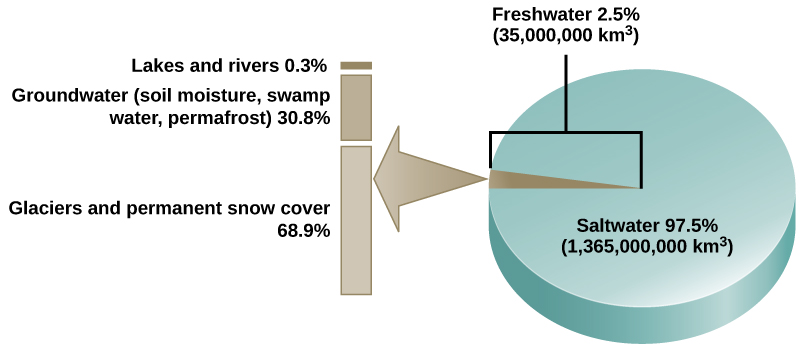
Figure 46.12図 46.12
Only 2.5 percent of water on Earth is fresh water, and less than 1 percent of fresh water is easily accessible to living things.
地球の水のうち淡水はわずか2.5%であり、生物が容易に利用できるのは、その淡水の1%未満である。
Water cycling is extremely important to ecosystem dynamics. Water has a major influence on climate and, thus, on the environments of ecosystems. Most of the water on Earth is stored for long periods in the oceans, underground, and as ice. Figure 46.13 illustrates the average time that an individual water molecule may spend in the Earth’s major water reservoirs. Residence time is a measure of the average time an individual water molecule stays in a particular reservoir.
英語のヒント
水の循環は、生態系の動態に極めて重要である。水は気候に、したがって生態系の環境にも大きな影響を及ぼす。地球の水の大半は、海洋、地下、氷の中に長期間蓄えられている。図46.13は、1つの水分子が地球の主要な水の貯蔵庫にとどまる平均時間を示す。滞留時間とは、個々の水分子がある貯蔵庫にとどまる平均時間の指標である。
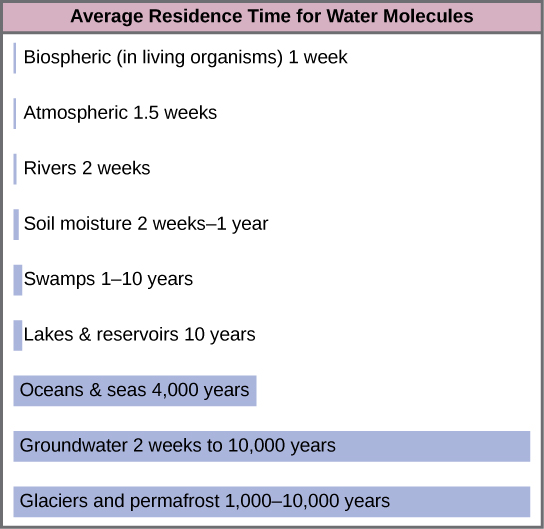


Figure 46.13図 46.13
This graph shows the average residence time for water molecules in the Earth’s water reservoirs.
地球上の水の貯蔵庫における、水分子の平均滞留時間。
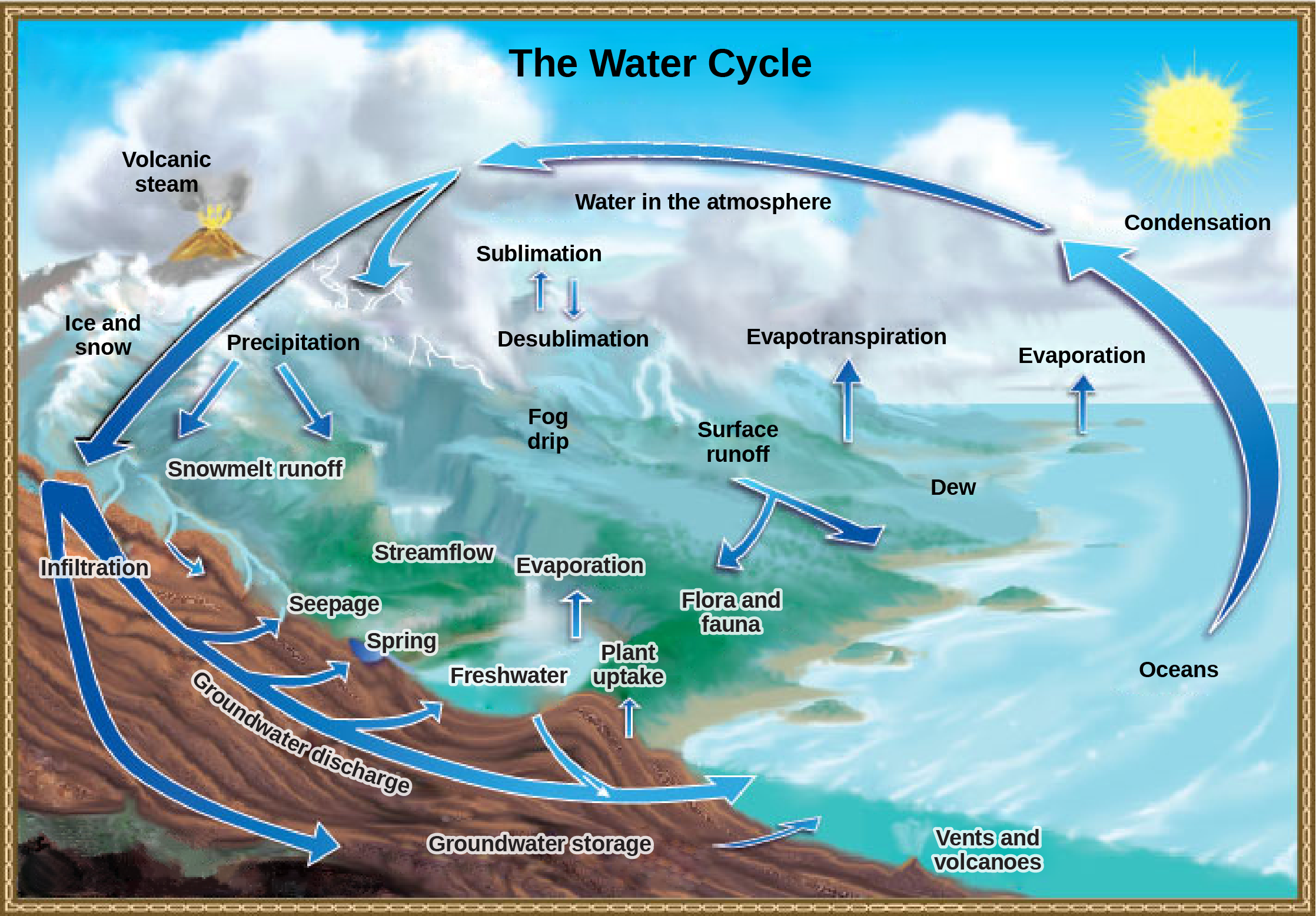
There are various processes that occur during the cycling of water, shown in Figure 46.14. These processes include the following:
図46.14に示すように、水の循環ではさまざまな過程が起こる。主なものは次のとおりである。
- evaporation/sublimation蒸発/昇華
- condensation/precipitation凝結/降水
- subsurface water flow地下の水の流れ
- surface runoff/snowmelt地表流出/融雪
- streamflow河川の流れ
The water cycle is driven by the sun’s energy as it warms the oceans and other surface waters. This leads to the evaporation (water to water vapor) of liquid surface water and the sublimation (ice to water vapor) of frozen water, which deposits large amounts of water vapor into the atmosphere. Over time, this water vapor condenses into clouds as liquid or frozen droplets and is eventually followed by precipitation (rain or snow), which returns water to the Earth’s surface. Rain eventually permeates into the ground, where it may evaporate again if it is near the surface, flow beneath the surface, or be stored for long periods. More easily observed is surface runoff: the flow of fresh water either from rain or melting ice. Runoff can then make its way through streams and lakes to the oceans or flow directly to the oceans themselves.
英語のヒント
水の循環は、海やほかの地表水を温める太陽のエネルギーによって駆動される。液体の地表水が蒸発(水から水蒸気へ)し、凍った水が昇華(氷から水蒸気へ)することで、大量の水蒸気が大気へ入る。時間とともに水蒸気は凝結し、液体または凍った小滴からなる雲となる。やがて降水(雨や雪)が起こり、水が地表へ戻る。雨は地中に浸透し、地表近くなら再び蒸発したり、地下を流れたり、長期間蓄えられたりする。より観察しやすいのは地表流出、つまり雨や融けた氷に由来する淡水の流れである。流出水は小川や湖を通って海へ達することも、直接海へ流れ込むこともある。
Rain and surface runoff are major ways in which minerals, including carbon, nitrogen, phosphorus, and sulfur, are cycled from land to water. The environmental effects of runoff will be discussed later as these cycles are described.
英語のヒント
雨と地表流出は、炭素、窒素、リン、硫黄などの無機成分が、陸から水へ循環する主な経路である。流出が環境に及ぼす影響は、これらの循環を説明する際に後で取り上げる。
OpenStax, Rice University; Biology 2e. (credit: modification of work by John M. Evans and Howard Perlman, USGS) · CC BY 4.0 · Source出典

Figure 46.14図 46.14
Water from the land and oceans enters the atmosphere by evaporation or sublimation, where it condenses into clouds and falls as rain or snow. Precipitated water may enter freshwater bodies or infiltrate the soil. The cycle is complete when surface or groundwater reenters the ocean. (credit: modification of work by John M. Evans and Howard Perlman, USGS)
陸と海の水は蒸発や昇華によって大気へ入り、そこで凝結して雲となり、雨や雪として降る。降水は淡水域へ入るか、土壌に浸透する。地表水や地下水が再び海へ入ると、循環が一巡する。(John M. EvansとHoward Perlman、USGSの作品を改変)