第46章生態系
46.2 Energy Flow through Ecosystems46.2 生態系を通るエネルギーの流れ
Learning Objectives学習目標
By the end of this section, you will be able to do the following:
この節を学び終えると、次のことができるようになる。
- Describe how organisms acquire energy in a food web and in associated food chains食物網と、それに含まれる食物連鎖で、生物がどうエネルギーを得るかを説明する。
- Explain how the efficiency of energy transfers between trophic levels affects ecosystem structure and dynamics栄養段階間のエネルギー移動の効率が、生態系の構造と動態にどう影響するかを説明する。
- Discuss trophic levels and how ecological pyramids are used to model them栄養段階と、それをモデル化する生態ピラミッドの使い方を論じる。
All living things require energy in one form or another. Energy is required by most complex metabolic pathways (often in the form of adenosine triphosphate, ATP), especially those responsible for building large molecules from smaller compounds, and life itself is an energy-driven process. Living organisms would not be able to assemble macromolecules (proteins, lipids, nucleic acids, and complex carbohydrates) from their monomeric subunits without a constant energy input.
英語のヒント
すべての生物は、何らかの形でエネルギーを必要とする。大半の複雑な代謝経路、とりわけ小さな化合物から大きな分子を組み立てる経路は、エネルギーを必要とする。多くの場合、その形はアデノシン三リン酸(ATP)である。生命そのものが、エネルギーによって駆動される過程である。絶え間ないエネルギーの供給がなければ、生物は単量体という構成単位から、高分子(タンパク質、脂質、核酸、複雑な炭水化物)を組み立てることができない。
It is important to understand how organisms acquire energy and how that energy is passed from one organism to another through food webs and their constituent food chains. Food webs illustrate how energy flows directionally through ecosystems, including how efficiently organisms acquire it, use it, and how much remains for use by other organisms of the food web.
英語のヒント
生物がどうエネルギーを獲得し、そのエネルギーが食物網とそれを構成する食物連鎖を通って、ある生物から別の生物へどう渡るかを理解することが重要である。食物網は、生態系を通るエネルギーの方向性をもつ流れを示す。そこには、生物がどれだけ効率よくエネルギーを得て利用するか、食物網のほかの生物が利用できるエネルギーがどれだけ残るかも含まれる。
How Organisms Acquire Energy in a Food Web食物網の中で生物がエネルギーを得る方法
Energy is acquired by living things in three ways: photosynthesis, chemosynthesis, and the consumption and digestion of other living or previously living organisms by heterotrophs.
英語のヒント
生物がエネルギーを得る方法は3つある。光合成、化学合成、そして従属栄養生物が生きているか、以前は生きていたほかの生物を食べて消化することである。
Photosynthetic and chemosynthetic organisms are both grouped into a category known as autotrophs: organisms capable of synthesizing their own food (more specifically, capable of using inorganic carbon as a carbon source). Photosynthetic autotrophs (photoautotrophs) use sunlight as an energy source, whereas chemosynthetic autotrophs (chemoautotrophs) use inorganic molecules as an energy source. Autotrophs are critical for all ecosystems. Without these organisms, energy would not be available to other living organisms and life itself would not be possible.
英語のヒント
光合成生物と化学合成生物は、どちらも独立栄養生物と呼ばれる区分にまとめられる。これは自分の食物を合成できる生物、より厳密には無機炭素を炭素源として利用できる生物である。光合成を行う独立栄養生物(光独立栄養生物)は、日光をエネルギー源として使う。一方、化学合成を行う独立栄養生物(化学独立栄養生物)は、無機分子をエネルギー源に使う。独立栄養生物は、すべての生態系で極めて重要である。これらがなければ、ほかの生物はエネルギーを利用できず、生命そのものが成り立たない。
Photoautotrophs, such as plants, algae, and photosynthetic bacteria, serve as the energy source for a majority of the world’s ecosystems. These ecosystems are often described by grazing food webs. Photoautotrophs harness the solar energy of the sun by converting it to chemical energy in the form of ATP (and NADP). The energy stored in ATP is used to synthesize complex organic molecules, such as glucose.
英語のヒント
植物、藻類、光合成細菌などの光独立栄養生物は、世界の生態系の大半にとってエネルギー源となる。これらの生態系は、生食食物網で表されることが多い。光独立栄養生物は、太陽のエネルギーをATP(およびNADP)の形の化学エネルギーへ変えて利用する。ATPに蓄えたエネルギーを使い、グルコースのような複雑な有機分子を合成する。
Chemoautotrophs are primarily bacteria that are found in rare ecosystems where sunlight is not available, such as in those associated with dark caves or hydrothermal vents at the bottom of the ocean (Figure 46.9). Many chemoautotrophs in hydrothermal vents use hydrogen sulfide (H2S), which is released from the vents as a source of chemical energy. This allows chemoautotrophs to synthesize complex organic molecules, such as glucose, for their own energy and in turn supplies energy to the rest of the ecosystem.
英語のヒント
化学独立栄養生物は主に細菌であり、暗い洞窟や海底の熱水噴出孔など、日光が利用できない珍しい生態系に見られる(図46.9)。熱水噴出孔の多くの化学独立栄養生物は、そこから放出される硫化水素(H2S)を化学エネルギー源として使う。それによって、グルコースなどの複雑な有機分子を自らのエネルギーのために合成でき、その結果、生態系のほかの部分にもエネルギーを供給する。
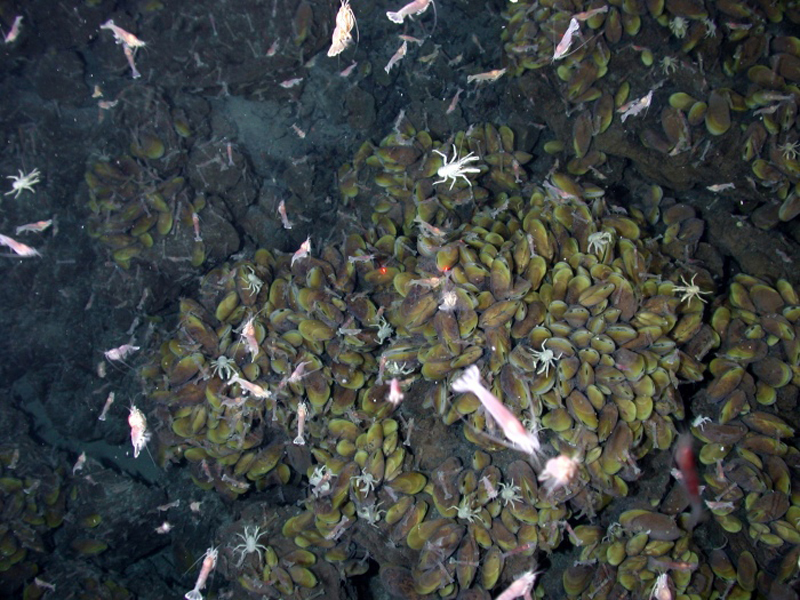

Figure 46.9図 46.9
Swimming shrimp, a few squat lobsters, and hundreds of vent mussels are seen at a hydrothermal vent at the bottom of the ocean. As no sunlight penetrates to this depth, the ecosystem is supported by chemoautotrophic bacteria and organic material that sinks from the ocean’s surface. This picture was taken in 2006 at the submerged NW Eifuku volcano off the coast of Japan by the National Oceanic and Atmospheric Administration (NOAA). The summit of this highly active volcano lies 1535 m below the surface.
海底の熱水噴出孔には、泳ぐエビ、数匹のコシオリエビ類、数百個の熱水域のイガイ類が見られる。この深さには日光が届かないため、生態系は化学独立栄養細菌と、海面から沈んでくる有機物に支えられている。この写真は、米国海洋大気庁(NOAA)が2006年に日本沖の北西永福海山で撮影した。非常に活動的なこの海底火山の山頂は、海面下1,535 mにある。
Productivity within Trophic Levels栄養段階内の生産力
Productivity within an ecosystem can be defined as the percentage of energy entering the ecosystem incorporated into biomass in a particular trophic level. Biomass is the total mass, in a unit area at the time of measurement, of living or previously living organisms within a trophic level. Ecosystems have characteristic amounts of biomass at each trophic level. For example, in the English Channel ecosystem the primary producers account for a biomass of 4 g/m2 (grams per square meter), while the primary consumers exhibit a biomass of 21 g/m2.
英語のヒント
生態系内の生産力は、生態系へ入るエネルギーのうち、ある栄養段階の生物量に取り込まれる割合として定義できる。生物量とは、測定時点の単位面積内にある、生きているか以前は生きていた、ある栄養段階の生物の総質量である。生態系には、栄養段階ごとに特徴的な生物量がある。たとえばイギリス海峡の生態系では、一次生産者の生物量は4 g/m2(1平方メートルあたりグラム)、一次消費者は21 g/m2である。
The productivity of the primary producers is especially important in any ecosystem because these organisms bring energy to other living organisms by photoautotrophy or chemoautotrophy. The rate at which photosynthetic primary producers incorporate energy from the sun is called gross primary productivity. An example of gross primary productivity is shown in the compartment diagram of energy flow within the Silver Springs aquatic ecosystem as shown (Figure 46.8). In this ecosystem, the total energy accumulated by the primary producers (gross primary productivity) was shown to be 20,810 kcal/m2/yr.
英語のヒント
一次生産者は、光独立栄養または化学独立栄養によって、ほかの生物にエネルギーをもたらす。そのため、どの生態系でも一次生産者の生産力は特に重要である。光合成を行う一次生産者が太陽からエネルギーを取り込む速度を、総一次生産力という。総一次生産力の例は、シルバースプリングスの水生生態系におけるエネルギーの流れの区画図に示されている(図46.8)。この生態系で一次生産者が蓄えたエネルギーの総量(総一次生産力)は、20,810 kcal/m2/年だった。
Because all organisms need to use some of this energy for their own functions (like respiration and resulting metabolic heat loss) scientists often refer to the net primary productivity of an ecosystem. Net primary productivity is the energy that remains in the primary producers after accounting for the organisms’ respiration and heat loss. The net productivity is then available to the primary consumers at the next trophic level. In our Silver Springs example, 13,187 of the 20,810 kcal/m2/yr were used for respiration or were lost as heat, leaving 7,633 kcal/m2/yr of energy for use by the primary consumers.
英語のヒント
すべての生物は、得たエネルギーの一部を自らの機能に使う必要がある。呼吸や、それに伴う代謝熱の損失などである。そのため科学者は、生態系の純一次生産力に言及することが多い。純一次生産力とは、呼吸と熱損失を差し引いた後に一次生産者に残るエネルギーである。この純生産分が、次の栄養段階にいる一次消費者に利用可能となる。シルバースプリングスの例では、20,810 kcal/m2/年のうち13,187が呼吸に使われるか熱として失われ、一次消費者が使えるエネルギーとして7,633 kcal/m2/年が残った。