第46章生態系
Modeling Ecosystems Energy Flow: Ecological Pyramids生態系のエネルギー流をモデル化する:生態ピラミッド
The structure of ecosystems can be visualized with ecological pyramids, which were first described by the pioneering studies of Charles Elton in the 1920s. Ecological pyramids show the relative amounts of various parameters (such as number of organisms, energy, and biomass) across trophic levels.
英語のヒント
生態系の構造は、生態ピラミッドによって視覚化できる。これは1920年代、チャールズ・エルトンの先駆的な研究によって初めて記述された。生態ピラミッドは、栄養段階ごとの生物の数、エネルギー、生物量など、さまざまな指標の相対的な量を示す。
Pyramids of numbers can be either upright or inverted, depending on the ecosystem. As shown in Figure 46.10, typical grassland during the summer has a base of many plants, and the numbers of organisms decrease at each trophic level. However, during the summer in a temperate forest, the base of the pyramid consists of few trees compared with the number of primary consumers, mostly insects. Because trees are large, they have great photosynthetic capability, and dominate other plants in this ecosystem to obtain sunlight. Even in smaller numbers, primary producers in forests are still capable of supporting other trophic levels.
英語のヒント
個体数ピラミッドは、生態系によって正立する場合も逆転する場合もある。図46.10のように、夏の典型的な草原では、多数の植物が基盤となり、栄養段階が上がるごとに生物数が減る。しかし、夏の温帯林では、ピラミッドの基盤の樹木数は、主に昆虫からなる一次消費者の数より少ない。樹木は大きく、高い光合成能力をもち、日光を得るために生態系内のほかの植物より優勢になる。森林の一次生産者は、数が少なくてもほかの栄養段階を支えられる。
Another way to visualize ecosystem structure is with pyramids of biomass. This pyramid measures the amount of energy converted into living tissue at the different trophic levels. Using the Silver Springs ecosystem example, this data exhibits an upright biomass pyramid (Figure 46.10), whereas the pyramid from the English Channel example is inverted. The plants (primary producers) of the Silver Springs ecosystem make up a large percentage of the biomass found there. However, the phytoplankton in the English Channel example make up less biomass than the primary consumers, the zooplankton. As with inverted pyramids of numbers, this inverted pyramid is not due to a lack of productivity from the primary producers, but results from the high turnover rate of the phytoplankton. The phytoplankton are consumed rapidly by the primary consumers, thus, minimizing their biomass at any particular point in time. However, phytoplankton reproduce quickly, thus they are able to support the rest of the ecosystem.
英語のヒント
生態系の構造を視覚化する別の方法に、生物量ピラミッドがある。これは、各栄養段階で生きた組織へ変換されたエネルギー量を測る。シルバースプリングスの生態系のデータでは、生物量ピラミッドは正立する(図46.10)。一方、イギリス海峡の例では逆転する。シルバースプリングスの植物(一次生産者)は、そこにある生物量の大部分を占める。しかし、イギリス海峡の植物プランクトンの生物量は、一次消費者である動物プランクトンより少ない。個体数ピラミッドの逆転と同じく、この逆転も一次生産者の生産力不足によるのではなく、植物プランクトンの高い入れ替わり速度による。植物プランクトンは一次消費者に速やかに食べられるため、ある一時点の生物量は小さくなる。しかし、速く増殖するため、生態系のほかの部分を支えられる。
Pyramid ecosystem modeling can also be used to show energy flow through the trophic levels. Notice that these numbers are the same as those used in the energy flow compartment diagram in (Figure 46.8). Pyramids of energy are always upright, and an ecosystem without sufficient primary productivity cannot be supported. All types of ecological pyramids are useful for characterizing ecosystem structure. However, in the study of energy flow through the ecosystem, pyramids of energy are the most consistent and representative models of ecosystem structure (Figure 46.10).
英語のヒント
Consequences of Food Webs: Biological Magnification食物網がもたらす結果:生物濃縮
One of the most important environmental consequences of ecosystem dynamics is biomagnification. Biomagnification is the increasing concentration of persistent, toxic substances in organisms at each trophic level, from the primary producers to the apex consumers. Many substances have been shown to bioaccumulate, including the pesticide dichlorodiphenyltrichloroethane (DDT), which was described in the 1960s bestseller, Silent Spring, by marine biologist Rachel Carson. DDT was a commonly used pesticide before its dangers became known. In some aquatic ecosystems, organisms from each trophic level consumed many organisms of the lower level, which caused DDT to increase in birds (apex consumers) that ate fish. Thus, the birds accumulated sufficient amounts of DDT to cause fragility in their eggshells. This effect increased egg breakage during nesting and was shown to have adverse effects on these bird populations. Carson's combination of scientific knowledge and illuminating writing helped raise awareness about overall environmental issues as well as the specifics of the pesticide. The use of DDT was banned in the United States in the 1970s.
英語のヒント
生態系動態が環境にもたらす最も重要な結果の1つが、生物濃縮である。これは、一次生産者から頂点消費者へ栄養段階を上がるにつれ、生物内の残留性の高い有害物質の濃度が増すことである。生物内に蓄積することが示された物質は多く、殺虫剤のジクロロジフェニルトリクロロエタン(DDT)もその1つである。DDTは、海洋生物学者レイチェル・カーソンによる1960年代のベストセラー『沈黙の春』で取り上げられた。危険性が知られる前は、広く使われる殺虫剤だった。ある水生生態系では、各栄養段階の生物が下位段階の多数の生物を食べるため、魚を食べる鳥(頂点消費者)の体内でDDTが増加した。その結果、卵殻をもろくするほどの量が蓄積した。営巣中に卵が壊れやすくなり、鳥の個体群に悪影響が生じることが示された。カーソンは科学的知識と問題を明らかにする文章を組み合わせ、殺虫剤の具体的な問題だけでなく、環境問題全般への認識を高めた。米国では1970年代にDDTの使用が禁止された。
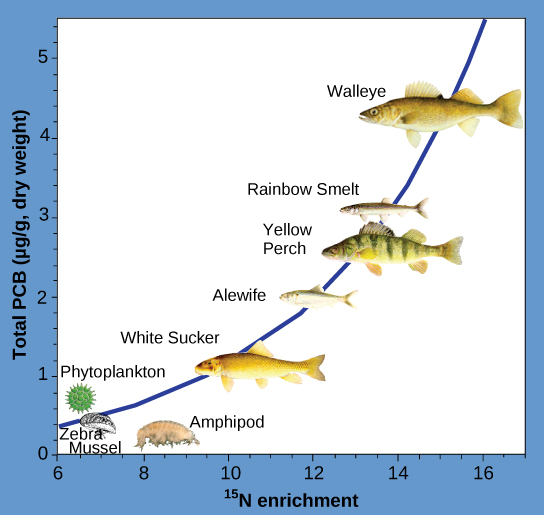
Other substances that biomagnify are polychlorinated biphenyls (PCBs), which were used in coolant liquids in the United States until their use was banned in 1979, and heavy metals, such as mercury, lead, and cadmium. These substances were best studied in aquatic ecosystems, where fish species at different trophic levels accumulate toxic substances brought through the ecosystem by the primary producers. As illustrated in a study performed by the National Oceanic and Atmospheric Administration (NOAA) in the Saginaw Bay of Lake Huron (Figure 46.11), PCB concentrations increased from the ecosystem’s primary producers (phytoplankton) through the different trophic levels of fish species. The apex consumer (walleye) has more than four times the amount of PCBs compared to phytoplankton. Also, based on results from other studies, birds that eat these fish may have PCB levels at least one order of magnitude higher than those found in the lake fish.
英語のヒント
生物濃縮するほかの物質には、米国で1979年に使用が禁止されるまで冷却液に使われていたポリ塩化ビフェニル(PCB)や、水銀、鉛、カドミウムなどの重金属がある。これらの物質は水生生態系で特によく研究されてきた。そこでは、一次生産者を通して生態系へ入った有害物質が、さまざまな栄養段階の魚に蓄積する。米国海洋大気庁(NOAA)がヒューロン湖のサギノー湾で行った研究(図46.11)では、一次生産者の植物プランクトンから、各栄養段階の魚へ進むにつれてPCB濃度が増加した。頂点消費者のウォールアイには、植物プランクトンの4倍を超えるPCBが含まれる。ほかの研究によれば、これらの魚を食べる鳥のPCB濃度は、湖の魚より少なくとも1桁高い可能性がある。
OpenStax, Rice University; Biology 2e. (credit: Patricia Van Hoof, NOAA, GLERL) · CC BY 4.0 · Source出典

Figure 46.11図 46.11
This chart shows the PCB concentrations found at the various trophic levels in the Saginaw Bay ecosystem of Lake Huron. Numbers on the x-axis reflect enrichment with heavy isotopes of nitrogen (15N), which is a marker for increasing trophic level. Notice that the fish in the higher trophic levels accumulate more PCBs than those in lower trophic levels. (credit: Patricia Van Hoof, NOAA, GLERL)
ヒューロン湖サギノー湾の生態系における、各栄養段階のPCB濃度。横軸の数値は窒素の重い同位体(15N)の濃縮度を示し、これは栄養段階の上昇の指標となる。高い栄養段階の魚ほど、低い段階の魚よりPCBを多く蓄積していることに注目しよう。(出典:Patricia Van Hoof、NOAA、GLERL)
Other concerns have been raised by the accumulation of heavy metals, such as mercury and cadmium, in certain types of seafood. The United States Environmental Protection Agency (EPA) recommends that pregnant people and young children should not consume any swordfish, shark, king mackerel, or tilefish because of their high mercury content. These individuals are advised to eat fish low in mercury: salmon, tilapia, shrimp, pollock, and catfish. Biomagnification is a good example of how ecosystem dynamics can affect our everyday lives, even influencing the food we eat.
英語のヒント
ある種の魚介類に水銀やカドミウムなどの重金属が蓄積することにも、懸念が示されている。米国環境保護庁(EPA)は、水銀含有量が高いため、妊娠中の人や幼い子どもはメカジキ、サメ、キングマッケレル、タイルフィッシュを一切食べないよう勧告している。これらの人には、サケ、ティラピア、エビ、スケトウダラ、ナマズなど、水銀の少ない魚介類を食べることが勧められている。生物濃縮は、生態系の動態が日常生活に影響し、食べるものにも関わることを示すよい例である。