第46章生態系
The Carbon Cycle炭素循環
Carbon is the second most abundant element in living organisms. Carbon is present in all organic molecules, and its role in the structure of macromolecules is of primary importance to living organisms.
英語のヒント
炭素は、生物の中で2番目に多い元素である。すべての有機分子に存在し、高分子の構造における炭素の役割は、生物にとって最も重要なものの1つである。
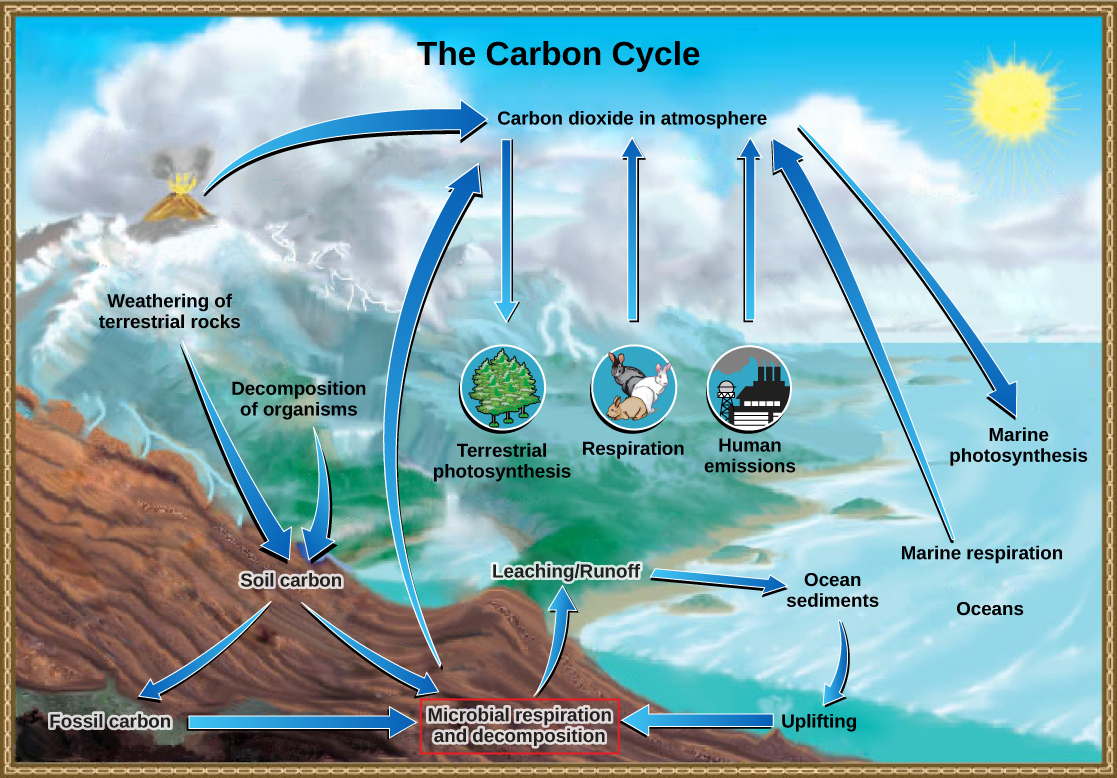
The carbon cycle is most easily studied as two interconnected sub-cycles: one dealing with rapid carbon exchange among living organisms and the other dealing with the long-term cycling of carbon through geologic processes. The entire carbon cycle is shown in Figure 46.15.
英語のヒント
炭素循環は、相互につながる2つの小循環に分けると最も学びやすい。一方は生物間の速い炭素交換、もう一方は地質学的過程を通る長期的な炭素循環である。炭素循環の全体を図46.15に示す。
OpenStax, Rice University; Biology 2e. (credit: modification of work by John M. Evans and Howard Perlman, USGS) · CC BY 4.0 · Source出典
Figure 46.15図 46.15
Carbon dioxide gas exists in the atmosphere and is dissolved in water. Photosynthesis converts carbon dioxide gas to organic carbon, and respiration cycles the organic carbon back into carbon dioxide gas. Long-term storage of organic carbon occurs when matter from living organisms is buried deep underground and becomes fossilized. Volcanic activity and, more recently, human emissions, bring this stored carbon back into the carbon cycle. (credit: modification of work by John M. Evans and Howard Perlman, USGS)
二酸化炭素は大気中に気体として存在し、水にも溶けている。光合成は二酸化炭素を有機炭素へ変え、呼吸は有機炭素を二酸化炭素へ戻す。生物由来の物質が地下深くに埋まり、化石化すると、有機炭素が長期に貯蔵される。火山活動や、より最近では人間による排出が、この貯蔵炭素を炭素循環へ戻す。(John M. EvansとHoward Perlman、USGSの作品を改変)
The Biological Carbon Cycle生物的な炭素循環
Living organisms are connected in many ways, even between ecosystems. A good example of this connection is the exchange of carbon between autotrophs and heterotrophs within and between ecosystems by way of atmospheric carbon dioxide. Carbon dioxide is the basic building block that most autotrophs use to build multicarbon, high energy compounds, such as glucose. The energy harnessed from the sun is used by these organisms to form the covalent bonds that link carbon atoms together. These chemical bonds thereby store this energy for later use in the process of respiration. Most terrestrial autotrophs obtain their carbon dioxide directly from the atmosphere, while marine autotrophs acquire it in the dissolved form from the partial ionization of carbonic acid into bicarbonate ions (H2CO3−). However carbon dioxide is acquired, a by-product of the process is oxygen. The photosynthetic organisms are responsible for creating the oxygen content of our atmosphere; oxygen makes up approximately 21 percent of the atmosphere that we observe today.
英語のヒント
生物はさまざまな形でつながっており、そのつながりは生態系の境界も越える。よい例は、大気中の二酸化炭素を介して、生態系内や生態系間で独立栄養生物と従属栄養生物が炭素を交換することである。二酸化炭素は、大半の独立栄養生物が、グルコースなど、複数の炭素をもつ高エネルギー化合物を作るための基本材料である。これらの生物は太陽から得たエネルギーを使い、炭素原子同士を結ぶ共有結合を作る。この化学結合にエネルギーが蓄えられ、後に呼吸で利用される。陸上の独立栄養生物の大半は二酸化炭素を大気から直接得る。一方、海洋の独立栄養生物は、炭酸が炭酸水素イオン(H2CO3−)へ部分的に電離することによって、溶けた形の二酸化炭素を得る。二酸化炭素をどのように得るにせよ、その過程の副産物は酸素である。光合成生物は大気中の酸素を作り出してきた。今日の大気では、酸素が約21%を占める。
Heterotrophs and autotrophs are partners in biological carbon exchange (especially the primary consumers, largely herbivores). Heterotrophs acquire the high-energy carbon compounds from the autotrophs by consuming them, and breaking them down by respiration to obtain cellular energy, such as ATP. The most efficient type of respiration, aerobic respiration, requires oxygen obtained from the atmosphere or dissolved in water. Thus, there is a constant exchange of oxygen and carbon dioxide between the autotrophs (which need the carbon) and the heterotrophs (which need the oxygen). Gas exchange through the atmosphere and water is one way that the carbon cycle connects all living organisms on Earth.
英語のヒント
従属栄養生物と独立栄養生物は、生物的な炭素交換の相手である。特に、主に草食動物からなる一次消費者が関わる。従属栄養生物は独立栄養生物を食べて高エネルギーの炭素化合物を得て、呼吸で分解し、ATPなどの細胞のエネルギーを得る。最も効率のよい呼吸である好気呼吸には、大気中または水に溶けた酸素が必要である。そのため、炭素を必要とする独立栄養生物と、酸素を必要とする従属栄養生物の間では、酸素と二酸化炭素の交換が絶えず行われる。大気と水を通じた気体交換は、炭素循環が地球上のすべての生物をつなぐ仕組みの1つである。
The Biogeochemical Carbon Cycle生物地球化学的な炭素循環
The movement of carbon through the land, water, and air is complex, and in many cases, it occurs much more slowly geologically than as seen between living organisms. Carbon is stored for long periods in what are known as carbon reservoirs, which include the atmosphere, bodies of liquid water (mostly oceans), ocean sediment, soil, land sediments (including fossil fuels), and the Earth’s interior.
英語のヒント
陸、水、大気を通る炭素の移動は複雑であり、地質学的な移動は、生物間の移動よりはるかに遅いことが多い。炭素は、炭素貯蔵庫と呼ばれる場所に長期間蓄えられる。大気、液体の水域(主に海洋)、海洋堆積物、土壌、陸上の堆積物(化石燃料を含む)、地球内部などがそれに当たる。
As stated, the atmosphere is a major reservoir of carbon in the form of carbon dioxide and is essential to the process of photosynthesis. The level of carbon dioxide in the atmosphere is greatly influenced by the reservoir of carbon in the oceans. The exchange of carbon between the atmosphere and water reservoirs influences how much carbon is found in each location, and each one affects the other reciprocally. Carbon dioxide (CO2) from the atmosphere dissolves in water and combines with water molecules to form carbonic acid, and then it ionizes to carbonate and bicarbonate ions (Figure 46.16)
英語のヒント
すでに述べたように、大気は二酸化炭素という形の炭素の主要な貯蔵庫であり、光合成に不可欠である。大気中の二酸化炭素濃度は、海洋の炭素貯蔵庫に大きく影響される。大気と水の貯蔵庫の間の炭素交換は、それぞれに存在する炭素量に影響し、両者は互いに作用する。大気中の二酸化炭素(CO2)は水に溶け、水分子と結びついて炭酸となり、その後、炭酸イオンと炭酸水素イオンへ電離する(図46.16)。
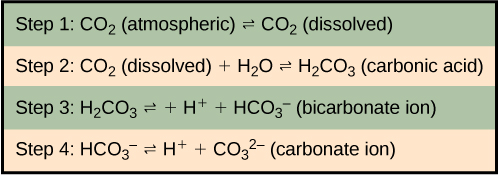


Figure 46.16図 46.16
Carbon dioxide reacts with water to form bicarbonate and carbonate ions.
二酸化炭素は水と反応し、炭酸水素イオンと炭酸イオンを生じる。
The equilibrium coefficients are such that more than 90 percent of the carbon in the ocean is found as bicarbonate ions. Some of these ions combine with seawater calcium to form calcium carbonate (CaCO3), a major component of marine organism shells. These organisms eventually form sediments on the ocean floor. Over geologic time, the calcium carbonate forms limestone, which comprises the largest carbon reservoir on Earth.
英語のヒント
平衡係数の値により、海洋の炭素の90%以上は炭酸水素イオンとして存在する。その一部は海水中のカルシウムと結びつき、海洋生物の殻の主要成分である炭酸カルシウム(CaCO3)を作る。これらの生物は、やがて海底の堆積物となる。地質学的な時間をかけて炭酸カルシウムは石灰岩となり、地球最大の炭素貯蔵庫を構成する。
On land, carbon is stored in soil as a result of the decomposition of living organisms (by decomposers) or from weathering of terrestrial rock and minerals. This carbon can be leached into the water reservoirs by surface runoff. Deeper underground, on land and at sea, are fossil fuels: the anaerobically decomposed remains of plants that take millions of years to form. Fossil fuels are considered a nonrenewable resource because their use far exceeds their rate of formation. A nonrenewable resource, such as fossil fuel, is either regenerated very slowly or not at all. Another way for carbon to enter the atmosphere is from land (including land beneath the surface of the ocean) by the eruption of volcanoes and other geothermal systems. Carbon sediments from the ocean floor are taken deep within the Earth by the process of subduction: the movement of one tectonic plate beneath another. Carbon is released as carbon dioxide when a volcano erupts or from volcanic hydrothermal vents.
英語のヒント
陸上では、分解者による生物の分解や、陸上の岩石・鉱物の風化によって、炭素が土壌に蓄えられる。この炭素は、地表流出によって水の貯蔵庫へ溶脱することがある。陸と海の地下深くには化石燃料がある。これは、数百万年かけて形成される、植物が嫌気的に分解された残骸である。化石燃料は、使用速度が生成速度を大幅に上回るため、再生不可能な資源とされる。化石燃料のような再生不可能資源は、再生が極めて遅いか、まったく再生されない。炭素が大気へ入る別の経路は、海面下を含む陸の火山噴火や、ほかの地熱系である。海底の炭素堆積物は、あるプレートが別のプレートの下へ動く沈み込みによって、地球内部深くへ運ばれる。火山の噴火や火山性の熱水噴出孔から、炭素が二酸化炭素として放出される。
Humans contribute to atmospheric carbon by the burning of fossil fuels and other materials. Since the Industrial Revolution, humans have significantly increased the release of carbon and carbon compounds, which has in turn affected the climate and overall environment.
英語のヒント
人間は、化石燃料やほかの物質を燃やすことで、大気中の炭素を増やしている。産業革命以降、人間は炭素と炭素化合物の放出を大幅に増やし、それが気候と環境全体に影響してきた。
Animal husbandry by humans also increases atmospheric carbon. The large numbers of land animals raised to feed the Earth’s growing population results in increased carbon dioxide levels in the atmosphere due to farming practices and respiration and methane production. This is another example of how human activity indirectly affects biogeochemical cycles in a significant way. Although much of the debate about the future effects of increasing atmospheric carbon on climate change focuses on fossils fuels, scientists take natural processes, such as volcanoes and respiration, into account as they model and predict the future impact of this increase.
英語のヒント
人間の畜産も、大気中の炭素を増やす。増大する世界人口を養うために育てられる多数の陸上動物は、飼育方法、呼吸、メタン生成によって、大気中の二酸化炭素濃度の増加をもたらす。これは、人間の活動が生物地球化学的循環に間接的に大きな影響を与える、もう1つの例である。大気中の炭素の増加が将来の気候変動に及ぼす影響についての議論は、多くが化石燃料に集中している。しかし科学者は、その増加の将来の影響をモデル化・予測するとき、火山や呼吸のような自然の過程も考慮している。