第46章生態系
The Nitrogen Cycle窒素循環
Getting nitrogen into the living world is difficult. Plants and phytoplankton are not equipped to incorporate nitrogen from the atmosphere (which exists as tightly bonded, triple covalent N2) even though this molecule comprises approximately 78 percent of the atmosphere. Nitrogen enters the living world via free-living and symbiotic bacteria, which incorporate nitrogen into their macromolecules through nitrogen fixation (conversion of N2). Cyanobacteria live in most aquatic ecosystems where sunlight is present; they play a key role in nitrogen fixation. Cyanobacteria are able to use inorganic sources of nitrogen to “fix” nitrogen. Rhizobium bacteria live symbiotically in the root nodules of legumes (such as peas, beans, and peanuts) and provide them with the organic nitrogen they need. (For example, gardeners often grow peas both for their produce and to naturally add nitrogen to the soil. This practice goes back to ancient times, even if the science has only been recently understood.) Free-living bacteria, such as Azotobacter, are also important nitrogen fixers.
英語のヒント
窒素を生物の世界へ取り込むことは難しい。大気中の窒素は、強い三重共有結合をもつN2として存在する。この分子が大気の約78%を占めるにもかかわらず、植物や植物プランクトンは大気から窒素を取り込む仕組みをもたない。窒素は、自由生活性細菌や共生細菌を介して生物の世界へ入る。これらの細菌は窒素固定(N2の変換)によって、窒素を自らの高分子に取り込む。シアノバクテリアは、日光のある大半の水生生態系に生息し、窒素固定に重要な役割を果たす。無機の窒素源を使って窒素を「固定」できる。リゾビウム属の細菌は、エンドウ、インゲン、ラッカセイなど、マメ科植物の根粒に共生し、必要な有機窒素を供給する。たとえば園芸では、収穫だけでなく土壌に自然に窒素を加える目的でもエンドウを育てる。この習慣は古代にさかのぼり、科学的な仕組みが理解されたのは最近のことである。アゾトバクターなどの自由生活性細菌も、重要な窒素固定生物である。
Organic nitrogen is especially important to the study of ecosystem dynamics since many ecosystem processes, such as primary production and decomposition, are limited by the available supply of nitrogen. As shown in Figure 46.17, the nitrogen that enters living systems by nitrogen fixation is successively converted from organic nitrogen back into nitrogen gas by bacteria. This process occurs in three steps in terrestrial systems: ammonification, nitrification, and denitrification. First, the ammonification process converts nitrogenous waste from living animals or from the remains of dead animals into ammonium (NH4+) by certain bacteria and fungi. Second, the ammonium is converted to nitrites (NO2−) by nitrifying bacteria, such as Nitrosomonas, through nitrification. Subsequently, nitrites are converted to nitrates (NO3−) by similar organisms. Third, the process of denitrification occurs, whereby bacteria, such as Pseudomonas and Clostridium, convert the nitrates into nitrogen gas, allowing it to reenter the atmosphere.
英語のヒント
一次生産や分解など、生態系の多くの過程は利用できる窒素量に制限される。そのため、有機窒素は生態系動態の研究で特に重要である。図46.17のように、窒素固定で生物系へ入った窒素は、細菌によって有機窒素から窒素気体へ順に変換される。陸上では、アンモニア化、硝化、脱窒という3段階で進む。まず、ある種の細菌や菌類が、生きた動物の窒素老廃物や死んだ動物の残骸を、アンモニウム(NH4+)へ変える。これがアンモニア化である。次に、ニトロソモナスなどの硝化細菌が、硝化によってアンモニウムを亜硝酸イオン(NO2−)に変える。続いて、同様の生物が亜硝酸イオンを硝酸イオン(NO3−)へ変える。第3に脱窒が起こる。シュードモナスやクロストリジウムなどの細菌が硝酸イオンを窒素気体へ変え、大気へ戻せるようにする。
Human activity can release nitrogen into the environment by two primary means: the combustion of fossil fuels, which releases different nitrogen oxides, and by the use of artificial fertilizers in agriculture, which are then washed into lakes, streams, and rivers by surface runoff. Atmospheric nitrogen is associated with several effects on Earth’s ecosystems including the production of acid rain (as nitric acid, HNO3) and greenhouse gas (as nitrous oxide, N2O) potentially causing climate change. A major effect from fertilizer runoff is saltwater and freshwater eutrophication, a process whereby nutrient runoff causes the excess growth of microorganisms, depleting dissolved oxygen levels and killing ecosystem fauna.
英語のヒント
人間の活動は、主に2つの方法で窒素を環境へ放出する。1つは、さまざまな窒素酸化物を放出する化石燃料の燃焼である。もう1つは農業での人工肥料の使用で、肥料は地表流出によって湖や大小の河川へ流される。大気中の窒素化合物は、硝酸(HNO3)による酸性雨の発生や、気候変動を引き起こしうる温室効果ガスの亜酸化窒素(N2O)など、生態系への複数の影響に関わる。肥料流出の主な影響の1つは、海水・淡水の富栄養化である。栄養分の流入が微生物の過剰な増殖を引き起こし、溶存酸素を減らして、生態系の動物を死なせる過程である。
A similar process occurs in the marine nitrogen cycle, where the ammonification, nitrification, and denitrification processes are performed by marine bacteria. Some of this nitrogen falls to the ocean floor as sediment, which can then be moved to land in geologic time by uplift of the Earth’s surface and thereby incorporated into terrestrial rock. Although the movement of nitrogen from rock directly into living systems has been traditionally seen as insignificant compared with nitrogen fixed from the atmosphere, a recent study showed that this process may indeed be significant and should be included in any study of the global nitrogen cycle. Scott L. Morford, Benjamin Z. Houlton, and Randy A. Dahlgren, “Increased Forest Ecosystem Carbon and Nitrogen Storage from Nitrogen Rich Bedrock,” Nature 477, no. 7362 (2011): 78–81.
英語のヒント
海洋の窒素循環でも同様の過程が起こり、海洋細菌がアンモニア化、硝化、脱窒を行う。窒素の一部は海底へ沈んで堆積物となり、地質学的な時間の中で地表の隆起によって陸へ移動し、陸上の岩石に組み込まれる。岩石から直接生物系へ移る窒素は、大気から固定される窒素に比べて重要でないと従来考えられてきた。しかし近年の研究では、この過程が実際には重要である可能性が示され、地球規模の窒素循環の研究には含めるべきだとされた。Scott L. Morford, Benjamin Z. Houlton, and Randy A. Dahlgren, “Increased Forest Ecosystem Carbon and Nitrogen Storage from Nitrogen Rich Bedrock,” Nature 477, no. 7362 (2011): 78–81.
The Phosphorus Cycleリン循環
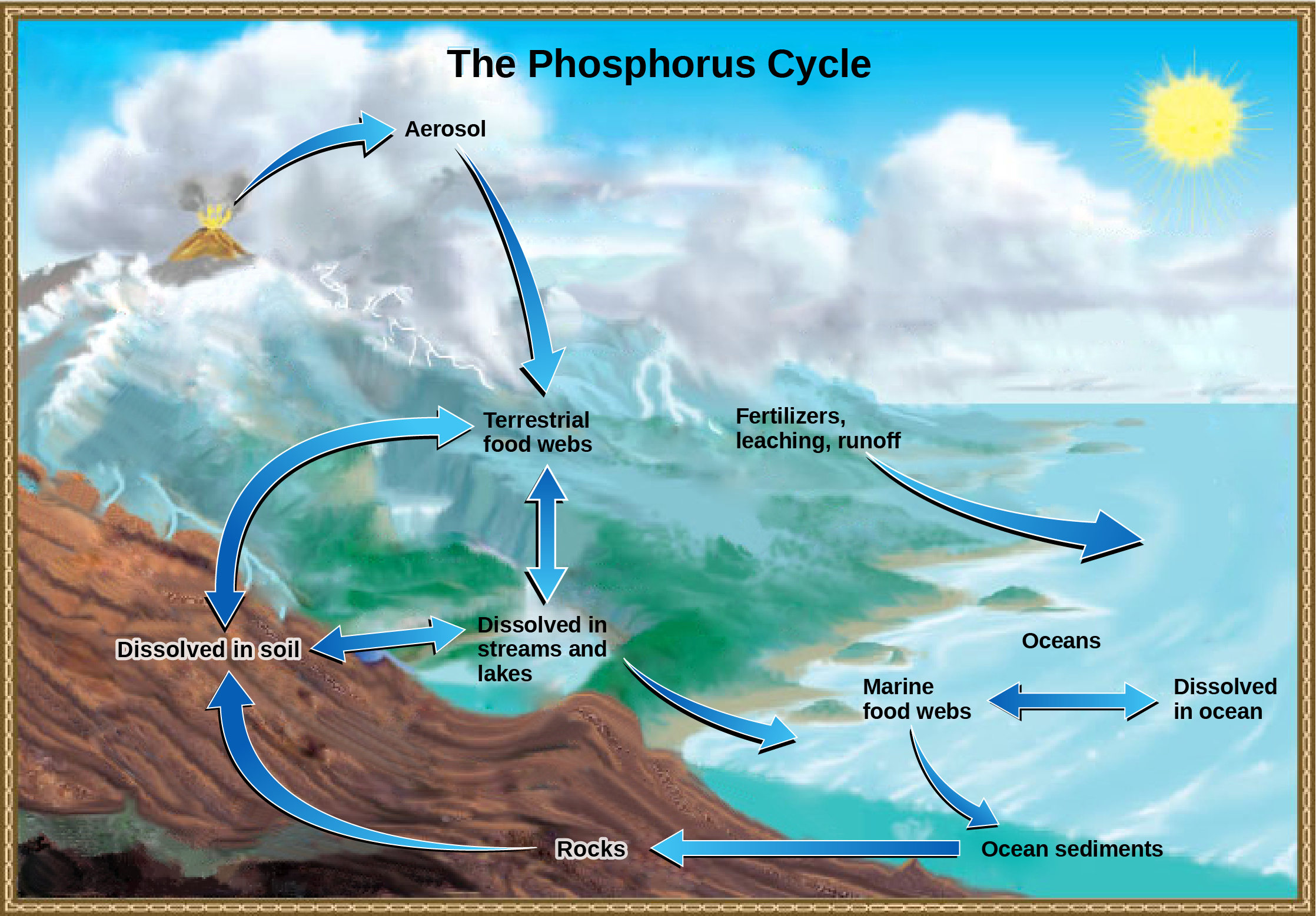
Phosphorus is an essential nutrient for living processes; it is a major component of nucleic acid and phospholipids, and, as calcium phosphate, makes up the supportive components of our bones. Phosphorus is often the limiting nutrient (necessary for growth) in aquatic ecosystems (Figure 46.18).
英語のヒント
リンは生命活動に不可欠な栄養素である。核酸とリン脂質の主要成分であり、リン酸カルシウムとして骨を支える成分を構成する。水生生態系では、リンが成長に必要な制限栄養素となることが多い(図46.18)。
Phosphorus occurs in nature as the phosphate ion (PO43−). In addition to phosphate runoff as a result of human activity, natural surface runoff occurs when it is leached from phosphate-containing rock by weathering, thus sending phosphates into rivers, lakes, and the ocean. This rock has its origins in the ocean. Phosphate-containing ocean sediments form primarily from the bodies of ocean organisms and from their excretions. However, in remote regions, volcanic ash, aerosols, and mineral dust may also be significant phosphate sources. This sediment then is moved to land over geologic time by the uplifting of areas of the Earth’s surface.
英語のヒント
リンは自然界ではリン酸イオン(PO43−)として存在する。人間の活動によるリン酸塩の流出に加え、リン酸塩を含む岩石から風化によって溶脱し、河川、湖、海へ運ばれる自然の地表流出もある。この岩石の起源は海にある。リン酸塩を含む海洋堆積物は、主に海洋生物の体と排泄物から形成される。しかし遠隔地では、火山灰、エアロゾル、鉱物の粉塵も重要なリン酸塩供給源となりうる。その堆積物は、地質学的な時間の中で地表の一部が隆起することによって、陸へ移動する。
Phosphorus is also reciprocally exchanged between phosphate dissolved in the ocean and marine ecosystems. The movement of phosphate from the ocean to the land and through the soil is extremely slow, with the average phosphate ion having an oceanic residence time between 20,000 and 100,000 years.
英語のヒント
リンは、海に溶けたリン酸塩と海洋生態系の間でも双方向に交換される。リン酸塩が海から陸へ移り、土壌を通る速度は極めて遅い。リン酸イオンの海洋での平均滞留時間は、2万〜10万年である。
OpenStax, Rice University; Biology 2e. (credit: modification of work by John M. Evans and Howard Perlman, USGS) · CC BY 4.0 · Source出典
Figure 46.18図 46.18
In nature, phosphorus exists as the phosphate ion (PO43−). Weathering of rocks and volcanic activity releases phosphate into the soil, water, and air, where it becomes available to terrestrial food webs. Phosphate enters the oceans via surface runoff, groundwater flow, and river flow. Phosphate dissolved in ocean water cycles into marine food webs. Some phosphate from the marine food webs falls to the ocean floor, where it forms sediment. (credit: modification of work by John M. Evans and Howard Perlman, USGS)
自然界でリンはリン酸イオン(PO43−)として存在する。岩石の風化や火山活動によってリン酸塩が土壌、水、大気へ放出され、陸上食物網が利用できるようになる。地表流出、地下水の流れ、河川の流れを通じて海へ入り、海水に溶けたリン酸塩は海洋食物網を循環する。その一部は海底へ沈み、堆積物を作る。(John M. EvansとHoward Perlman、USGSの作品を改変)
As discussed in Ecology and the Biosphere, excess phosphorus and nitrogen that enters these ecosystems from fertilizer runoff and from sewage causes excessive growth of microorganisms and depletes the dissolved oxygen, which leads to the death of many ecosystem fauna, such as shellfish and finfish. This process is responsible for dead zones in lakes and at the mouths of many major rivers (Figure 46.19).
英語のヒント
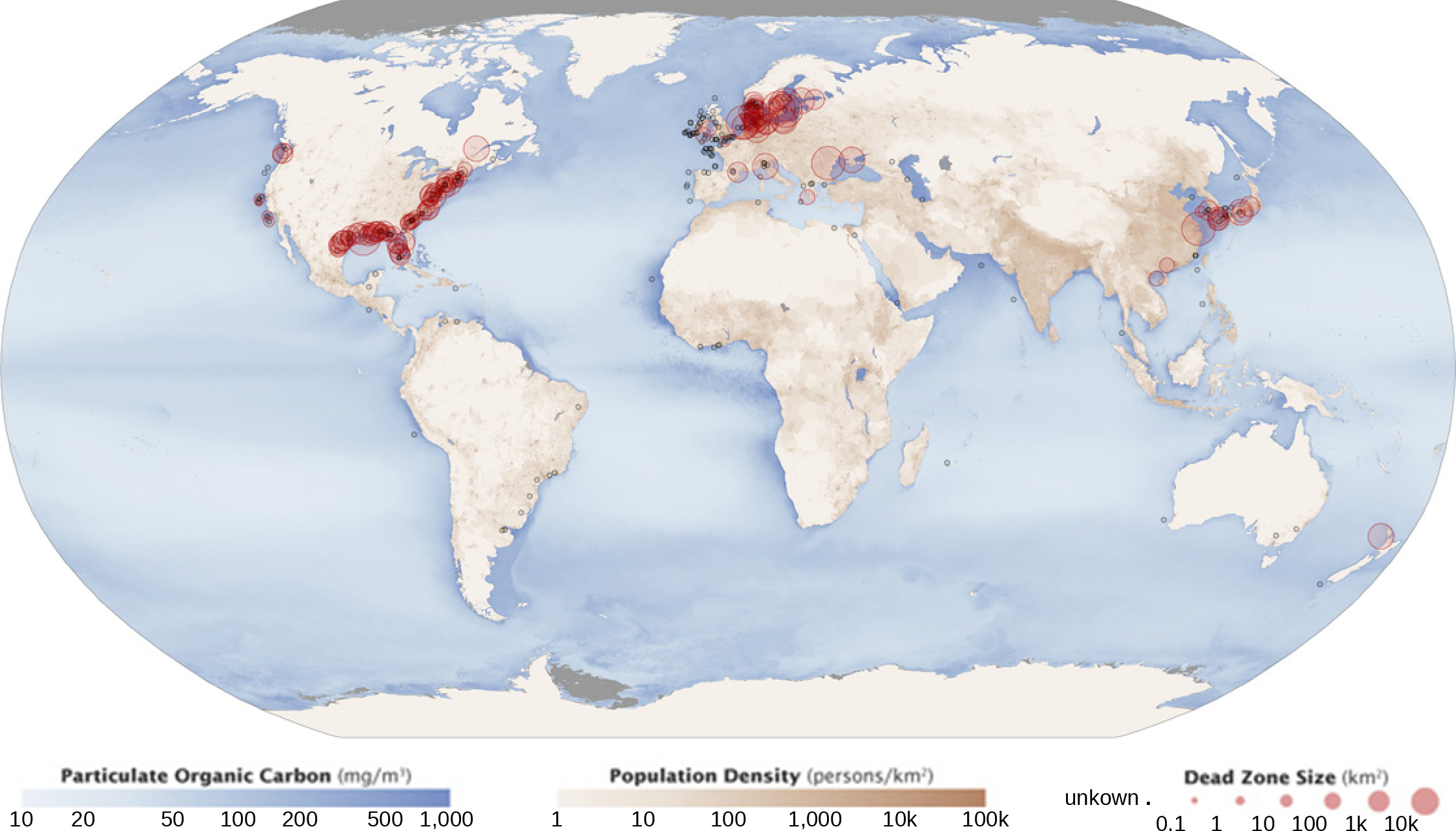


Figure 46.19図 46.19
Dead zones occur when phosphorus and nitrogen from fertilizers cause excessive growth of microorganisms, which depletes oxygen and kills fauna. Worldwide, large dead zones are found in coastal areas of high population density. (credit: NASA Earth Observatory)
肥料に由来するリンと窒素が微生物の過剰増殖を起こすと、酸素が減少し、動物が死んでデッドゾーンが生じる。世界では、人口密度の高い沿岸地域に大きなデッドゾーンが見られる。(出典:NASA Earth Observatory)
As discussed earlier, a dead zone is an area within a freshwater or marine ecosystem where large areas are depleted of their normal flora and fauna; these zones can be caused by eutrophication, oil spills, dumping of toxic chemicals, and other human activities. The number of dead zones has been increasing for several years, and more than 400 of these zones were present as of 2008. One of the worst dead zones is off the coast of the United States in the Gulf of Mexico, where fertilizer runoff from the Mississippi River basin has created a dead zone of over 8463 square miles. Phosphate and nitrate runoff from fertilizers also negatively affect several lake and bay ecosystems including the Chesapeake Bay in the eastern United States.
英語のヒント
すでに述べたように、デッドゾーンとは、淡水または海洋の生態系で、本来の植物相と動物相が広い範囲で失われた場所である。富栄養化、石油流出、有害化学物質の投棄などの人間活動によって生じうる。数はこの数年間増加しており、2008年時点では400か所以上存在した。最悪のものの1つは、米国沖のメキシコ湾にある。ミシシッピ川流域からの肥料流出によって、8,463平方マイルを超えるデッドゾーンができた。肥料由来のリン酸塩と硝酸塩の流出は、米国東部のチェサピーク湾をはじめ、複数の湖や湾の生態系にも悪影響を与えている。