第46章生態系
The Sulfur Cycle硫黄循環
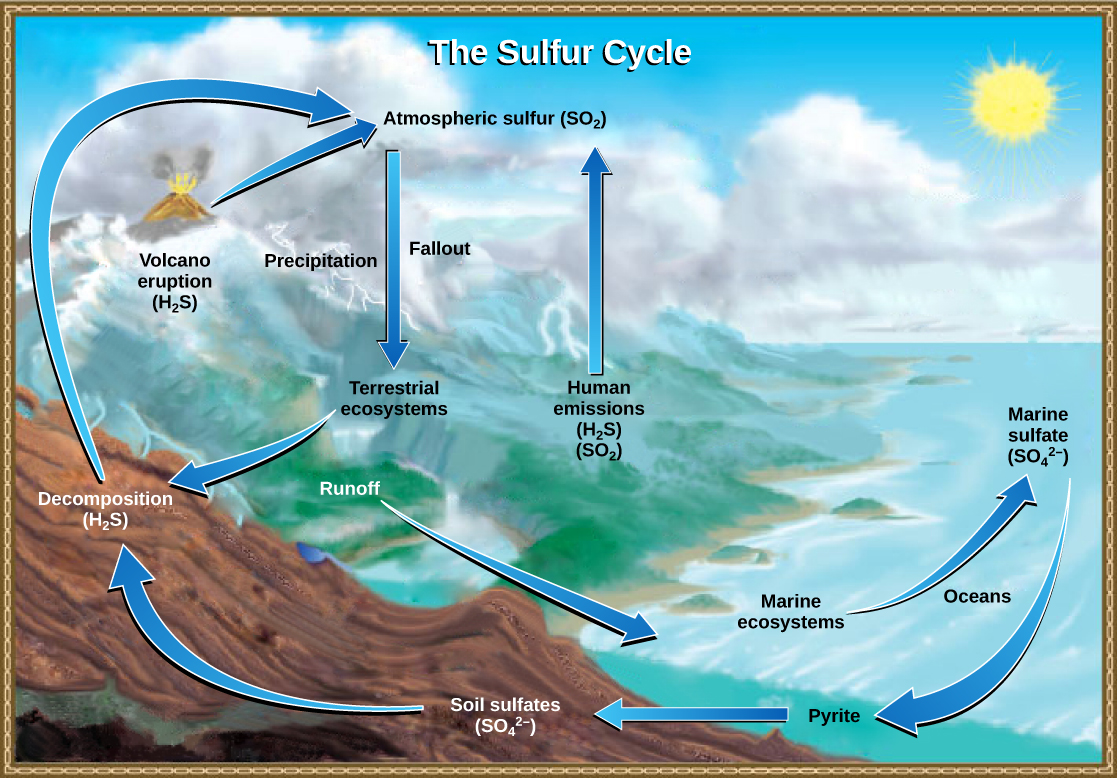
Sulfur is an essential element for the macromolecules of living things. As a part of the amino acid cysteine, it is involved in the formation of disulfide bonds within proteins, which help to determine their 3-D folding patterns, and hence their functions. As shown in Figure 46.21, sulfur cycles between the oceans, land, and atmosphere. Atmospheric sulfur is found in the form of sulfur dioxide (SO2) and enters the atmosphere in three ways: from the decomposition of organic molecules, from volcanic activity and geothermal vents, and from the burning of fossil fuels by humans.
英語のヒント
硫黄は、生物の高分子に不可欠な元素である。アミノ酸のシステインの一部として、タンパク質内のジスルフィド結合の形成に関わる。この結合は、タンパク質の立体的な折りたたみ方、したがって機能を決めるのを助ける。図46.21のように、硫黄は海洋、陸、大気の間を循環する。大気中の硫黄は二酸化硫黄(SO2)の形で存在し、有機分子の分解、火山活動や地熱噴出孔、人間による化石燃料の燃焼という3つの経路で大気へ入る。
OpenStax, Rice University; Biology 2e. (credit: modification of work by John M. Evans and Howard Perlman, USGS) · CC BY 4.0 · Source出典
Figure 46.21図 46.21
Sulfur dioxide from the atmosphere becomes available to terrestrial and marine ecosystems when it is dissolved in precipitation as weak sulfurous acid or when it falls directly to the Earth as fallout. Weathering of rocks also makes sulfates available to terrestrial ecosystems. Decomposition of living organisms returns sulfates to the ocean, soil, and atmosphere. (credit: modification of work by John M. Evans and Howard Perlman, USGS)
大気中の二酸化硫黄は、弱い亜硫酸として降水に溶けるか、直接地上に降下することで、陸上・海洋生態系が利用できるようになる。岩石の風化も、陸上生態系へ硫酸塩を供給する。生物の分解によって、硫酸塩は海、土壌、大気へ戻る。(John M. EvansとHoward Perlman、USGSの作品を改変)
On land, sulfur is deposited in four major ways: precipitation, direct fallout from the atmosphere, rock weathering, and geothermal vents (Figure 46.21). Atmospheric sulfur is found in the form of sulfur dioxide (SO2), and as rain falls through the atmosphere, sulfur is dissolved in the form of weak sulfurous acid (H2SO3). Sulfur can also fall directly from the atmosphere in a process called fallout. Also, the weathering of sulfur-containing rocks releases sulfur into the soil. These rocks originate from ocean sediments that are moved to land by the geologic uplifting of ocean sediments. Terrestrial ecosystems can then make use of these soil sulfates (), and upon the death and decomposition of these organisms, release the sulfur back into the atmosphere as hydrogen sulfide (H2S) gas.
英語のヒント
陸上に硫黄が沈着する主な経路は、降水、大気からの直接の降下、岩石の風化、地熱噴出孔の4つである(図46.21)。大気中の硫黄は二酸化硫黄(SO2)として存在し、雨が大気を通って降ると、弱い亜硫酸(H2SO3)の形で溶ける。硫黄は、降下と呼ばれる過程で、大気から直接落ちることもある。硫黄を含む岩石の風化も、土壌へ硫黄を放出する。これらの岩石は、地質学的な隆起によって陸へ移った海洋堆積物に由来する。陸上生態系は、この土壌中の硫酸イオン()を利用できる。生物が死んで分解されると、硫黄は硫化水素(H2S)気体として大気へ戻る。
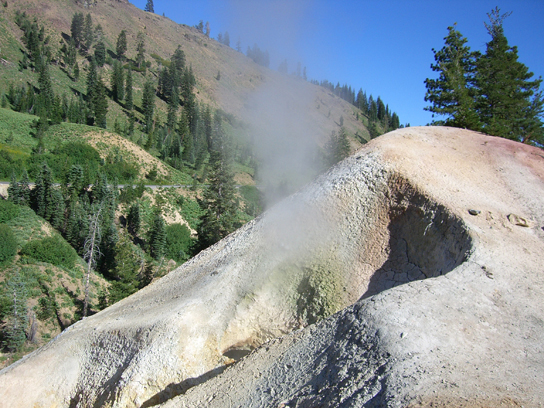


Figure 46.22図 46.22
At this sulfur vent in Lassen Volcanic National Park in northeastern California, the yellowish sulfur deposits are visible near the mouth of the vent.
カリフォルニア州北東部のラッセン火山国立公園にある硫黄の噴気孔。噴出口近くには、黄色がかった硫黄の堆積が見える。
Sulfur enters the ocean via runoff from land, from atmospheric fallout, and from underwater geothermal vents. Some ecosystems (Figure 46.9) rely on chemoautotrophs using sulfur as a biological energy source. This sulfur then supports marine ecosystems in the form of sulfates.
英語のヒント
硫黄は、陸からの流出、大気からの降下、海底の地熱噴出孔を介して海へ入る。一部の生態系(図46.9)は、硫黄を生物のエネルギー源として使う化学独立栄養生物に依存する。この硫黄は、硫酸塩の形で海洋生態系を支える。
Human activities have played a major role in altering the balance of the global sulfur cycle. The burning of large quantities of fossil fuels, especially from coal, releases larger amounts of sulfur dioxide and hydrogen sulfide gas into the atmosphere. Acid rain is caused by rainwater falling to the ground through mostly sulfur dioxide gas, turning it into weak sulfurous acid. Acid rain damages the natural environment by lowering the pH of lakes, which kills many of the resident fauna; it also affects the man-made environment through the chemical degradation of buildings. For example, many marble monuments, such as the Lincoln Memorial in Washington, DC, have suffered significant damage from acid rain over the years.
英語のヒント
人間活動は、地球規模の硫黄循環の均衡を変える大きな役割を果たしてきた。大量の化石燃料、とりわけ石炭を燃やすと、大量の二酸化硫黄と硫化水素が大気へ放出される。酸性雨は、雨水が主に二酸化硫黄を含む大気を通って地上へ降り、弱い亜硫酸になることで生じる。酸性雨は、湖のpHを下げてそこにすむ多くの動物を死なせ、自然環境を損なう。また、建物を化学的に劣化させ、人間の造った環境にも影響する。たとえばワシントンD.C.のリンカーン記念堂など、多くの大理石の記念建造物は、長年の酸性雨で大きな被害を受けてきた。
Section Summary節のまとめ
Mineral nutrients are cycled through ecosystems and their environment. Of particular importance are water, carbon, nitrogen, phosphorus, and sulfur. All of these cycles have major impacts on ecosystem structure and function. A variety of human activities, such as pollution, oil spills, and other events have damaged ecosystems, potentially causing global climate change. The health of Earth depends on understanding these cycles and how to protect the environment from irreversible damage.
無機栄養塩は、生態系とその環境を循環する。特に重要なのは、水、炭素、窒素、リン、硫黄である。これらの循環はすべて、生態系の構造と機能に大きく影響する。汚染、石油流出などのさまざまな人間活動や出来事は、生態系を損傷し、地球規模の気候変動をもたらす可能性がある。地球の健全さは、これらの循環と、環境を回復不可能な損傷から守る方法を理解できるかどうかにかかっている。
Visual Connection Questions図を使った問題
Exercises 26練習問題 26
Exercise 26問題 26
Figure 46.17 Which of the following statements about the nitrogen cycle is false?
図46.17 窒素循環について、次のうち誤っている記述はどれか。
- Ammonification converts organic nitrogenous matter from living organisms into ammonium (NH4+).アンモニア化は、生物由来の有機窒素化合物をアンモニウム(NH4+)へ変える。
- Denitrification by bacteria converts nitrates (NO3−) to nitrogen gas (N2).細菌の脱窒は、硝酸イオン(NO3−)を窒素気体(N2)へ変える。
- Nitrification by bacteria converts nitrates (NO3−) to nitrites (NO2−).細菌の硝化は、硝酸イオン(NO3−)を亜硝酸イオン(NO2−)へ変える。
- Nitrogen fixing bacteria convert nitrogen gas (N2) into organic compounds.窒素固定細菌は、窒素気体(N2)を有機化合物へ変える。
Solution解き方
Figure 46.17 C: Nitrification by bacteria converts nitrates (NO3−) to nitrites (NO2−).
図46.17 C:「細菌の硝化は、硝酸イオン(NO3−)を亜硝酸イオン(NO2−)へ変える。」
Review Questions確認問題
Exercises 27–34練習問題 27–34
Exercise 27問題 27
The movement of mineral nutrients through organisms and their environment is called a ________ cycle.
生物と環境を通る無機栄養塩の移動を、________循環という。
- biological生物的
- bioaccumulation生物蓄積
- biogeochemical生物地球化学的
- biochemical生化学的
Solution解き方
C
C
Exercise 28問題 28
Carbon is present in the atmosphere as ________.
炭素は大気中に________として存在する。
- carbon dioxide二酸化炭素
- carbonate ion炭酸イオン
- carbon dust炭素の粉塵
- carbon monoxide一酸化炭素
Solution解き方
A
A
Exercise 29問題 29
The majority of water found on Earth is:
地球上の水の大半はどれか。
- ice氷
- water vapor水蒸気
- fresh water淡水
- salt water塩水
Solution解き方
D
D
Exercise 30問題 30
The average time a molecule spends in its reservoir is known as ________.
分子が貯蔵庫にとどまる平均時間を________という。
- residence time滞留時間
- restriction time制限時間
- resilience time回復時間
- storage time貯蔵時間
Solution解き方
A
A
Exercise 31問題 31
The process whereby oxygen is depleted by the growth of microorganisms due to excess nutrients in aquatic systems is called ________.
水生系で、過剰な栄養分による微生物の増殖が酸素を減らす過程を________という。
- dead zoningデッドゾーン化
- eutrophication富栄養化
- retroficationレトロフィケーション
- depletion枯渇
Solution解き方
B
B
Exercise 32問題 32
The process whereby nitrogen is brought into organic molecules is called ________.
窒素が有機分子に取り込まれる過程を________という。
- nitrification硝化
- denitrification脱窒
- nitrogen fixation窒素固定
- nitrogen cycling窒素循環
Solution解き方
C
C
Exercise 33問題 33
Which of the following approaches would be the most effective way to reduce greenhouse carbon dioxide?
温室効果をもたらす二酸化炭素を減らすには、次のどの方法が最も効果的だろうか。
- Increase waste deposition into the deep ocean.深海への廃棄物投棄を増やす。
- Plant more environmentally-suitable plants.環境に適した植物をより多く植える。
- Increase use of fuel sources that do not produce carbon dioxide as a by-product.副産物として二酸化炭素を出さない燃料源の利用を増やす。
- Decrease livestock agriculture.畜産を減らす。
Solution解き方
B
B
Exercise 34問題 34
How would loss of fungi in a forest effect biogeochemical cycles in the area?
森林から菌類が失われると、その地域の生物地球化学的循環にどう影響するか。
- Nitrogen could no longer be fixed into organic molecules.窒素を有機分子に固定できなくなる。
- Phosphorus stores would be released for use by other organisms.貯蔵されたリンが放出され、ほかの生物が利用できるようになる。
- Sulfur release from eroding rocks would cease.侵食される岩石からの硫黄の放出が止まる。
- Carbon would accumulate in dead organic matter and waste.死んだ有機物や老廃物の中に炭素が蓄積する。
Solution解き方
D
D