第46章生態系
46.1 Ecology of Ecosystems46.1 生態系の生態学
Learning Objectives学習目標
By the end of this section, you will be able to do the following:
この節を学び終えると、次のことができるようになる。
- Describe the basic ecosystem types基本的な生態系の種類を説明する。
- Explain the methods that ecologists use to study ecosystem structure and dynamics生態系の構造と動態を研究するために、生態学者が用いる方法を説明する。
- Identify the different methods of ecosystem modeling生態系をモデル化するさまざまな方法を区別する。
- Differentiate between food chains and food webs and recognize the importance of each食物連鎖と食物網を区別し、それぞれの重要性を理解する。
Life in an ecosystem is often about competition for limited resources, a characteristic of the theory of natural selection. Competition in communities (all living things within specific habitats) is observed both within species and among different species. The resources for which organisms compete include organic material, sunlight, and mineral nutrients, which provide the energy for living processes and the matter to make up organisms’ physical structures. Other critical factors influencing community dynamics are the components of its physical and geographic environment: a habitat’s latitude, amount of rainfall, topography (elevation), and available species. These are all important environmental variables that determine which organisms can exist within a particular area.
英語のヒント
生態系における生活は、しばしば限られた資源をめぐる競争と関わっており、これは自然選択の理論に見られる特徴である。群集、すなわちある生息地にいるすべての生物の間では、同種内でも異なる種の間でも競争が見られる。生物が競い合う資源には有機物、日光、無機栄養塩があり、これらは生命活動のためのエネルギーと、生物の体の構造を作る物質を供給する。群集の動態に影響するほかの重要な要因は、物理的・地理的な環境の構成要素である。生息地の緯度、降水量、地形(標高)、そこに存在する種などが含まれる。いずれも、ある地域にどの生物が存在できるかを決める重要な環境変数である。
An ecosystem is a community of living organisms and their interactions with their abiotic (nonliving) environment. Ecosystems can be small, such as the tide pools found near the rocky shores of many oceans, or large, such as the Amazon Rainforest in Brazil (Figure 46.2).
英語のヒント
生態系は、生物の群集と、それらの生物と非生物的環境との相互作用からなる。生態系には、多くの海の岩場の海岸近くに見られる潮だまりのように小さいものも、ブラジルのアマゾン熱帯雨林のように大きいものもある(図46.2)。
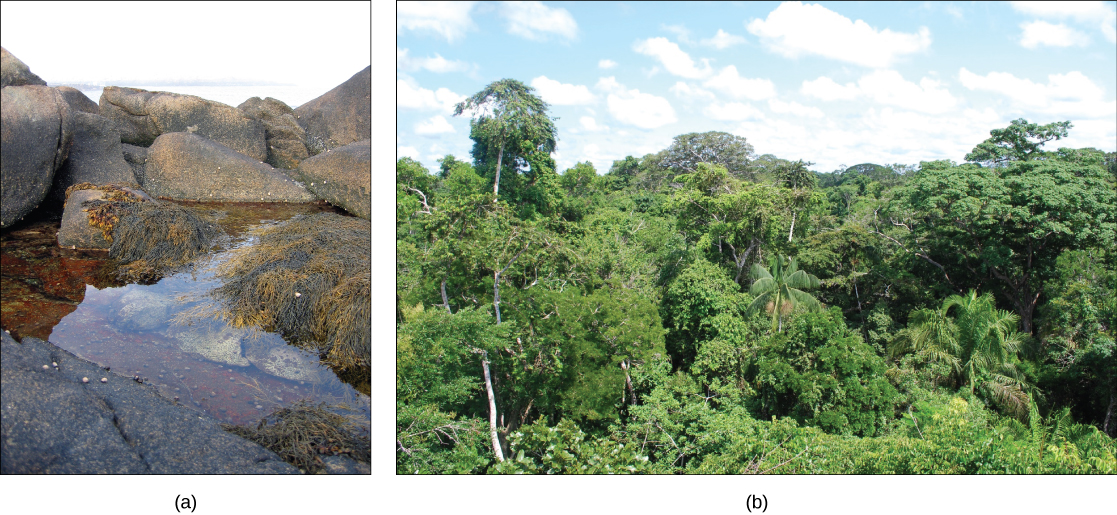
OpenStax, Rice University; Biology 2e. (credit a: modification of work by “takomabibelot”/Flickr; credit b: modification of work by Ivan Mlinaric) · CC BY 4.0 · Source出典

Figure 46.2図 46.2
A (a) tidal pool ecosystem in Matinicus Island in Maine is a small ecosystem, while the (b) Amazon Rainforest in Brazil is a large ecosystem. (credit a: modification of work by “takomabibelot”/Flickr; credit b: modification of work by Ivan Mlinaric)
(a)メーン州マティニカス島の潮だまりは小さな生態系であり、(b)ブラジルのアマゾン熱帯雨林は大きな生態系である。(a:「takomabibelot」/Flickrの作品を改変。b:Ivan Mlinaricの作品を改変)
There are three broad categories of ecosystems based on their general environment: freshwater, ocean water, and terrestrial. Within these broad categories are individual ecosystem types based on the organisms present and the type of environmental habitat.
英語のヒント
生態系は、全体的な環境に基づいて淡水、海水、陸上という3つの大きな区分に分けられる。それぞれの大区分の中に、存在する生物や生息環境の種類に基づく個々の生態系の型がある。
Ocean ecosystems are the most common, comprising over 70 percent of the Earth's surface and consisting of three basic types: shallow ocean, deep ocean water, and deep ocean surfaces (the low depth areas of the deep oceans). The shallow ocean ecosystems include extremely biodiverse coral reef ecosystems, and the deep ocean surface is known for its large numbers of plankton and krill (small crustaceans) that support it. These two environments are especially important to aerobic respirators worldwide as the phytoplankton perform 40 percent of all photosynthesis on Earth. Although not as diverse as the other two, deep ocean ecosystems contain a wide variety of marine organisms. Such ecosystems exist even at the bottom of the ocean where light is unable to penetrate through the water.
英語のヒント
海洋生態系は最も広く見られ、地球表面の70%以上を占める。基本的には、浅い海、深海の水域、深い海の表層(深い海のうち水深の浅い部分)の3種類からなる。浅海の生態系には、生物多様性が極めて高いサンゴ礁生態系が含まれる。深い海の表層は、生態系を支える多数のプランクトンやオキアミ(小型の甲殻類)で知られている。これら2つの環境では植物プランクトンが地球上の光合成全体の40%を行うため、世界中の好気呼吸を行う生物にとって特に重要である。深海生態系はほかの2つほど多様ではないが、幅広い海洋生物を含む。光が水中を透過して届くことのできない海底にも、このような生態系が存在する。
Freshwater ecosystems are the rarest, occurring on only 1.8 percent of the Earth's surface. Lakes, rivers, streams, and springs comprise these systems. They are quite diverse, and they support a variety of fish, amphibians, reptiles, insects, phytoplankton, fungi, and bacteria.
英語のヒント
淡水生態系は最も少なく、地球表面のわずか1.8%にしか存在しない。湖、河川、小川、湧水がこれに当たる。淡水生態系は非常に多様で、さまざまな魚類、両生類、爬虫類、昆虫、植物プランクトン、菌類、細菌を支えている。
Terrestrial ecosystems, also known for their diversity, are grouped into large categories called biomes, such as tropical rain forests, savannas, deserts, coniferous forests, deciduous forests, and tundra. Grouping these ecosystems into just a few biome categories obscures the great diversity of the individual ecosystems within them. For example, there is great variation in desert vegetation: the saguaro cacti and other plant life in the Sonoran Desert, in the United States, are relatively abundant compared to the desolate rocky desert of Boa Vista, an island off the coast of Western Africa (Figure 46.3).
英語のヒント
多様性で知られる陸上生態系は、熱帯雨林、サバンナ、砂漠、針葉樹林、落葉樹林、ツンドラなど、生物群系と呼ばれる大きな区分にまとめられる。しかし、これらの生態系をわずかな生物群系の区分にまとめると、その中にある個々の生態系の大きな多様性が見えにくくなる。たとえば砂漠の植生には大きな違いがある。米国のソノラ砂漠では、サワロサボテンをはじめとする植物が、西アフリカ沖の島ボア・ヴィスタの荒涼とした岩石砂漠に比べて比較的豊富である(図46.3)。
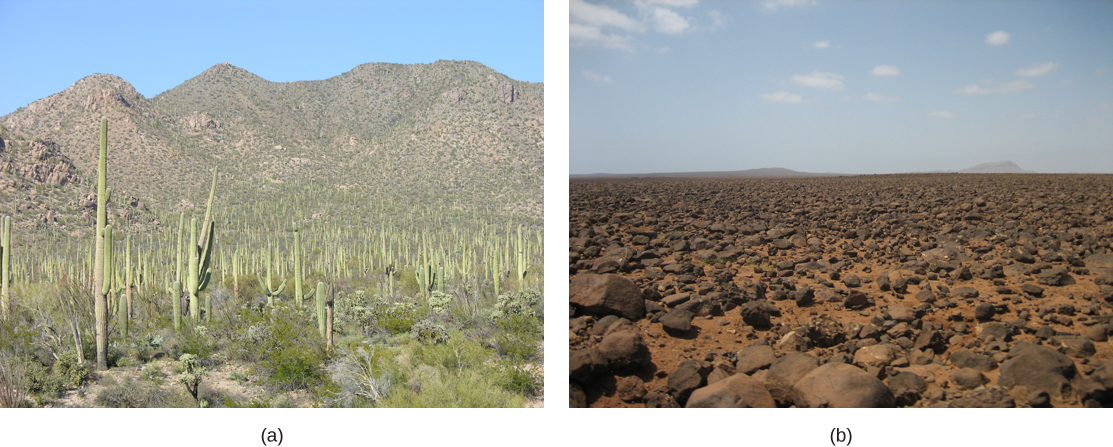
OpenStax, Rice University; Biology 2e. (credit a: modification of work by Jay Galvin; credit b: modification of work by Ingo Wölbern) · CC BY 4.0 · Source出典

Figure 46.3図 46.3
Desert ecosystems, like all ecosystems, can vary greatly. The desert in (a) Saguaro National Park, Arizona, has abundant plant life, while the rocky desert of (b) Boa Vista island, Cape Verde, Africa, is devoid of plant life. (credit a: modification of work by Jay Galvin; credit b: modification of work by Ingo Wölbern)
砂漠生態系も、ほかのすべての生態系と同様に、大きく異なることがある。(a)アリゾナ州のサワロ国立公園の砂漠には豊富な植物があるが、(b)アフリカのカーボベルデ、ボア・ヴィスタ島の岩石砂漠には植物がない。(a:Jay Galvinの作品を改変。b:Ingo Wölbernの作品を改変)
Ecosystems are complex with many interacting parts. They are routinely exposed to various disturbances, or changes in the environment that effect their compositions: yearly variations in rainfall and temperature and the slower processes of plant growth, which may take several years. Many of these disturbances result from natural processes. For example, when lightning causes a forest fire and destroys part of a forest ecosystem, the ground is eventually populated by grasses, then by bushes and shrubs, and later by mature trees, restoring the forest to its former state. The impact of environmental disturbances caused by human activities is as important as the changes wrought by natural processes. Human agricultural practices, air pollution, acid rain, global deforestation, overfishing, eutrophication, oil spills, and waste dumping on land and into the ocean are all issues of concern to conservationists.
英語のヒント
生態系は、互いに作用する多くの部分をもつ複雑な仕組みである。生態系は日常的にさまざまな攪乱、つまりその構成に影響する環境の変化にさらされる。これには降水量や気温の年ごとの変動や、数年かかることもある植物の成長という、より緩やかな過程が含まれる。これらの攪乱の多くは自然の過程から生じる。たとえば落雷が山火事を引き起こして森林生態系の一部を破壊すると、やがて地面には草が生え、その後は低木、さらに成熟した樹木が生育し、森林は以前の状態に戻る。人間の活動が引き起こす環境攪乱の影響も、自然の過程がもたらす変化と同じくらい重要である。農業の方法、大気汚染、酸性雨、世界的な森林減少、乱獲、富栄養化、石油流出、陸上や海洋への廃棄物投棄は、いずれも自然保護に関わる人々が懸念する問題である。
Equilibrium is the steady state of an ecosystem where all organisms are in balance with their environment and with each other. In ecology, two parameters are used to measure changes in ecosystems: resistance and resilience. Resistance is the ability of an ecosystem to remain at equilibrium in spite of disturbances. Resilience is the speed at which an ecosystem recovers equilibrium after being disturbed. Ecosystem resistance and resilience are especially important when considering human impact. The nature of an ecosystem may change to such a degree that it can lose its resilience entirely. This process can lead to the complete destruction or irreversible altering of the ecosystem.
英語のヒント
平衡とは、すべての生物が環境と、また互いとの間で釣り合っている生態系の定常状態である。生態学では、生態系の変化を測るために抵抗性と回復力という2つの指標を用いる。抵抗性とは、攪乱があっても生態系が平衡を保つ能力である。回復力とは、攪乱を受けた後に生態系が平衡を取り戻す速さである。生態系の抵抗性と回復力は、人間の影響を考えるときに特に重要である。生態系の性質が大きく変わり、回復力を完全に失うこともある。この過程は、生態系の完全な破壊や、元に戻せない変化につながりうる。