第46章生態系
Food Chains and Food Webs食物連鎖と食物網
The term “food chain” is sometimes used metaphorically to describe human social situations. Individuals who are considered successful are seen as being at the top of the food chain, consuming all others for their benefit, whereas the less successful are seen as being at the bottom.
英語のヒント
「食物連鎖」という言葉は、人間社会の状況を表す比喩として使われることがある。成功したと見なされる人は、自分の利益のために他者をすべて食い物にする、食物連鎖の頂点にいる人とされる。その一方で、成功していない人は底辺にいるとされる。
The scientific understanding of a food chain is more precise than in its everyday usage. In ecology, a food chain is a linear sequence of organisms through which nutrients and energy pass: primary producers, primary consumers, and higher-level consumers are used to describe ecosystem structure and dynamics. There is a single path through the chain. Each organism in a food chain occupies what is called a trophic level. Depending on their role as producers or consumers, species or groups of species can be assigned to various trophic levels.
英語のヒント
食物連鎖の科学的な意味は、日常的な用法より厳密である。生態学では、食物連鎖は栄養分とエネルギーが通過する、生物の直線的な連なりを指す。一次生産者、一次消費者、より高次の消費者を用いて、生態系の構造と動態を表す。連鎖を通る経路は1本である。食物連鎖の各生物は、栄養段階と呼ばれる位置を占める。生産者や消費者としての役割に応じて、種や種の集まりをさまざまな栄養段階に割り当てることができる。
In many ecosystems, the bottom of the food chain consists of photosynthetic organisms (plants and/or phytoplankton), which are called primary producers. The organisms that consume the primary producers are herbivores: the primary consumers. Secondary consumers are usually carnivores that eat the primary consumers. Tertiary consumers are carnivores that eat other carnivores. Higher-level consumers feed on the next lower trophic levels, and so on, up to the organisms at the top of the food chain: the apex consumers. In the Lake Ontario food chain shown in Figure 46.4, the Chinook salmon is the apex consumer at the top of this food chain.
英語のヒント
多くの生態系では、食物連鎖の最下部は、一次生産者と呼ばれる光合成生物(植物や植物プランクトン)からなる。一次生産者を食べる生物は草食動物で、一次消費者に当たる。二次消費者は通常、一次消費者を食べる肉食動物である。三次消費者は、ほかの肉食動物を食べる肉食動物である。より高次の消費者は、その1つ下の栄養段階の生物を食べる。この関係が続き、食物連鎖の頂点にいる頂点消費者に至る。図46.4に示すオンタリオ湖の食物連鎖では、マスノスケが頂点消費者である。
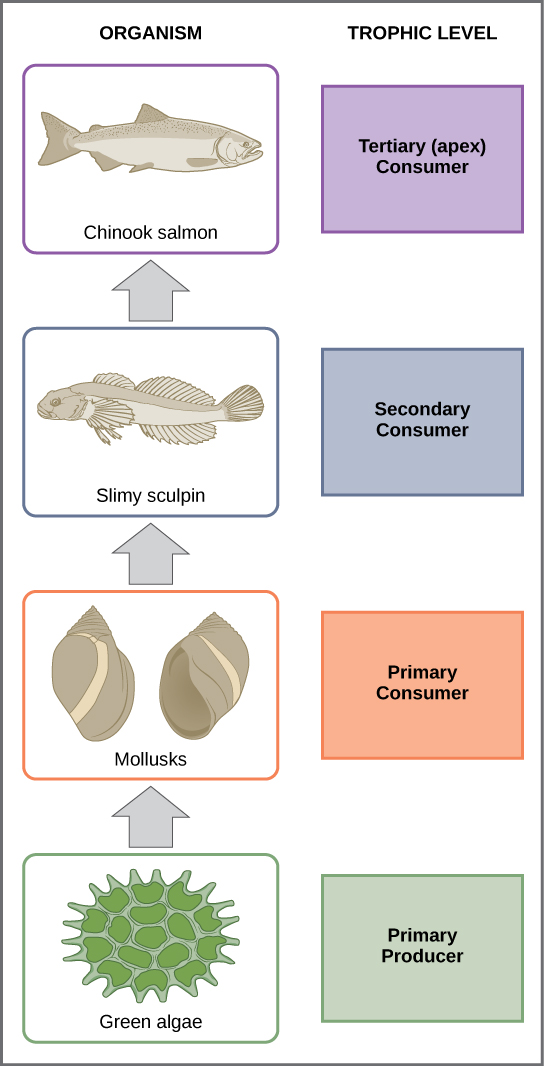
Figure 46.4図 46.4
These are the trophic levels of a food chain in Lake Ontario at the United States-Canada border. Energy and nutrients flow from photosynthetic green algae at the bottom to the top of the food chain: the Chinook salmon.
米国とカナダの国境にあるオンタリオ湖の食物連鎖の栄養段階。エネルギーと栄養分は、最下部の光合成を行う緑藻から、食物連鎖の頂点にいるマスノスケへ流れる。
One major factor that limits the length of food chains is energy. Energy is lost as heat between each trophic level due to the second law of thermodynamics. Thus, after a limited number of trophic energy transfers, the amount of energy remaining in the food chain may not be great enough to support viable populations at yet a higher trophic level.
英語のヒント
食物連鎖の長さを制限する主な要因の1つはエネルギーである。熱力学の第二法則により、各栄養段階の間でエネルギーが熱として失われる。そのため、栄養段階間でエネルギーがある程度の回数移動すると、食物連鎖に残るエネルギー量は、さらに高い栄養段階で存続可能な個体群を支えるには不足することがある。
The loss of energy between trophic levels is illustrated by the pioneering studies of Howard T. Odum in the Silver Springs, Florida, ecosystem in the 1940s (Figure 46.5). The primary producers generated 20,819 kcal/m2/yr (kilocalories per square meter per year), the primary consumers generated 3368 kcal/m2/yr, the secondary consumers generated 383 kcal/m2/yr, and the tertiary consumers only generated 21 kcal/m2/yr. Thus, there is little energy remaining for another level of consumers in this ecosystem.
英語のヒント
栄養段階間でのエネルギーの損失は、ハワード・T・オダムが1940年代にフロリダ州シルバースプリングスの生態系で行った先駆的研究に示されている(図46.5)。一次生産者は20,819 kcal/m2/年(1平方メートルあたり年間キロカロリー)、一次消費者は3,368 kcal/m2/年、二次消費者は383 kcal/m2/年、三次消費者はわずか21 kcal/m2/年のエネルギーを生み出した。したがって、この生態系には、さらにもう1段階の消費者に使えるエネルギーがほとんど残っていない。
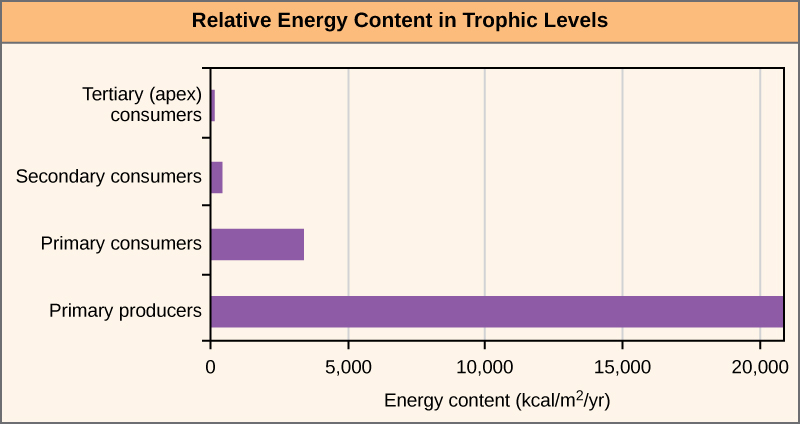
Figure 46.5図 46.5
The relative energy in trophic levels in a Silver Springs, Florida, ecosystem is shown. Each trophic level has less energy available and supports fewer organisms at the next level.
フロリダ州シルバースプリングスの生態系における各栄養段階の相対的なエネルギー量。栄養段階が上がるごとに利用可能なエネルギーが減り、次の段階で支えられる生物の数も少なくなる。
There is one problem when using food chains to accurately describe most ecosystems. Even when all organisms are grouped into appropriate trophic levels, some of these organisms can feed on species from more than one trophic level; likewise, some of these organisms can be eaten by species from multiple trophic levels. In other words, the linear model of ecosystems, the food chain, is not completely descriptive of ecosystem structure. A holistic model—which accounts for all the interactions between different species and their complex interconnected relationships with each other and with the environment—is a more accurate and descriptive model for ecosystems. A food web is a graphic representation of a holistic, nonlinear web of primary producers, primary consumers, and higher-level consumers used to describe ecosystem structure and dynamics (Figure 46.6).
英語のヒント
食物連鎖を使って大半の生態系を正確に表そうとすると、1つの問題が生じる。すべての生物を適切な栄養段階に分類しても、複数の栄養段階に属する種を食べる生物がいる。同様に、複数の栄養段階に属する種に食べられる生物もいる。つまり、生態系を直線的に表す食物連鎖モデルでは、生態系の構造を完全には記述できない。異なる種同士のすべての相互作用と、互いの間や環境との間の複雑なつながりを考慮する全体的なモデルの方が、生態系をより正確に、詳しく表せる。食物網は、一次生産者、一次消費者、より高次の消費者が作る、全体を捉えた非直線的な網を図に表したもので、生態系の構造と動態の説明に使われる(図46.6)。
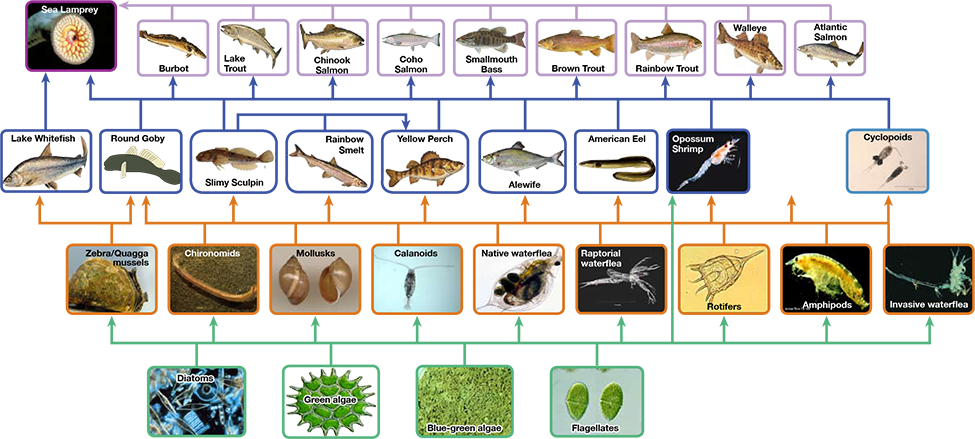


Figure 46.6図 46.6
This food web shows the interactions between organisms across trophic levels in the Lake Ontario ecosystem. Primary producers are outlined in green, primary consumers in orange, secondary consumers in blue, and tertiary (apex) consumers in purple. Arrows point from an organism that is consumed to the organism that consumes it. Notice how some lines point to more than one trophic level. For example, the opossum shrimp eats both primary producers and primary consumers. (credit: NOAA, GLERL)
この食物網は、オンタリオ湖の生態系で栄養段階をまたぐ生物間の相互作用を示す。一次生産者は緑、一次消費者はオレンジ、二次消費者は青、三次(頂点)消費者は紫で囲まれている。矢印は食べられる生物から食べる生物へ向く。複数の栄養段階へ向かう線があることに注目しよう。たとえばアミ類は一次生産者と一次消費者の両方を食べる。(出典:NOAA、GLERL)
A comparison of the two types of structural ecosystem models shows strength in both. Food chains are more flexible for analytical modeling, are easier to follow, and are easier to experiment with, whereas food web models more accurately represent ecosystem structure and dynamics, and data can be directly used as input for simulation modeling.
英語のヒント
生態系の構造を表すこの2種類のモデルを比較すると、どちらにも長所がある。食物連鎖は分析モデルを作る際の柔軟性が高く、たどりやすく、実験もしやすい。一方、食物網モデルは生態系の構造と動態をより正確に表し、そのデータをシミュレーションモデルへの入力として直接使える。
Two general types of food webs are often shown interacting within a single ecosystem. A grazing food web (such as the Lake Ontario food web in Figure 46.6) has plants or other photosynthetic organisms at its base, followed by herbivores and various carnivores. A detrital food web consists of a base of organisms that feed on decaying organic matter (dead organisms), called decomposers or detritivores. These organisms are usually bacteria or fungi that recycle organic material back into the biotic part of the ecosystem as they themselves are consumed by other organisms. As all ecosystems require a method to recycle material from dead organisms, most grazing food webs have an associated detrital food web. For example, in a meadow ecosystem, plants may support a grazing food web of different organisms, primary and other levels of consumers, while at the same time supporting a detrital food web of bacteria, fungi, and detrivorous invertebrates feeding off dead plants and animals.
英語のヒント
1つの生態系の中で、2種類の基本的な食物網が相互作用することがよくある。生食食物網(図46.6のオンタリオ湖の食物網など)は、植物やほかの光合成生物を基盤とし、その上に草食動物やさまざまな肉食動物が続く。腐食食物網では、分解者または腐食者と呼ばれる、分解中の有機物(死んだ生物)を食べる生物が基盤となる。これらの生物は通常、細菌や菌類で、自らもほかの生物に食べられることによって、有機物を生態系の生物的な部分へ戻す。すべての生態系は死んだ生物の物質を再利用する仕組みを必要とするため、大半の生食食物網には腐食食物網が結びついている。たとえば草地の生態系では、植物は一次消費者やほかの栄養段階のさまざまな生物からなる生食食物網を支える。同時に、死んだ動植物を食べる細菌、菌類、腐食性無脊椎動物からなる腐食食物網も支えている。