第40章循環器系
Blood Pressure血圧
The pressure of the blood flow in the body is produced by the hydrostatic pressure of the fluid (blood) against the walls of the blood vessels. Fluid will move from areas of high to low hydrostatic pressures. In the arteries, the hydrostatic pressure near the heart is very high and blood flows to the arterioles where the rate of flow is slowed by the narrow openings of the arterioles. During systole, when new blood is entering the arteries, the artery walls stretch to accommodate the increase of pressure of the extra blood; during diastole, the walls return to normal because of their elastic properties. The blood pressure of the systole phase and the diastole phase, graphed in Figure 40.19, gives the two pressure readings for blood pressure. For example, 120/80 indicates a reading of 120 mm Hg during the systole and 80 mm Hg during diastole. Throughout the cardiac cycle, the blood continues to empty into the arterioles at a relatively even rate. This resistance to blood flow is called peripheral resistance.
英語のヒント
体内を流れる血液の圧力は、液体である血液が血管壁に及ぼす静水圧によって生じる。液体は、静水圧の高い領域から低い領域へ移動する。動脈では、心臓の近くの静水圧が非常に高く、血液は細動脈へ流れる。細動脈の狭い入口によって、流れは遅くなる。収縮期には、新しい血液が動脈へ入るため、動脈壁が伸び、追加された血液による圧力上昇に対応する。拡張期には、弾性によって動脈壁が元に戻る。図40.19の収縮期と拡張期の血圧が、血圧測定で示される2つの値である。たとえば120/80は、収縮期が120mmHg、拡張期が80mmHgであることを表す。心周期を通じて、血液は比較的一定の速度で細動脈へ流れ続ける。この血流への抵抗を末梢抵抗という。
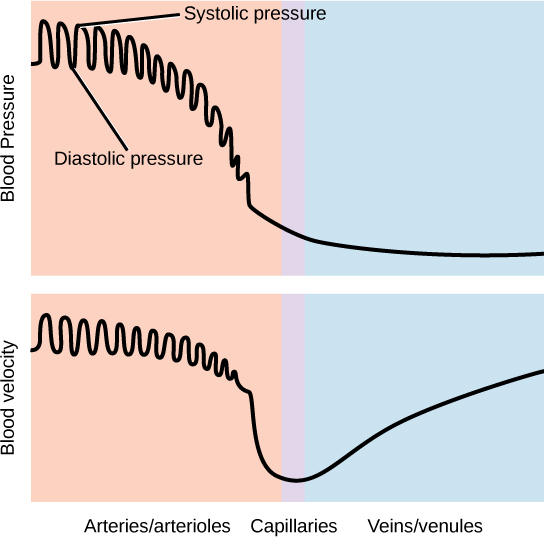

Figure 40.19図 40.19
Blood pressure is related to the blood velocity in the arteries and arterioles. In the capillaries and veins, the blood pressure continues to decrease but velocity increases.
動脈と細動脈では、血圧は血流速度と関係する。毛細血管と静脈では、血圧は下がり続ける一方、流速は増加する。
Blood Pressure Regulation血圧の調節
Cardiac output is the volume of blood pumped by the heart in one minute. It is calculated by multiplying the number of heart contractions that occur per minute (heart rate) times the stroke volume (the volume of blood pumped into the aorta per contraction of the left ventricle). Therefore, cardiac output can be increased by increasing heart rate, as when exercising. However, cardiac output can also be increased by increasing stroke volume, such as if the heart contracts with greater strength. Stroke volume can also be increased by speeding blood circulation through the body so that more blood enters the heart between contractions. During heavy exertion, the blood vessels relax and increase in diameter, offsetting the increased heart rate and ensuring adequate oxygenated blood gets to the muscles. Stress triggers a decrease in the diameter of the blood vessels, consequently increasing blood pressure. These changes can also be caused by nerve signals or hormones, and even standing up or lying down can have a great effect on blood pressure.
英語のヒント
心拍出量は、心臓が1分間に送り出す血液の体積である。1分間の心臓の収縮回数である心拍数に、左心室の1回の収縮で大動脈へ送られる血液量である一回拍出量を掛けて求める。したがって、運動時のように心拍数を増やすと、心拍出量を増やせる。また、心臓がより強く収縮するなどして一回拍出量を増やしても、心拍出量は増える。体内の血液循環を速め、収縮と収縮の間に心臓へ入る血液を増やすことでも、一回拍出量を増やせる。激しい運動中は血管が弛緩して太くなり、心拍数の増加を相殺するとともに、酸素の多い血液が筋へ十分に届くようにする。ストレスは血管の直径を小さくし、その結果、血圧を上げる。これらの変化は、神経信号やホルモンによっても起こる。立ち上がったり横になったりするだけでも、血圧に大きな影響がありうる。
Section Summaryこの節のまとめ
Blood primarily moves through the body by the rhythmic movement of smooth muscle in the vessel wall and by the action of the skeletal muscle as the body moves. Blood is prevented from flowing backward in the veins by one-way valves. Blood flow through the capillary beds is controlled by precapillary sphincters to increase and decrease flow depending on the body’s needs and is directed by nerve and hormone signals. Lymph vessels take fluid that has leaked out of the blood to the lymph nodes where it is cleaned before returning to the heart. During systole, blood enters the arteries, and the artery walls stretch to accommodate the extra blood. During diastole, the artery walls return to normal. The blood pressure of the systole phase and the diastole phase gives the two pressure readings for blood pressure.
血液は、主に血管壁の平滑筋の規則的な動きと、体の動きに伴う骨格筋の作用によって体内を移動する。静脈内では、一方向に開く弁が逆流を防ぐ。毛細血管床の血流は、神経やホルモンの信号に従い、体の必要に応じて前毛細血管括約筋が増減を調節する。リンパ管は、血液から漏れ出した液体をリンパ節へ運ぶ。液体はそこで浄化され、心臓へ戻る。収縮期には血液が動脈へ入り、動脈壁は増えた血液を受け入れるために伸びる。拡張期には元へ戻る。収縮期と拡張期の圧力が、血圧の2つの測定値となる。
Visual Connection Questions図を使った問題
Exercises 21練習問題 21
Exercise 21問題 21
Figure 40.17 Varicose veins are veins that become enlarged because the valves no longer close properly, allowing blood to flow backward. Varicose veins are often most prominent on the legs. Why do you think this is the case?
図40.17 静脈瘤は、弁が正常に閉じなくなり、血液が逆流するために拡張した静脈である。静脈瘤は脚で特に目立つことが多い。なぜだと考えられるだろうか。
Solution解き方
Figure 40.17 Blood in the legs is farthest away from the heart and has to flow up to reach it.
図40.17 脚の血液は心臓から最も遠く、心臓に達するには上向きに流れなければならない。
Review Questions確認問題
Exercises 22練習問題 22
Exercise 22問題 22
High blood pressure would be a result of ________.
高血圧は、____によって生じると考えられる。
- a high cardiac output and high peripheral resistance大きい心拍出量と大きい末梢抵抗
- a high cardiac output and low peripheral resistance大きい心拍出量と小さい末梢抵抗
- a low cardiac output and high peripheral resistance小さい心拍出量と大きい末梢抵抗
- a low cardiac output and low peripheral resistance小さい心拍出量と小さい末梢抵抗
Solution解き方
A
A
Critical Thinking Questions考察問題
Exercises 23練習問題 23
Exercise 23問題 23
How does blood pressure change during heavy exercise?
激しい運動中、血圧はどのように変わるか。
Solution解き方
The heart rate increases, which increases the hydrostatic pressure against the artery walls. At the same time, the arterioles dilate in response to the increased exercise, which reduces peripheral resistance.
心拍数が増え、動脈壁にかかる静水圧が高くなる。同時に、運動量の増加に応じて細動脈が拡張し、末梢抵抗が小さくなる。
blood pressure (BP)
血圧(BP)
pressure of blood in the arteries that helps to push blood through the body
動脈内の血液の圧力で、血液を体内へ押し流すのを助ける。
cardiac output
心拍出量
the volume of blood pumped by the heart in one minute as a product of heart rate multiplied by stroke volume
心臓が1分間に送り出す血液量。心拍数と一回拍出量の積で求める。
lymph node
リンパ節
specialized organ that contains a large number of macrophages that clean the lymph before the fluid is returned to the heart
液体が心臓へ戻る前にリンパを浄化する、多数のマクロファージを含む特殊な器官。
peripheral resistance
末梢抵抗
resistance of the artery and blood vessel walls to the pressure placed on them by the force of the heart pumping
心臓のポンプ作用が生む圧力に対する、動脈や血管壁の抵抗。
precapillary sphincter
前毛細血管括約筋
small muscle that controls blood circulation in the capillary beds
毛細血管床の血液循環を制御する小さな筋。
stroke volume
一回拍出量
the volume of blood pumped into the aorta per contraction of the left ventricle
左心室の1回の収縮で大動脈へ送られる血液量。