第40章循環器系
40.1 Overview of the Circulatory System40.1 循環器系の概要
Learning Objectives学習目標
By the end of this section, you will be able to do the following:
この節を終えると、次のことができるようになる。
- Describe an open and closed circulatory system開放血管系と閉鎖血管系を説明する。
- Describe interstitial fluid and hemolymph間質液と血リンパを説明する。
- Compare and contrast the organization and evolution of the vertebrate circulatory system脊椎動物の循環器系の構成と進化について、共通点と相違点を比較する。
In all animals, except a few simple types, the circulatory system is used to transport nutrients and gases through the body. Simple diffusion allows some water, nutrient, waste, and gas exchange into primitive animals that are only a few cell layers thick; however, bulk flow is the only method by which the entire body of larger more complex organisms is accessed.
英語のヒント
少数の単純な種類を除くすべての動物では、体内で栄養素や気体を運ぶために循環器系が使われる。体の厚さが細胞数層分しかない原始的な動物では、単純な拡散によって水、栄養素、老廃物、気体のある程度の交換が可能である。しかし、より大きく複雑な生物の全身に物質を届けるには、液体がまとまって流れるバルクフローが必要となる。
Circulatory System Architecture循環器系の構造
The circulatory system is effectively a network of cylindrical vessels: the arteries, veins, and capillaries that emanate from a pump, the heart. In all vertebrate organisms, as well as some invertebrates, this is a closed-loop system, in which the blood is not free in a cavity. In a closed circulatory system, blood is contained inside blood vessels and circulates unidirectionally from the heart around the systemic circulatory route, then returns to the heart again, as illustrated in Figure 40.2a. As opposed to a closed system, arthropods—including insects, crustaceans, and most mollusks—have an open circulatory system, as illustrated in Figure 40.2b. In an open circulatory system, the blood is not enclosed in the blood vessels but is pumped into a cavity called a hemocoel and is called hemolymph because the blood mixes with the interstitial fluid. As the heart beats and the animal moves, the hemolymph circulates around the organs within the body cavity and then reenters the hearts through openings called ostia. This movement allows for gas and nutrient exchange. An open circulatory system does not use as much energy as a closed system to operate or to maintain; however, there is a trade-off with the amount of blood that can be moved to metabolically active organs and tissues that require high levels of oxygen. In fact, one reason that insects with wing spans of up to two feet wide (70 cm) are not around today is probably because they were outcompeted by the arrival of birds 150 million years ago. Birds, having a closed circulatory system, are thought to have moved more agilely, allowing them to get food faster and possibly to prey on the insects.
英語のヒント
循環器系は、実質的には円筒形の管のネットワークである。すなわち、ポンプである心臓から広がる動脈、静脈、毛細血管である。すべての脊椎動物と一部の無脊椎動物では、血液が体の空洞へ自由に流れ出さない、閉じた回路になっている。閉鎖血管系では、血液は血管の中にあり、図40.2aのように、心臓から体循環の経路を一方向に流れて、再び心臓へ戻る。これに対し、昆虫、甲殻類、大半の軟体動物を含む節足動物は、図40.2bに示す開放血管系をもつ。開放血管系では、血液は血管内に閉じ込められず、血体腔という空間へ送り出される。血液が間質液と混ざるため、この液体を血リンパという。心臓の拍動や動物の動きによって、血リンパは体腔内の器官の周囲を循環し、心門と呼ばれる開口部から心臓へ戻る。この動きによって、気体と栄養素が交換される。開放血管系は、閉鎖血管系ほど作動や維持にエネルギーを使わない。しかし、高い酸素濃度を必要とする代謝の活発な器官や組織へ運べる血液量との間に、トレードオフがある。実際、翼を広げると2フィート(70cm)にもなる昆虫が現在はいない理由の1つは、おそらく1億5000万年前に鳥類が現れ、競争に敗れたためである。閉鎖血管系をもつ鳥類は、より機敏に動き、素早く食物を得られ、ときには昆虫を捕食することもできたと考えられる。
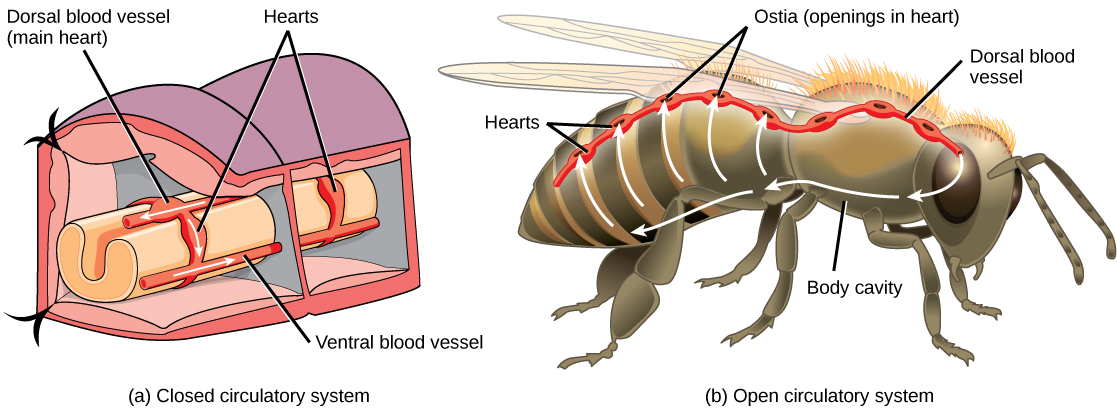
Figure 40.2図 40.2
In (a) closed circulatory systems, the heart pumps blood through vessels that are separate from the interstitial fluid of the body. Most vertebrates and some invertebrates, like this annelid earthworm, have a closed circulatory system. In (b) open circulatory systems, a fluid called hemolymph is pumped through a blood vessel that empties into the body cavity. Hemolymph returns to the blood vessel through openings called ostia. Arthropods like this bee and most mollusks have open circulatory systems.
(a)閉鎖血管系では、心臓が血管を通して血液を送り、血液は体の間質液と分けられている。大半の脊椎動物と、この環形動物のミミズのような一部の無脊椎動物は、閉鎖血管系をもつ。(b)開放血管系では、血リンパという液体が血管を通って送り出され、体腔へ流れ込む。血リンパは、心門と呼ばれる開口から血管へ戻る。このハチのような節足動物や、大半の軟体動物は開放血管系をもつ。
Circulatory System Variation in Animals動物の循環器系の多様性
The circulatory system varies from simple systems in invertebrates to more complex systems in vertebrates. The simplest animals, such as the sponges (Porifera) and rotifers (Rotifera), do not need a circulatory system because diffusion allows adequate exchange of water, nutrients, and waste, as well as dissolved gases, as shown in Figure 40.3a. Organisms that are more complex but still only have two layers of cells in their body plan, such as jellies (Cnidaria) and comb jellies (Ctenophora) also use diffusion through their epidermis and internally through the gastrovascular compartment. Both their internal and external tissues are bathed in an aqueous environment and exchange fluids by diffusion on both sides, as illustrated in Figure 40.3b. Exchange of fluids is assisted by the pulsing of the jellyfish body.
英語のヒント
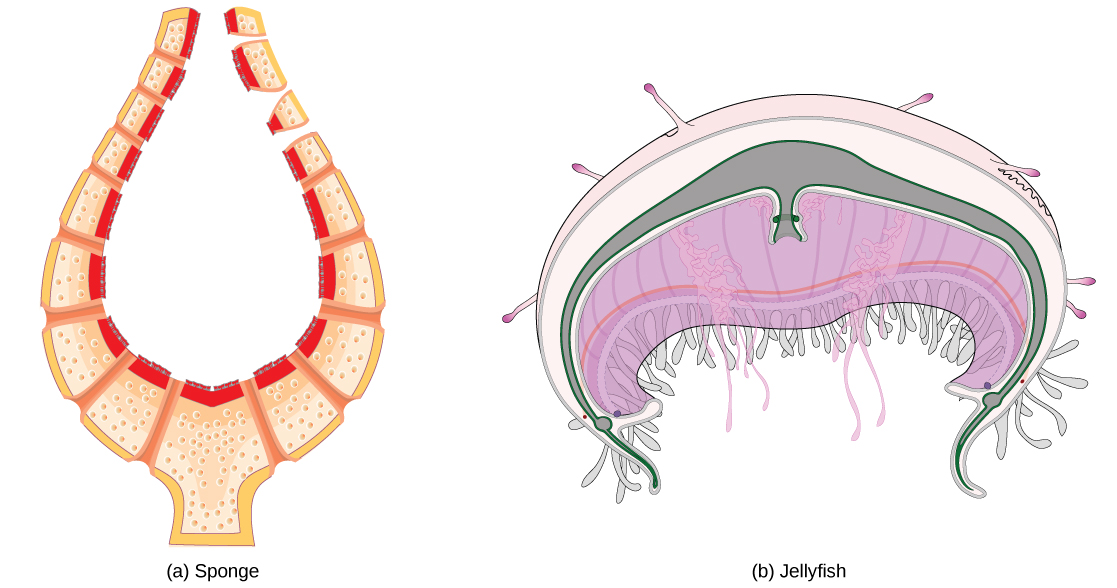
Figure 40.3図 40.3
Simple animals consisting of a single cell layer such as the (a) sponge or only a few cell layers such as the (b) jellyfish do not have a circulatory system. Instead, gases, nutrients, and wastes are exchanged by diffusion.
(a)カイメンのように細胞1層、または(b)クラゲのように細胞数層からなる単純な動物には、循環器系がない。代わりに、気体、栄養素、老廃物は拡散によって交換される。
For more complex organisms, diffusion is not efficient for cycling gases, nutrients, and waste effectively through the body; therefore, more complex circulatory systems evolved. Most arthropods and many mollusks have open circulatory systems. In an open system, an elongated beating heart pushes the hemolymph through the body and muscle contractions help to move fluids. The larger more complex crustaceans, including lobsters, have developed arterial-like vessels to push blood through their bodies, and the most active mollusks, such as squids, have evolved a closed circulatory system and are able to move rapidly to catch prey. Closed circulatory systems are a characteristic of vertebrates; however, there are significant differences in the structure of the heart and the circulation of blood between the different vertebrate groups due to adaptation during evolution and associated differences in anatomy. Figure 40.4 illustrates the basic circulatory systems of some vertebrates: fish, amphibians, reptiles, and mammals.
英語のヒント
より複雑な生物では、拡散だけで気体、栄養素、老廃物を全身に効率よく循環させることはできない。そのため、より複雑な循環器系が進化した。大半の節足動物と多くの軟体動物は、開放血管系をもつ。細長い心臓の拍動が血リンパを体内へ押し送り、筋の収縮が液体の移動を助ける。ロブスターなどの大型で複雑な甲殻類は、動脈のような血管を発達させ、血液を体内へ押し送る。イカなど、最も活動的な軟体動物は閉鎖血管系を進化させ、獲物を捕らえるために素早く動ける。閉鎖血管系は脊椎動物の特徴である。しかし、進化の過程での適応と、それに伴う解剖学的な違いによって、心臓の構造や血液循環は脊椎動物の群ごとに大きく異なる。図40.4は、魚類、両生類、爬虫類、哺乳類の基本的な循環器系を示す。
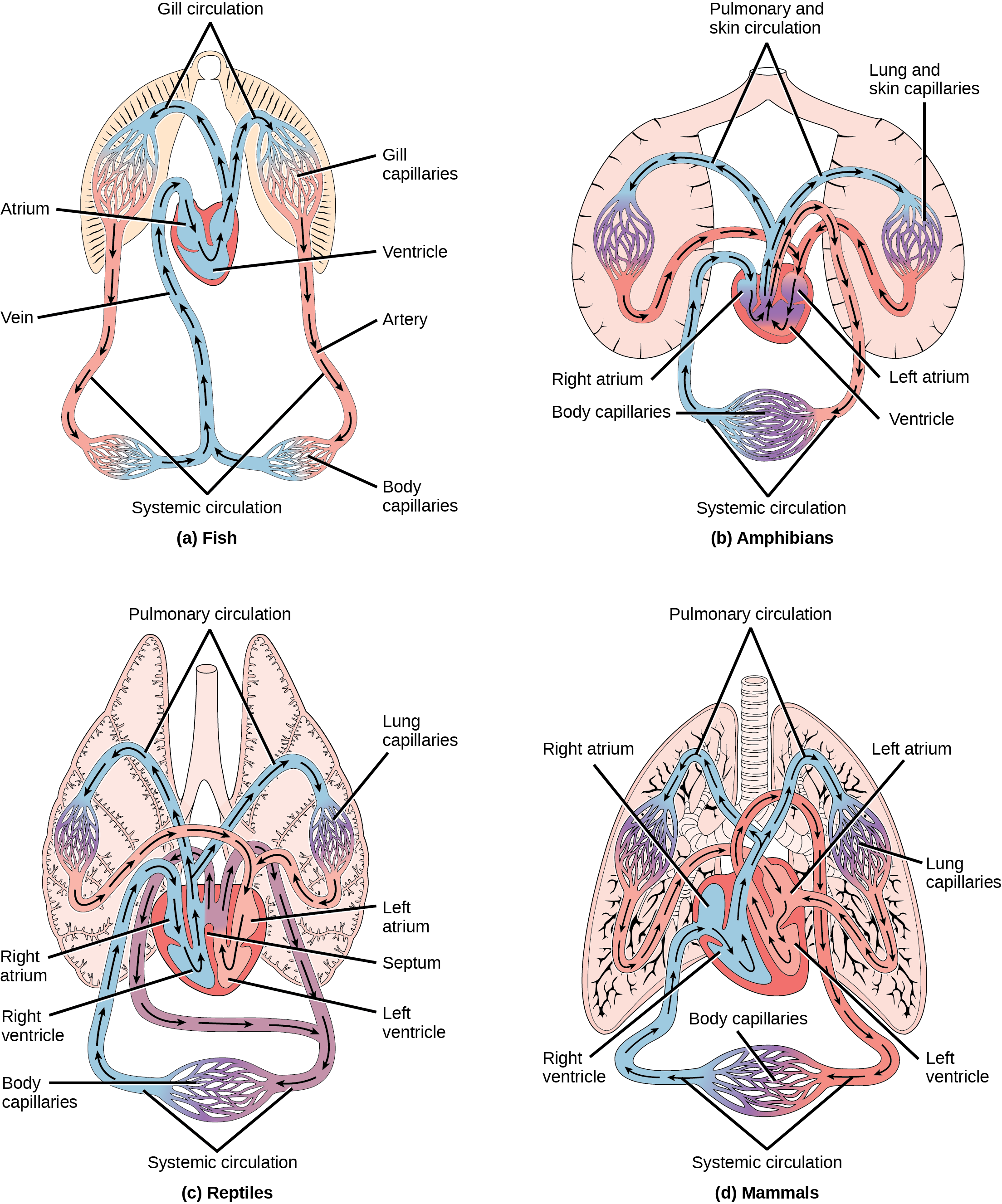


Figure 40.4図 40.4
(a) Fish have the simplest circulatory systems of the vertebrates: blood flows unidirectionally from the two-chambered heart through the gills and then the rest of the body. (b) Amphibians have two circulatory routes: one for oxygenation of the blood through the lungs and skin, and the other to take oxygen to the rest of the body. The blood is pumped from a three-chambered heart with two atria and a single ventricle. (c) Reptiles also have two circulatory routes; however, blood is only oxygenated through the lungs. The heart is three chambered, but the ventricles are partially separated so some mixing of oxygenated and deoxygenated blood occurs except in crocodilians and birds. (d) Mammals and birds have the most efficient heart with four chambers that completely separate the oxygenated and deoxygenated blood; it pumps only oxygenated blood through the body and deoxygenated blood to the lungs.
(a)魚類は、脊椎動物で最も単純な循環器系をもつ。血液は2室の心臓からえらへ、その後、体の残りの部分へ一方向に流れる。(b)両生類には2つの循環経路がある。一方は肺と皮膚を通って血液に酸素を取り込み、もう一方は体の残りの部分へ酸素を運ぶ。血液は、心房2つと心室1つの3室の心臓から送られる。(c)爬虫類も2つの循環経路をもつが、血液が酸素を取り込むのは肺だけである。心臓は3室からなり、心室が部分的に仕切られているため、ワニ類と鳥類を除くと、酸素の多い血液と少ない血液が一部混ざる。(d)哺乳類と鳥類は、最も効率のよい4室の心臓をもち、酸素の多い血液と少ない血液を完全に分ける。全身には酸素の多い血液だけを、肺には酸素の少ない血液を送る。
As illustrated in Figure 40.4a. Fish have a single circuit for blood flow and a two-chambered heart that has only a single atrium and a single ventricle. The atrium collects blood that has returned from the body and the ventricle pumps the blood to the gills where gas exchange occurs and the blood is re-oxygenated; this is called gill circulation. The blood then continues through the rest of the body before arriving back at the atrium; this is called systemic circulation. This unidirectional flow of blood produces a gradient of oxygenated to deoxygenated blood around the fish’s systemic circuit. The result is a limit in the amount of oxygen that can reach some of the organs and tissues of the body, reducing the overall metabolic capacity of fish.
英語のヒント
図40.4aのように、魚類の血流は1つの回路をもち、心臓は心房1つと心室1つの2室からなる。心房は体から戻った血液を受け取り、心室はえらへ血液を送り出す。えらでガス交換が起こり、血液は再び酸素を取り込む。これをえら循環という。その後、血液は体の残りの部分を通って心房へ戻る。これを体循環という。この一方向の流れにより、魚の体循環の回路を進むにつれて、血液は酸素の多い状態から少ない状態へ変化する。その結果、体の一部の器官や組織へ届く酸素量が制限され、魚類全体の代謝能力に限界が生じる。
In amphibians, reptiles, birds, and mammals, blood flow is directed in two circuits: one through the lungs and back to the heart, which is called pulmonary circulation, and the other throughout the rest of the body and its organs including the brain (systemic circulation). In amphibians, gas exchange also occurs through the skin during pulmonary circulation and is referred to as pulmocutaneous circulation.
英語のヒント
両生類、爬虫類、鳥類、哺乳類では、血液は2つの回路を流れる。一方は肺を通って心臓へ戻る肺循環であり、もう一方は脳を含む体の残りの部分と器官をめぐる体循環である。両生類では、肺循環の間に皮膚でもガス交換が起こるため、肺皮循環と呼ばれる。
As shown in Figure 40.4b, amphibians have a three-chambered heart that has two atria and one ventricle rather than the two-chambered heart of fish. The two atria (superior heart chambers) receive blood from the two different circuits (the lungs and the systems), and then there is some mixing of the blood in the heart’s ventricle (inferior heart chamber), which reduces the efficiency of oxygenation. The advantage to this arrangement is that high pressure in the vessels pushes blood to the lungs and body. The mixing is mitigated by a ridge within the ventricle that diverts oxygen-rich blood through the systemic circulatory system and deoxygenated blood to the pulmocutaneous circuit. For this reason, amphibians are often described as having double circulation.
英語のヒント
図40.4bのように、両生類の心臓は、魚類の2室とは異なり、心房2つと心室1つの3室からなる。上側の2つの心房は、それぞれ異なる2つの回路、すなわち肺と全身から血液を受け取る。血液は下側の心室で一部混ざり、酸素化の効率が下がる。この構成の利点は、血管内の高い圧力によって、肺と全身へ血液を押し出せることである。心室内の隆起が、酸素の多い血液を体循環へ、酸素の少ない血液を肺皮循環へ振り分けるため、混ざり合いが抑えられる。このように、両生類は二重循環をもつとされる。
Most reptiles also have a three-chambered heart similar to the amphibian heart that directs blood to the pulmonary and systemic circuits, as shown in Figure 40.4c. The ventricle is divided more effectively by a partial septum, which results in less mixing of oxygenated and deoxygenated blood. Some reptiles (alligators and crocodiles) are the most primitive animals to exhibit a four-chambered heart. Crocodilians have a unique circulatory mechanism where the heart shunts blood from the lungs toward the stomach and other organs during long periods of submergence, for instance, while the animal waits for prey or stays underwater waiting for prey to rot. One adaptation includes two main arteries that leave the same part of the heart: one takes blood to the lungs and the other provides an alternate route to the stomach and other parts of the body. Two other adaptations include a hole in the heart between the two ventricles, called the foramen of Panizza, which allows blood to move from one side of the heart to the other, and specialized connective tissue that slows the blood flow to the lungs. Together these adaptations have made crocodiles and alligators one of the most evolutionarily successful animal groups on earth.
英語のヒント
大半の爬虫類も、両生類と同じような3室の心臓をもち、図40.4cのように血液を肺循環と体循環へ送る。心室は不完全な中隔によってより効果的に仕切られているため、酸素の多い血液と少ない血液の混合が少ない。一部の爬虫類、すなわちアリゲーターやクロコダイルは、4室の心臓をもつ最も原始的な動物である。ワニ類には独特な循環の仕組みがある。長時間潜水するとき、たとえば獲物を待つときや、水中で獲物が腐るのを待つときに、心臓が血液の流れを肺から胃やほかの器官へ振り向ける。その適応の1つとして、心臓の同じ部分から2本の主要な動脈が出る。一方は肺へ血液を運び、もう一方は胃や体のほかの部分への別経路となる。さらに2つの適応がある。1つは、左右の心室の間にあるパニッツァ孔という穴で、心臓の一方から他方へ血液を移動させる。もう1つは、肺への血流を遅くする特殊な結合組織である。これらの適応が合わさり、クロコダイルやアリゲーターは、進化的に地球上で最も成功した動物群の1つとなっている。
In mammals and birds, the heart is also divided into four chambers: two atria and two ventricles, as illustrated in Figure 40.4d. The oxygenated blood is separated from the deoxygenated blood, which improves the efficiency of double circulation and is probably required for the warm-blooded lifestyle of mammals and birds. The four-chambered heart of birds and mammals evolved independently from a three-chambered heart. The independent evolution of the same or a similar biological trait is referred to as convergent evolution.
英語のヒント
哺乳類と鳥類でも、図40.4dのように、心臓は心房2つと心室2つの4室に分かれる。酸素の多い血液と少ない血液が分離されているため、二重循環の効率が高い。この仕組みは、哺乳類や鳥類の恒温性の生活に必要だったと考えられる。鳥類と哺乳類の4室の心臓は、3室の心臓から、それぞれ独立に進化した。同じ、またはよく似た生物の形質が独立して進化することを、収斂進化という。