第40章循環器系
40.2 Components of the Blood40.2 血液の成分
Learning Objectives学習目標
By the end of this section, you will be able to do the following:
この節を終えると、次のことができるようになる。
- List the basic components of the blood血液の基本成分を挙げる。
- Compare red and white blood cells赤血球と白血球を比較する。
- Describe blood plasma and serum血漿と血清を説明する。
Hemoglobin is responsible for distributing oxygen, and to a lesser extent, carbon dioxide, throughout the circulatory systems of humans, vertebrates, and many invertebrates. The blood is more than the proteins, though. Blood is actually a term used to describe the liquid that moves through the vessels and includes plasma (the liquid portion, which contains water, proteins, salts, lipids, and glucose) and the cells (red and white cells) and cell fragments called platelets. Blood plasma is actually the dominant component of blood and contains the water, proteins, electrolytes, lipids, and glucose. The cells are responsible for carrying the gases (red cells) and the immune response (white). The platelets are responsible for blood clotting. Interstitial fluid that surrounds cells is separate from the blood, but in hemolymph, they are combined. In humans, cellular components make up approximately 45 percent of the blood and the liquid plasma 55 percent. Blood is 20 percent of a person’s extracellular fluid and eight percent of weight.
英語のヒント
ヘモグロビンは、ヒトを含む脊椎動物や多くの無脊椎動物の循環器系で、酸素と、それより少量の二酸化炭素を運ぶ。しかし、血液はタンパク質だけではない。血液とは、血管を流れる液体を表す言葉である。水、タンパク質、塩類、脂質、グルコースを含む液体成分の血漿と、赤血球・白血球という細胞、血小板という細胞片からなる。血液の主要成分は実際には血漿であり、水、タンパク質、電解質、脂質、グルコースを含む。赤血球は気体の運搬を、白血球は免疫応答を担い、血小板は血液凝固を担う。細胞を取り囲む間質液は血液とは別のものだが、血リンパでは両者が混ざっている。ヒトでは、細胞成分が血液の約45%、液体の血漿が55%を占める。血液は、人の細胞外液の20%、体重の8%に相当する。
The Role of Blood in the Body体内での血液の役割
Blood, like the human blood illustrated in Figure 40.5 is important for regulation of the body’s systems and homeostasis. Blood helps maintain homeostasis by stabilizing pH, temperature, osmotic pressure, and by eliminating excess heat. Blood supports growth by distributing nutrients and hormones, and by removing waste. Blood plays a protective role by transporting clotting factors and platelets to prevent blood loss and transporting the disease-fighting agents or white blood cells to sites of infection.
英語のヒント
図40.5に示すヒトの血液のように、血液は体の各器官系の調節と恒常性にとって重要である。pH、温度、浸透圧を安定させ、余分な熱を取り除くことで、恒常性の維持を助ける。栄養素やホルモンを配り、老廃物を除去することで、成長を支える。また、凝固因子や血小板を運んで出血を防ぎ、病原体と戦う白血球を感染部位へ運ぶことで、体を保護する。
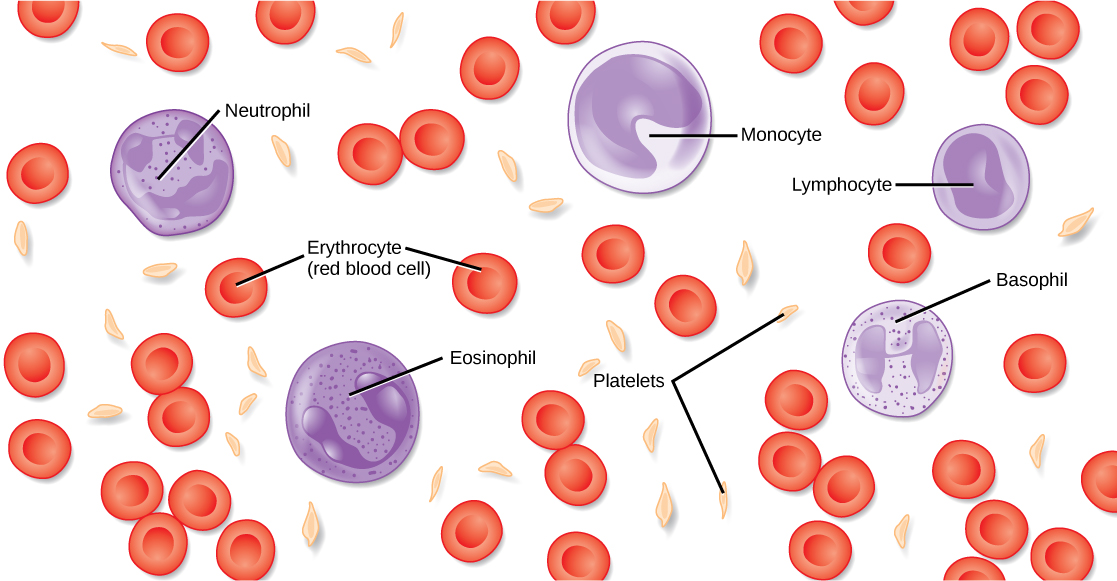
Figure 40.5図 40.5
The cells and cellular components of human blood are shown. Red blood cells deliver oxygen to the cells and remove carbon dioxide. White blood cells—including neutrophils, monocytes, lymphocytes, eosinophils, and basophils—are involved in the immune response. Platelets form clots that prevent blood loss after injury.
ヒトの血液の細胞と細胞成分を示す。赤血球は細胞へ酸素を届け、二酸化炭素を取り除く。好中球、単球、リンパ球、好酸球、好塩基球などの白血球は、免疫応答に関わる。血小板は血餅を形成し、損傷後の出血を防ぐ。
Red Blood Cells赤血球
Red blood cells, or erythrocytes (erythro- = “red”; -cyte = “cell”), are specialized cells that circulate through the body delivering oxygen to cells; they are formed from stem cells in the bone marrow. In mammals, red blood cells are small biconcave cells that at maturity do not contain a nucleus or mitochondria and are only 7–8 µm in size. In birds and non-avian reptiles, a nucleus is still maintained in red blood cells.
英語のヒント
赤血球は、英語でerythrocytesと呼ばれる(erythro-は「赤」、-cyteは「細胞」)。体内を循環して細胞へ酸素を届ける特殊化した細胞で、骨髄の幹細胞からつくられる。哺乳類の赤血球は、大きさがわずか7〜8µmの小さな両凹円盤状の細胞で、成熟すると核もミトコンドリアももたない。鳥類と鳥類以外の爬虫類では、赤血球にも核が残っている。
The red coloring of blood comes from the iron-containing protein hemoglobin, illustrated in Figure 40.6a. The principle job of this protein is to carry oxygen, but it also transports carbon dioxide as well. Hemoglobin is packed into red blood cells at a rate of about 250 million molecules of hemoglobin per cell. Each hemoglobin molecule binds four oxygen molecules so that each red blood cell carries one billion molecules of oxygen. There are approximately 25 trillion red blood cells in the five liters of blood in the human body, which could carry up to 25 sextillion (25 × 1021) molecules of oxygen in the body at any time. In mammals, the lack of organelles in erythrocytes leaves more room for the hemoglobin molecules, and the lack of mitochondria also prevents use of the oxygen for metabolic respiration. Only mammals have anucleated red blood cells, and some mammals (camels, for instance) even have nucleated red blood cells. The advantage of nucleated red blood cells is that these cells can undergo mitosis. Anucleated red blood cells metabolize anaerobically (without oxygen), making use of a primitive metabolic pathway to produce ATP and increase the efficiency of oxygen transport.
英語のヒント
血液の赤い色は、図40.6aに示す、鉄を含むタンパク質のヘモグロビンに由来する。主な役割は酸素の運搬だが、二酸化炭素も運ぶ。赤血球1個には、約2億5000万分子のヘモグロビンが詰まっている。ヘモグロビン1分子は4分子の酸素を結合するため、赤血球1個で10億分子の酸素を運ぶ。ヒトの体内の約5リットルの血液には、約25兆個の赤血球があり、最大で25×1021個の酸素分子を常時運べる。哺乳類の赤血球では、細胞小器官がない分だけ、ヘモグロビンを収容する空間が増える。また、ミトコンドリアがないため、代謝のための呼吸に酸素を使うこともない。無核の赤血球をもつのは哺乳類だけであり、一部の哺乳類、たとえばラクダは有核の赤血球をもつ。有核赤血球の利点は、有糸分裂できることである。無核赤血球は嫌気的に、すなわち酸素なしで代謝し、原始的な代謝経路を利用してATPをつくることで、酸素運搬の効率を高める。
Not all organisms use hemoglobin as the method of oxygen transport. Invertebrates that utilize hemolymph rather than blood use different pigments to bind to the oxygen. These pigments use copper or iron to bind to the oxygen. Invertebrates have a variety of other respiratory pigments. Hemocyanin, a blue-green, copper-containing protein, illustrated in Figure 40.6b is found in mollusks, crustaceans, and some of the arthropods. Chlorocruorin, a green-colored, iron-containing pigment is found in four families of polychaete tubeworms. Hemerythrin, a red, iron-containing protein is found in some polychaete worms and annelids and is illustrated in Figure 40.6c. Despite the name, hemerythrin does not contain a heme group and its oxygen-carrying capacity is poor compared to hemoglobin.
英語のヒント
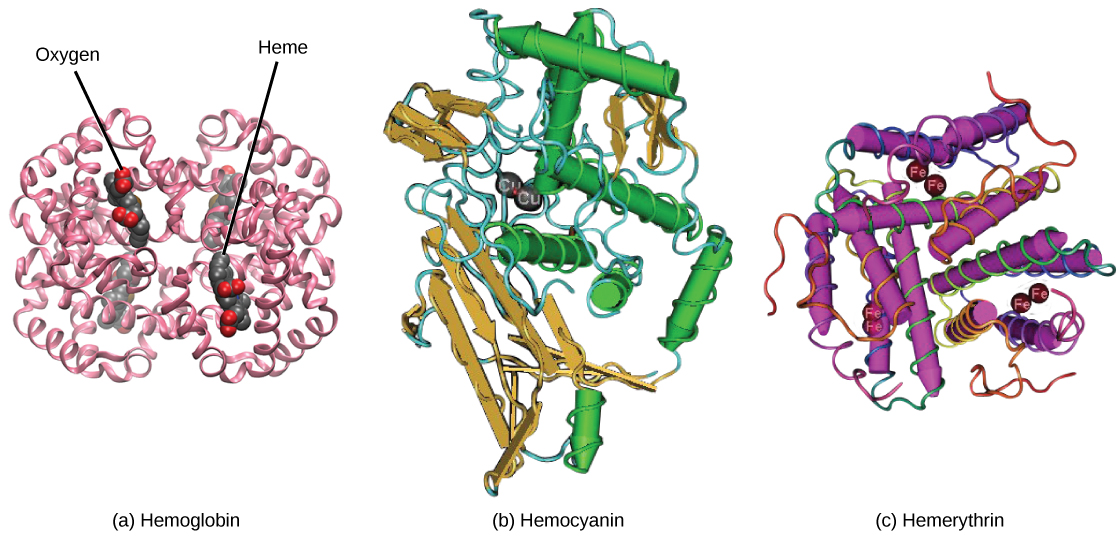


Figure 40.6図 40.6
In most vertebrates, (a) hemoglobin delivers oxygen to the body and removes some carbon dioxide. Hemoglobin is composed of four protein subunits, two alpha chains and two beta chains, and a heme group that has iron associated with it. The iron reversibly associates with oxygen, and in so doing is oxidized from Fe2+ to Fe3+. In most mollusks and some arthropods, (b) hemocyanin delivers oxygen. Unlike hemoglobin, hemocyanin is not carried in blood cells, but floats free in the hemolymph. Copper instead of iron binds the oxygen, giving the hemolymph a blue-green color. In annelids, such as the earthworm, and some other invertebrates, (c) hemerythrin carries oxygen. Like hemoglobin, hemerythrin is carried in blood cells and has iron associated with it, but despite its name, hemerythrin does not contain heme.
大半の脊椎動物では、(a)ヘモグロビンが体へ酸素を運び、二酸化炭素の一部を除去する。ヘモグロビンは、α鎖2本とβ鎖2本の計4つのタンパク質サブユニットと、鉄を含むヘム基からなる。鉄は酸素と可逆的に結合し、その際にFe2+からFe3+へ酸化される。大半の軟体動物と一部の節足動物では、(b)ヘモシアニンが酸素を運ぶ。ヘモグロビンと違い、血球内に収められず、血リンパ中を自由に浮遊する。鉄の代わりに銅が酸素を結合し、血リンパを青緑色にする。ミミズなどの環形動物と、一部のほかの無脊椎動物では、(c)ヘメリトリンが酸素を運ぶ。ヘモグロビンと同様に血球内にあり、鉄を含むが、その名前に反してヘムは含まない。
The small size and large surface area of red blood cells allows for rapid diffusion of oxygen and carbon dioxide across the plasma membrane. In the lungs, carbon dioxide is released and oxygen is taken in by the blood. In the tissues, oxygen is released from the blood and carbon dioxide is bound for transport back to the lungs. Studies have found that hemoglobin also binds nitrous oxide (NO). NO is a vasodilator that relaxes the blood vessels and capillaries and may help with gas exchange and the passage of red blood cells through narrow vessels. Nitroglycerin, a heart medication for angina and heart attacks, is converted to NO to help relax the blood vessels and increase oxygen flow through the body.
英語のヒント
赤血球は小さく表面積が大きいため、細胞膜を通して酸素と二酸化炭素が速やかに拡散できる。肺では、血液が二酸化炭素を放出して酸素を取り込む。組織では、血液が酸素を放出し、二酸化炭素を結合して肺へ持ち帰る。研究によって、ヘモグロビンは亜酸化窒素(NO)にも結合することが分かっている。NOは血管拡張物質であり、血管や毛細血管を弛緩させ、ガス交換や狭い血管内の赤血球の通過を助ける可能性がある。狭心症や心臓発作の治療薬であるニトログリセリンは、NOへ変換され、血管を弛緩させて体内の酸素の流れを増やす。
A characteristic of red blood cells is their glycolipid and glycoprotein coating; these are lipids and proteins that have carbohydrate molecules attached. In humans, the surface glycoproteins and glycolipids on red blood cells vary between individuals, producing the different blood types, such as A, B, and O. Red blood cells have an average life span of 120 days, at which time they are broken down and recycled in the liver and spleen by phagocytic macrophages, a type of white blood cell.
英語のヒント
赤血球の特徴の1つは、糖脂質と糖タンパク質で表面が覆われていることである。これらは、糖質の分子が結合した脂質やタンパク質である。ヒトでは、赤血球表面の糖タンパク質と糖脂質が個人ごとに異なり、A型、B型、O型などの血液型を生む。赤血球の平均寿命は120日で、その時期になると、肝臓や脾臓にある食作用を行うマクロファージによって分解され、再利用される。マクロファージは白血球の一種である。