第25章種子をつくらない植物
The Importance of Seedless Plants無種子植物の重要性
Mosses and liverworts are often the first macroscopic organisms to colonize an area, both in a primary succession—where bare land is settled for the first time by living organisms, or in a secondary succession—where soil remains intact after a catastrophic event wipes out many existing species. Their spores are carried by the wind, birds, or insects. Once mosses and liverworts are established, they provide food and shelter for other plant species. In a hostile environment, like the tundra where the soil is frozen, bryophytes grow well because they do not have roots and can dry and rehydrate quickly once water is again available. Mosses are at the base of the food chain in the tundra biome. Many species—from small herbivorous insects to musk oxen and reindeer—depend on mosses for food. In turn, predators feed on the herbivores, which are the primary consumers. Some reports indicate that bryophytes make the soil more amenable to colonization by other plants. Because they establish symbiotic relationships with nitrogen-fixing cyanobacteria, mosses replenish the soil with nitrogen.
英語のヒント
蘚類と苔類は、ある地域に最初に進出する肉眼で見える生物であることが多い。これは、生物が裸地に初めて定着する一次遷移でも、壊滅的な出来事で既存の多くの種が失われた後も土壌は残っている二次遷移でも同様である。胞子は風、鳥、昆虫によって運ばれる。蘚類と苔類が定着すると、ほかの植物種に食物と隠れ場所を提供する。土壌が凍るツンドラのような厳しい環境でも、コケ植物はよく育つ。根をもたず、乾燥しても、再び水が得られれば素早く水分を取り戻せるからである。蘚類は、ツンドラのバイオームの食物連鎖の基盤にある。小さな植食性昆虫からジャコウウシやトナカイまで、多くの種が蘚類を食物として頼っている。今度は、一次消費者である草食動物を捕食者が食べる。コケ植物は、ほかの植物が定着しやすい土壌をつくるという報告もある。蘚類は窒素固定を行うシアノバクテリアと共生関係を結ぶため、土壌に窒素を補給する。
By the end of the nineteenth century, scientists had observed that lichens and mosses were becoming increasingly rare in urban and suburban areas. Because bryophytes have neither a root system for absorption of water and nutrients, nor a cuticular layer that protects them from desiccation, pollutants in rainwater readily penetrate their tissues as they absorb moisture and nutrients through their entire exposed surfaces. Therefore, pollutants dissolved in rainwater penetrate plant tissues readily and have a larger impact on mosses than on other plants. The disappearance of mosses can be considered a biological indicator for the level of pollution in the environment.
英語のヒント
19世紀末までに、科学者たちは都市部や郊外で地衣類と蘚類がますます少なくなっていることを観察していた。コケ植物には、水と栄養分を吸収する根系も、乾燥から身を守るクチクラ層もない。そのため、露出した表面全体から水分と栄養分を吸収すると、雨水中の汚染物質も容易に組織へ侵入する。したがって、雨水に溶けた汚染物質は植物組織に侵入しやすく、ほかの植物よりも蘚類に大きな影響を与える。蘚類の消失は、環境中の汚染水準を示す生物指標と考えることができる。
Ferns contribute to the environment by promoting the weathering of rock, accelerating the formation of topsoil, and slowing down erosion as rhizomes spread throughout the soil. The water ferns of the genus Azolla harbor nitrogen-fixing cyanobacteria and restore this important nutrient to aquatic habitats.
英語のヒント
シダ類は、岩石の風化を促し、表土の形成を速め、根茎が土壌全体に広がることで侵食を遅らせて、環境に貢献する。アカウキクサ属 Azolla の水生シダは、窒素固定を行うシアノバクテリアを宿し、この重要な栄養分を水中の生息地へ戻す。
Seedless plants have historically played a role in human life with uses as tools, fuel, and medicine. For example, dried peat moss, Sphagnum, is commonly used as fuel in some parts of Europe and is considered a renewable resource. Sphagnum bogs (Figure 25.26) are cultivated with cranberry and blueberry bushes. In addition, the ability of Sphagnum to hold moisture makes the moss a common soil conditioner. Even florists use blocks of Sphagnum to maintain moisture for floral arrangements!
英語のヒント
無種子植物は、歴史を通して道具、燃料、薬として利用され、人間の暮らしで役割を果たしてきた。たとえば、乾燥したミズゴケはヨーロッパの一部で燃料としてよく使われ、再生可能な資源と考えられている。ミズゴケ湿原(図25.26)では、クランベリーやブルーベリーの低木が栽培される。さらに、ミズゴケには水分を保つ能力があるため、土壌改良材としてよく使われる。花屋でさえ、フラワーアレンジメントの水分を保つために、ミズゴケの塊を使っている。
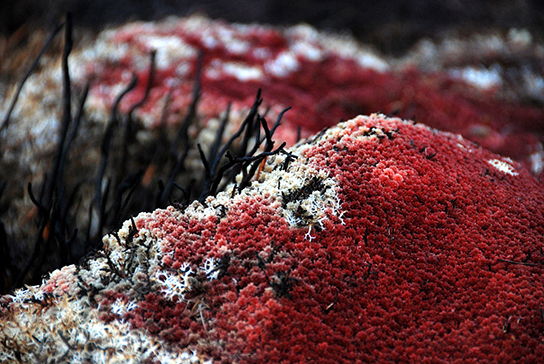

Figure 25.26図 25.26
Sphagnum moss. Sphagnum acutifolium is dried peat moss and can be used as fuel. (credit: Ken Goulding)
ミズゴケ。Sphagnum acutifolium は、乾燥したミズゴケとして燃料に利用できる。(クレジット:Ken Goulding)
The attractive fronds of ferns make them a favorite ornamental plant. Because they thrive in low light, they are well suited as house plants. More importantly, fiddleheads of bracken fern (Pteridium aquilinum) are a traditional spring food of Native Americans, and are popular as a side dish in French cuisine. The licorice fern, Polypodium glycyrrhiza, is part of the diet of the Pacific Northwest coastal tribes, owing in part to the sweetness of its rhizomes. It has a faint licorice taste and serves as a sweetener. The rhizome also figures in the pharmacopeia of Native Americans for its medicinal properties and is used as a remedy for sore throat.
英語のヒント
シダの美しい羽葉は、観賞用植物として人気がある。弱い光でもよく育つので、室内植物に適している。さらに重要なのは、ワラビ Pteridium aquilinum の巻いた若芽がアメリカ先住民の伝統的な春の食べ物であり、フランス料理でも付け合わせとして人気があることである。リコリスファーン Polypodium glycyrrhiza は、根茎が甘いこともあって、太平洋岸北西部の沿岸の部族の食生活に取り入れられている。かすかなリコリスの味があり、甘味料として使われる。また、その薬効から、根茎はアメリカ先住民の薬の体系にも登場し、のどの痛みの治療薬として利用される。
By far the greatest impact of seedless vascular plants on human life, however, comes from their extinct progenitors. The tall club mosses, horsetails, and tree-like ferns that flourished in the swampy forests of the Carboniferous period gave rise to large deposits of coal throughout the world. Coal provided an abundant source of energy during the Industrial Revolution, which had tremendous consequences on human societies, including rapid technological progress and growth of large cities, as well as the degradation of the environment. Coal is still a prime source of energy and also a major contributor to global warming.
英語のヒント
しかし、無種子維管束植物が人間の暮らしに及ぼした、はるかに大きな影響は、絶滅した祖先に由来する。石炭紀の湿地林に繁茂した背の高いヒカゲノカズラ類、トクサ類、樹木状のシダ類は、世界各地の大規模な石炭層を生んだ。石炭は産業革命の間、豊富なエネルギー源を供給した。産業革命は、急速な技術進歩や大都市の成長、さらには環境の悪化など、人間社会に非常に大きな影響をもたらした。石炭は現在も主要なエネルギー源であり、地球温暖化の大きな要因でもある。
Section Summaryこの節のまとめ
The seedless vascular plants show several features important to living on land: vascular tissue, roots, and leaves. Vascular systems consist of xylem tissue, which transports water and minerals, and phloem tissue, which transports sugars and proteins. With the development of the vascular system, leaves appeared to act as large photosynthetic organs, and roots to access water from the ground. Small uncomplicated leaves are termed microphylls. Large leaves with vein patterns are termed megaphylls. Modified leaves that bear sporangia are called sporophylls. Some sporophylls are arranged in cone structures called strobili.
無種子維管束植物には、陸上生活に重要ないくつかの特徴、すなわち維管束組織、根、葉がある。維管束系は、水と無機養分を運ぶ木部組織と、糖とタンパク質を運ぶ師部組織からなる。維管束系の発達とともに、大きな光合成器官として働く葉と、地中の水を利用する根が現れた。小さく単純な葉を小葉、葉脈の配置をもつ大きな葉を大葉という。胞子嚢をつけるように変化した葉は、胞子葉と呼ばれる。一部の胞子葉は、胞子嚢穂と呼ばれる円錐状の構造に配列する。
The support and conductive properties of vascular tissues have allowed the sporophyte generation of vascular plants to become increasingly dominant. The seedless vascular plants include club mosses, which are the most primitive; whisk ferns, which lost leaves and roots by reductive evolution; and horsetails and ferns. Ferns are the most advanced group of seedless vascular plants. They are distinguished by large leaves called fronds and small sporangia-containing structures called sori, which are found on the underside of the fronds.
英語のヒント
維管束組織の支持能力と輸送能力によって、維管束植物の胞子体世代は次第に優勢となった。無種子維管束植物には、最も原始的なヒカゲノカズラ類、退化的進化で葉と根を失ったマツバラン類、そしてトクサ類とシダ類が含まれる。シダ類は、無種子維管束植物の中で最も進んだグループである。羽葉と呼ばれる大きな葉と、その下面に見られる、胞子嚢群と呼ばれる胞子嚢を含む小さな構造を特徴とする。
Both mosses and ferns play an essential role in the balance of the ecosystems. Mosses are pioneering species that colonize bare or devastated environments and make it possible for succession to occur. They contribute to the enrichment of the soil and provide shelter and nutrients for animals in hostile environments. Mosses are important biological indicators of environmental pollution. Ferns are important for providing natural habitats, as soil stabilizers, and as decorative plants. Both mosses and ferns are part of traditional medical practice. In addition to culinary, medical, and decorative purposes, mosses and ferns can be used as fuels, and ancient seedless plants were important contributors to the fossil fuel deposits that we now use as an energy resource.
英語のヒント
蘚類もシダ類も、生態系の釣り合いを保つうえで欠かせない役割を果たす。蘚類は、裸地や荒廃した環境に定着し、遷移を可能にする先駆種である。土壌を豊かにすることに貢献し、厳しい環境の動物に隠れ場所と栄養分を提供する。蘚類は、環境汚染の重要な生物指標である。シダ類は、自然の生息地を提供すること、土壌を安定させること、観賞用植物として重要である。蘚類もシダ類も、伝統的な医療で利用されている。食用、薬用、観賞用に加えて、燃料としても利用できる。また、古代の無種子植物は、現在私たちがエネルギー資源として利用する化石燃料の堆積物の形成に、大きく寄与した。