第25章種子をつくらない植物
Gametangia in Seedless Plants無種子植物の配偶子嚢
Gametangia (singular, gametangium) are structures observed on multicellular haploid gametophytes. In the gametangia, precursor cells give rise to gametes by mitosis. The male gametangium (antheridium) releases sperm. Seedless plants produce sperm equipped with flagella that enable them to swim in a moist environment to the archegonium: the female gametangium. The embryo develops inside the archegonium as the sporophyte. Gametangia are prominent in seedless plants, but are absent or rudimentary in seed plants.
英語のヒント
配偶子嚢(複数形gametangia、単数形gametangium)は、多細胞の半数体配偶体に見られる構造である。その中では、前駆細胞が有糸分裂して配偶子を作る。雄性配偶子嚢である造精器は、精子を放出する。無種子植物の精子には鞭毛があり、湿った環境を泳いで、雌性配偶子嚢である造卵器へ到達できる。胚は、造卵器の内部で胞子体として発達する。配偶子嚢は無種子植物で顕著だが、種子植物では欠けるか、痕跡的である。
Apical Meristems頂端分裂組織
Shoots and roots of plants increase in length through rapid cell division in a tissue called the apical meristem, which is a small mitotically active zone of cells found at the shoot tip or root tip (Figure 25.4). The apical meristem is made of undifferentiated cells that continue to proliferate throughout the life of the plant. Meristematic cells give rise to all the specialized tissues of the organism. Elongation of the shoots and roots allows a plant to access additional space and resources: light in the case of the shoot, and water and minerals in the case of roots. A separate meristem, called the lateral meristem, produces cells that increase the diameter of tree trunks.
英語のヒント
植物のシュートと根は、頂端分裂組織という組織での速い細胞分裂によって、長さを増す。この組織は、シュートの先端や根端にある、有糸分裂が活発な小さな細胞領域である(図25.4)。頂端分裂組織は、植物の一生を通して増殖し続ける、未分化細胞からなる。分裂組織の細胞は、体のすべての特殊化した組織を生み出す。シュートと根の伸長によって、植物は、追加の空間と資源へ到達できる。シュートでは光、根では水と無機養分である。側方分裂組織という別の分裂組織は、木の幹の直径を増やす細胞を作る。
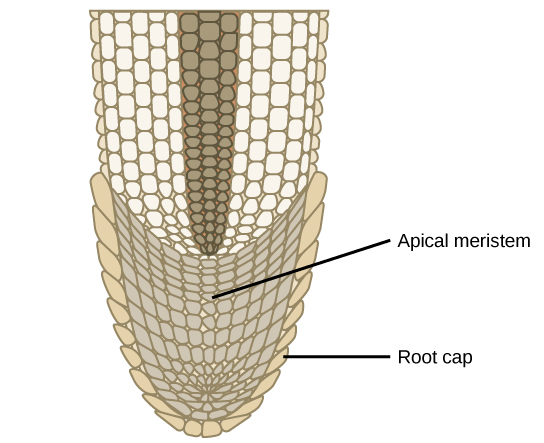

Figure 25.4図 25.4
Apical meristem at a root tip. Addition of new cells in a root occurs at the apical meristem. Subsequent enlargement of these cells causes the organ to grow and elongate. The root cap protects the fragile apical meristem as the root tip is pushed through the soil by cell elongation.
根端の頂端分裂組織。根では、頂端分裂組織で新しい細胞が追加される。その後、細胞が大きくなることで、器官が成長・伸長する。細胞の伸長によって根端が土中へ押し進められる際、根冠が壊れやすい頂端分裂組織を保護する。
Additional Land Plant Adaptations陸上植物のさらなる適応
As plants adapted to dry land and became independent from the constant presence of water in damp habitats, new organs and structures made their appearance. Early land plants did not grow more than a few inches off the ground, competing for light on these low mats. By developing a shoot and growing taller, individual plants captured more light. Because air offers substantially less support than water, land plants incorporated more rigid molecules in their stems (and later, tree trunks). In small plants such as single-celled algae, simple diffusion suffices to distribute water and nutrients throughout the organism. However, for plants to evolve larger forms, the evolution of a conductive tissue for the distribution of water and solutes was a prerequisite. The evolution of vascular tissue in plants met both of these needs. The vascular system contains two types of conductive tissue: xylem and phloem. Xylem conducts water and minerals absorbed from the soil up to the shoot, while phloem transports food derived from photosynthesis throughout the entire plant. In xylem, the cells walls are reinforced with lignin, whose tough hydrophobic polymers help prevent the seepage of water across the xylem cell walls. Lignin also adds to the strength of these tissues in supporting the plant. The vascular tissues extend into the root of land plants. The root system evolved to take up water and minerals from the soil, and to anchor the increasingly taller shoot in the soil.
英語のヒント
植物が陸地へ適応し、湿った生息地に常にある水から独立するにつれ、新しい器官や構造が現れた。初期の陸上植物は、地面から数インチ以上には伸びず、低いマット状の植生の中で光を奪い合っていた。シュートを発達させて高く育つことで、個々の植物はより多くの光を得た。空気は水よりはるかに支えが弱いため、陸上植物は茎、そして後には幹に、より硬い分子を取り込んだ。単細胞藻類のような小さな植物では、単純な拡散で、水と栄養を全体へ配るのに十分である。しかし、大型化するには、水や溶質を分配する通導組織の進化が前提条件だった。維管束組織の進化は、支持と輸送の両方の必要を満たした。維管束系には、木部と師部という二種類の通導組織がある。木部は土壌から吸収した水と無機養分をシュートへ運び、師部は光合成由来の養分を植物全体へ運ぶ。木部の細胞壁はリグニンで補強される。その丈夫で疎水性の高分子は、細胞壁を通じた水の漏出を防ぐのを助ける。リグニンは、植物を支える組織の強度も高める。維管束組織は根へも伸びる。根系は、土壌から水と無機養分を取り込み、次第に高くなるシュートを土に固定するために進化した。
In land plants, a waxy, waterproof cover called a cuticle protects the leaves and stems from desiccation. However, the cuticle also prevents intake of carbon dioxide needed for the synthesis of carbohydrates through photosynthesis. To overcome this, stomata or pores that open and close to regulate traffic of gases and water vapor appeared in plants as they moved away from moist environments into drier habitats.
英語のヒント
陸上植物では、クチクラというワックス状で防水性の被覆が、葉や茎を乾燥から守る。しかし、クチクラは、光合成による炭水化物合成に必要な二酸化炭素の取り込みも妨げる。これを克服するため、植物が湿った環境から乾いた生息地へ移るにつれて、開閉して気体と水蒸気の出入りを調節する穴、すなわち気孔が現れた。
Water filters ultraviolet-B (UVB) light, which is harmful to all organisms, especially those that must absorb light to survive. This filtering does not occur for land plants. Exposure to damaging radiation presented an additional challenge to land colonization, which was met by the evolution of biosynthetic pathways for the synthesis of protective flavonoids and other pigments that absorb UV wavelengths of light and protect the aerial parts of plants from photodynamic damage.
英語のヒント
水は、すべての生物、特に生存のために光を吸収しなければならない生物に有害な、紫外線B(UVB)を遮る。陸上植物では、この遮蔽は起こらない。有害な放射線への曝露は、陸上進出にもう一つの課題を加えた。これには、保護用のフラボノイドや他の色素を合成する生合成経路の進化によって対処した。これらの色素は紫外線波長の光を吸収し、地上部を光による損傷から守る。
Plants cannot avoid being eaten by animals. Instead, they synthesize a large range of poisonous secondary metabolites: complex organic molecules such as alkaloids, whose noxious smells and unpleasant taste deter animals. These toxic compounds can also cause severe diseases and even death, thus discouraging predation. Humans have used many of these compounds for centuries as drugs, medications, or spices. In contrast, as plants co-evolved with animals, the development of sweet and nutritious metabolites lured animals into providing valuable assistance in dispersing pollen grains, fruit, or seeds. Plants have been enlisting animals to be their helpers in this way for hundreds of millions of years.
英語のヒント
植物は、動物に食べられることを避けられない。代わりに、アルカロイドのような複雑な有機分子を含む、多様な有毒二次代謝産物を合成する。その有害なにおいや不快な味は、動物を遠ざける。これらの化合物は、重病や死を引き起こすこともあり、捕食を抑える。ヒトは何世紀も、これらの多くを薬物、医薬品、香辛料として使ってきた。一方、植物と動物が共進化する中で、甘く栄養のある代謝産物の発達は、動物を引き寄せ、花粉粒、果実、種子の散布に、貴重な助けを提供させた。植物はこうして、数億年にわたり、動物を協力者として取り込んできた。