第25章種子をつくらない植物
Alternation of Generations世代交代
All sexually reproducing organisms have both haploid and diploid cells in their life cycles. In organisms with haplontic life cycles, the haploid stage is dominant, while in organisms with a diplontic life cycle, the diploid stage is the dominant life stage. Dominant in this context means both the stage in which the organism spends most of its time, and the stage in which most mitotic cell reproduction occurs—the multicellular stage. In haplontic life cycles, the only diploid cell is the zygote, which undergoes immediate meiosis to restore the haploid state. In diplontic life cycles, the only haploid cells are the gametes, which combine to restore the diploid state at their earliest convenience. Humans, for example, are diplontic.
英語のヒント
有性生殖するすべての生物は、生活環に半数体細胞と二倍体細胞の両方をもつ。半数体型生活環では半数体段階が優勢で、二倍体型生活環では二倍体段階が優勢である。ここでいう優勢とは、生物が時間の大部分を過ごす段階であり、かつ有糸分裂による細胞増殖の大部分が起こる、多細胞の段階を意味する。半数体型生活環では、唯一の二倍体細胞は接合子であり、直ちに減数分裂して半数体状態へ戻る。二倍体型生活環では、唯一の半数体細胞は配偶子であり、できるだけ早い機会に融合して二倍体状態へ戻る。たとえば、ヒトは二倍体型である。
Alternation of generations describes a life cycle in which an organism has both haploid and diploid multicellular stages (Figure 25.2). This type of life cycle, which is found in all plants, is described as haplodiplontic.
英語のヒント
世代交代は、生物が半数体と二倍体の両方に多細胞段階をもつ生活環を表す(図25.2)。すべての植物に見られるこの型の生活環を、単複相型という。
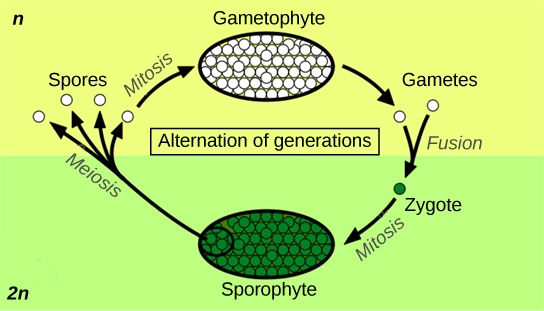

Figure 25.2図 25.2
Alternation of generations between the 1n gametophyte and 2n sporophyte is shown. Mitosis occurs in both gametophyte and sporophyte generations. Diploid sporophytes produce haploid spores by meiosis, while haploid gametophytes produce gametes by mitosis. (credit: Peter Coxhead)
1nの配偶体と2nの胞子体の間の世代交代を示す。配偶体世代と胞子体世代の両方で有糸分裂が起こる。二倍体の胞子体は減数分裂で半数体胞子を作り、半数体の配偶体は有糸分裂で配偶子を作る。(クレジット:Peter Coxhead)
In alternation of generations, the multicellular haploid form, known as a gametophyte, is followed in the developmental sequence by a multicellular diploid form, the sporophyte. The gametophyte gives rise to the gametes (reproductive cells) by mitosis. This can be the most obvious phase of the life cycle of the plant, as in the mosses, or it can occur in a microscopic structure, such as a pollen grain, in the seed plants. The evolution of the land plants is marked by increasing prominence of the sporophyte generation. The sporophyte stage is barely noticeable in non-vascular plants (the collective term for the plants that include the liverworts and mosses). In the seed plants, the sporophyte phase can be a towering tree, as in sequoias and pines.
英語のヒント
世代交代では、配偶体という多細胞の半数体に続き、発生の順序として、多細胞の二倍体である胞子体が現れる。配偶体は、有糸分裂によって配偶子(生殖細胞)を作る。この段階は、コケのように植物の生活環で最も目立つ場合もあれば、種子植物の花粉粒のように微小な構造内に生じる場合もある。陸上植物の進化は、胞子体世代が次第に目立つようになることで特徴づけられる。非維管束植物(苔類や蘚類を含む植物の総称)では、胞子体段階はほとんど目立たない。種子植物では、セコイアやマツのように、そびえ立つ木が胞子体段階であることもある。
Protection of the embryo is a major requirement for land plants. The vulnerable embryo must be sheltered from desiccation and other environmental hazards. In both seedless and seed plants, the female gametophyte provides protection and nutrients to the embryo as it develops into the new sporophyte. This distinguishing feature of land plants gave the group its alternate name of embryophytes.
英語のヒント
胚の保護は、陸上植物にとって重要な要件である。傷つきやすい胚は、乾燥や他の環境上の危険から守られなければならない。無種子植物でも種子植物でも、雌性配偶体は、胚が新しい胞子体へ発達する間、保護と栄養を提供する。陸上植物を特徴づけるこの性質から、有胚植物という別名がつけられた。
Sporangia in Seedless Plants無種子植物の胞子嚢
The sporophyte of seedless plants is diploid and results from syngamy (fusion) of two gametes. The sporophyte bears the sporangia (singular, sporangium). The term “sporangia” literally means “a vessel for spores,” as it is a reproductive sac in which spores are formed (Figure 25.3). Inside the multicellular sporangia, the diploid sporocytes, or mother cells, produce haploid spores by meiosis, during which the 2n chromosome number is reduced to 1n (note that in many plants, chromosome number is complicated by polyploidy: for example, durum wheat is tetraploid, bread wheat is hexaploid, and some ferns are 1000-ploid). The spores are later released by the sporangia and disperse in the environment. When the haploid spore germinates in a hospitable environment, it generates a multicellular gametophyte by mitosis. The gametophyte supports the zygote formed from the fusion of gametes and the resulting young sporophyte (vegetative form). The cycle then begins anew.
英語のヒント
無種子植物の胞子体は二倍体で、二つの配偶子の接合、すなわち融合から生じる。胞子体は胞子嚢(複数形sporangia、単数形sporangium)をつける。sporangiaは文字どおり「胞子の容器」を意味し、胞子が作られる生殖用の袋である(図25.3)。多細胞の胞子嚢内では、二倍体の胞子母細胞が減数分裂して半数体胞子を作り、2nの染色体数が1nへ減る。多くの植物では、倍数性によって染色体数が複雑になることに注意しよう。たとえば、デュラムコムギは四倍体、パンコムギは六倍体で、一部のシダは1,000倍体である。胞子は、後に胞子嚢から放出され、環境中へ散布される。半数体胞子が好適な環境で発芽すると、有糸分裂によって多細胞の配偶体を作る。配偶体は、配偶子の融合でできた接合子と、そこから生じる若い胞子体(栄養体)を支える。そして生活環が、再び始まる。
OpenStax, Rice University; Biology 2e. (credit: Javier Martin) Embedded rights notice: Copyright 2008 · CC BY 4.0 · Source出典

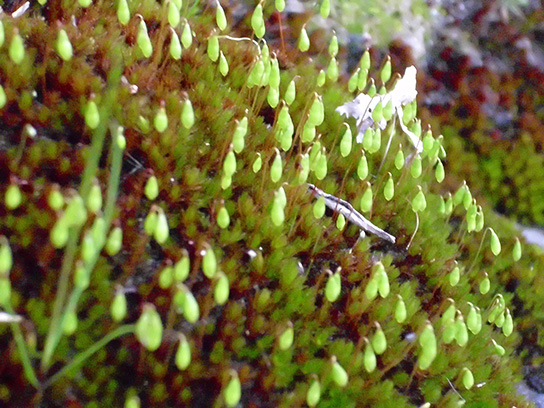
Figure 25.3図 25.3
Sporangia. Spore-producing sacs called sporangia grow at the ends of long, thin stalks in this photo of the moss Bryum capillare. (credit: Javier Martin)
胞子嚢。蘚類Bryum capillareの写真で、長く細い柄の先に、胞子を作る袋である胞子嚢が育っている。(クレジット:Javier Martin)
Plants that produce only one type of spore are called homosporous and the resultant gametophyte produces both male and female gametes, usually on the same individual. Non-vascular plants are homosporous, and the gametophyte is the dominant generation in the life cycle. Plants that produce two types of spores are called heterosporous. The male spores are called microspores, because of their smaller size, and develop into the male gametophyte; the comparatively larger megaspores develop into the female gametophyte. A few seedless vascular plants and all seed plants are heterosporous, and the sporophyte is the dominant generation.
英語のヒント
1種類の胞子だけを作る植物を同形胞子性といい、生じる配偶体は、通常は同じ個体で、雄性と雌性の両配偶子を作る。非維管束植物は同形胞子性で、生活環では配偶体世代が優勢である。2種類の胞子を作る植物を異形胞子性という。雄性の胞子は、より小さいため小胞子と呼ばれ、雄性配偶体へ発達する。比較的大きい大胞子は、雌性配偶体へ発達する。少数の無種子維管束植物と、すべての種子植物は異形胞子性であり、胞子体世代が優勢である。
The spores of seedless plants are surrounded by thick cell walls containing a tough polymer known as sporopollenin. As the name suggests, it is also found in the walls of pollen grains. This complex substance is characterized by long chains of organic molecules related to fatty acids and carotenoids: hence the yellow color of most pollen. Sporopollenin is unusually resistant to chemical and biological degradation. In seed plants, in which pollen is the male gametophyte, the toughness of sporopollenin explains the existence of well-preserved pollen fossils. Sporopollenin was once thought to be an innovation of land plants; however, the charophyte Coleochaetes also forms spores that contain sporopollenin.
英語のヒント
無種子植物の胞子は、スポロポレニンという丈夫な高分子を含む、厚い細胞壁に囲まれる。その名が示すように、花粉粒の壁にも含まれる。この複雑な物質は、脂肪酸やカロテノイドに関連する有機分子の長い鎖を特徴とし、これが多くの花粉の黄色の理由でもある。スポロポレニンは、化学的・生物学的分解に並外れて強い。花粉が雄性配偶体である種子植物では、その丈夫さによって、保存状態のよい花粉化石の存在を説明できる。かつては陸上植物の新機軸と考えられていたが、シャジクモ類のColeochaetesも、スポロポレニンを含む胞子を作る。