第25章種子をつくらない植物
Leaves, Sporophylls, and Strobili葉、胞子葉、胞子嚢穂
A third innovation marks the seedless vascular plants. Accompanying the prominence of the sporophyte and the development of vascular tissue, the appearance of true leaves improved their photosynthetic efficiency. Leaves capture more sunlight with their increased surface area by employing more chloroplasts to trap light energy and convert it to chemical energy, which is then used to fix atmospheric carbon dioxide into carbohydrates. The carbohydrates are exported to the rest of the plant by the conductive cells of phloem tissue.
英語のヒント
無種子維管束植物を特徴づける、三つ目の新しい特徴がある。胞子体が優勢になり、維管束組織が発達するのに伴って、本来の葉が現れ、光合成の効率が向上した。葉は増大した表面積でより多くの日光を受け、より多くの葉緑体を使って光エネルギーをとらえ、化学エネルギーに変える。その化学エネルギーは、次に大気中の二酸化炭素を炭水化物へ固定するために使われる。炭水化物は、師部組織の通導細胞によって、植物のほかの部分へ送り出される。
The existence of two types of leaf morphology—microphylls and megaphylls—suggests that leaves evolved independently in several groups of plants. Microphylls ("little leaves") are small and have a simple vascular system. The first microphylls in the fossil record can be dated to 350 million years ago in the Carboniferous era. A single unbranched vein—a bundle of vascular tissue made of xylem and phloem—runs through the center of the leaf. Microphylls may have originated from the flattening of lateral branches, or from sporangia that lost their reproductive capabilities. Microphylls are seen in club mosses. Microphylls probably preceded the development of megaphylls ("big leaves"), which are larger leaves with a pattern of multiple veins. Megaphylls most likely appeared independently several times during the course of evolution. Their complex networks of veins suggest that several branches may have combined into a flattened organ, with the gaps between the branches being filled with photosynthetic tissue. Megaphylls are seen in ferns and more derived vascular plants.
英語のヒント
小葉と大葉という二つの葉の形態が存在することから、葉はいくつかの植物群で独立に進化したと考えられる。小葉、つまり「小さな葉」は小型で、単純な維管束系をもつ。化石記録に見られる最初の小葉は、石炭紀の3億5000万年前のものと年代決定できる。葉の中央を、枝分かれしない一本の葉脈、すなわち木部と師部からなる維管束組織の束が通る。小葉は、側枝が平たくなったものか、生殖能力を失った胞子嚢に由来する可能性がある。小葉はヒカゲノカズラ類に見られる。小葉はおそらく大葉、つまり「大きな葉」の発達に先行した。大葉は、複数の葉脈の配置をもつ、より大きな葉である。大葉は、進化の過程でおそらく何度か独立に現れた。複雑な葉脈の網から、いくつかの枝がまとまって平たい器官となり、枝と枝の隙間が光合成組織で埋まった可能性が考えられる。大葉は、シダ類と、さらに派生した維管束植物に見られる。
In addition to photosynthesis, leaves play another role in the life of the plants. Pine cones, mature fronds of ferns, and flowers are all sporophylls—leaves that were modified structurally to bear sporangia. In conifers, the commonly named pine cones, strobili are cone-like structures that contain sporangia.
英語のヒント
葉は光合成に加えて、植物の生活でもう一つの役割を果たす。松かさ、シダの成熟した葉、花は、すべて胞子葉、すなわち胞子嚢をつけるように構造が変化した葉である。針葉樹では、一般に松かさと呼ばれる球果は、胞子嚢を含む円錐状の構造である。
Ferns and Other Seedless Vascular Plantsシダ類とその他の無種子維管束植物
By the late Devonian period, plants had evolved vascular tissue, well-defined leaves, and root systems. With these advantages, plants increased in height and size. During the Carboniferous period (360 to 300 MYA), swamp forests of club mosses and horsetails—some specimens reaching heights of more than 30 m (100 ft)—covered most of the land. These forests gave rise to the extensive coal deposits that gave the Carboniferous its name. In seedless vascular plants, the sporophyte became the dominant phase of the life cycle.
英語のヒント
デボン紀後期までに、植物は維管束組織、明瞭な葉、根系を進化させていた。これらの利点によって、植物は背が高くなり、体も大きくなった。石炭紀、3億6000万〜3億年前には、ヒカゲノカズラ類やトクサ類の湿地林が陸地の大半を覆い、30 m(100 ft)を超える高さに達する個体もあった。これらの森林は、石炭紀の名の由来である大規模な石炭層を生んだ。無種子維管束植物では、生活環の中で胞子体が優勢な段階になった。
Water is still required as a medium of sperm transport during the fertilization of seedless vascular plants, and most favor a moist environment. Modern-day seedless tracheophytes include club mosses, horsetails, ferns, and whisk ferns.
英語のヒント
無種子維管束植物の受精では、精子を運ぶ媒体として今も水が必要であり、大半が湿った環境を好む。現生の無種子維管束植物には、ヒカゲノカズラ類、トクサ類、シダ類、マツバラン類が含まれる。
Phylum Lycophyta: Club Mosses小葉植物門:ヒカゲノカズラ類
The club mosses, or phylum Lycophyta, are the earliest group of seedless vascular plants. They dominated the landscape of the Carboniferous, growing into tall trees and forming large swamp forests. Today’s club mosses are diminutive, evergreen plants consisting of a stem (which may be branched) and microphylls (Figure 25.17). The phylum Lycophyta consists of close to 1,200 species, including the quillworts (Isoetales), the club mosses (Lycopodiales), and spike mosses (Selaginellales), none of which are true mosses or bryophytes.
英語のヒント
ヒカゲノカズラ類、すなわち小葉植物門は、無種子維管束植物で最も初期のグループである。石炭紀には高木へ成長し、大きな湿地林を形成して、景観の主役となっていた。現在のヒカゲノカズラ類は、枝分かれすることもある茎と小葉からなる、小さな常緑植物である(図25.17)。小葉植物門は1200種近くからなり、ミズニラ目、ヒカゲノカズラ目、イワヒバ目を含む。これらはいずれも、英名に moss とあっても、本来の蘚類やコケ植物ではない。
Lycophytes follow the pattern of alternation of generations seen in the bryophytes, except that the sporophyte is the major stage of the life cycle. Some lycophytes, like the club moss Lycopodium, produce gametophytes that are independent of the sporophyte, developing underground or in other locations where they can form mycorrhizal associations with fungi. In many club mosses, the sporophyte gives rise to sporophylls arranged in strobili, cone-like structures that give the class its name. Sporangia develop within the chamber formed by each sporophyll.
英語のヒント
小葉植物は、コケ植物に見られる世代交代の様式に従うが、胞子体が生活環の主要な段階となる点が異なる。ヒカゲノカズラ属 Lycopodium など、一部の小葉植物は、胞子体から独立した配偶体をつくる。配偶体は地下や、そのほか菌類と菌根共生を結べる場所で発達する。多くのヒカゲノカズラ類では、胞子体から胞子葉が生じ、英語のグループ名の由来となった円錐状の構造である胞子嚢穂に配列する。それぞれの胞子葉がつくる室の中で、胞子嚢が発達する。
Lycophytes can be homosporous (spores of the same size) or heterosporous (spores of different sizes). The spike moss Selaginella is a heterosporous lycophyte. The same strobilus will contain microsporangia, which produce spores that will develop into the male gametophyte, and megasporangia, which produce spores that will develop into the female gametophyte. Both gametophytes develop within the protective strobilus.
英語のヒント
小葉植物には、同じ大きさの胞子をつくる同形胞子性のものと、異なる大きさの胞子をつくる異形胞子性のものがある。イワヒバ属 Selaginella は、異形胞子性の小葉植物である。同じ胞子嚢穂の中に、小胞子嚢と大胞子嚢が含まれる。小胞子嚢は雄性配偶体へ発達する胞子をつくり、大胞子嚢は雌性配偶体へ発達する胞子をつくる。どちらの配偶体も、それらを保護する胞子嚢穂の内部で発達する。
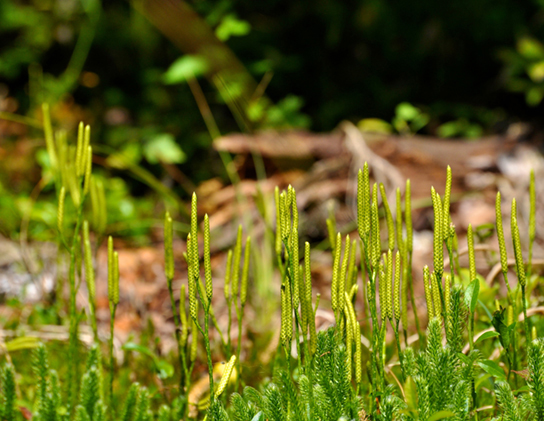

Figure 25.17図 25.17
Lycopodium. In the club mosses such as Lycopodium clavatum, sporangia are arranged in clusters called strobili. The generic name means "wolf-foot" from the resemblance of the branched sporophyte to a paw. The specific epithet clavatum refers to the club-shaped strobilus, and reflects the common name of the phylum. (credit: Cory Zanker)
英語のヒント
ヒカゲノカズラ属。Lycopodium clavatum などのヒカゲノカズラ類では、胞子嚢が、胞子嚢穂と呼ばれる集まりをなして配列する。属名は「オオカミの足」を意味し、枝分かれした胞子体が足に似ていることに由来する。種小名 clavatum は、こん棒状の胞子嚢穂を指し、この門の英語の通称を反映している。(クレジット:Cory Zanker)