第25章種子をつくらない植物
25.3 Bryophytes25.3 コケ植物
Learning Objectives学習目標
By the end of this section, you will be able to do the following:
この節を学び終えると、次のことができるようになる。
- Identify the main characteristics of bryophytesコケ植物の主な特徴を挙げる。
- Describe the distinguishing traits of liverworts, hornworts, and mosses苔類、ツノゴケ類、蘚類を区別する形質を説明する。
- Chart the development of land adaptations in the bryophytes
英語のヒント
コケ植物における陸上適応の発達を図示する。 - Describe the events in the bryophyte lifecycleコケ植物の生活環で起こる出来事を説明する。
Bryophytes are the closest extant relatives of early terrestrial plants. The first bryophytes (liverworts) most likely appeared in the Ordovician period, about 450 million years ago. Because they lack lignin and other resistant structures, the likelihood of bryophytes forming fossils is rather small. Some spores protected by sporopollenin have survived and are attributed to early bryophytes. By the Silurian period (435 MYA), however, vascular plants had spread through the continents. This compelling fact is used as evidence that non-vascular plants must have preceded the Silurian period.
英語のヒント
コケ植物は、初期の陸上植物に最も近縁な現生の植物である。最初のコケ植物である苔類は、おそらく約4億5000万年前のオルドビス紀に出現した。リグニンなどの丈夫な構造を欠くため、コケ植物が化石になる可能性はかなり低い。スポロポレニンに保護された胞子の一部は残っており、初期のコケ植物に由来するとされている。しかしシルル紀、4億3500万年前までには、維管束植物が大陸全体に広がっていた。この説得力のある事実は、非維管束植物がシルル紀よりも前に存在していたはずだという証拠として用いられる。
More than 25,000 species of bryophytes thrive in mostly damp habitats, although some live in deserts. They constitute the major flora of inhospitable environments like the tundra, where their small size and tolerance to desiccation offer distinct advantages. They generally lack lignin and do not have actual tracheids (xylem cells specialized for water conduction). Rather, water and nutrients circulate inside specialized conducting cells. Although the term non-tracheophyte is more accurate, bryophytes are commonly called non-vascular plants.
英語のヒント
2万5000種を超えるコケ植物が、主として湿った生息地で生育しているが、砂漠に暮らすものもある。ツンドラのような厳しい環境では、主要な植物群を構成する。こうした場所では、小さな体と乾燥への耐容性が明確な利点となる。一般にリグニンを欠き、本来の仮道管、すなわち水の輸送に特化した木部細胞をもたない。その代わり、水と栄養分は特殊化した通導細胞の内部を循環する。「非維管束植物」よりも「非仮道管植物」のほうが正確な用語だが、コケ植物は一般に非維管束植物と呼ばれている。
In a bryophyte, all the conspicuous vegetative organs—including the photosynthetic leaf-like structures, the thallus (“plant body”), stem, and the rhizoid that anchors the plant to its substrate—belong to the haploid organism or gametophyte. The male gametes formed by bryophytes swim with a flagellum, so fertilization is dependent on the presence of water. The bryophyte embryo also remains attached to the parent plant, which protects and nourishes it. The sporophyte that develops from the embryo is barely noticeable. The sporangium—the multicellular sexual reproductive structure in which meiosis produces haploid spores—is present in bryophytes and absent in the majority of algae. This is also a characteristic of land plants.
英語のヒント
コケ植物では、光合成を行う葉のような構造、葉状体、すなわち「植物体」、茎、そして植物を基質に固定する仮根など、目につく栄養器官はすべて、半数体の個体、すなわち配偶体に属する。コケ植物がつくる雄性配偶子は鞭毛で泳ぐため、受精は水の存在に依存する。コケ植物の胚も親植物につながったままで、親から保護と栄養を受ける。胚から発達する胞子体は、ほとんど目立たない。胞子嚢は、減数分裂によって半数体胞子をつくる多細胞の有性生殖構造であり、コケ植物には存在するが、大半の藻類には存在しない。これも陸上植物の特徴である。
The bryophytes are divided into three phyla: the liverworts or Marchantiophyta, the hornworts or Anthocerotophyta, and the mosses or true Bryophyta.
コケ植物は、苔類のゼニゴケ植物門、ツノゴケ類のツノゴケ植物門、そして蘚類、すなわち狭義の蘚類植物門の三つの門に分けられる。
Liverworts苔類
Liverworts (Marchantiophyta) are currently classified as the plants most closely related to the ancestor of vascular plants that adapted to terrestrial environments. In fact, liverworts have colonized every terrestrial habitat on Earth and diversified to more than 7000 existing species (Figure 25.9). Lobate liverworts form a flat thallus, with lobes that have a vague resemblance to the lobes of the liver (Figure 25.10), which accounts for the name given to the phylum. Leafy liverworts have tiny leaflike structures attached to a stalk. Several leafy liverworts are shown in Figure 25.9.
英語のヒント
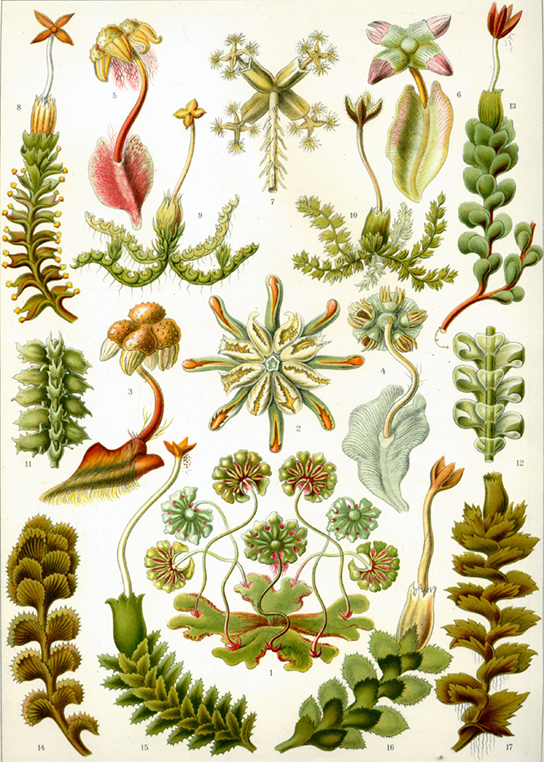
Figure 25.9図 25.9
Liverworts. This 1904 drawing shows the variety of forms of Marchantiophyta.
苔類。1904年に描かれたこの図は、ゼニゴケ植物門の形態の多様性を示している。
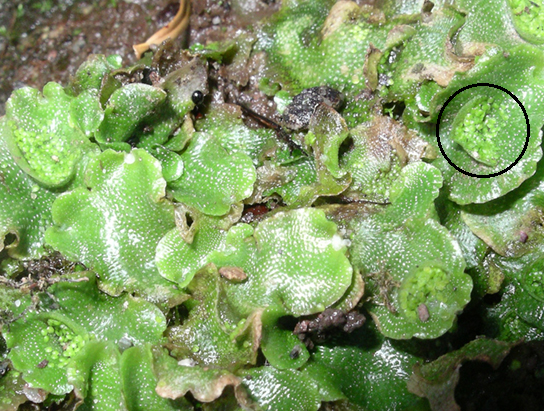


Figure 25.10図 25.10
Liverwort gametophyte. A liverwort, Lunularia cruciata, displays its lobate, flat thallus. The organism in the photograph is in the gametophyte stage, but has not yet produced gametangia. Lunularia gametophytes produce crescent-shaped gemmae (circled), which contain asexual spores. The tiny white dots on the surface of the thallus are air pores.
英語のヒント
苔類の配偶体。ミカヅキゼニゴケ Lunularia cruciata には、裂片のある平たい葉状体が見られる。写真の個体は配偶体の段階にあるが、まだ配偶子嚢をつくっていない。ミカヅキゼニゴケの配偶体は、無性胞子を含む三日月形の無性芽をつくる(丸で囲った部分)。葉状体表面の小さな白い点は、気室孔である。
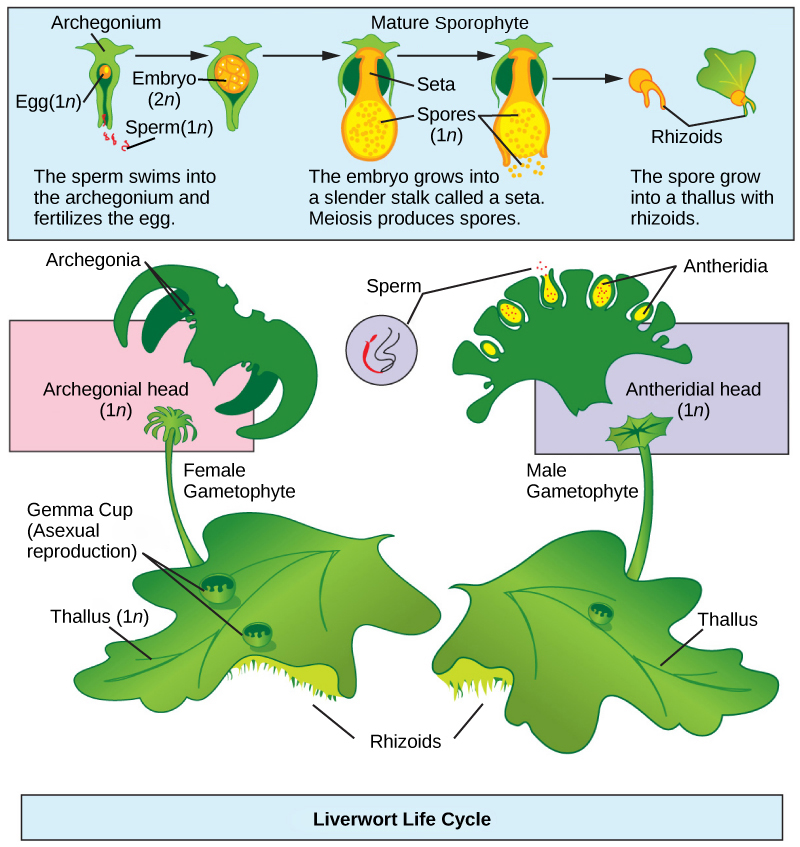
Openings in the thallus that allow the movement of gases may be observed in liverworts (Figure 25.10). However, these are not stomata, because they do not actively open and close by the action of guard cells. Instead, the thallus takes up water over its entire surface and has no cuticle to prevent desiccation, which explains their preferred wet habitats. Figure 25.11 represents the lifecycle of a lobate liverwort. Haploid spores germinate into flattened thalli attached to the substrate by thin, single-celled filaments. Stalk-like structures (gametophores) grow from the thallus and carry male and female gametangia, which may develop on separate, individual plants, or on the same plant, depending on the species. Flagellated male gametes develop within antheridia (male gametangia). The female gametes develop within archegonia (female gametangia). Once released, the male gametes swim with the aid of their flagella to an archegonium, and fertilization ensues. The zygote grows into a small sporophyte still contained in the archegonium. The diploid zygote will give rise, by meiosis, to the next generation of haploid spores, which can be disseminated by wind or water. In many liverworts, spore dispersal is facilitated by elaters—long single cells that suddenly change shape as they dry out and throw adjacent spores out of the spore capsule. Liverwort plants can also reproduce asexually, by the breaking of “branches” or the spreading of leaf fragments called gemmae. In this latter type of reproduction, the gemmae—small, intact, complete pieces of plant that are produced in a cup on the surface of the thallus (shown in Figure 25.11 and Figure 25.12)—are splashed out of the cup by raindrops. The gemmae then land nearby and develop into gametophytes.
英語のヒント
苔類では、気体の移動を可能にする葉状体の開口部が観察できる(図25.10)。しかし、孔辺細胞の作用によって能動的に開閉するわけではないため、これらは気孔ではない。葉状体は表面全体で水を取り込み、乾燥を防ぐクチクラをもたない。このことが、苔類が湿った生息地を好む理由である。図25.11は、裂片をもつ苔類の生活環を示している。半数体胞子は発芽して、細い単細胞の糸状構造で基質に付着した平たい葉状体になる。葉状体から柄のような構造、配偶子嚢托が伸び、雄性と雌性の配偶子嚢をつける。種によって、それぞれが別個体に発達する場合と、同じ個体に発達する場合がある。鞭毛をもつ雄性配偶子は、雄性配偶子嚢である造精器の内部で発達する。雌性配偶子は、雌性配偶子嚢である造卵器の内部で発達する。放出された雄性配偶子は鞭毛を使って造卵器へ泳ぎ、続いて受精が起こる。接合子は、造卵器の中に収まったまま小さな胞子体へと成長する。二倍体の接合子は減数分裂によって次世代の半数体胞子を生じ、胞子は風や水によって散布される。多くの苔類では、弾糸が胞子散布を助ける。弾糸は長い単細胞で、乾くと突然形を変え、隣接する胞子を胞子嚢から投げ出す。苔類は「枝」が折れたり、無性芽と呼ばれる葉の断片が広がったりすることによって、無性生殖も行う。後者の生殖では、葉状体の表面にある杯状構造の中で、小さくても欠損のない完全な植物の一片である無性芽がつくられる(図25.11と図25.12)。雨粒が当たると、無性芽は杯状構造の外へ飛び出す。その後、近くに着地して配偶体に発達する。
OpenStax, Rice University; Biology 2e. (credit: modification of work by Mariana Ruiz Villareal) · CC BY 4.0 · Source出典

Figure 25.11図 25.11
Reproductive cycle of liverworts. The life cycle of a typical lobate liverwort is shown. This image shows a liverwort in which antheridia and archegonia are produced on separate gametophytes. (credit: modification of work by Mariana Ruiz Villareal)
苔類の生殖環。典型的な、裂片をもつ苔類の生活環を示している。この図の苔類では、造精器と造卵器が別々の配偶体につくられる。(クレジット:Mariana Ruiz Villareal の作品を改変)