第25章種子をつくらない植物
Evolution of Land Plants陸上植物の進化
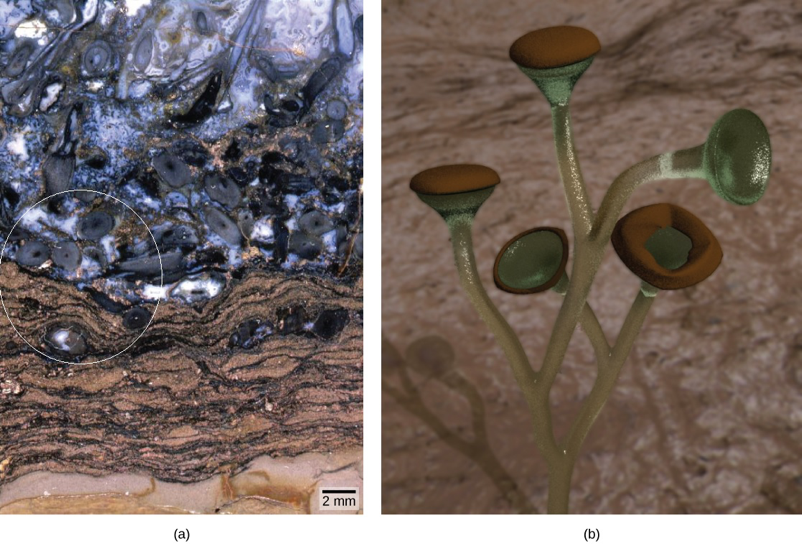
No discussion of the evolution of plants on land can be undertaken without a brief review of the timeline of the geological eras. The early era, known as the Paleozoic, is divided into six periods. It starts with the Cambrian period, followed by the Ordovician, Silurian, Devonian, Carboniferous, and Permian. The major event to mark the Ordovician, more than 500 million years ago, was the colonization of land by the ancestors of modern land plants. Fossilized cells, cuticles, and spores of early land plants have been dated as far back as the Ordovician period in the early Paleozoic era. The oldest-known vascular plants have been identified in deposits from the late Silurian and early Devonian. One of the richest sources of information is the Rhynie chert, a sedimentary rock deposit found in Rhynie, Scotland (Figure 25.5), where embedded fossils of some of the earliest vascular plants have been identified.
英語のヒント
陸上植物の進化を論じるには、地質時代の時間軸を簡単に振り返る必要がある。古生代という初期の時代は、六つの紀に分かれる。カンブリア紀に始まり、オルドビス紀、シルル紀、デボン紀、石炭紀、ペルム紀が続く。5億年以上前のオルドビス紀を特徴づける主要な出来事は、現代の陸上植物の祖先による陸上進出だった。初期の陸上植物の化石化した細胞、クチクラ、胞子は、古生代初期のオルドビス紀にまでさかのぼる。既知の最古の維管束植物は、シルル紀後期とデボン紀初期の堆積物で確認されている。特に情報が豊富なのは、スコットランドのライニーにある堆積岩層、ライニーチャートである(図25.5)。そこに埋め込まれた、最初期の維管束植物の化石が同定されている。
OpenStax, Rice University; Biology 2e. (credit b: modification of work by Peter Coxhead based on original image by “Smith609”/Wikimedia Commons; scale-bar data from Matt Russell) · CC BY 4.0 · Source出典

Figure 25.5図 25.5
Early vascular plant fossils. This Rhynie chert (a) contains fossilized material from vascular plants. Reconstruction of Cooksonia (b), is shown based upon the fossilized remains inside the circle in (a). (credit b: modification of work by Peter Coxhead based on original image by “Smith609”/Wikimedia Commons; scale-bar data from Matt Russell)
初期の維管束植物の化石。(a)このライニーチャートは、維管束植物の化石を含む。(b)Cooksoniaの復元図は、aの円内の化石遺体に基づく。(bのクレジット:“Smith609”/Wikimedia Commonsの原画像に基づくPeter Coxheadの作品を改変。スケールバーのデータ:Matt Russell)
Paleobotanists distinguish between extinct species, as fossils, and extant species, which are still living. These extinct vascular plants most probably lacked true leaves and roots and formed low vegetation mats similar in size to modern-day mosses, although some could reach one meter in height. The later genus Cooksonia, which flourished during the Silurian, has been extensively studied from well-preserved examples. Imprints of Cooksonia show slender branching stems ending in what appear to be sporangia. From the recovered specimens, it is not possible to establish for certain whether Cooksonia possessed vascular tissues. Fossils indicate that by the end of the Devonian period, ferns, horsetails, and seed plants populated the landscape, giving rising to trees and forests. This luxuriant vegetation helped enrich the atmosphere with oxygen, making it easier for air-breathing animals to colonize dry land. Plants also established early symbiotic relationships with fungi, creating mycorrhizae: a relationship in which the fungal network of filaments increases the efficiency of the plant root system, and the plants provide the fungi with byproducts of photosynthesis.
英語のヒント
古植物学者は、化石として残る絶滅種と、今も生きている現生種を区別する。これらの絶滅した維管束植物は、おそらく真の葉と根を欠き、現代のコケほどの低い植生マットを作っていた。ただし、高さ1メートルに達するものもあった。後に現れ、シルル紀に繁栄したCooksonia属は、保存のよい標本から詳しく研究されている。その印象化石は、細い分枝する茎の先に、胞子嚢らしきものがあることを示す。得られた標本からは、維管束組織をもっていたかどうかを、確実には判断できない。化石は、デボン紀末までに、シダ、トクサ類、種子植物が景観に広がり、樹木や森林を生じたことを示す。この豊かな植生は、大気に酸素を増やし、空気呼吸する動物が陸地へ進出するのを容易にした。植物はまた、菌類との初期の共生関係を築き、菌根を作った。この関係では、菌糸の網が根系の効率を高め、植物は光合成の副産物を菌類へ与える。