第25章種子をつくらない植物
25.2 Green Algae: Precursors of Land Plants25.2 緑藻:陸上植物の先駆者
Learning Objectives学習目標
By the end of this section, you will be able to do the following:
この節を学び終えると、次のことができるようになる。
- Describe the traits shared by green algae and land plants緑藻と陸上植物が共有する形質を説明する。
- Explain why charophytes are considered the closest algal relative to land plantsシャジクモ類が、藻類の中で陸上植物に最も近縁と考えられる理由を説明する。
- Explain how current phylogenetic relationships are reshaped by comparative analysis of DNA sequences
英語のヒント
DNA 配列の比較解析によって、現在の系統関係がどのように見直されるかを説明する。
Streptophytesストレプト植物
Until recently, all photosynthetic eukaryotes were classified as members of the kingdom Plantae. The brown and golden algae, however, are now reassigned to the protist supergroup Chromalveolata. This is because apart from their ability to capture light energy and fix CO2, they lack many structural and biochemical traits that are characteristic of plants. The plants are now classified, along with the red and green algae, in the protist supergroup Archaeplastida. Green algae contain the same carotenoids and chlorophyll a and b as land plants, whereas other algae have different accessory pigments and types of chlorophyll molecules in addition to chlorophyll a. Both green algae and land plants also store carbohydrates as starch. Their cells contain chloroplasts that display a dizzying variety of shapes, and their cell walls contain cellulose, as do land plants. Which of the green algae to include among the plants has not been phylogenetically resolved.
英語のヒント
最近まで、すべての光合成真核生物は植物界に分類されていた。しかし、褐藻と黄金色藻は現在、原生生物のスーパーグループであるクロムアルベオラータに移されている。光エネルギーを捕らえ、CO2を固定する能力以外には、植物に特徴的な構造的・生化学的形質の多くを欠くためである。植物は現在、紅藻や緑藻とともに、原生生物のスーパーグループであるアーケプラスチダに分類される。緑藻は、陸上植物と同じカロテノイドおよび葉緑素a、bを含む。一方、他の藻類は、葉緑素aに加え、異なる補助色素や種類の葉緑素分子をもつ。緑藻と陸上植物は、ともに炭水化物をデンプンとして貯蔵する。その細胞には、目を見張るほど多様な形の葉緑体があり、陸上植物と同じく、細胞壁にセルロースを含む。緑藻のどれを植物に含めるかは、系統学的には解決されていない。
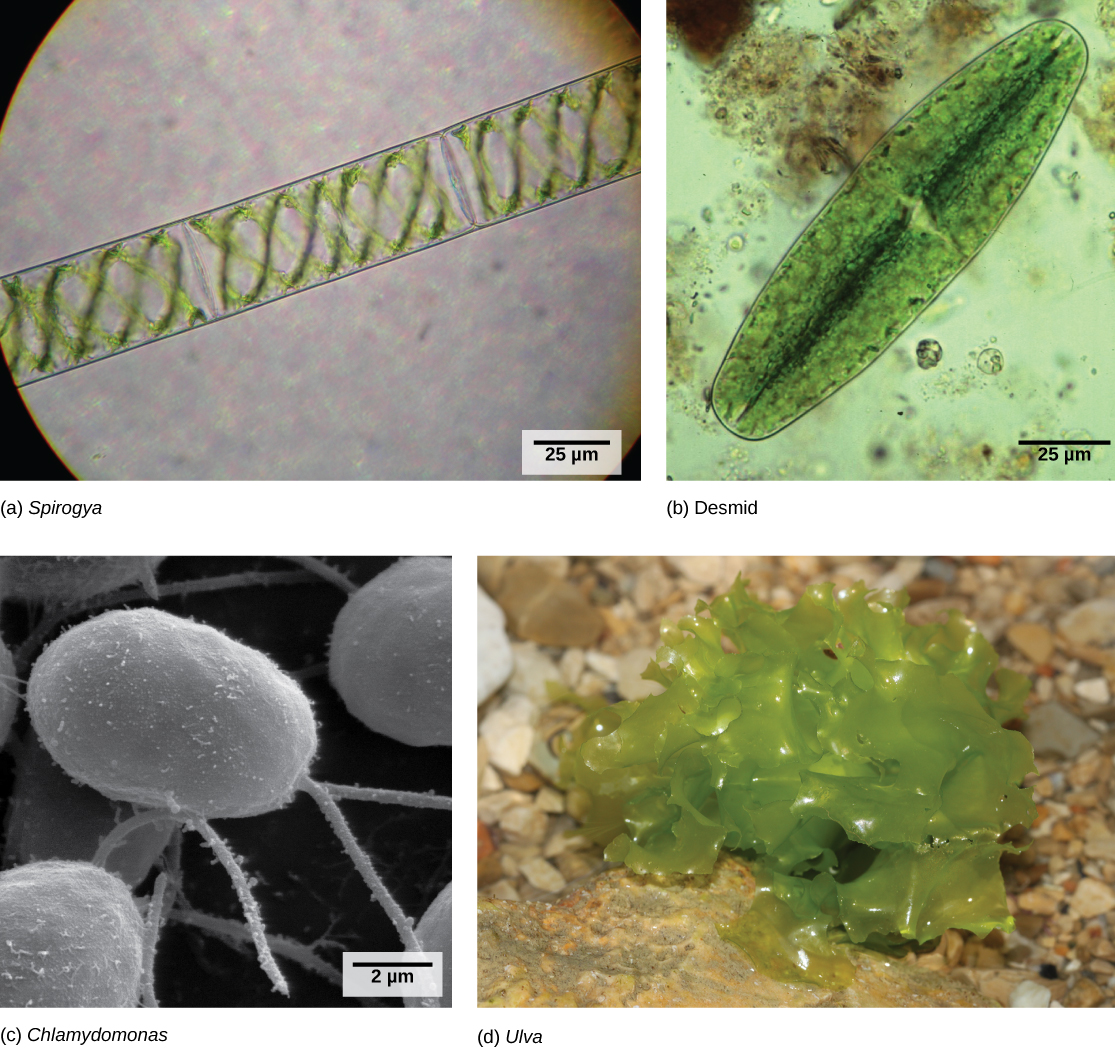
Green algae fall into two major groups, the chlorophytes and the charophytes. The chlorophytes include the genera Chlorella, Chlamydomonas, the sea lettuce Ulva, and the colonial alga Volvox. The charophytes include desmids, as well as the genera Spirogyra, Coleochaete, and Chara. There are familiar green algae in both groups. Some green algae are single cells, such as Chlamydomonas and desmids, which adds to the ambiguity of green algae classification, because plants are multicellular. Other green algae, like Volvox, form colonies, and some, like Ulva are multicellular (Figure 25.7). Spirogyra is a long filament of colonial cells. Most members of this genus live in fresh water, brackish water, seawater, or even in snow patches. A few green algae can survive on soil, provided it is covered by a thin film of moisture within which they can live. Periodic dry spells provide a selective advantage to algae that can survive water stress.
英語のヒント
緑藻は、クロロフィタとシャジクモ類という二つの主要群に分かれる。クロロフィタには、クロレラ属、クラミドモナス属、「海のレタス」と呼ばれるアオサ属、群体性藻類のボルボックス属が含まれる。シャジクモ類には、ツヅミモ類に加え、アオミドロ属、Coleochaete属、Chara属が含まれる。どちらの群にも、よく知られた緑藻がある。クラミドモナスやツヅミモ類のように単細胞の緑藻もあり、植物は多細胞であることから、緑藻分類の曖昧さを増している。ボルボックスのように群体を作るものや、アオサのように多細胞のものもある(図25.7)。アオミドロは、群体をなす細胞の長い糸状体である。この属の大部分は、淡水、汽水、海水、さらには雪の斑状に残る場所にもすむ。少数の緑藻は、生きられる薄い水膜で覆われていれば、土の上でも生存できる。周期的な乾燥期は、水ストレスに耐える藻類に、選択上の優位性を与える。
OpenStax, Rice University; Biology 2e. (credit b: modification of work by Derek Keats; credit c: modification of work by Dartmouth Electron Microscope Facility, Dartmouth College; credit d: modification of work by Holger Krisp; scale-bar data from Matt Russell) · CC BY 4.0 · Source出典

Figure 25.7図 25.7
Green algae. Charophyta include (a) Spirogyra and (b) desmids. Chlorophyta include (c) Chlamydomonas, and (d) Ulva. Desmids and Chlamydomonas are single-celled organisms, Spirogyra forms chains of cells, and Ulva forms multicellular structures resembling leaves, although the cells are not differentiated as they are in higher plants (credit b: modification of work by Derek Keats; credit c: modification of work by Dartmouth Electron Microscope Facility, Dartmouth College; credit d: modification of work by Holger Krisp; scale-bar data from Matt Russell)
緑藻。シャジクモ類には、(a)アオミドロと(b)ツヅミモ類が含まれる。クロロフィタには、(c)クラミドモナスと(d)アオサが含まれる。ツヅミモ類とクラミドモナスは単細胞生物で、アオミドロは細胞の鎖を、アオサは葉に似た多細胞構造を作る。ただし、細胞は高等植物のようには分化していない。(bのクレジット:Derek Keatsによる作品を改変。c:Dartmouth CollegeのDartmouth Electron Microscope Facilityによる作品を改変。d:Holger Krispによる作品を改変。スケールバーのデータ:Matt Russell)
The chlorophytes and the charophytes differ in a few respects that, in addition to molecular analysis, place the land plants as a sister group of the charophytes. First, cells in charophytes and the land plants divide along cell plates called phragmoplasts, in which microtubules parallel to the spindle serve as guides for the vesicles of the forming cell plate. In the chlorophytes, the cell plate is organized by a phycoplast, in which the microtubules are perpendicular to the spindle. Second, only the charophytes and the land plants have plasmodesmata, or intercellular channels that allow the transfer of materials from cell to cell. In the chlorophytes, intercellular connections do not persist in mature multicellular forms. Finally, both charophytes and the land plants show apical growth—growth from the tips of the plant rather than throughout the plant body. Consequently, land plants and the charophytes are now part of a new monophyletic group called Streptophyta.
英語のヒント
クロロフィタとシャジクモ類は、いくつかの点で異なる。これらの相違と分子解析により、陸上植物はシャジクモ類の姉妹群に置かれる。第一に、シャジクモ類と陸上植物の細胞は、フラグモプラストと呼ばれる細胞板に沿って分裂する。そこでは、紡錘体に平行な微小管が、形成中の細胞板の小胞を導く。クロロフィタでは、細胞板はファイコプラストによって組織化され、その微小管は紡錘体と直交する。第二に、シャジクモ類と陸上植物だけが、細胞間の物質移動を可能にする通路、原形質連絡をもつ。クロロフィタでは、成熟した多細胞体に細胞間のつながりは残らない。最後に、両者は、植物体全体ではなく先端から成長する、頂端成長を示す。そのため、陸上植物とシャジクモ類は現在、ストレプト植物という新しい単系統群に含まれる。
Reproduction of Green Algae緑藻の生殖
Green algae reproduce both asexually, by fragmentation or dispersal of spores, or sexually, by producing gametes that fuse during fertilization. In a single-celled organism such as Chlamydomonas, there is no mitosis after fertilization. In the multicellular Ulva, a sporophyte grows by mitosis after fertilization (and thus exhibits alternation of generations). Both Chlamydomonas and Ulva produce flagellated gametes.
英語のヒント
緑藻は、断片化や胞子散布によって無性生殖し、受精時に融合する配偶子を作ることによって有性生殖もする。クラミドモナスのような単細胞生物では、受精後に有糸分裂は起こらない。多細胞のアオサでは、受精後に有糸分裂によって胞子体が成長し、したがって世代交代を示す。クラミドモナスとアオサは、どちらも鞭毛のある配偶子を作る。
Charophytesシャジクモ類
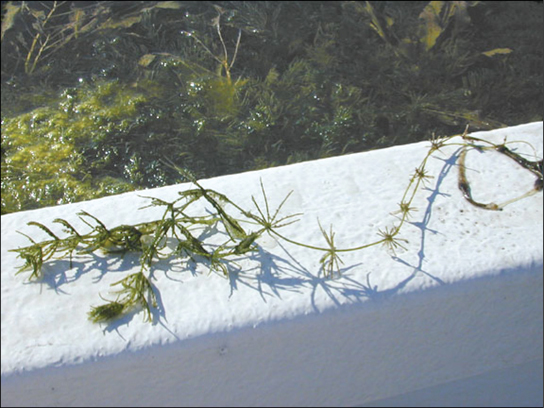
The charophytes include several different algal orders that have each been suggested to be the closest relatives of the land plants: the Charales, the Zygnematales, and the Coleochaetales. The Charales can be traced back 420 million years. They live in a range of freshwater habitats and vary in size from a few millimeters to a meter in length. The representative genus is Chara (Figure 25.8), often called muskgrass or skunkweed because of its unpleasant smell. Large cells form the thallus: the main stem of the alga. Branches arising from the nodes are made of smaller cells. Male and female reproductive structures are found on the nodes, and the sperm have flagella. Although Chara looks superficially like some land plants, a major difference is that the stem has no supportive tissue. However, the Charales exhibit a number of traits that are significant for adaptation to land life. They produce the compounds lignin and sporopollenin, and form plasmodesmata that connect the cytoplasm of adjacent cells. Although the life cycle of the Charales is haplontic (the main form is haploid, and diploid zygotes are formed but have a brief existence), the egg, and later, the zygote, form in a protected chamber on the haploid parent plant.
英語のヒント
シャジクモ類には、シャジクモ目、ホシミドロ目、コレオケーテ目など、いくつかの藻類の目が含まれ、それぞれが陸上植物の最も近い親類の候補とされてきた。シャジクモ目は4億2,000万年前までさかのぼる。多様な淡水環境にすみ、大きさは数ミリメートルから長さ1メートルまである。代表的な属はChara(図25.8)で、不快なにおいのため、英語ではmuskgrassやskunkweedと呼ばれることが多い。大型細胞が、藻類の主軸である葉状体を作る。節から出る枝は、より小さな細胞からなる。雄性と雌性の生殖構造は節にあり、精子は鞭毛をもつ。Charaは表面的には一部の陸上植物に似るが、大きな違いは、茎に支持組織がないことである。しかしシャジクモ目は、陸上生活への適応に重要な多くの特徴を示す。リグニンとスポロポレニンを作り、隣接細胞の細胞質をつなぐ原形質連絡を形成する。生活環は半数体型で、主な体は半数体であり、二倍体接合子は作られるが短期間しか存在しない。それでも、卵と、それに続く接合子は、半数体の親植物上の保護された室内に作られる。
OpenStax, Rice University; Biology 2e. (credit: South Florida Information Access, U.S. Geological Survey) · CC BY 4.0 · Source出典

Figure 25.8図 25.8
Chara. The representative alga, Chara, is a noxious weed in Florida, where it clogs waterways. (credit: South Florida Information Access, U.S. Geological Survey)
Chara。代表的な藻類Charaは、フロリダでは水路を詰まらせる有害な水草である。(クレジット:South Florida Information Access、U.S. Geological Survey)
The Coleochaetes are branched or disclike multicellular forms. They can produce both sexually and asexually, but the life cycle is basically haplontic. Recent extensive DNA sequence analysis of charophytes indicates that the Zygnematales are more closely related to the embryophytes than the Charales or the Coleochaetales. The Zygnematales include the familiar genus Spirogyra, as well as the desmids. As techniques in DNA analysis improve and new information on comparative genomics arises, the phylogenetic connections between the charophytes and the land plants will continued to be examined to produce a satisfactory solution to the mystery of the origin of land plants.
英語のヒント
Coleochaete類は、枝分かれした、または円盤状の多細胞体である。有性生殖も無性生殖もできるが、生活環は基本的に半数体型である。近年のシャジクモ類の広範なDNA配列解析は、ホシミドロ目が、シャジクモ目やコレオケーテ目よりも有胚植物に近縁であることを示す。ホシミドロ目には、よく知られたアオミドロ属に加え、ツヅミモ類が含まれる。DNA解析技術が向上し、比較ゲノミクスの新情報が得られるにつれて、陸上植物の起源の謎に納得できる解決を与えるため、シャジクモ類と陸上植物の系統的なつながりは、今後も検討され続けるだろう。