第25章種子をつくらない植物
Phylum Monilophyta: Class Equisetopsida (Horsetails)大葉シダ植物門:トクサ綱(トクサ類)
Horsetails, whisk ferns, and ferns belong to the phylum Monilophyta, with horsetails placed in the class Equisetopsida. The single genus Equisetum is the survivor of a large group of plants, known as Arthrophyta, which produced large trees and entire swamp forests in the Carboniferous. The plants are usually found in damp environments and marshes (Figure 25.18).
英語のヒント
トクサ類、マツバラン類、シダ類は大葉シダ植物門に属し、その中でトクサ類はトクサ綱に置かれる。唯一の属であるトクサ属 Equisetum は、有節植物と呼ばれる大きな植物群の生き残りである。有節植物は石炭紀に大木となり、湿地林全体を形成していた。これらの植物は、ふつう湿った環境や湿地に見られる(図25.18)。
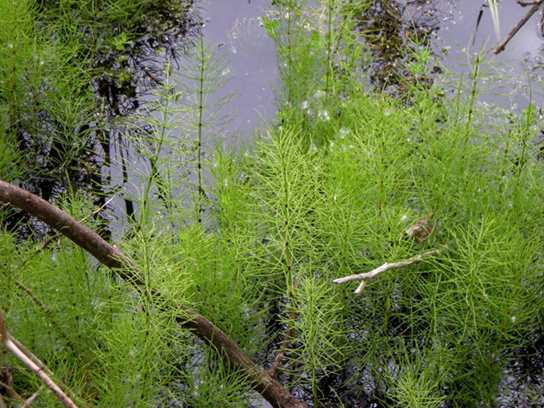
Figure 25.18図 25.18
Horsetails. Horsetails, named for the brushy appearance of the sporophyte, thrive in a marsh. (credit: Myriam Feldman)
トクサ類。胞子体のブラシのような見た目から名づけられたトクサ類が、湿地によく生育している。(クレジット:Myriam Feldman)
The stem of a horsetail is characterized by the presence of joints or nodes, hence the name Arthrophyta (arthro- = "joint"; -phyta = "plant"). Leaves and branches come out as whorls from the evenly spaced joints. The needle-shaped leaves do not contribute greatly to photosynthesis, the majority of which takes place in the green stem (Figure 25.19).
英語のヒント
トクサ類の茎は、継ぎ目、すなわち節があることを特徴とする。そのため、Arthrophyta という名がついている(arthro- は「関節」、-phyta は「植物」)。等間隔に並ぶ節から、葉と枝が輪生する。針状の葉は光合成にあまり寄与せず、光合成の大部分は緑色の茎で行われる(図25.19)。
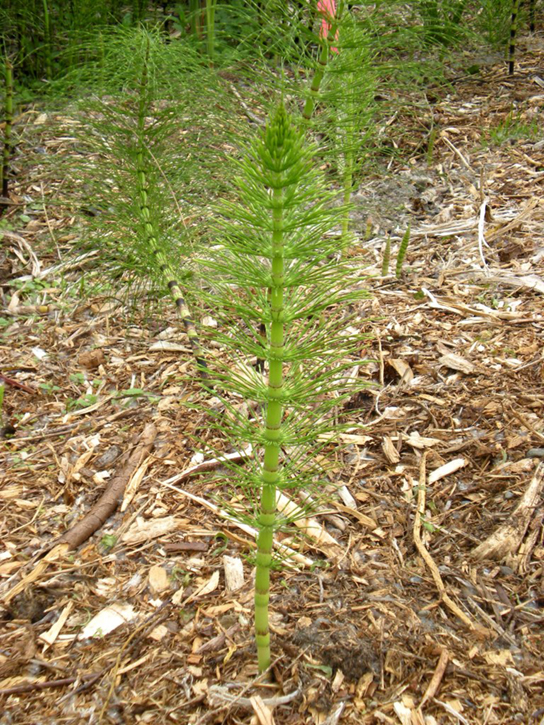
Figure 25.19図 25.19
The jointed stem of a horsetail. Thin leaves originating at the joints are noticeable on the horsetail plant. Because silica deposited in the cell walls made these plants abrasive, horsetails were once used as scrubbing brushes and were nicknamed scouring rushes. (credit: Myriam Feldman)
英語のヒント
節のあるトクサ類の茎。トクサ類では、節から生じる細い葉が目立つ。細胞壁に沈着したシリカによって表面が研磨性をもつため、かつてはたわしとして使われ、「磨き草」とも呼ばれていた。(クレジット:Myriam Feldman)
Silica collected by in the epidermal cells contributes to the stiffness of horsetail plants, but underground stems known as rhizomes anchor the plants to the ground. Modern-day horsetails are homosporous. The spores are attached to elaters—as we have seen, these are coiled threads that spring open in dry weather and casts the spores to a location distant from the parent plants. The spores then germinate to produce small bisexual gametophytes.
英語のヒント
表皮細胞に蓄積したシリカは、トクサ類の硬さに寄与する。一方、根茎と呼ばれる地下茎が植物を地面に固定する。現生のトクサ類は同形胞子性である。胞子には弾糸が付いている。これまで見たように、弾糸は巻いた糸状構造で、乾燥した天候になると勢いよく開き、胞子を親植物から離れた場所へ飛ばす。その後、胞子が発芽して、小さな両性の配偶体をつくる。
Phylum Monilophyta: Class Psilotopsida (Whisk Ferns)大葉シダ植物門:マツバラン綱(マツバラン類)
While most ferns form large leaves and branching roots, the whisk ferns, class Psilotopsida, lack both roots and leaves, probably lost by reduction. Photosynthesis takes place in their green stems, which branch dichotomously. Small yellow knobs form at the tip of a branch or at branch nodes and contain the sporangia (Figure 25.20). Spores develop into gametophytes that are only a few millimeters across, but which produce both male and female gametangia. Whisk ferns were considered early pterophytes. However, recent comparative DNA analysis suggests that this group may have lost both vascular tissue and roots through evolution, and is more closely related to ferns.
英語のヒント
大半のシダ類は大きな葉と枝分かれした根をつくるが、マツバラン綱のマツバラン類は、根も葉も欠く。おそらく退化によって失われたと考えられる。光合成は、二又に枝分かれする緑色の茎で行われる。枝の先端や節には、胞子嚢を含む小さな黄色いこぶができる(図25.20)。胞子は、幅がわずか数ミリメートルの配偶体へ発達するが、この配偶体は雄性と雌性の両方の配偶子嚢をつくる。マツバラン類は初期のシダ植物と考えられていた。しかし最近の DNA の比較解析では、このグループが進化の過程で維管束組織と根の両方を失った可能性があり、シダ類により近縁であることが示唆されている。
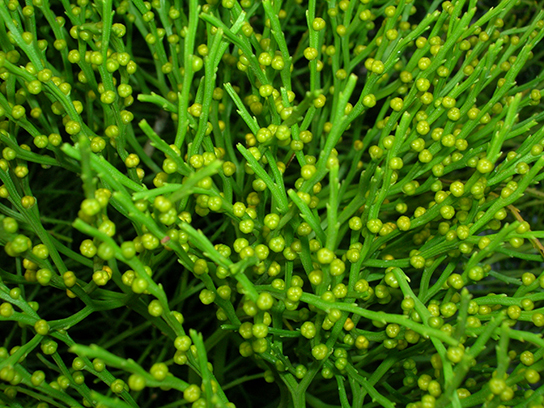
Figure 25.20図 25.20
Psilotum. The whisk fern Psilotum nudum has conspicuous green stems with knob-shaped sporangia. (credit: Forest & Kim Starr)
マツバラン属。マツバラン Psilotum nudum は、こぶ状の胞子嚢をもつ目立つ緑色の茎を備える。(クレジット:Forest & Kim Starr)
Phylum Monilophyta: Class Polypodiopsida (True Ferns)大葉シダ植物門:ウラボシ綱(真正シダ類)
With their large fronds, the true ferns are perhaps the most readily recognizable seedless vascular plants. They are also considered to be the most advanced seedless vascular plants and display characteristics commonly observed in seed plants. More than 20,000 species of ferns live in environments ranging from the tropics to temperate forests. Although some species survive in dry environments, most ferns are restricted to moist, shaded places. Ferns made their appearance in the fossil record during the Devonian period (420 MYA) and expanded during the Carboniferous (360 to 300 MYA).
英語のヒント
大きな葉をもつ真正シダ類は、おそらく無種子維管束植物の中で最も容易に見分けられる。また、最も進んだ無種子維管束植物と考えられ、種子植物によく見られる特徴を示す。2万種を超えるシダ類が、熱帯から温帯林までの環境に暮らしている。乾燥した環境で生きる種もあるが、大半は湿った日陰に限られる。シダ類はデボン紀、4億2000万年前に化石記録へ現れ、石炭紀の3億6000万〜3億年前に広がった。
The dominant stage of the life cycle of a fern is the sporophyte, which consists of large compound leaves called fronds. Fronds may be either finely divided or broadly lobed. Fronds fulfill a double role; they are photosynthetic organs that also carry reproductive organs. The stem may be buried underground as a rhizome, from which adventitious roots grow to absorb water and nutrients from the soil; or, they may grow above ground as a trunk in tree ferns (Figure 25.21). Adventitious organs are those that grow in unusual places, such as roots growing from the side of a stem.
英語のヒント
シダの生活環で優勢な段階は胞子体であり、羽葉と呼ばれる大きな複葉をもつ。羽葉は細かく分かれることも、大きな裂片に分かれることもある。光合成器官であると同時に生殖器官をつける、二重の役割を担っている。茎は根茎として地下に埋まり、そこから不定根が伸びて土壌の水と栄養分を吸収することもある。また、木生シダでは地上に幹として伸びることもある(図25.21)。不定器官とは、茎の側面から伸びる根のように、通常とは異なる場所に生じる器官である。
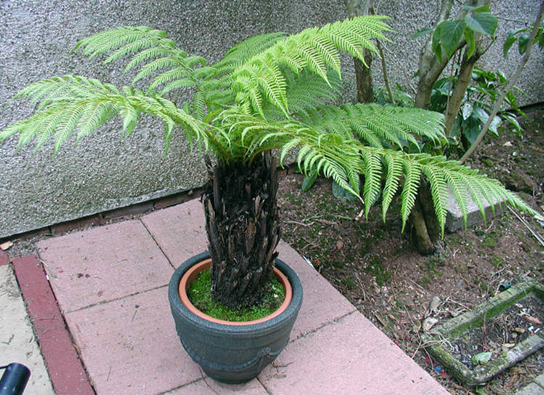


Figure 25.21図 25.21
A tree fern. Some specimens of this short tree-fern species can grow very tall. (credit: Adrian Pingstone)
木生シダ。この背の低い木生シダの種でも、非常に高く成長する個体がある。(クレジット:Adrian Pingstone)
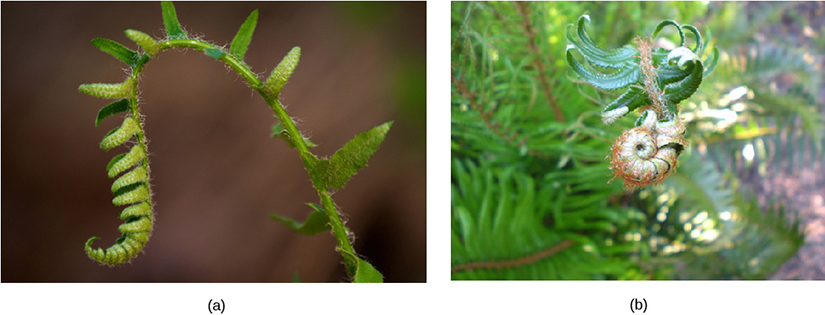
The tip of a developing fern frond is rolled into a crozier, or fiddlehead (Figure 25.22). Fiddleheads unroll as the frond develops.
英語のヒント
成長中のシダの羽葉の先端は、巻葉、またはフィドルヘッドと呼ばれる巻いた形をとる(図25.22)。羽葉が発達するにつれて、巻葉はほどける。
OpenStax, Rice University; Biology 2e. (credit a: modification of work by Cory Zanker; credit b: modification of work by Myriam Feldman) · CC BY 4.0 · Source出典

Figure 25.22図 25.22
Fern fiddleheads. Croziers, or fiddleheads, are the tips of fern fronds. (credit a: modification of work by Cory Zanker; credit b: modification of work by Myriam Feldman)
シダの巻葉。巻葉、またはフィドルヘッドは、シダの羽葉の先端である。(クレジット a:Cory Zanker の作品を改変、b:Myriam Feldman の作品を改変)
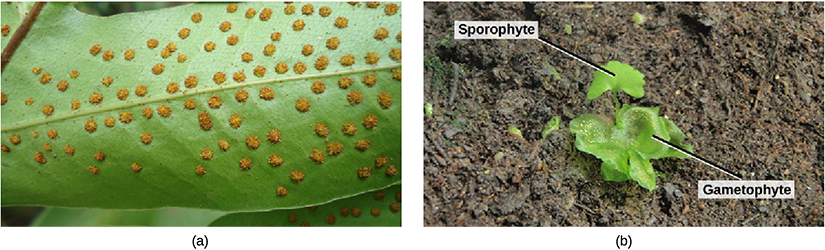
On the underside of each mature fern frond are groups of sporangia called sori (Figure 25.23a). Most ferns are homosporous. Spores are produced by meiosis and are released into the air from the sporangium. Those that land on a suitable substrate germinate and form a heart-shaped gametophyte, or prothallus, which is attached to the ground by thin filamentous rhizoids (Figure 25.23b). Gametophytes produce both antheridia and archegonia. Like the sperm cells of other pterophytes, fern sperm have multiple flagella and must swim to the archegonium, which releases a chemoattractant to guide them. The zygote develops into a fern sporophyte, which emerges from the archegonium of the gametophyte. Maturation of antheridia and archegonia at different times encourages cross-fertilization. The full life cycle of a fern is depicted in Figure 25.24.
英語のヒント
成熟したシダの羽葉の下面には、胞子嚢群と呼ばれる胞子嚢の集まりがある(図25.23a)。大半のシダ類は同形胞子性である。減数分裂によって胞子がつくられ、胞子嚢から空気中へ放出される。適した基質に着地した胞子は発芽し、ハート形の配偶体、すなわち前葉体になる。前葉体は、細い糸状の仮根で地面に付着する(図25.23b)。配偶体は、造精器と造卵器の両方をつくる。ほかのシダ植物の精子と同様、シダの精子も複数の鞭毛をもち、造卵器まで泳がなければならない。造卵器は、精子を導く化学誘引物質を放出する。接合子はシダの胞子体へ発達し、配偶体の造卵器から伸び出す。造精器と造卵器が異なる時期に成熟することが、他家受精を促す。シダの生活環全体を図25.24に示す。
OpenStax, Rice University; Biology 2e. (credit: Myriam Feldman). (b) Fern gametophyte and young sporophyte. The sporophyte and gametophyte are labeled. (credit: modification of work by "Vlmastra"/Wikimedia Commons) · CC BY 4.0 · Source出典

Figure 25.23図 25.23
Fern reproductive stages. Sori (a) appear as small bumps on the underside of a fern frond. (credit: Myriam Feldman). (b) Fern gametophyte and young sporophyte. The sporophyte and gametophyte are labeled. (credit: modification of work by "Vlmastra"/Wikimedia Commons)
シダの生殖段階。(a)シダの羽葉の下面に、小さな隆起として見える胞子嚢群。(クレジット:Myriam Feldman)(b)シダの配偶体と若い胞子体。胞子体と配偶体にラベルが付けられている。(クレジット:「Vlmastra」/Wikimedia Commons の作品を改変)