第25章種子をつくらない植物
Hornwortsツノゴケ類
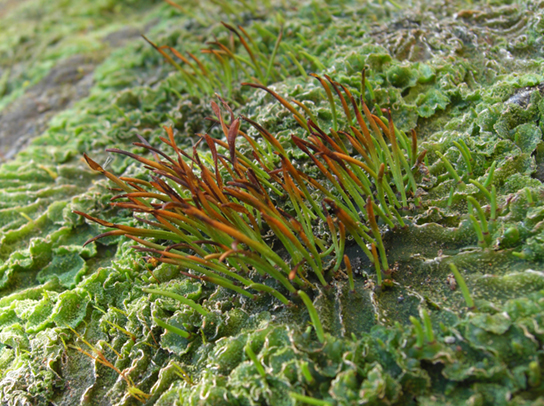
The defining characteristic of the hornworts (Anthocerotophyta) is the narrow, pipe-like sporophyte. Hornworts have colonized a variety of habitats on land, although they are never far from a source of moisture. The short, blue-green gametophyte is the dominant phase of the life cycle of a hornwort. The sporophytes emerge from the parent gametophyte and continue to grow throughout the life of the plant (Figure 25.12).
英語のヒント
ツノゴケ類、すなわちツノゴケ植物門を特徴づけるのは、細く管状の胞子体である。ツノゴケ類は陸上のさまざまな生息地に進出したが、水分の供給源から遠く離れて暮らすことはない。生活環では、背の低い青緑色の配偶体が優勢である。胞子体は親である配偶体から伸び出し、植物が生きている間ずっと成長し続ける(図25.12)。
OpenStax, Rice University; Biology 2e. (credit: modification of work by Jason Hollinger) · CC BY 4.0 · Source出典

Figure 25.12図 25.12
Hornwort sporophytes. Hornworts grow a tall and slender sporophyte. (credit: modification of work by Jason Hollinger)
ツノゴケ類の胞子体。ツノゴケ類は、背が高く細い胞子体を伸ばす。(クレジット:Jason Hollinger の作品を改変)
Stomata (air pores that can be opened and closed) appear in the hornworts and are abundant on the sporophyte. Photosynthetic cells in the thallus each contain a single chloroplast. Meristem cells at the base of the plant keep dividing and adding to the height of the sporophyte. This growth pattern is unique to the hornworts. Many hornworts establish symbiotic relationships with cyanobacteria that fix nitrogen from the environment.
英語のヒント
開閉できる空気の通り道である気孔は、ツノゴケ類に現れ、胞子体に豊富に見られる。葉状体の光合成細胞には、それぞれ葉緑体が一つずつ含まれる。植物の基部にある分裂組織の細胞は分裂し続け、胞子体の高さを増していく。この成長様式は、ツノゴケ類に特有である。多くのツノゴケ類は、環境中の窒素を固定するシアノバクテリアと共生関係を結ぶ。
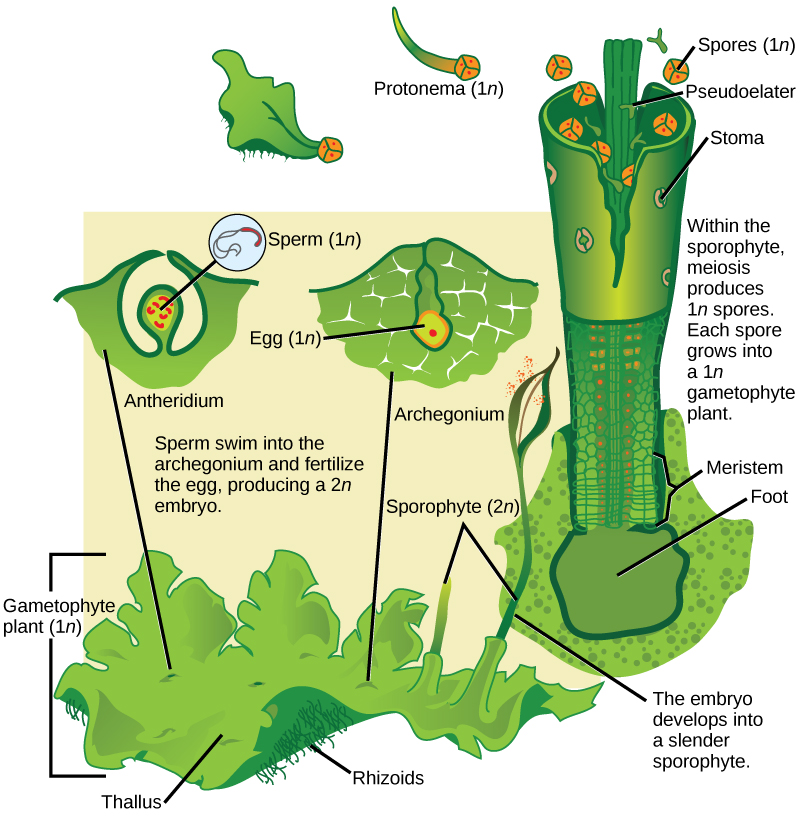
The lifecycle of hornworts (Figure 25.13) follows the general pattern of alternation of generations. The gametophytes grow as flat thalli on the soil with embedded male and female gametangia. Flagellated sperm swim to the archegonia and fertilize eggs. The zygote develops into a long and slender sporophyte that eventually splits open down the side, releasing spores. Thin branched cells called pseudoelaters surround the spores and help propel them farther in the environment. The haploid spores germinate and give rise to the next generation of gametophytes.
英語のヒント
ツノゴケ類の生活環(図25.13)は、世代交代の一般的な様式に従う。配偶体は土の上で平たい葉状体として成長し、その中に雄性と雌性の配偶子嚢が埋め込まれている。鞭毛をもつ精子が造卵器へ泳いで、卵と受精する。接合子は長く細い胞子体へと発達し、やがてその側面が裂けて胞子を放出する。胞子を取り囲む、偽弾糸と呼ばれる細く枝分かれした細胞は、胞子を周囲へより遠く飛ばすのを助ける。半数体胞子は発芽し、次世代の配偶体を生じる。
OpenStax, Rice University; Biology 2e. (credit: modification of work by “Smith609”/Wikimedia Commons based on original work by Mariana Ruiz Villareal) · CC BY 4.0 · Source出典

Figure 25.13図 25.13
Reproductive cycle of hornworts. The alternation of generation in hornworts is shown. (credit: modification of work by “Smith609”/Wikimedia Commons based on original work by Mariana Ruiz Villareal)
ツノゴケ類の生殖環。ツノゴケ類の世代交代を示している。(クレジット:Mariana Ruiz Villareal の原図に基づく「Smith609」/Wikimedia Commons の作品を改変)
Mosses蘚類
The mosses are the most numerous of the non-vascular plants. More than 10,000 species of mosses have been catalogued. Their habitats vary from the tundra, where they are the main vegetation, to the understory of tropical forests. In the tundra, the mosses’ shallow rhizoids allow them to fasten to a substrate without penetrating the frozen soil. Mosses slow down erosion, store moisture and soil nutrients, and provide shelter for small animals as well as food for larger herbivores, such as the musk ox. Mosses are very sensitive to air pollution and are used to monitor air quality. They are also sensitive to copper salts, so these salts are a common ingredient of compounds marketed to eliminate mosses from lawns.
英語のヒント
蘚類は、非維管束植物の中で最も種類が多い。1万種を超える蘚類が記載されている。生息地は、主要な植生をなすツンドラから、熱帯林の林床まで多様である。ツンドラでは、浅い仮根によって、凍った土に入り込むことなく基質に付着できる。蘚類は侵食を遅らせ、水分と土壌の栄養分を蓄え、小動物に隠れ場所を提供する。また、ジャコウウシなどの大型草食動物には食物を提供する。蘚類は大気汚染に非常に敏感で、大気の質を監視するために使われる。銅塩にも敏感なので、芝生からコケを除去するために市販されている薬剤には、銅塩がよく含まれている。
Mosses form diminutive gametophytes, which are the dominant phase of the lifecycle. Green, flat structures with a simple midrib—resembling true leaves, but lacking stomata and vascular tissue—are attached in a spiral to a central stalk. Mosses have stomata only on the sporophyte. Water and nutrients are absorbed directly through the leaflike structures of the gametophyte. Some mosses have small branches. A primitive conductive system that carries water and nutrients runs up the gametophyte's stalk, but does not extend into the leaves. Additionally, mosses are anchored to the substrate—whether it is soil, rock, or roof tiles—by multicellular rhizoids, precursors of roots. They originate from the base of the gametophyte, but are not the major route for the absorption of water and minerals. The lack of a true root system explains why it is so easy to rip moss mats from a tree trunk. The mosses therefore occupy a threshold position between other bryophytes and the vascular plants.
英語のヒント
蘚類は小さな配偶体をつくり、生活環ではこれが優勢な段階となる。中央の軸には、単純な中肋をもつ緑色の平たい構造が、らせん状に付いている。この構造は本来の葉に似るが、気孔と維管束組織を欠く。蘚類で気孔が見られるのは、胞子体だけである。水と栄養分は、配偶体の葉状構造を通じて直接吸収される。小さな枝をもつ蘚類もある。水と栄養分を運ぶ原始的な通導系が配偶体の軸を上へ走るが、葉の中までは延びていない。また蘚類は、根の前駆体である多細胞の仮根によって、土、岩、屋根瓦などの基質に固定されている。仮根は配偶体の基部から生じるが、水と無機養分を吸収する主な経路ではない。本来の根系を欠くため、樹幹からコケの敷物を簡単に引きはがすことができる。このように蘚類は、ほかのコケ植物と維管束植物との境界に位置する。
The moss lifecycle follows the pattern of alternation of generations as shown in Figure 25.14. The most familiar structure is the haploid gametophyte, which germinates from a haploid spore and forms first a protonema—usually, a tangle of single-celled filaments that hug the ground. Cells akin to an apical meristem actively divide and give rise to a gametophore, consisting of a photosynthetic stem and foliage-like structures. Male and female gametangia develop at the tip of separate gametophores. The antheridia (male organs) produce many sperm, whereas the archegonia (the female organs) each form a single egg at the base (venter) of a flask-shaped structure. The archegonium produces attractant substances and at fertilization, the sperm swims down the neck to the venter and unites with the egg inside the archegonium. The zygote, protected by the archegonium, divides and grows into a sporophyte, still attached by its foot to the gametophyte.
英語のヒント
蘚類の生活環は、図25.14に示すように世代交代の様式をとる。最もなじみのある構造は、半数体の配偶体である。これは半数体胞子の発芽によって生じ、まず原糸体をつくる。原糸体は通常、地面に密着する単細胞の糸状構造が絡み合ったものである。頂端分裂組織に似た細胞が活発に分裂し、光合成を行う茎と葉状構造からなる配偶子嚢托を生じる。雄性と雌性の配偶子嚢は、別々の配偶子嚢托の先端に発達する。雄性器官である造精器は多数の精子をつくるが、雌性器官である造卵器は、それぞれフラスコ状構造の基部、すなわち腹部に卵を一つつくる。造卵器は誘引物質をつくり、受精の際には精子が頸部を下って腹部まで泳ぎ、造卵器の内部で卵と融合する。造卵器に保護された接合子は分裂し、足で配偶体につながったまま胞子体へ成長する。
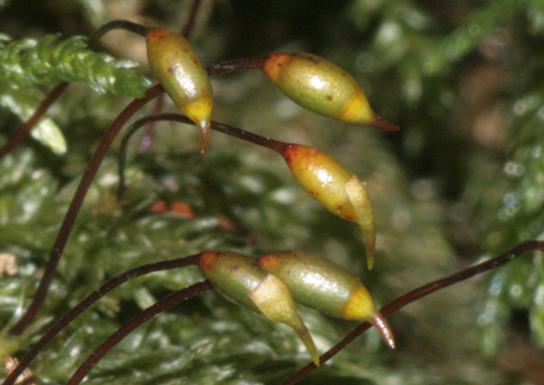
The moss sporophyte is dependent on the gametophyte for nutrients. The slender seta (plural, setae), as seen in Figure 25.15, contains tubular cells that transfer nutrients from the base of the sporophyte (the foot) to the sporangium or capsule.
英語のヒント
蘚類の胞子体は、栄養分を配偶体に依存する。図25.15に見られる細い蒴柄には、胞子体の基部である足から胞子嚢、すなわち蒴まで、栄養分を運ぶ管状の細胞が含まれる。
OpenStax, Rice University; Biology 2e. (credit: modification of work by Hermann Schachner) · CC BY 4.0 · Source出典

Figure 25.15図 25.15
Moss sporophyte. This photograph shows the long slender stems, called setae, connected to capsules of the moss Thamnobryum alopecurum. The operculum and remnants of the calyptra are visible in some capsules. (credit: modification of work by Hermann Schachner)
英語のヒント
蘚類の胞子体。この写真は、Thamnobryum alopecurum の蒴につながる、蒴柄と呼ばれる長く細い茎を示している。一部の蒴には、蒴蓋と帽の残りが見える。(クレジット:Hermann Schachner の作品を改変)
Spore mother cells in the sporangium undergo meiosis to produce haploid spores. The sporophyte has several features that protect the developing spores and aid in their dispersal. The calyptra, derived from the walls of the archegonium, covers the sporangium. A structure called the operculum is at the tip of the spore capsule. The calyptra and operculum fall off when the spores are ready for dispersal. The peristome, tissue around the mouth of the capsule, is made of triangular, close-fitting units like little “teeth.” The peristome opens and closes, depending on moisture levels, and periodically releases spores.
英語のヒント
胞子嚢の中では、胞子母細胞が減数分裂して半数体胞子をつくる。胞子体には、発達中の胞子を守り、散布を助ける特徴がいくつかある。造卵器の壁に由来する帽が、胞子嚢を覆う。胞子を含む蒴の先端には、蒴蓋と呼ばれる構造がある。胞子を散布する準備が整うと、帽と蒴蓋が落ちる。蒴の口の周囲にある組織、蒴歯は、小さな「歯」のような三角形の単位が密に並んでできている。蒴歯は湿度に応じて開閉し、定期的に胞子を放出する。