第16章遺伝子発現
16.6 Eukaryotic Translational and Post-translational Gene Regulation16.6 真核生物における翻訳段階と翻訳後の遺伝子調節
Learning Objectives学習目標
By the end of this section, you will be able to do the following:
この節を終えると、次のことができるようになる。
- Understand the process of translation and discuss its key factors翻訳の過程を理解し、その主要な因子について論じる。
- Describe how the initiation complex controls translation開始複合体が翻訳をどのように制御するかを説明する。
- Explain the different ways in which the post-translational control of gene expression takes place翻訳後の遺伝子発現制御が行われる、さまざまな方法を説明する。
After RNA has been transported to the cytoplasm, it is translated into protein. Control of this process is largely dependent on the RNA molecule. As previously discussed, the stability of the RNA will have a large impact on its translation into a protein. As the stability changes, the amount of time that it is available for translation also changes.
英語のヒント
RNAは細胞質へ輸送された後、タンパク質へ翻訳される。この過程の制御は、RNA分子に大きく依存している。すでに述べたように、RNAの安定性は、タンパク質への翻訳に大きな影響を及ぼす。安定性が変わると、RNAを翻訳に利用できる時間の長さも変わる。
The Initiation Complex and Translation Rate開始複合体と翻訳速度
Like transcription, translation is controlled by proteins that bind and initiate the process. In translation, the complex that assembles to start the process is referred to as the translation initiation complex. In eukaryotes, translation is initiated by binding the initiating met-tRNAi to the 40S ribosome. This tRNA is brought to the 40S ribosome by a protein initiation factor, eukaryotic initiation factor-2 (eIF-2). The eIF-2 protein binds to the high-energy molecule guanosine triphosphate (GTP). The tRNA-eIF2-GTP complex then binds to the 40S ribosome. A second complex forms on the mRNA. Several different initiation factors recognize the 5' cap of the mRNA and proteins bound to the poly-A tail of the same mRNA, forming the mRNA into a loop. The cap-binding protein eIF4F brings the mRNA complex together with the 40S ribosome complex. The ribosome then scans along the mRNA until it finds a start codon AUG. When the anticodon of the initiator tRNA and the start codon are aligned, the GTP is hydrolyzed, the initiation factors are released, and the large 60S ribosomal subunit binds to form the translation complex. The binding of eIF-2 to the RNA is controlled by phosphorylation. If eIF-2 is phosphorylated, it undergoes a conformational change and cannot bind to GTP. Therefore, the initiation complex cannot form properly and translation is impeded (Figure 16.14). When eIF-2 remains unphosphorylated, the initiation complex can form normally and translation can proceed.
英語のヒント
転写と同様に、翻訳も、結合してその過程を開始させるタンパク質によって制御される。翻訳では、この過程を始めるために組み立てられる複合体を、翻訳開始複合体と呼ぶ。真核生物では、開始用のmet-tRNAiが40Sリボソームに結合することで翻訳が始まる。このtRNAは、タンパク質である開始因子、真核生物開始因子2(eIF-2)によって40Sリボソームへ運ばれる。eIF-2タンパク質は、高エネルギー分子であるグアノシン三リン酸(GTP)に結合する。次に、tRNA-eIF2-GTP複合体が40Sリボソームに結合する。mRNA上には、二つ目の複合体が形成される。いくつかの異なる開始因子が、mRNAの5′キャップと、同じmRNAのポリA尾部に結合したタンパク質を認識し、mRNAを輪の形にする。キャップ結合タンパク質eIF4Fが、mRNAの複合体と40Sリボソームの複合体を結びつける。次いで、リボソームは開始コドンAUGを見つけるまで、mRNAに沿って走査する。開始tRNAのアンチコドンと開始コドンが位置を合わせると、GTPが加水分解され、開始因子が放出され、大きい方の60Sリボソームサブユニットが結合して翻訳複合体を形成する。RNAへのeIF-2の結合は、リン酸化によって制御される。eIF-2がリン酸化されると、立体構造が変化してGTPに結合できなくなる。その結果、開始複合体が適切に形成されず、翻訳が妨げられる(図16.14)。eIF-2がリン酸化されない状態に保たれると、開始複合体が正常に形成され、翻訳が進行できる。
Chemical Modifications, Protein Activity, and Longevity化学修飾、タンパク質の活性、寿命
Proteins can be chemically modified with the addition of groups including methyl, phosphate, acetyl, and ubiquitin groups. The addition or removal of these groups from proteins regulates their activity or the length of time they exist in the cell. Sometimes these modifications can regulate where a protein is found in the cell—for example, in the nucleus, in the cytoplasm, or attached to the plasma membrane.
英語のヒント
タンパク質は、メチル基、リン酸基、アセチル基、ユビキチンなどの基を付加されることで、化学的に修飾される。このような基をタンパク質に付加したり取り除いたりすることで、タンパク質の活性や、細胞内に存在する時間の長さが調節される。こうした修飾が、細胞内のどこにタンパク質が存在するかを調節する場合もある。例えば、核内、細胞質内、あるいは細胞膜に結合した場所などである。
Chemical modifications occur in response to external stimuli such as stress, the lack of nutrients, heat, or ultraviolet light exposure. These changes can alter epigenetic accessibility, transcription, mRNA stability, or translation—all resulting in changes in expression of various genes. This is an efficient way for the cell to rapidly change the levels of specific proteins in response to the environment. Because proteins are involved in every stage of gene regulation, the phosphorylation of a protein (depending on the protein that is modified) can alter accessibility to the chromosome, can alter translation (by altering transcription factor binding or function), can change nuclear shuttling (by influencing modifications to the nuclear pore complex), can alter RNA stability (by binding or not binding to the RNA to regulate its stability), can modify translation (increase or decrease), or can change post-translational modifications (add or remove phosphates or other chemical modifications).
英語のヒント
化学修飾は、ストレス、栄養不足、熱、紫外線への曝露など、外部からの刺激に応答して起こる。こうした変化は、エピジェネティックな接近のしやすさ、転写、mRNAの安定性、翻訳を変えることがあり、いずれもさまざまな遺伝子の発現の変化をもたらす。これは、細胞が環境に応答して特定のタンパク質の量を素早く変えるための効率的な方法である。タンパク質は遺伝子調節のあらゆる段階に関与しているため、タンパク質のリン酸化は、どのタンパク質が修飾されるかに応じて、染色体への接近のしやすさを変えたり、翻訳を変えたり(転写因子の結合や機能を変えることで)、核への出入りを変えたり(核膜孔複合体の修飾に影響することで)できる。また、RNAの安定性を変えること(RNAに結合する、または結合しないことでその安定性を調節する)、翻訳を変えること(増加または減少させる)、翻訳後修飾を変えること(リン酸の付加や除去、またはほかの化学修飾)もできる。
The addition of a ubiquitin group to a protein marks that protein for degradation. Ubiquitin acts like a flag indicating that the protein lifespan is complete. These proteins are moved to the proteasome, an organelle that functions to remove proteins, to be degraded (Figure 16.15). One way to control gene expression, therefore, is to alter the longevity of the protein.
英語のヒント
タンパク質にユビキチンが付加されると、そのタンパク質に分解対象の目印が付く。ユビキチンは、そのタンパク質の寿命が尽きたことを示す旗のように働く。これらのタンパク質は、タンパク質の除去を担う細胞小器官であるプロテアソームへ運ばれ、分解される(図16.15)。したがって、タンパク質の寿命を変えることも、遺伝子発現を制御する方法の一つである。
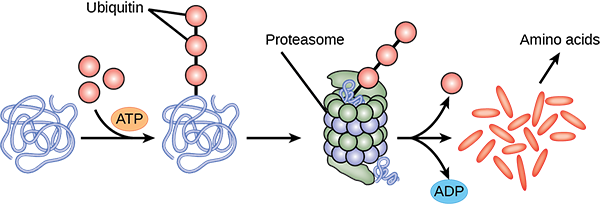

Figure 16.15図 16.15
Proteins with ubiquitin tags are marked for degradation within the proteasome.
ユビキチンの目印が付いたタンパク質は、プロテアソーム内での分解対象として印を付けられている。