第16章遺伝子発現
16.4 Eukaryotic Transcription Gene Regulation16.4 真核生物における転写段階の遺伝子調節
Learning Objectives学習目標
By the end of this section, you will be able to do the following:
この節を終えると、次のことができるようになる。
- Discuss the role of transcription factors in gene regulation遺伝子調節における転写因子の役割を論じる。
- Explain how enhancers and repressors regulate gene expressionエンハンサーとリプレッサーが遺伝子発現をどのように調節するかを説明する。
Like prokaryotic cells, the transcription of genes in eukaryotes requires the action of an RNA polymerase to bind to a DNA sequence upstream of a gene in order to initiate transcription. However, unlike prokaryotic cells, the eukaryotic RNA polymerase requires other proteins, or transcription factors, to facilitate transcription initiation. RNA polymerase by itself cannot initiate transcription in eukaryotic cells. There are two types of transcription factors that regulate eukaryotic transcription: General (or basal) transcription factors bind to the core promoter region to assist with the binding of RNA polymerase. Specific transcription factors bind to various regions outside of the core promoter region and interact with the proteins at the core promoter to enhance or repress the activity of the polymerase.
英語のヒント
原核細胞と同様に、真核生物の遺伝子の転写にも、RNAポリメラーゼが遺伝子の上流にあるDNA配列に結合して転写を開始する働きが必要である。しかし原核細胞とは異なり、真核生物のRNAポリメラーゼは、転写開始を助けるほかのタンパク質、すなわち転写因子を必要とする。真核細胞では、RNAポリメラーゼだけで転写を開始することはできない。真核生物の転写を調節する転写因子には、二つの種類がある。一般(基本)転写因子はコアプロモーター領域に結合して、RNAポリメラーゼの結合を助ける。特異的転写因子はコアプロモーター領域の外にあるさまざまな領域に結合し、コアプロモーターにあるタンパク質と相互作用して、ポリメラーゼの活性を高めたり抑えたりする。
The Promoter and the Transcription Machineryプロモーターと転写装置
Genes are organized to make the control of gene expression easier. The promoter region is immediately upstream of the coding sequence. This region can be short (only a few nucleotides in length) or quite long (hundreds of nucleotides long). The longer the promoter, the more available space for proteins to bind. This also adds more control to the transcription process. The length of the promoter is gene-specific and can differ dramatically between genes. Consequently, the level of control of gene expression can also differ quite dramatically between genes. The purpose of the promoter is to bind transcription factors that control the initiation of transcription.
英語のヒント
遺伝子は、遺伝子発現を制御しやすいように配置されている。プロモーター領域は、コード配列のすぐ上流にある。この領域は短い場合(わずか数ヌクレオチドの長さ)も、かなり長い場合(数百ヌクレオチドの長さ)もある。プロモーターが長いほど、タンパク質が結合できる空間が増える。これにより、転写過程に対する制御も増える。プロモーターの長さは遺伝子ごとに固有であり、遺伝子間で大きく異なることがある。したがって、遺伝子発現を制御する程度も、遺伝子ごとに大きく異なりうる。プロモーターの役割は、転写開始を制御する転写因子を結合させることである。
Within the core promoter region, 25 to 35 bases upstream of the transcriptional start site, resides the TATA box. The TATA box has the consensus sequence of 5’-TATAAA-3’. The TATA box is the binding site for a protein complex called TFIID, which contains a TATA-binding protein. Binding of TFIID recruits other transcription factors, including TFIIB, TFIIE, TFIIF, and TFIIH. Some of these transcription factors help to bind the RNA polymerase to the promoter, and others help to activate the transcription initiation complex.
英語のヒント
コアプロモーター領域内で、転写開始部位から25〜35塩基上流に、TATAボックスが存在する。TATAボックスのコンセンサス配列は5′-TATAAA-3′である。TATAボックスは、TATA結合タンパク質を含むTFIIDというタンパク質複合体の結合部位である。TFIIDが結合すると、TFIIB、TFIIE、TFIIF、TFIIHなどのほかの転写因子が呼び寄せられる。これらの転写因子の一部はRNAポリメラーゼがプロモーターに結合するのを助け、ほかのものは転写開始複合体の活性化を助ける。
In addition to the TATA box, other binding sites are found in some promoters. Some biologists prefer to restrict the range of the eukaryotic promoter to the core promoter, or polymerase binding site, and refer to these additional sites as promoter-proximal elements, because they are usually found within a few hundred base pairs upstream of the transcriptional start site. Examples of these elements are the CAAT box, with the consensus sequence 5’-CCAAT-3’ and the GC box, with the consensus sequence 5’-GGGCGG-3’. Specific transcription factors can bind to these promoter-proximal elements to regulate gene transcription. A given gene may have its own combination of these specific transcription-factor binding sites. There are hundreds of transcription factors in a cell, each of which binds specifically to a particular DNA sequence motif. When transcription factors bind to the promoter just upstream of the encoded gene, it is referred to as a cis-acting element, because it is on the same chromosome just next to the gene. Transcription factors respond to environmental stimuli that cause the proteins to find their binding sites and initiate transcription of the gene that is needed.
英語のヒント
TATAボックス以外にも、一部のプロモーターには別の結合部位がある。真核生物のプロモーターの範囲をコアプロモーター、すなわちポリメラーゼの結合部位に限定し、これらの追加の部位をプロモーター近傍エレメントと呼ぶことを好む生物学者もいる。これらの部位は通常、転写開始部位の上流数百塩基対以内にあるためである。その例として、コンセンサス配列が5′-CCAAT-3′のCAATボックスや、5′-GGGCGG-3′のGCボックスがある。特異的転写因子はこれらのプロモーター近傍エレメントに結合し、遺伝子の転写を調節できる。一つの遺伝子が、こうした特異的転写因子の結合部位の独自の組み合わせをもつことがある。細胞内には数百の転写因子があり、それぞれが特定のDNA配列モチーフに特異的に結合する。転写因子がコードされる遺伝子のすぐ上流のプロモーターに結合する場合、その領域は遺伝子と同じ染色体上ですぐ隣にあるため、シス作用エレメントと呼ばれる。転写因子は環境からの刺激に応答し、その刺激によってタンパク質は自らの結合部位を見つけ、必要な遺伝子の転写を開始する。
Enhancers and Transcriptionエンハンサーと転写
In some eukaryotic genes, there are additional regions that help increase or enhance transcription. These regions, called enhancers, are not necessarily close to the genes they enhance. They can be located upstream of a gene, within the coding region of the gene, downstream of a gene, or may be thousands of nucleotides away.
英語のヒント
真核生物の一部の遺伝子には、転写を増やす、すなわち促進するのを助ける追加の領域がある。エンハンサーと呼ばれるこれらの領域は、発現を高める対象の遺伝子の近くにあるとは限らない。遺伝子の上流、遺伝子のコード領域内、遺伝子の下流にあることもあれば、数千ヌクレオチド離れていることもある。
Enhancer regions are binding sequences, or sites, for specific transcription factors. When a protein transcription factor binds to its enhancer sequence, the shape of the protein changes, allowing it to interact with proteins at the promoter site. However, since the enhancer region may be distant from the promoter, the DNA must bend to allow the proteins at the two sites to come into contact. DNA bending proteins help to bend the DNA and bring the enhancer and promoter regions together (Figure 16.10). This shape change allows for the interaction of the specific activator proteins bound to the enhancers with the general transcription factors bound to the promoter region and the RNA polymerase.
英語のヒント
エンハンサー領域は、特異的転写因子が結合する配列、すなわち結合部位である。タンパク質である転写因子が対応するエンハンサー配列に結合すると、そのタンパク質の形が変わり、プロモーター部位のタンパク質と相互作用できるようになる。しかし、エンハンサー領域はプロモーターから離れている場合があるので、二つの部位のタンパク質が接触できるように、DNAが曲がる必要がある。DNAを曲げるタンパク質は、DNAを曲げ、エンハンサー領域とプロモーター領域を近づける働きを助ける(図16.10)。この形の変化により、エンハンサーに結合した特異的なアクチベータータンパク質が、プロモーター領域に結合した一般転写因子やRNAポリメラーゼと相互作用できるようになる。
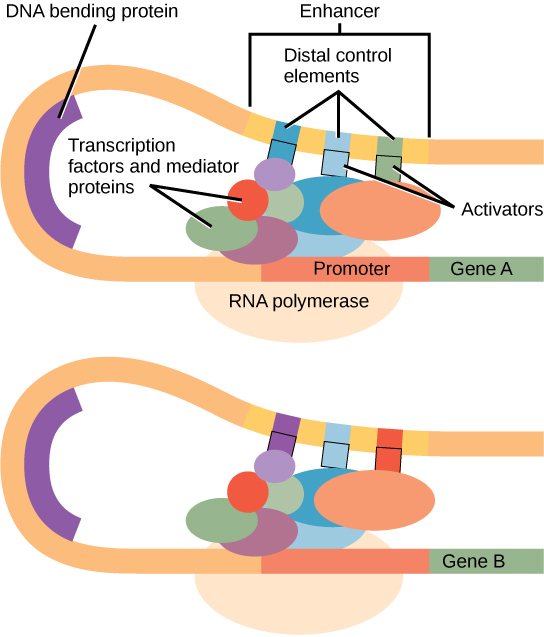

Figure 16.10図 16.10
Interaction between proteins at the promoter and enhancer sites. An enhancer is a DNA sequence that promotes transcription. Each enhancer is made up of short DNA sequences called distal control elements. Activators bound to the distal control elements interact with mediator proteins and transcription factors. Two different genes may have the same promoter but different distal control elements, enabling differential gene expression.
英語のヒント
プロモーター部位とエンハンサー部位のタンパク質どうしの相互作用。エンハンサーは、転写を促進するDNA配列である。各エンハンサーは、遠位調節エレメントと呼ばれる短いDNA配列からなる。遠位調節エレメントに結合したアクチベーターは、メディエータータンパク質や転写因子と相互作用する。異なる二つの遺伝子が同じプロモーターをもちながら、遠位調節エレメントは異なる場合があり、それによって遺伝子発現を異なるものにできる。