第16章遺伝子発現
16.1 Regulation of Gene Expression16.1 遺伝子発現の調節
Learning Objectives学習目標
By the end of this section, you will be able to do the following:
この節を学ぶと、次のことができるようになる。
- Discuss why every cell does not express all of its genes all of the timeどの細胞も、すべての遺伝子を常に発現させるわけではない理由を論じる。
- Describe how prokaryotic gene regulation occurs at the transcriptional level原核生物の遺伝子調節が、転写の水準でどのように起こるかを説明する。
- Discuss how eukaryotic gene regulation occurs at the epigenetic, transcriptional, post-transcriptional, translational, and post-translational levels真核生物の遺伝子調節が、エピジェネティック、転写、転写後、翻訳、翻訳後の各水準でどのように起こるかを論じる。
For a cell to function properly, necessary proteins must be synthesized at the proper time and place. All cells control or regulate the synthesis of proteins from information encoded in their DNA. The process of turning on a gene to produce RNA and protein is called gene expression. Whether in a simple unicellular organism or a complex multi-cellular organism, each cell controls when and how its genes are expressed. For this to occur, there must be internal chemical mechanisms that control when a gene is expressed to make RNA and protein, how much of the protein is made, and when it is time to stop making that protein because it is no longer needed.
英語のヒント
細胞が正しく働くには、必要なタンパク質が、適切な時に、適切な場所で合成されなければならない。すべての細胞は、DNAにコードされた情報からのタンパク質合成を制御、すなわち調節している。遺伝子をオンにしてRNAやタンパク質を作る過程を、遺伝子発現という。単純な単細胞生物でも、複雑な多細胞生物でも、各細胞は、いつ、どのように遺伝子を発現させるかを制御する。そのためには、遺伝子をいつ発現させてRNAとタンパク質を作るか、どれだけタンパク質を作るか、そして、もう必要でなくなったためにいつ製造を止めるかを制御する、細胞内の化学的な仕組みが必要である。
The regulation of gene expression conserves energy and space. It would require a significant amount of energy for an organism to express every gene at all times, so it is more energy efficient to turn on the genes only when they are required. In addition, only expressing a subset of genes in each cell saves space because DNA must be unwound from its tightly coiled structure to transcribe and translate the DNA. Cells would have to be enormous if every protein were expressed in every cell all the time.
英語のヒント
遺伝子発現の調節は、エネルギーと空間を節約する。生物がすべての遺伝子を常に発現させるには、大量のエネルギーが必要になる。そのため、必要なときだけ遺伝子をオンにするほうが、エネルギー効率がよい。また、各細胞で一部の遺伝子だけを発現させることは、空間の節約にもなる。DNAを転写・翻訳するには、密に巻かれた構造をほどかなければならないからだ。すべての細胞ですべてのタンパク質が常に発現していたら、細胞は巨大でなければならない。
The control of gene expression is extremely complex. Malfunctions in this process are detrimental to the cell and can lead to the development of many diseases, including cancer.
英語のヒント
遺伝子発現の制御は、きわめて複雑である。この過程の不具合は細胞に有害であり、がんを含む多くの病気の発症につながりうる。
Prokaryotic versus Eukaryotic Gene Expression原核生物と真核生物の遺伝子発現
To understand how gene expression is regulated, we must first understand how a gene codes for a functional protein in a cell. The process occurs in both prokaryotic and eukaryotic cells, just in slightly different manners.
遺伝子発現がどのように調節されるかを理解するには、まず、遺伝子が細胞内で機能するタンパク質をどのようにコードするかを理解しなければならない。この過程は原核細胞でも真核細胞でも起こるが、その仕方が少し異なる。
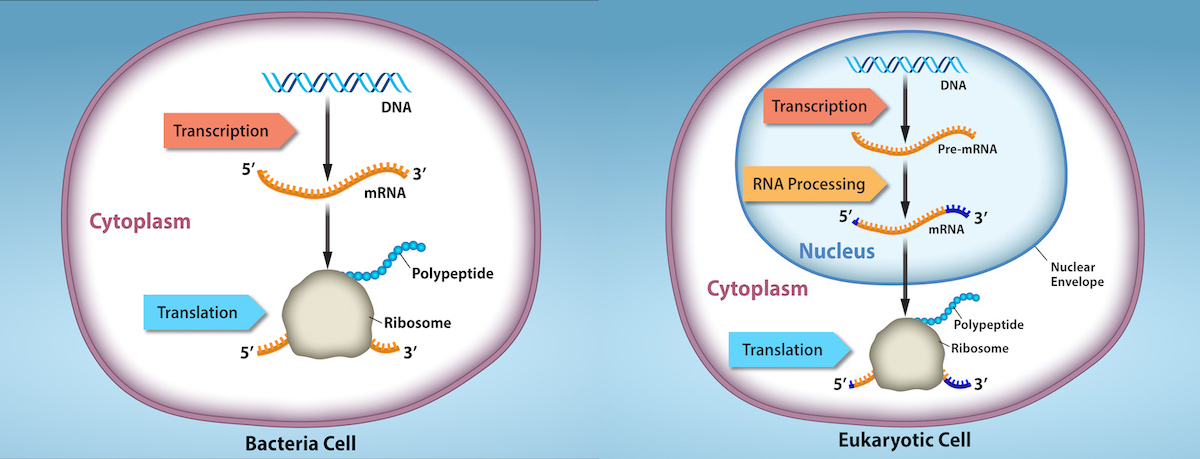
Prokaryotic organisms are single-celled organisms that lack a cell nucleus, and their DNA therefore floats freely in the cell cytoplasm. To synthesize a protein, the processes of transcription and translation occur almost simultaneously. When the resulting protein is no longer needed, transcription stops. As a result, the primary method to control what type of protein and how much of each protein is expressed in a prokaryotic cell is the regulation of DNA transcription. All of the subsequent steps occur automatically. When more protein is required, more transcription occurs. Therefore, in prokaryotic cells, the control of gene expression is mostly at the transcriptional level.
英語のヒント
原核生物は核をもたない単細胞生物であり、DNAは細胞質内に自由に浮かんでいる。タンパク質を合成する際、転写と翻訳はほぼ同時に起こる。作られるタンパク質が不要になると、転写が止まる。したがって、原核細胞でどの種類のタンパク質をどれだけ発現させるかを制御する主な方法は、DNA転写の調節である。その後の段階は、すべて自動的に進む。タンパク質がもっと必要になれば、転写が増える。そのため、原核細胞の遺伝子発現制御は、主に転写の水準で行われる。
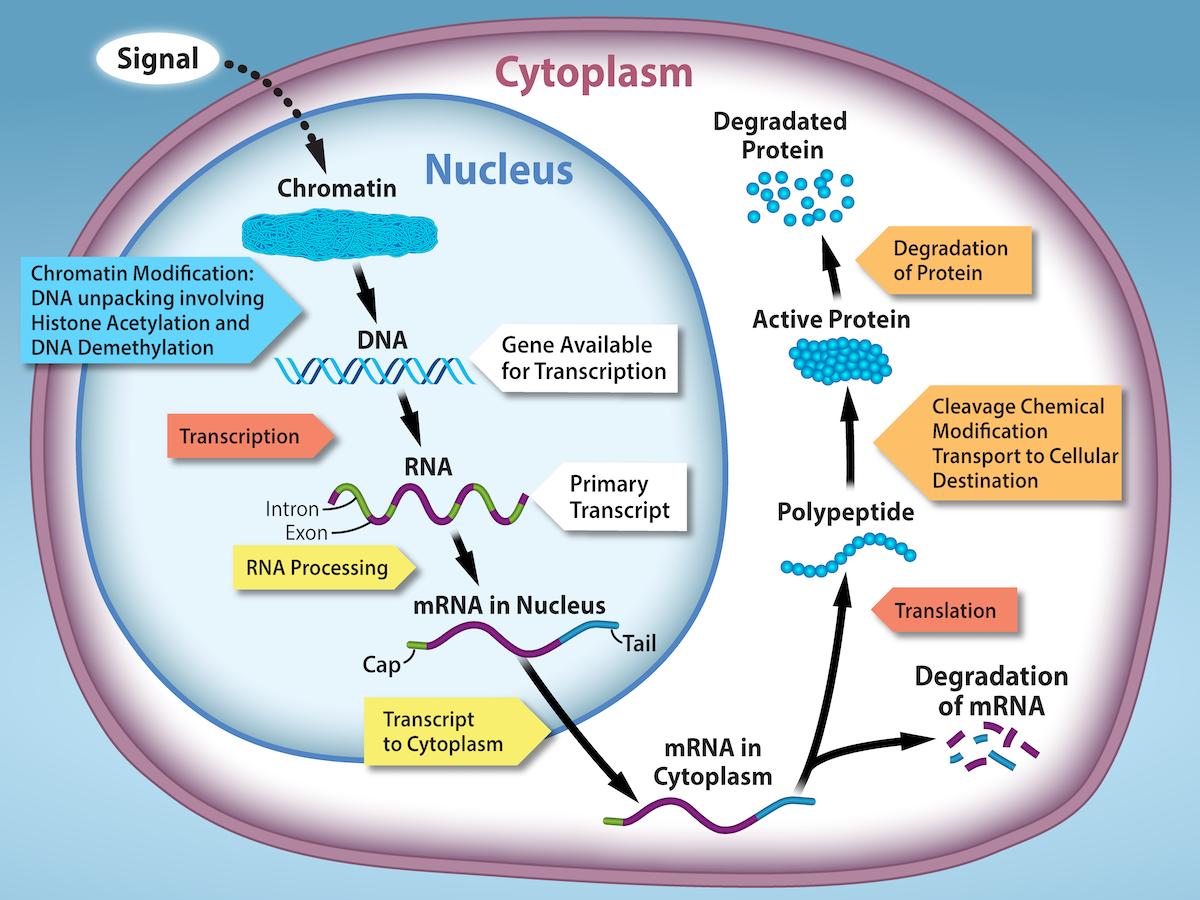
Eukaryotic cells, in contrast, have intracellular organelles that add to their complexity. In eukaryotic cells, the DNA is contained inside the cell’s nucleus and there it is transcribed into RNA. The newly synthesized RNA is then transported out of the nucleus into the cytoplasm, where ribosomes translate the RNA into protein. The processes of transcription and translation are physically separated by the nuclear membrane; transcription occurs only within the nucleus, and translation occurs only outside the nucleus in the cytoplasm. The regulation of gene expression can occur at all stages of the process (Figure 16.3). Regulation may occur when the DNA is uncoiled and loosened from nucleosomes to bind transcription factors (epigenetic level), when the RNA is transcribed (transcriptional level), when the RNA is processed and exported to the cytoplasm after it is transcribed (post-transcriptional level), when the RNA is translated into protein (translational level), or after the protein has been made (post-translational level).
英語のヒント
これに対し、真核細胞には細胞内小器官があり、複雑さが増している。DNAは細胞の核内に収まり、そこでRNAへ転写される。新しく合成されたRNAは、次に核の外の細胞質へ運ばれ、そこでリボソームがRNAをタンパク質へ翻訳する。転写と翻訳の過程は、核膜によって物理的に分かれている。転写は核内でだけ、翻訳は核外の細胞質でだけ起こる。遺伝子発現の調節は、この過程のすべての段階で行われうる(図16.3)。DNAがほどけてヌクレオソームから緩み、転写因子が結合できるようになる段階(エピジェネティックな水準)、RNAが転写される段階(転写の水準)、転写後にRNAが加工されて細胞質へ運ばれる段階(転写後の水準)、RNAがタンパク質へ翻訳される段階(翻訳の水準)、タンパク質ができた後(翻訳後の水準)に調節が起こることがある。
OpenStax, Rice University; Biology 2e. Credit: Rao, A. and Ryan, K. Department of Biology, Texas A&M University. · CC BY 4.0 · Source出典

Figure 16.2図 16.2
Locations of gene regulation. The regulation of gene expression occurs at multiple steps going from DNA to the functional gene product, usually a protein. It begins with chromatin structure making the DNA more or less accessible for transcription by RNA polymerase. In eukaryotes, the primary mRNA transcript must be processed before it can be translated in the cytoplasm. The final level of active protein in the cell depends not only on the rate of synthesis, but also on the rate of degradation of mRNA and protein. Credit: Rao, A. and Ryan, K. Department of Biology, Texas A&M University.
英語のヒント
遺伝子調節が起こる場所。遺伝子発現の調節は、DNAから、通常はタンパク質である機能的な遺伝子産物へ至る、複数の段階で起こる。最初の段階では、クロマチン構造が、RNAポリメラーゼによる転写のためのDNAへの接近しやすさを変える。真核生物では、一次mRNA転写産物は、細胞質で翻訳される前に加工されなければならない。細胞内の活性をもつタンパク質の最終的な量は、合成速度だけでなく、mRNAとタンパク質の分解速度にも依存する。クレジット:Rao, A. and Ryan, K.、テキサスA&M大学生物学科。
OpenStax, Rice University; Biology 2e. Credit: Rao, A., Ryan, K. Fletcher, S. and Tag, A. Department of Biology, Texas A&M University. · CC BY 4.0 · Source出典

Figure 16.3図 16.3
Regulation in prokaryotes and eukaryotes. A. Prokaryotic transcription and translation occur simultaneously in the cytoplasm, and regulation occurs primarily at the transcriptional level. B. Eukaryotic gene expression is regulated during transcription and RNA processing, which take place in the nucleus, and during protein translation, which takes place in the cytoplasm. Further regulation may occur through post-translational modifications of proteins in both prokaryotes and eukaryotes. Credit: Rao, A., Ryan, K. Fletcher, S. and Tag, A. Department of Biology, Texas A&M University.
原核生物と真核生物における調節。A:原核生物の転写と翻訳は細胞質で同時に起こり、調節は主に転写の水準で行われる。B:真核生物の遺伝子発現は、核内で起こる転写とRNA加工の間、および細胞質で起こるタンパク質の翻訳の間に調節される。原核生物でも真核生物でも、タンパク質の翻訳後修飾によって、さらに調節されることがある。クレジット:Rao, A., Ryan, K., Fletcher, S. and Tag, A.、テキサスA&M大学生物学科。
The differences in the regulation of gene expression between prokaryotes and eukaryotes are summarized in Table 16.1. The regulation of gene expression is discussed in detail in subsequent modules.
原核生物と真核生物の遺伝子発現調節の違いを、表16.1にまとめる。遺伝子発現の調節は、これ以降の節で詳しく説明する。
Differences in the Regulation of Gene Expression of Prokaryotic and Eukaryotic Organisms 原核生物と真核生物の遺伝子発現調節の違い |
|
|---|---|
Prokaryotic organisms 原核生物 |
Eukaryotic organisms 真核生物 |
Lack a membrane-bound nucleus 膜に囲まれた核をもたない。 |
Contain nucleus 核をもつ。 |
DNA is found in the cytoplasm DNAは細胞質にある。 |
DNA is confined to the nuclear compartment DNAは核の区画内に限られる。 |
RNA transcription and protein formation occur almost simultaneously RNAの転写とタンパク質の形成が、ほぼ同時に起こる。 |
RNA transcription occurs prior to protein formation, and it takes place in the nucleus. Translation of RNA to protein occurs in the cytoplasm. RNAの転写はタンパク質形成に先立って核内で起こる。RNAからタンパク質への翻訳は、細胞質で起こる。 |
Gene expression is regulated primarily at the transcriptional level 遺伝子発現は主に転写の水準で調節される。 |
Gene expression is regulated at many levels (epigenetic, transcriptional, nuclear shuttling, post-transcriptional, translational, and post-translational) 遺伝子発現は、多くの水準(エピジェネティック、転写、核内外の移送、転写後、翻訳、翻訳後)で調節される。 |