第16章遺伝子発現
16.3 Eukaryotic Epigenetic Gene Regulation16.3 真核生物におけるエピジェネティックな遺伝子調節
Learning Objectives学習目標
By the end of this section, you will be able to do the following:
この節を終えると、次のことができるようになる。
- Explain how chromatin remodeling controls transcriptional accessクロマチンリモデリングが、転写のための接近をどのように制御するかを説明する。
- Describe how access to DNA is controlled by histone modificationヒストン修飾によってDNAへの接近がどのように制御されるかを説明する。
- Describe how DNA methylation is related to epigenetic gene changesDNAのメチル化とエピジェネティックな遺伝子の変化との関係を説明する。
Eukaryotic gene expression is more complex than prokaryotic gene expression because the processes of transcription and translation are physically separated. Unlike prokaryotic cells, eukaryotic cells can regulate gene expression at many different levels. Epigenetic changes are inheritable changes in gene expression that do not result from changes in the DNA sequence. Eukaryotic gene expression begins with control of access to the DNA. Transcriptional access to the DNA can be controlled in two general ways: chromatin remodeling and DNA methylation. Chromatin remodeling changes the way that DNA is associated with chromosomal histones. DNA methylation is associated with developmental changes and gene silencing.
英語のヒント
真核生物の遺伝子発現は、転写と翻訳の過程が物理的に分離しているため、原核生物の遺伝子発現よりも複雑である。原核細胞とは異なり、真核細胞はさまざまな段階で遺伝子発現を調節できる。エピジェネティックな変化とは、DNA配列の変化によって生じたものではない、受け継がれうる遺伝子発現の変化である。真核生物の遺伝子発現は、DNAへの接近の制御から始まる。転写のためにDNAへ接近できるかどうかは、大きく分けて、クロマチンリモデリングとDNAメチル化という二つの方法で制御される。クロマチンリモデリングは、DNAが染色体のヒストンと結びついている仕方を変える。DNAメチル化は、発生に伴う変化や遺伝子サイレンシングと関連している。
Epigenetic Control: Regulating Access to Genes within the Chromosomeエピジェネティックな制御:染色体内の遺伝子への接近を調節する
The human genome encodes over 20,000 genes, with hundreds to thousands of genes on each of the 23 human chromosomes. The DNA in the nucleus is precisely wound, folded, and compacted into chromosomes so that it will fit into the nucleus. It is also organized so that specific segments can be accessed as needed by a specific cell type.
英語のヒント
ヒトのゲノムには2万を超える遺伝子がコードされており、ヒトの23本の染色体のそれぞれに数百から数千の遺伝子がある。核内のDNAは、核の中に収まるように、精密に巻かれ、折り畳まれ、圧縮されて染色体となっている。また、特定の種類の細胞が必要に応じて特定の部分に接近できるように整理されている。
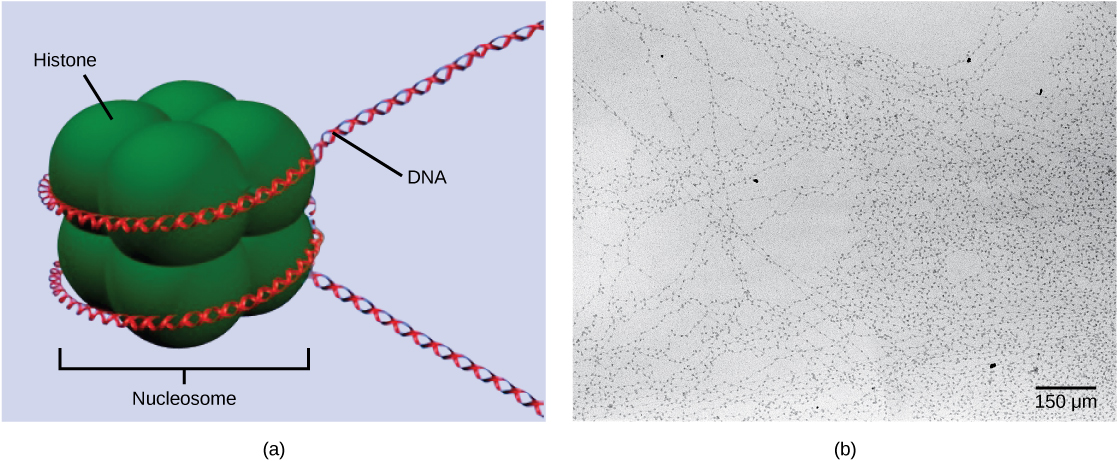
The first level of organization, or packing, is the winding of DNA strands around histone proteins. Histones package and order DNA into structural units called nucleosome complexes, which can control the access of proteins to the DNA regions (Figure 16.7a). Under the electron microscope, this winding of DNA around histone proteins to form nucleosomes looks like small beads on a string (Figure 16.7b).
英語のヒント
OpenStax, Rice University; Biology 2e. (credit “micrograph”: modification of work by Chris Woodcock) · CC BY 4.0 · Source出典
Figure 16.7図 16.7
DNA is folded around histone proteins to create (a) nucleosome complexes. These nucleosomes control the access of proteins to the underlying DNA. When viewed through an electron microscope (b), the nucleosomes look like beads on a string. (credit “micrograph”: modification of work by Chris Woodcock)
英語のヒント
DNAはヒストンタンパク質の周りに折り畳まれ、(a)ヌクレオソーム複合体を形成する。ヌクレオソームは、タンパク質がその内部のDNAに接近できるかどうかを制御する。電子顕微鏡で観察すると(b)、ヌクレオソームは糸でつながったビーズのように見える。(「顕微鏡写真」のクレジット:Chris Woodcockの作品を改変)
These beads (histone proteins) can move along the string (DNA) to expose different sections of the molecule. If DNA encoding a specific gene is to be transcribed into RNA, the nucleosomes surrounding that region of DNA can slide down the DNA to open that specific chromosomal region and allow for the transcriptional machinery (RNA polymerase) to initiate transcription (Figure 16.8).
英語のヒント
これらのビーズ(ヒストンタンパク質)は、糸(DNA)に沿って移動して、DNA分子のさまざまな部分を露出させることができる。特定の遺伝子をコードするDNAがRNAへ転写される場合には、そのDNA領域を囲むヌクレオソームがDNAに沿って滑るように移動し、その染色体領域を開いて、転写装置(RNAポリメラーゼ)が転写を開始できるようにする(図16.8)。
How closely the histone proteins associate with the DNA is regulated by signals found on both the histone proteins and on the DNA. These signals are functional groups added to histone proteins or to DNA and determine whether a chromosomal region should be open or closed (Figure 16.9 depicts modifications to histone proteins and DNA). These tags are not permanent, but may be added or removed as needed. Some chemical groups (phosphate, methyl, or acetyl groups) are attached to specific amino acids in histone "tails" at the N-terminus of the protein. These groups do not alter the DNA base sequence, but they do alter how tightly wound the DNA is around the histone proteins. DNA is a negatively charged molecule and unmodified histones are positively charged; therefore, changes in the charge of the histone will change how tightly wound the DNA molecule will be. By adding chemical modifications like acetyl groups, the charge becomes less positive, and the binding of DNA to the histones is relaxed. Altering the location of nucleosomes and the tightness of histone binding opens some regions of chromatin to transcription and closes others.
英語のヒント
ヒストンタンパク質がDNAとどの程度密接に結びつくかは、ヒストンタンパク質とDNAの両方にあるシグナルによって調節される。これらのシグナルは、ヒストンタンパク質やDNAに付加された官能基であり、染色体のある領域を開いた状態にするか、閉じた状態にするかを決める(図16.9はヒストンタンパク質とDNAへの修飾を示す)。これらの目印は永久的なものではなく、必要に応じて付加したり取り除いたりできる。一部の化学基(リン酸基、メチル基、アセチル基)は、タンパク質のN末端にあるヒストンの「尾部」の特定のアミノ酸に付加される。これらの基はDNAの塩基配列を変えないが、DNAがヒストンタンパク質の周りにどの程度きつく巻きついているかを変える。DNAは負に帯電した分子であり、修飾されていないヒストンは正に帯電している。そのため、ヒストンの電荷が変化すると、DNA分子の巻きつきの強さも変わる。アセチル基の付加などの化学修飾を加えると、正の電荷が弱まり、DNAとヒストンの結合が緩む。ヌクレオソームの位置やヒストンとの結合の強さが変わることで、クロマチンの一部の領域は転写可能な状態になり、ほかの領域は転写できない状態になる。
The DNA molecule itself can also be modified by methylation. DNA methylation occurs within very specific regions called CpG islands. These are stretches with a high frequency of cytosine and guanine dinucleotide DNA pairs (CG) found in the promoter regions of genes. The cytosine member of the CG pair can be methylated (a methyl group is added). Methylated genes are usually silenced, although methylation may have other regulatory effects. In some cases, genes that are silenced during the development of the gametes of one parent are transmitted in their silenced condition to the offspring. Such genes are said to be imprinted. Parental diet or other environmental conditions may also affect the methylation patterns of genes, which in turn modifies gene expression. Changes in chromatin organization interact with DNA methylation. DNA methyltransferases appear to be attracted to chromatin regions with specific histone modifications. Highly methylated (hypermethylated) DNA regions with deacetylated histones are tightly coiled and transcriptionally inactive.
英語のヒント
DNA分子そのものも、メチル化による修飾を受けることがある。DNAのメチル化は、CpGアイランドと呼ばれるきわめて特異的な領域内で起こる。これは、遺伝子のプロモーター領域に見られ、シトシンとグアニンの二ヌクレオチドからなるDNAの組(CG)が高頻度に存在する部分である。CGの組のシトシン側はメチル化されることがある(メチル基が付加される)。メチル化された遺伝子は通常は発現が抑えられるが、メチル化はそれ以外の調節作用をもつ場合もある。一方の親の配偶子が発達する途中で発現が抑えられた遺伝子が、その状態のまま子に伝えられる場合がある。このような遺伝子は、インプリンティングされているという。親の食事などの環境条件も、遺伝子のメチル化のパターンに影響し、それがさらに遺伝子発現を変えることがある。クロマチン構造の変化は、DNAのメチル化と相互に作用する。DNAメチルトランスフェラーゼは、特定のヒストン修飾をもつクロマチン領域に引き寄せられるようである。ヒストンが脱アセチル化され、DNAが高度にメチル化(過剰メチル化)された領域は、きつく巻かれていて転写活性がない。
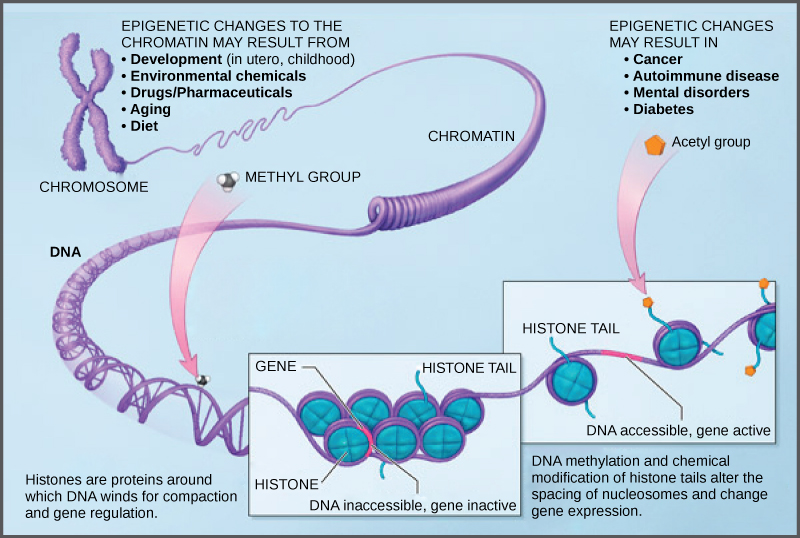


Figure 16.9図 16.9
Histone proteins and DNA nucleotides can be modified chemically. Modifications affect nucleosome spacing and gene expression. (credit: modification of work by NIH)
ヒストンタンパク質とDNAのヌクレオチドは、化学的に修飾されることがある。修飾は、ヌクレオソームの間隔と遺伝子発現に影響する。(クレジット:NIHの作品を改変)
Epigenetic changes are not permanent, although they often persist through multiple rounds of cell division and may even cross generational lines. Chromatin remodeling alters the chromosomal structure (open or closed) as needed. If a gene is to be transcribed, the histone proteins and DNA in the chromosomal region encoding that gene are modified in a way that opens the promoter region to allow RNA polymerase and other proteins, called transcription factors, to bind and initiate transcription. If a gene is to remain turned off, or silenced, the histone proteins and DNA have different modifications that signal a closed chromosomal configuration. In this closed configuration, the RNA polymerase and transcription factors do not have access to the DNA and transcription cannot occur (Figure 16.9).
英語のヒント
エピジェネティックな変化は、何回もの細胞分裂を経て維持され、さらには世代を越える場合も多いが、永久的なものではない。クロマチンリモデリングは、必要に応じて染色体の構造を開いた状態や閉じた状態に変える。ある遺伝子が転写される場合には、その遺伝子をコードする染色体領域のヒストンタンパク質とDNAが、プロモーター領域を開くように修飾される。これにより、RNAポリメラーゼや転写因子と呼ばれるほかのタンパク質が結合し、転写を開始できる。遺伝子をオフの状態、すなわち発現を抑えた状態に保つ場合には、ヒストンタンパク質とDNAに別の修飾が加わり、染色体を閉じた構造にするシグナルとなる。この閉じた構造では、RNAポリメラーゼと転写因子はDNAに接近できず、転写は起こらない(図16.9)。