第16章遺伝子発現
16.2 Prokaryotic Gene Regulation16.2 原核生物の遺伝子調節
Learning Objectives学習目標
By the end of this section, you will be able to do the following:
この節を終えると、次のことができるようになる。
- Describe the steps involved in prokaryotic gene regulation原核生物の遺伝子調節に関わる段階を説明する。
- Explain the roles of activators, inducers, and repressors in gene regulation遺伝子調節におけるアクチベーター、インデューサー、リプレッサーの役割を説明する。
The DNA of prokaryotes is organized into a circular chromosome, supercoiled within the nucleoid region of the cell cytoplasm. Proteins that are needed for a specific function, or that are involved in the same biochemical pathway, are encoded together in blocks called operons. For example, all of the genes needed to use lactose as an energy source are coded next to each other in the lactose (or lac) operon, and transcribed into a single mRNA.
英語のヒント
原核生物のDNAは環状染色体を形成し、細胞質内の核様体領域で超らせんになっている。特定の機能に必要なタンパク質や、同じ生化学経路に関与するタンパク質は、オペロンというまとまりの中に一緒にコードされる。たとえば、ラクトースをエネルギー源として使うために必要な遺伝子はすべて、ラクトース(lac)オペロン内に隣り合ってコードされ、1本のmRNAへ転写される。
In prokaryotic cells, there are three types of regulatory molecules that can affect the expression of operons: repressors, activators, and inducers. Repressors and activators are proteins produced in the cell. Both repressors and activators regulate gene expression by binding to specific DNA sites adjacent to the genes they control. In general, activators bind to the promoter site, while repressors bind to operator regions. Repressors prevent transcription of a gene in response to an external stimulus, whereas activators increase the transcription of a gene in response to an external stimulus. Inducers are small molecules that> may be produced by the cell or that are in the cell’s environment. Inducers either activate or repress transcription depending on the needs of the cell and the availability of substrate.
英語のヒント
原核細胞には、オペロンの発現に影響する調節分子が3種類ある。リプレッサー、アクチベーター、インデューサーである。リプレッサーとアクチベーターは、細胞内で作られるタンパク質である。どちらも、制御する遺伝子に隣接する特定のDNA部位に結合して、遺伝子発現を調節する。一般に、アクチベーターはプロモーター部位、リプレッサーはオペレーター領域に結合する。リプレッサーは外部刺激に応じて遺伝子の転写を妨げ、アクチベーターは外部刺激に応じて転写を増やす。インデューサーは、細胞が作るか、細胞の周囲の環境に存在する小分子である。細胞の必要性や基質の利用可能性に応じ、転写を活性化または抑制する。
The trp Operon: A Repressible Operontrpオペロン:抑制可能なオペロン
Bacteria such as Escherichia coli need amino acids to survive, and are able to synthesize many of them. Tryptophan is one such amino acid that E. coli can either ingest from the environment or synthesize using enzymes that are encoded by five genes. These five genes are next to each other in what is called the tryptophan (trp) operon (Figure 16.4). The genes are transcribed into a single mRNA, which is then translated to produce all five enzymes. If tryptophan is present in the environment, then E. coli does not need to synthesize it and the trp operon is switched off. However, when tryptophan availability is low, the switch controlling the operon is turned on, the mRNA is transcribed, the enzyme proteins are translated, and tryptophan is synthesized.
英語のヒント
大腸菌(Escherichia coli)のような細菌は、生存のためにアミノ酸を必要とし、その多くを自ら合成できる。トリプトファンもその1つであり、大腸菌は環境から取り込むことも、5つの遺伝子にコードされた酵素を使って合成することもできる。この5つの遺伝子は、トリプトファン(trp)オペロンという領域に隣り合っている(図16.4)。遺伝子は1本のmRNAへ転写され、そのmRNAが翻訳されて5種類すべての酵素が作られる。環境にトリプトファンがあれば、大腸菌は合成する必要がなく、trpオペロンはオフになる。しかし、利用できるトリプトファンが少ないと、オペロンを制御するスイッチがオンになり、mRNAが転写され、酵素タンパク質が翻訳され、トリプトファンが合成される。
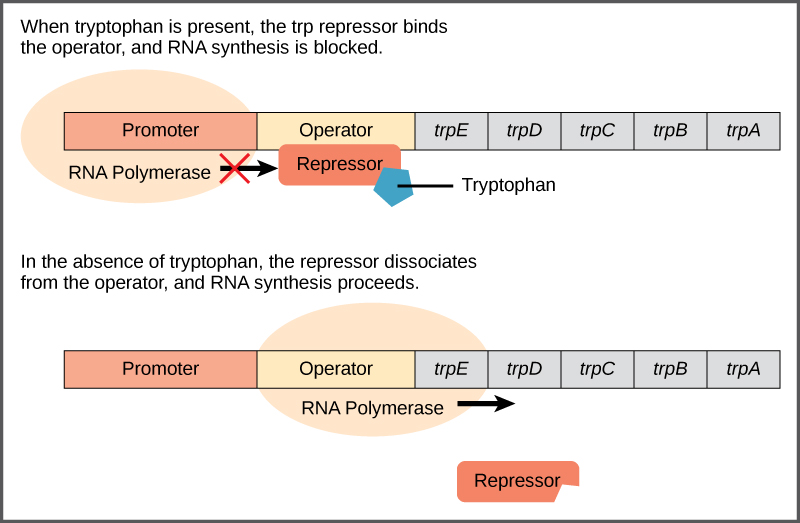

Figure 16.4図 16.4
The tryptophan operon. The five genes that are needed to synthesize tryptophan in E. coli are located next to each other in the trp operon. When tryptophan is plentiful, two tryptophan molecules bind the repressor protein at the operator sequence. This physically blocks the RNA polymerase from transcribing the tryptophan genes. When tryptophan is absent, the repressor protein does not bind to the operator and the genes are transcribed.
英語のヒント
トリプトファンオペロン。大腸菌がトリプトファンを合成するために必要な5つの遺伝子は、trpオペロン内に隣り合って存在する。トリプトファンが豊富なときは、2分子のトリプトファンがオペレーター配列上のリプレッサータンパク質に結合する。これが物理的な障害となり、RNAポリメラーゼはトリプトファン遺伝子を転写できない。トリプトファンがないと、リプレッサーはオペレーターに結合せず、遺伝子が転写される。
The trp operon includes three important regions: the coding region, the trp operator and the trp promoter. The coding region includes the genes for the five tryptophan biosynthesis enzymes. Just before the coding region is the transcriptional start site. The promoter sequence, to which RNA polymerase binds to initiate transcription, is before or “upstream” of the transcriptional start site. Between the promoter and the transcriptional start site is the operator region.
英語のヒント
trpオペロンには、コード領域、trpオペレーター、trpプロモーターという3つの重要な領域がある。コード領域には、5種類のトリプトファン生合成酵素の遺伝子が含まれる。コード領域のすぐ前に、転写開始部位がある。RNAポリメラーゼが結合して転写を開始するプロモーター配列は、転写開始部位より前、すなわち「上流」にある。プロモーターと転写開始部位の間には、オペレーター領域がある。
The trp operator contains the DNA code to which the trp repressor protein can bind. However, the repressor alone cannot bind to the operator. When tryptophan is present in the cell, two tryptophan molecules bind to the trp repressor, which changes the shape of the repressor protein to a form that can bind to the trp operator. Binding of the tryptophan–repressor complex at the operator physically prevents the RNA polymerase from binding to the promoter and transcribing the downstream genes.
英語のヒント
trpオペレーターには、trpリプレッサータンパク質が結合できるDNA配列がある。しかし、リプレッサーだけではオペレーターに結合できない。細胞内にトリプトファンがあると、2分子がtrpリプレッサーに結合し、その形を、trpオペレーターに結合できる形へ変える。トリプトファンとリプレッサーの複合体がオペレーターに結合すると、RNAポリメラーゼがプロモーターに結合して下流の遺伝子を転写するのを、物理的に妨げる。
When tryptophan is not present in the cell, the repressor by itself does not bind to the operator, the polymerase can transcribe the enzyme genes, and tryptophan is synthesized. Because the repressor protein actively binds to the operator to keep the genes turned off, the trp operon is said to be negatively regulated and the proteins that bind to the operator to silence trp expression are negative regulators.
英語のヒント
細胞内にトリプトファンがなければ、リプレッサー単独ではオペレーターに結合しないため、ポリメラーゼが酵素遺伝子を転写でき、トリプトファンが合成される。リプレッサータンパク質が自らオペレーターに結合して遺伝子をオフに保つため、trpオペロンは負の調節を受けるという。オペレーターに結合してtrpの発現を抑えるタンパク質は、負の調節因子である。