第16章遺伝子発現
Catabolite Activator Protein (CAP): A Transcriptional Activatorカタボライト活性化タンパク質(CAP):転写活性化因子
Just as the trp operon is negatively regulated by tryptophan molecules, there are proteins that bind to the promoter sequences that act as positive regulators to turn genes on and activate them. For example, when glucose is scarce, E. coli bacteria can turn to other sugar sources for fuel. To do this, new genes to process these alternate sugars must be transcribed. When glucose levels drop, cyclic AMP (cAMP) begins to accumulate in the cell. The cAMP molecule is a signaling molecule that is involved in glucose and energy metabolism in E. coli. Accumulating cAMP binds to the positive regulator catabolite activator protein (CAP), a protein that binds to the promoters of operons which control the processing of alternative sugars. When cAMP binds to CAP, the complex then binds to the promoter region of the genes that are needed to use the alternate sugar sources (Figure 16.5). In these operons, a CAP-binding site is located upstream of the RNA-polymerase-binding site in the promoter. CAP binding stabilizes the binding of RNA polymerase to the promoter region and increases transcription of the associated protein-coding genes.
英語のヒント
trpオペロンがトリプトファン分子によって負に調節されるのと同じように、プロモーター配列に結合し、遺伝子をオンにして活性化する正の調節因子として働くタンパク質もある。たとえば、グルコースが乏しくなると、大腸菌は燃料をほかの糖源に切り替えることができる。そのためには、代わりの糖を処理する新たな遺伝子を転写しなければならない。グルコース濃度が下がると、細胞内に環状AMP(cAMP)が蓄積し始める。cAMPは、大腸菌のグルコース代謝とエネルギー代謝に関わるシグナル分子である。蓄積したcAMPは、正の調節因子であるカタボライト活性化タンパク質(CAP)に結合する。CAPは、代わりの糖の処理を制御するオペロンのプロモーターに結合するタンパク質である。cAMPがCAPに結合すると、その複合体は、代わりの糖源を利用するために必要な遺伝子のプロモーター領域に結合する(図16.5)。これらのオペロンでは、CAP結合部位は、プロモーター内のRNAポリメラーゼ結合部位より上流にある。CAPの結合は、RNAポリメラーゼのプロモーター領域への結合を安定化し、関連するタンパク質コード遺伝子の転写を増やす。
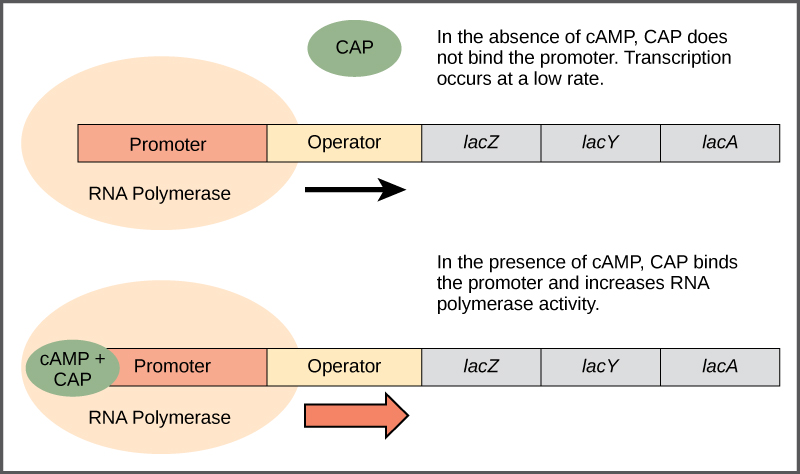

Figure 16.5図 16.5
Transcriptional activation by the CAP protein. When glucose levels fall, E. coli may use other sugars for fuel but must transcribe new genes to do so. As glucose supplies become limited, cAMP levels increase. This cAMP binds to the CAP protein, a positive regulator that binds to a promoter region upstream of the genes required to use other sugar sources.
CAPタンパク質による転写活性化。グルコース濃度が下がると、大腸菌はほかの糖を燃料に使うことがあるが、そのためには新たな遺伝子を転写する必要がある。グルコースの供給が限られるにつれ、cAMP濃度が上がる。cAMPはCAPタンパク質に結合する。CAPは、ほかの糖源の利用に必要な遺伝子の上流のプロモーター領域へ結合する、正の調節因子である。
The lac Operon: An Inducible Operonlacオペロン:誘導可能なオペロン
The third type of gene regulation in prokaryotic cells occurs through inducible operons, which have proteins that bind to activate or repress transcription depending on the local environment and the needs of the cell. The lac operon is a typical inducible operon. As mentioned previously, E. coli is able to use other sugars as energy sources when glucose concentrations are low. One such sugar source is lactose. The lac operon encodes the genes necessary to acquire and process the lactose from the local environment. The Z gene of the lac operon encodes beta-galactosidase, which breaks lactose down to glucose and galactose.
英語のヒント
原核細胞の3つ目の遺伝子調節は、誘導可能なオペロンを介して起こる。これらには、周囲の環境と細胞の必要に応じて結合し、転写を活性化または抑制するタンパク質がある。lacオペロンは、その典型例である。すでに述べたように、大腸菌はグルコース濃度が低いと、ほかの糖をエネルギー源として使える。そのような糖源の1つがラクトースである。lacオペロンは、周囲の環境からラクトースを取り込んで処理するために必要な遺伝子をコードする。lacオペロンのZ遺伝子は、ラクトースをグルコースとガラクトースに分解するβ-ガラクトシダーゼをコードする。
However, for the lac operon to be activated, two conditions must be met. First, the level of glucose must be very low or non-existent. Second, lactose must be present. Only when glucose is absent and lactose is present will the lac operon be transcribed (Figure 16.6). In the absence of glucose, the binding of the CAP protein makes transcription of the lac operon more effective. When lactose is present, its metabolite, allolactose, binds to the lac repressor and changes its shape so that it cannot bind to the lac operator to prevent transcription. This combination of conditions makes sense for the cell, because it would be energetically wasteful to synthesize the enzymes to process lactose if glucose was plentiful or lactose was not available. It should be mentioned that the lac operon is transcribed at a very low rate even when glucose is present and lactose absent.
英語のヒント
しかし、lacオペロンが活性化されるには、2つの条件が満たされなければならない。第1に、グルコース濃度が非常に低いか、まったく存在しないこと。第2に、ラクトースが存在することである。グルコースがなく、ラクトースがあるときにだけ、lacオペロンは転写される(図16.6)。グルコースがないときは、CAPの結合によってlacオペロンの転写がより効率的になる。ラクトースがあると、その代謝産物であるアロラクトースがlacリプレッサーに結合し、形を変える。その結果、リプレッサーはlacオペレーターに結合して転写を妨げることができなくなる。この条件の組み合わせは、細胞にとって理にかなっている。グルコースが豊富にある場合や、ラクトースを利用できない場合に、ラクトースを処理する酵素を合成するのは、エネルギーの無駄になるからだ。なお、グルコースがあり、ラクトースがない場合でも、lacオペロンは非常に低い速度で転写される。
If glucose is present, then CAP fails to bind to the promoter sequence to activate transcription. If lactose is absent, then the repressor binds to the operator to prevent transcription. If either of these conditions is met, then transcription remains off. Only when glucose is absent and lactose is present is the lac operon transcribed at a higher rate. If both glucose and lactose are present, the transcription rate is low as the CAP is not bound to promote maximal rates of lac operon transcription (Table 16.2).
英語のヒント
グルコースがあると、CAPはプロモーター配列に結合して転写を活性化することができない。ラクトースがなければ、リプレッサーがオペレーターに結合して転写を妨げる。どちらか一方の条件が満たされると、転写はオフのままである。グルコースがなく、ラクトースがあるときにだけ、lacオペロンは高い速度で転写される。両方がある場合は、lacオペロンの転写を最大限に促進するCAPが結合していないため、転写速度は低い(表16.2)。
Signals that Induce or Repress Transcription of the lac Operon lacオペロンの転写を誘導または抑制するシグナル |
||||
|---|---|---|---|---|
Glucose グルコース |
CAP binds CAPの結合 |
Lactose ラクトース |
Repressor binds リプレッサーの結合 |
Transcription 転写 |
+ |
- |
- |
+ |
No なし |
+ |
- |
+ |
- |
Some ある程度 |
- |
+ |
- |
+ |
No なし |
- |
+ |
+ |
- |
Yes あり |