第16章遺伝子発現
Control of RNA StabilityRNAの安定性の制御
Before the mRNA leaves the nucleus, it is given two protective "caps" that prevent the ends of the strand from degrading during its journey. 5' and 3' exonucleases can degrade unprotected RNAs. The 5' cap, which is placed on the 5' end of the mRNA, is usually composed of a methylated guanosine triphosphate molecule (GTP). The GTP is placed "backward" on the 5' end of the mRNA, so that the 5' carbons of the GTP and the terminal nucleotide are linked through three phosphates. The poly-A tail, which is attached to the 3' end, is usually composed of a long chain of adenine nucleotides. These changes protect the two ends of the RNA from exonuclease attack.
英語のヒント
mRNAが核を出る前に、輸送中に鎖の両端が分解されるのを防ぐ、二つの保護用の「キャップ」が付けられる。5′エキソヌクレアーゼと3′エキソヌクレアーゼは、保護されていないRNAを分解できる。mRNAの5′末端に付けられる5′キャップは、通常、メチル化されたグアノシン三リン酸(GTP)分子からなる。GTPはmRNAの5′末端に「逆向き」に付けられ、GTPと末端ヌクレオチドの5′炭素が三つのリン酸を介して結合する。mRNAの3′末端に付けられるポリA尾部は、通常、アデニンヌクレオチドが長く連なった鎖からなる。これらの変化は、RNAの両端をエキソヌクレアーゼの攻撃から守る。
Once the RNA is transported to the cytoplasm, the length of time that the RNA resides there can be controlled. Each RNA molecule has a defined lifespan and decays at a specific rate. This rate of decay can influence how much protein is in the cell. If the decay rate is increased, the RNA will not exist in the cytoplasm as long, shortening the time available for translation of the mRNA to occur. Conversely, if the rate of decay is decreased, the mRNA molecule will reside in the cytoplasm longer and more protein can be translated. This rate of decay is referred to as the RNA stability. If the RNA is stable, it will be detected for longer periods of time in the cytoplasm.
英語のヒント
RNAが細胞質へ運ばれると、そこにとどまる時間の長さを制御できる。それぞれのRNA分子には一定の寿命があり、特定の速度で分解される。この分解速度は、細胞内にどれだけのタンパク質が存在するかに影響しうる。分解速度が上がると、RNAが細胞質内に存在する時間は短くなり、mRNAを翻訳できる時間も短くなる。逆に、分解速度が下がると、mRNA分子は細胞質内により長くとどまり、より多くのタンパク質が翻訳される。この分解速度は、RNAの安定性と呼ばれる。RNAが安定であれば、細胞質内でより長い時間検出される。
Binding of proteins to the RNA can also influence its stability. Proteins called RNA-binding proteins, or RBPs, can bind to the regions of the mRNA just upstream or downstream of the protein-coding region. These regions in the RNA that are not translated into protein are called the untranslated regions, or UTRs. They are not introns (those have been removed in the nucleus). Rather, these are regions that regulate mRNA localization, stability, and protein translation. The region just before the protein-coding region is called the 5' UTR, whereas the region after the coding region is called the 3' UTR (Figure 16.13). The binding of RBPs to these regions can increase or decrease the stability of an RNA molecule, depending on the specific RBP that binds.
英語のヒント
RNAへのタンパク質の結合も、その安定性に影響することがある。RNA結合タンパク質(RBP)と呼ばれるタンパク質は、mRNAのタンパク質コード領域のすぐ上流または下流の領域に結合できる。RNAのうち、タンパク質へ翻訳されないこれらの領域は、非翻訳領域(UTR)と呼ばれる。これらはイントロンではない(イントロンは核内で除去されている)。そうではなく、mRNAの局在、安定性、タンパク質への翻訳を調節する領域である。タンパク質コード領域の直前の領域は5′ UTRと呼ばれ、コード領域の後ろの領域は3′ UTRと呼ばれる(図16.13)。RBPがこれらの領域に結合すると、結合するRBPの種類に応じて、RNA分子の安定性が高くなったり低くなったりする。
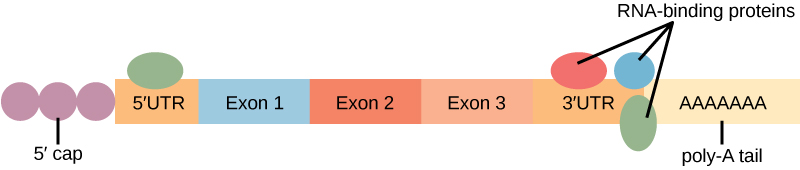

Figure 16.13図 16.13
RNA-binding proteins. The protein-coding region of this processed mRNA is flanked by 5' and 3' untranslated regions (UTRs). The presence of RNA-binding proteins at the 5' or 3' UTR influences the stability of the RNA molecule.
英語のヒント
RNA結合タンパク質。加工を終えたこのmRNAでは、タンパク質コード領域の両側に5′非翻訳領域と3′非翻訳領域(UTR)がある。5′ UTRまたは3′ UTRにRNA結合タンパク質が存在することは、RNA分子の安定性に影響する。
RNA Stability and microRNAsRNAの安定性とマイクロRNA
In addition to RBPs that bind to and control (increase or decrease) RNA stability, other elements called microRNAs can bind to the RNA molecule. These microRNAs, or miRNAs, are short RNA molecules that are only 21 to 24 nucleotides in length. The miRNAs are made in the nucleus as longer pre-miRNAs. These pre-miRNAs are chopped into mature miRNAs by a protein called Dicer. Like transcription factors and RBPs, mature miRNAs recognize a specific sequence and bind to the RNA; however, miRNAs also associate with a ribonucleoprotein complex called the RNA-induced silencing complex (RISC). The RNA component of the RISC base-pairs with complementary sequences on an mRNA and either impede translation of the message or lead to the degradation of the mRNA.
英語のヒント
RNAに結合してその安定性を制御する(高める、または低下させる)RBPに加えて、マイクロRNAと呼ばれる別の因子もRNA分子に結合できる。マイクロRNA(miRNA)は、長さがわずか21〜24ヌクレオチドの短いRNA分子である。miRNAは、核内で、より長いpre-miRNAとして作られる。pre-miRNAはDicerと呼ばれるタンパク質によって切断され、成熟miRNAとなる。転写因子やRBPと同様に、成熟miRNAは特定の配列を認識してRNAに結合する。しかしmiRNAは、RNA誘導サイレンシング複合体(RISC)と呼ばれるリボヌクレオタンパク質複合体にも結びつく。RISCのRNA成分は、mRNA上の相補的な配列と塩基対を形成し、そのメッセージの翻訳を妨げるか、mRNAの分解を引き起こす。
Section Summaryこの節のまとめ
Post-transcriptional control can occur at any stage after transcription, including RNA splicing and RNA stability. Once RNA is transcribed, it must be processed to create a mature RNA that is ready to be translated. This involves the removal of introns that do not code for protein. Spliceosomes bind to the signals that mark the exon/intron border to remove the introns and ligate the exons together. Once this occurs, the RNA is mature and can be translated. Alternative splicing can produce more than one mRNA from a given transcript. Different splicing variants may be produced under different conditions.
英語のヒント
転写後の制御は、RNAスプライシングやRNAの安定性など、転写後のどの段階でも起こりうる。RNAは転写された後、翻訳可能な成熟RNAになるように加工されなければならない。この過程には、タンパク質をコードしないイントロンの除去が含まれる。スプライソソームは、エクソンとイントロンの境界を示すシグナルに結合し、イントロンを取り除いてエクソンどうしを連結する。これが終わるとRNAは成熟し、翻訳可能になる。選択的スプライシングによって、一つの転写産物から複数のmRNAが作られることがある。異なる条件下では、異なるスプライシング変異体が作られる場合がある。
RNA is created and spliced in the nucleus, but needs to be transported to the cytoplasm to be translated. RNA is transported to the cytoplasm through the nuclear pore complex. Once the RNA is in the cytoplasm, the length of time it resides there before being degraded, called RNA stability, can also be altered to control the overall amount of protein that is synthesized. The RNA stability can be increased, leading to longer residency time in the cytoplasm, or decreased, leading to shortened time and less protein synthesis. RNA stability is controlled by RNA-binding proteins (RPBs) and microRNAs (miRNAs). These RPBs and miRNAs bind to the 5' UTR or the 3' UTR of the RNA to increase or decrease RNA stability. MicroRNAs associated with RISC complexes may repress translation or lead to mRNA breakdown.
英語のヒント
RNAは核内で作られ、スプライシングを受けるが、翻訳されるには細胞質へ運ばれる必要がある。RNAは核膜孔複合体を通って細胞質へ輸送される。細胞質に入ったRNAが分解されるまでそこにとどまる時間、すなわちRNAの安定性を変えることによっても、合成されるタンパク質の総量を制御できる。RNAの安定性が高くなると細胞質内にとどまる時間が長くなり、低くなるとその時間が短くなって、タンパク質合成が減る。RNAの安定性は、RNA結合タンパク質(RPB)とマイクロRNA(miRNA)によって制御される。これらのRPBとmiRNAは、RNAの5′ UTRまたは3′ UTRに結合して、RNAの安定性を高めたり低下させたりする。RISC複合体と結びついたマイクロRNAは、翻訳を抑制したり、mRNAの分解を引き起こしたりすることがある。