第6章代謝
6.5 Enzymes6.5 酵素
Learning Objectives学習目標
By the end of this section, you will be able to do the following:
この節を学び終えると、次のことができるようになる。
- Describe the role of enzymes in metabolic pathways代謝経路における酵素の役割を説明する。
- Explain how enzymes function as molecular catalysts酵素が分子触媒としてどのように働くか説明する。
- Discuss enzyme regulation by various factorsさまざまな要因による酵素の調節を論じる。
A substance that helps a chemical reaction to occur is a catalyst, and the special molecules that catalyze biochemical reactions are enzymes. Almost all enzymes are proteins, comprised of amino acid chains, and they perform the critical task of lowering the activation energies of chemical reactions inside the cell. Enzymes do this by binding to the reactant molecules, and holding them in such a way as to make the chemical bond-breaking and bond-forming processes take place more readily. It is important to remember that enzymes do not change the reaction's ∆G. In other words, they do not change whether a reaction is exergonic (spontaneous) or endergonic. This is because they do not change the reactants' or products' free energy. They only reduce the activation energy required to reach the transition state (Figure 6.15).
英語のヒント
化学反応が起こるのを助ける物質を触媒といい、生化学反応を触媒する特別な分子を酵素という。酵素のほとんどは、アミノ酸の鎖からなるタンパク質であり、細胞内の化学反応の活性化エネルギーを下げる重要な役割を果たす。酵素は、反応物の分子に結合し、化学結合の切断と形成が起こりやすいように保持することで、この働きを行う。酵素は反応の ∆G を変えないことを覚えておく必要がある。言い換えれば、反応が発エルゴン性(自発的)か吸エルゴン性かを変えることはない。反応物や生成物の自由エネルギーを変えないからである。酵素が下げるのは、遷移状態に達するために必要な活性化エネルギーだけである(図6.15)。
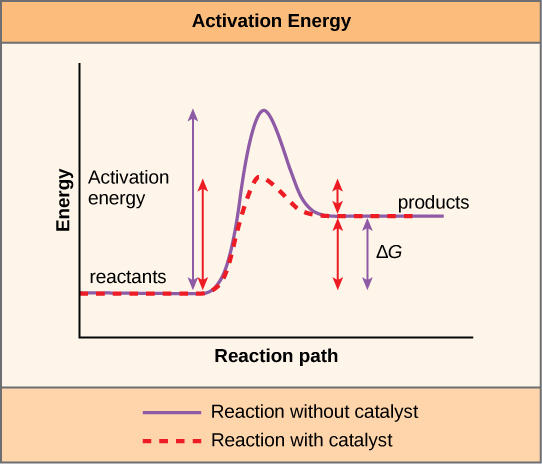
Figure 6.15図 6.15
Enzymes lower the reaction's activation energy but do not change the reaction's free energy.
酵素は反応の活性化エネルギーを下げるが、反応の自由エネルギーは変えない。
Enzyme Active Site and Substrate Specificity酵素の活性部位と基質特異性
The chemical reactants to which an enzyme binds are the enzyme’s substrates. There may be one or more substrates, depending on the particular chemical reaction. In some reactions, a single-reactant substrate breaks down into multiple products. In others, two substrates may come together to create one larger molecule. Two reactants might also enter a reaction, both become modified, and leave the reaction as two products. The location within the enzyme where the substrate binds is the enzyme’s active site. This is where the “action” happens. Since enzymes are proteins, there is a unique combination of amino acid residues (also side chains, or R groups) within the active site. Different properties characterize each residue. These can be large or small, weakly acidic or basic, hydrophilic or hydrophobic, positively or negatively charged, or neutral. The unique combination of amino acid residues, their positions, sequences, structures, and properties, creates a very specific chemical environment within the active site. This specific environment is suited to bind, albeit briefly, to a specific chemical substrate (or substrates). Due to this jigsaw puzzle-like match between an enzyme and its substrates (which adapts to find the best fit between the transition state and the active site), enzymes are known for their specificity. The “best fit” results from the shape and the amino acid functional group’s attraction to the substrate. There is a specifically matched enzyme for each substrate and, thus, for each chemical reaction; however, there is flexibility as well.
英語のヒント
酵素が結合する化学反応物を、その酵素の基質という。反応に応じて、基質は一つの場合も複数の場合もある。一つの反応物である基質が、複数の生成物へ分かれる反応もある。二つの基質が合わさり、一つの大きな分子をつくる反応もある。また、二つの反応物が反応に入り、両方とも変化して、二つの生成物として出ていくこともある。基質が結合する酵素内の場所を活性部位という。ここが「作用」の起こる場所である。酵素はタンパク質なので、活性部位には固有のアミノ酸残基(側鎖、またはR基)の組み合わせがある。それぞれの残基には、大きいか小さいか、弱酸性か塩基性か、親水性か疎水性か、正または負に帯電しているか中性か、といった異なる性質がある。アミノ酸残基の固有の組み合わせ、位置、配列、構造、性質が、活性部位内に非常に特有の化学的環境をつくる。この環境は、短い時間とはいえ、特定の化学基質と結合するのに適している。酵素と基質はジグソーパズルのように対応し、遷移状態と活性部位の間で最もよく適合するよう調整されるため、酵素は特異性をもつことで知られている。「最適な適合」は、形状と、アミノ酸の官能基が基質を引きつける力によって生じる。基質ごとに、したがって化学反応ごとに、特異的に対応する酵素があるが、柔軟性も存在する。
The fact that active sites are so perfectly suited to provide specific environmental conditions also means that they are subject to local environmental influences. It is true that increasing the environmental temperature generally increases reaction rates, enzyme-catalyzed or otherwise. However, increasing or decreasing the temperature outside of an optimal range can affect chemical bonds within the active site in such a way that they are less well suited to bind substrates. High temperatures will eventually cause enzymes, like other biological molecules, to denature, a process that changes the substance's natural properties. Likewise, the local environment's pH can also affect enzyme function. Active site amino acid residues have their own acidic or basic properties that are optimal for catalysis. These residues are sensitive to changes in pH that can impair the way substrate molecules bind. Enzymes are suited to function best within a certain pH range, and, as with temperature, extreme environmental pH values (acidic or basic) can cause enzymes to denature.
英語のヒント
活性部位が特定の環境条件をつくるのに非常によく適していることは、同時に、局所的な環境の影響を受けることも意味する。環境の温度を上げると、酵素で触媒されるかどうかにかかわらず、一般に反応速度は増加する。しかし、温度が最適範囲を超えて上がったり下がったりすると、活性部位内の化学結合が影響を受け、基質と結合しにくくなることがある。高温では、酵素もほかの生体分子と同様に、やがて変性する。変性とは、物質の本来の性質が変化する過程である。同様に、局所環境のpHも酵素の機能に影響する。活性部位のアミノ酸残基は、それぞれ触媒作用に最適な酸性または塩基性の性質をもつ。これらの残基はpH変化に敏感で、その変化は基質分子の結合を妨げる可能性がある。酵素は一定のpH範囲で最もよく働くようになっており、温度と同じく、極端なpH(酸性または塩基性)は変性の原因になる。
Induced Fit and Enzyme Function誘導適合と酵素の働き
For many years, scientists thought that enzyme-substrate binding took place in a simple “lock-and-key” fashion. This model asserted that the enzyme and substrate fit together perfectly in one instantaneous step. However, current research supports a more refined view scientists call induced fit (Figure 6.16). This model expands upon the lock-and-key model by describing a more dynamic interaction between enzyme and substrate. As the enzyme and substrate come together, their interaction causes a mild shift in the enzyme’s structure that confirms an ideal binding arrangement between the enzyme and the substrate's transition state. This ideal binding maximizes the enzyme’s ability to catalyze its reaction.
英語のヒント
長年、酵素と基質の結合は、単純な「鍵と鍵穴」式に起こると考えられていた。このモデルでは、酵素と基質は瞬時の一段階で完全にかみ合う。しかし、現在の研究は、誘導適合と呼ばれる、より精密な見方を支持している(図6.16)。このモデルは、酵素と基質の相互作用をより動的に説明し、鍵と鍵穴モデルを発展させたものである。酵素と基質が近づくと、相互作用によって酵素の構造がわずかに変わり、酵素と基質の遷移状態との間に理想的な結合配置が確立される。この理想的な結合が、酵素の触媒能力を最大限に高める。
When an enzyme binds its substrate, it forms an enzyme-substrate complex. This complex lowers the reaction's activation energy and promotes its rapid progression in one of many ways. On a basic level, enzymes promote chemical reactions that involve more than one substrate by bringing the substrates together in an optimal orientation. The appropriate region (atoms and bonds) of one molecule is juxtaposed to the other molecule's appropriate region with which it must react. Another way in which enzymes promote substrate reaction is by creating an optimal environment within the active site for the reaction to occur. Certain chemical reactions might proceed best in a slightly acidic or non-polar environment. The chemical properties that emerge from the particular arrangement of amino acid residues within an active site create the perfect environment for an enzyme’s specific substrates to react.
英語のヒント
酵素が基質に結合すると、酵素–基質複合体が形成される。この複合体は、さまざまな方法で反応の活性化エネルギーを下げ、速やかな進行を促す。基本的には、複数の基質を最適な向きで近づけることで、それらが関わる化学反応を促進する。一方の分子の適切な部分(原子と結合)が、反応すべき他方の分子の適切な部分の隣に配置される。酵素が基質の反応を促す別の方法は、活性部位内に反応に最適な環境をつくることである。弱酸性の環境や非極性の環境で最もよく進む化学反応もある。活性部位内のアミノ酸残基の特有な配置から生じる化学的性質が、その酵素に特異的な基質の反応に最適な環境をつくる。
You have learned that the activation energy required for many reactions includes the energy involved in manipulating or slightly contorting chemical bonds so that they can easily break and allow others to reform. Enzymatic action can aid this process. The enzyme-substrate complex can lower the activation energy by contorting substrate molecules in such a way as to facilitate bond-breaking, helping to reach the transition state. Finally, enzymes can also lower activation energies by taking part in the chemical reaction itself. The amino acid residues can provide certain ions or chemical groups that actually form covalent bonds with substrate molecules as a necessary step of the reaction process. In these cases, it is important to remember that the enzyme will always return to its original state at the reaction's completion. One of enzymes' hallmark properties is that they remain ultimately unchanged by the reactions they catalyze. After an enzyme catalyzes a reaction, it releases its product(s).
英語のヒント
多くの反応の活性化エネルギーには、結合を切りやすくし、別の結合をつくれるよう、化学結合を操作したりわずかにゆがめたりするためのエネルギーが含まれることを学んだ。酵素の働きは、この過程を助ける。酵素–基質複合体は、基質分子を結合が切れやすい形へゆがめ、遷移状態への到達を助けることで、活性化エネルギーを下げることができる。さらに酵素は、化学反応そのものに参加して活性化エネルギーを下げることもできる。アミノ酸残基が特定のイオンや化学基を供給し、反応過程に必要な段階として、基質分子と実際に共有結合を形成することがある。この場合も、反応が完了すると、酵素は必ず元の状態に戻ることを覚えておく必要がある。触媒する反応によって最終的には変化しないことは、酵素の際立った性質の一つである。酵素は反応を触媒した後、生成物を放出する。
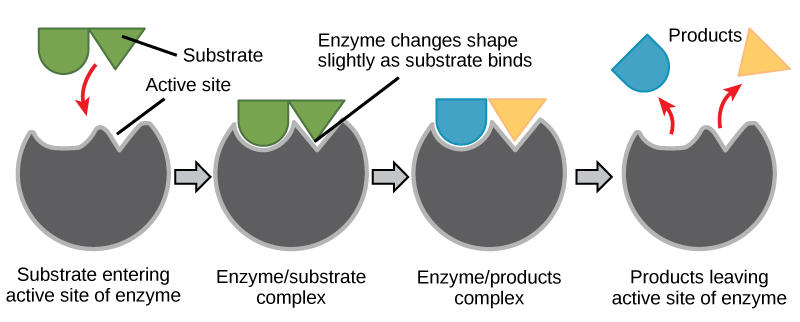


Figure 6.16図 6.16
According to the induced-fit model, both enzyme and substrate undergo dynamic conformational changes upon binding. The enzyme contorts the substrate into its transition state, thereby increasing the reaction's rate.
誘導適合モデルによると、酵素と基質は、結合すると双方が動的な立体構造の変化を起こす。酵素は基質をゆがめて遷移状態へ導き、反応速度を高める。