第6章代謝
Enzyme Compartmentalization酵素の区画化
In eukaryotic cells, molecules such as enzymes are usually compartmentalized into different organelles. This allows for yet another level of regulation of enzyme activity. Enzymes required only for certain cellular processes are sometimes housed separately along with their substrates, allowing for more efficient chemical reactions. Examples of this sort of enzyme regulation based on location and proximity include the enzymes involved in the latter stages of cellular respiration, which take place exclusively in the mitochondria, and the enzymes involved in digesting cellular debris and foreign materials, located within lysosomes.
英語のヒント
真核細胞では、酵素などの分子は通常、異なる細胞小器官に区画化されている。これによって、酵素活性を別の段階でも調節できる。特定の細胞内過程にだけ必要な酵素は、基質とともに別の区画に収められることがあり、化学反応をより効率的に進められる。場所や近さによる調節の例には、ミトコンドリア内だけで起こる細胞呼吸の後半の反応に関わる酵素や、リソソーム内にあり、細胞の残骸や異物を消化する酵素がある。
Feedback Inhibition in Metabolic Pathways代謝経路におけるフィードバック阻害
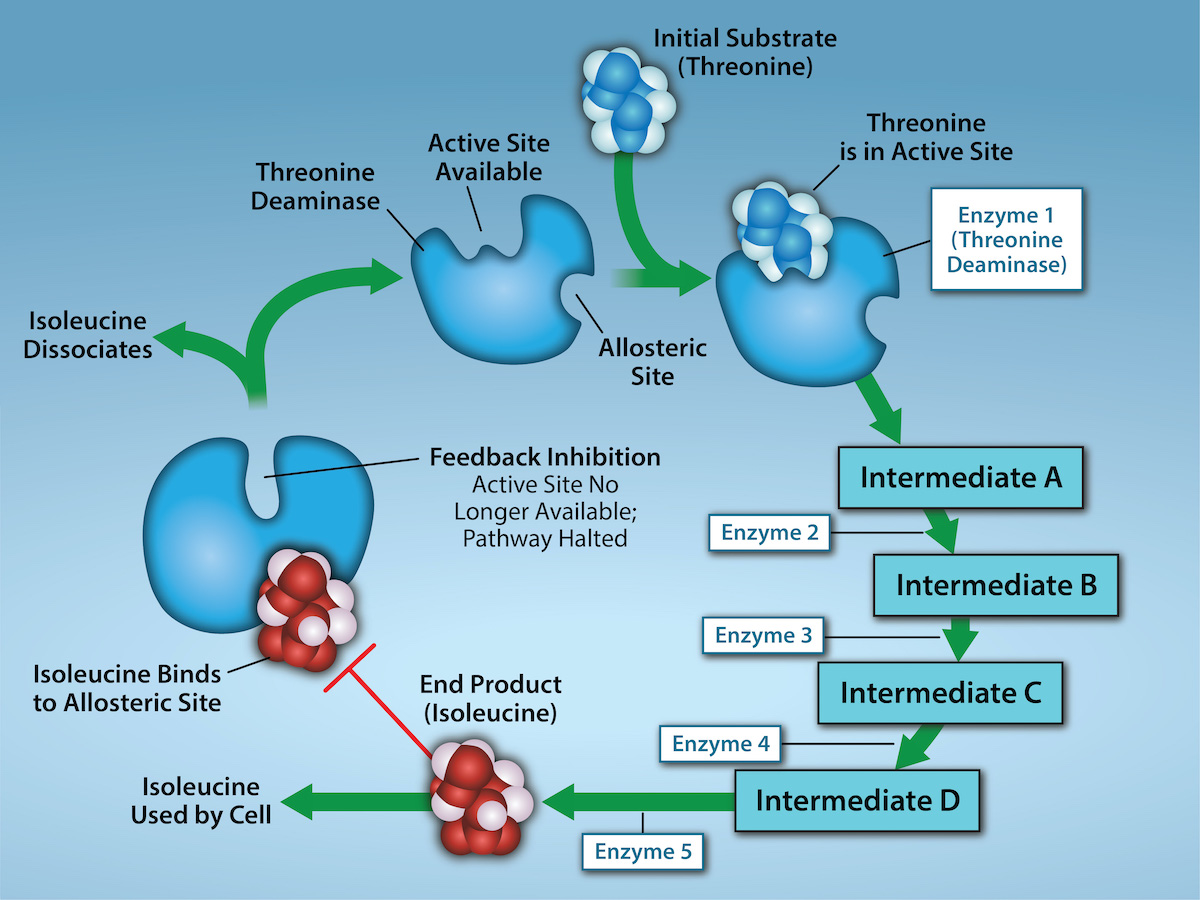
Molecules can regulate enzyme function in many ways. However, a major question remains: What are these molecules and from where do they come? Some are cofactors and coenzymes, ions, and organic molecules, as you have learned. What other molecules in the cell provide enzymatic regulation, such as allosteric modulation, and competitive and noncompetitive inhibition? The answer is that a wide variety of molecules can perform these roles. Some include pharmaceutical and non-pharmaceutical drugs, toxins, and poisons from the environment. Perhaps the most relevant sources of enzyme regulatory molecules, with respect to cellular metabolism, are cellular metabolic reaction products themselves. In a most efficient and elegant way, cells have evolved to use their own reactions' products for feedback inhibition of enzyme activity. Feedback inhibition involves using a reaction product to regulate its own further production (Figure 6.21). The cell responds to the abundance of specific products by slowing down production during anabolic or catabolic reactions. Such reaction products may inhibit the enzymes that catalyzed their production through the mechanisms that we described above.
英語のヒント
分子は多くの方法で酵素機能を調節できる。しかし、大きな疑問が残る。そうした分子は何で、どこから来るのだろうか。すでに学んだように、その一部は補因子や補酵素、イオン、有機分子である。アロステリック調節、競争阻害、非競争阻害などを担う、ほかの細胞内分子は何だろうか。実際には、非常に多様な分子がその役割を果たせる。医薬品や医薬品以外の薬物、環境由来の毒素や毒物なども含まれる。細胞代謝に関して特に重要な調節分子の供給源は、おそらく細胞の代謝反応の生成物そのものである。細胞は、自分自身の反応の生成物を酵素活性のフィードバック阻害に利用するという、非常に効率的で巧みな方法を進化させてきた。フィードバック阻害では、反応の生成物を使って、それ以上の生産を調節する(図6.21)。特定の生成物が豊富になると、細胞は同化反応や異化反応での生産を遅くする。こうした生成物は、上で述べた仕組みによって、自分をつくった酵素を阻害できる。
OpenStax, Rice University; Biology 2e. Credit: Rao, A., Ryan, K., Tag, A., Hawkins, A. and Fletcher S. Department of Biology, Texas A&M University. · CC BY 4.0 · Source出典

Figure 6.21図 6.21
Metabolic pathways are a series of reactions that multiple enzymes catalyze. Feedback inhibition, where the pathway's end product inhibits an upstream step, is an important regulatory mechanism in cells. Metabolic pathways are a series of reactions catalyzed by multiple enzymes (Intermediates A – D, Enzymes 1 – 5). Feedback inhibition occurs when the pathway's end product (here isoleucine) inhibits an upstream enzyme (indicated by red bar). In this example, isoleucine will bind to Threonine Deaminase (at the allosteric site) and prevent threonine from binding to this enzyme’s active site, effectively blocking this metabolic pathway. When isoleucine levels decrease, Threonine will then bind to Threonine Deaminase’s active site and the metabolic pathway will resume. This is an important regulatory mechanism in cells to inhibit the overproduction of a product. Credit: Rao, A., Ryan, K., Tag, A., Hawkins, A. and Fletcher S. Department of Biology, Texas A&M University.
代謝経路は、複数の酵素が触媒する一連の反応である。経路の最終生成物が上流の段階を阻害するフィードバック阻害は、細胞の重要な調節機構である。図では、複数の酵素(酵素1〜5)が一連の反応を触媒し、中間体A〜Dが生じる。最終生成物(ここではイソロイシン)が上流の酵素を阻害すると、フィードバック阻害が起こる。赤い棒がその阻害を示す。この例では、イソロイシンがトレオニンデアミナーゼのアロステリック部位に結合し、トレオニンが活性部位に結合するのを妨げて、代謝経路を実質的に遮断する。イソロイシンの量が減ると、トレオニンが再び酵素の活性部位に結合し、代謝経路が再開する。これは生成物の過剰生産を抑える重要な機構である。出典:Rao, A.、Ryan, K.、Tag, A.、Hawkins, A.、Fletcher S.、テキサスA&M大学生物学部。
Producing both amino acids and nucleotides is controlled through feedback inhibition. Additionally, ATP is an allosteric regulator of some of the enzymes involved in sugar's catabolic breakdown, the process that produces ATP. In this way, when ATP is abundant, the cell can prevent its further production. Remember that ATP is an unstable molecule that can spontaneously dissociate into ADP and inorganic phosphate. If too much ATP were present in a cell, much of it would go to waste. Alternatively, ADP serves as a positive allosteric regulator (an allosteric activator) for some of the same enzymes that ATP inhibits. Thus, when relative ADP levels are high compared to ATP, the cell is triggered to produce more ATP through sugar catabolism.
英語のヒント
アミノ酸とヌクレオチドの生産はいずれも、フィードバック阻害で制御される。またATPは、ATPを生み出す過程である糖の異化的分解に関わる一部の酵素を、アロステリックに調節する。これにより、ATPが豊富なとき、細胞はそれ以上の生産を防げる。ATPは自発的にADPと無機リン酸に解離しうる不安定な分子であることを思い出せ。細胞内にATPが多すぎれば、その多くが無駄になってしまう。これに対し、ADPは、ATPが阻害する同じ酵素の一部に対して、正のアロステリック調節因子(アロステリック活性化因子)として働く。そのため、ATPに比べてADPの量が相対的に多くなると、細胞は糖の異化を通じてATPをさらに生産するよう促される。
Section Summary節のまとめ
Enzymes are chemical catalysts that accelerate chemical reactions at physiological temperatures by lowering their activation energy. Enzymes are usually proteins consisting of one or more polypeptide chains. Enzymes have an active site that provides a unique chemical environment, comprised of certain amino acid R groups (residues). This unique environment is perfectly suited to convert particular chemical reactants for that enzyme, scientists call substrates, into unstable intermediates that they call transition states. Enzymes and substrates bind with an induced fit, which means that enzymes undergo slight conformational adjustments upon substrate contact, leading to full, optimal binding. Enzymes bind to substrates and catalyze reactions in four different ways: bringing substrates together in an optimal orientation, compromising the bond structures of substrates so that bonds can break down more easily, providing optimal environmental conditions for a reaction to occur, or participating directly in their chemical reaction by forming transient covalent bonds with the substrates.
酵素は、活性化エネルギーを下げることで、生理的な温度で化学反応を速める化学触媒である。通常は、一つ以上のポリペプチド鎖からなるタンパク質である。酵素の活性部位には、特定のアミノ酸R基(残基)によって固有の化学的環境がつくられている。この環境は、その酵素に特有の反応物である基質を、遷移状態と呼ばれる不安定な中間体へ変えるのに最適である。酵素と基質は誘導適合によって結合する。つまり、基質に接すると酵素の立体構造がわずかに調整され、十分に最適な結合が生じる。酵素は基質に結合して、四つの方法で反応を触媒する。基質同士を最適な向きで近づけること、基質の結合構造を変形させて切れやすくすること、反応に最適な環境条件を整えること、または基質との一時的な共有結合を形成して化学反応に直接参加することである。
Enzyme action must be regulated so that in a given cell at a given time, the desired reactions catalyze and the undesired reactions are not. Enzymes are regulated by cellular conditions, such as temperature and pH. They are also regulated through their location within a cell, sometimes compartmentalized so that they can only catalyze reactions under certain circumstances. Enzyme inhibition and activation via other molecules are other important ways that enzymes are regulated. Inhibitors can act competitively, noncompetitively, or allosterically. Noncompetitive inhibitors are usually allosteric. Activators can also enhance enzyme function allosterically. The most common method by which cells regulate the enzymes in metabolic pathways is through feedback inhibition. During feedback inhibition, metabolic pathway products serve as inhibitors (usually allosteric) of one or more of the enzymes (usually the first committed enzyme of the pathway) involved in the pathway that produces them.
酵素の作用は、ある時点のある細胞で、必要な反応が触媒され、不要な反応が触媒されないよう調節されなければならない。温度やpHなどの細胞内条件が酵素を調節する。細胞内の配置によっても調節され、ときには区画化により、特定の状況でしか反応を触媒できなくなっている。他の分子による阻害と活性化も、重要な調節方法である。阻害剤は、競争的、非競争的、またはアロステリックに作用する。非競争阻害剤は通常、アロステリックである。活性化因子も、アロステリックに酵素機能を高めることがある。細胞が代謝経路の酵素を調節する最も一般的な方法は、フィードバック阻害である。このとき、代謝経路の生成物が、自分を生産する経路に関わる一つ以上の酵素(通常は、その経路へ進むことを決める最初の酵素)の阻害剤(通常はアロステリック)として働く。