第6章代謝
Metabolic Pathways代謝経路
The processes of making and breaking down sugar molecules illustrate two types of metabolic pathways. A metabolic pathway is a series of interconnected biochemical reactions that convert a substrate molecule or molecules, step-by-step, through a series of metabolic intermediates, eventually yielding a final product or products. In the case of sugar metabolism, the first metabolic pathway synthesized sugar from smaller molecules, and the other pathway broke sugar down into smaller molecules. Scientists call these two opposite processes—the first requiring energy and the second producing energy—anabolic (building) and catabolic (breaking down) pathways, respectively. Consequently, building (anabolism) and degradation (catabolism) comprise metabolism.
英語のヒント
糖分子を作る過程と分解する過程は、二つの種類の代謝経路を示している。代謝経路とは、一つまたは複数の基質分子を、一連の代謝中間体を経て段階的に変換し、最後に一つまたは複数の生成物を生じる、相互につながった生化学反応の連続である。糖代謝では、一方の経路が小さな分子から糖を合成し、もう一方が糖を小さな分子へ分解した。互いに逆向きのこの二つの過程を、それぞれ同化(構築)経路と異化(分解)経路という。前者はエネルギーを必要とし、後者はエネルギーを生み出す。したがって、構築である同化と、分解である異化が、代謝を構成する。
Anabolic and Catabolic Pathways同化経路と異化経路
Anabolic pathways require an input of energy to synthesize complex molecules from simpler ones. Synthesizing sugar from CO2 is one example. Other examples are synthesizing large proteins from amino acid building blocks, and synthesizing new DNA strands from nucleic acid building blocks. These biosynthetic processes are critical to the cell's life, take place constantly, and demand energy that ATP and other high-energy molecules like NADH (nicotinamide adenine dinucleotide) and NADPH provide (Figure 6.5).
英語のヒント
同化経路は、単純な分子から複雑な分子を合成するために、エネルギーの入力を必要とする。CO2から糖を合成することが一例である。ほかには、アミノ酸という構成単位から大きなタンパク質を作ることや、核酸の構成単位から新しいDNA鎖を作ることが挙げられる。これらの生合成過程は細胞の生存に不可欠で、絶えず起こり、ATPや、NADH(ニコチンアミドアデニンジヌクレオチド)、NADPHなどの高エネルギー分子が供給するエネルギーを必要とする(図6.5)。
ATP is an important molecule for cells to have in sufficient supply at all times. The breakdown of sugars illustrates how a single glucose molecule can store enough energy to make a great deal of ATP, 36 to 38 molecules. This is a catabolic pathway. Catabolic pathways involve degrading (or breaking down) complex molecules into simpler ones. Molecular energy stored in the bonds of complex molecules is released in catabolic pathways and harvested in such a way that it can produce ATP. Other energy-storing molecules, such as fats, also break down through similar catabolic reactions to release energy and make ATP (Figure 6.5).
英語のヒント
ATPは、細胞が常に十分な量を確保しておくべき重要な分子である。糖の分解は、グルコース1分子が、36〜38分子という多量のATPを作るのに十分なエネルギーを蓄えられることを示す。これは異化経路である。異化経路は、複雑な分子をより単純な分子へ分解する過程を含む。複雑な分子の結合に蓄えられた分子エネルギーは、異化経路で放出され、ATPを作れる形で回収される。脂肪など、ほかのエネルギー貯蔵分子も、似た異化反応で分解され、エネルギーを放出してATPを作る(図6.5)。
It is important to know that metabolic pathway chemical reactions do not take place spontaneously. A protein called an enzyme facilitates or catalyzes each reaction step. Enzymes are important for catalyzing all types of biological reactions—those that require energy as well as those that release energy.
英語のヒント
代謝経路の化学反応は自然にひとりでに進むわけではない、という点を知っておくことが重要である。各反応段階は、酵素と呼ばれるタンパク質によって促進、すなわち触媒される。酵素は、エネルギーを必要とする反応も放出する反応も含め、あらゆる種類の生物学的反応を触媒するうえで重要である。
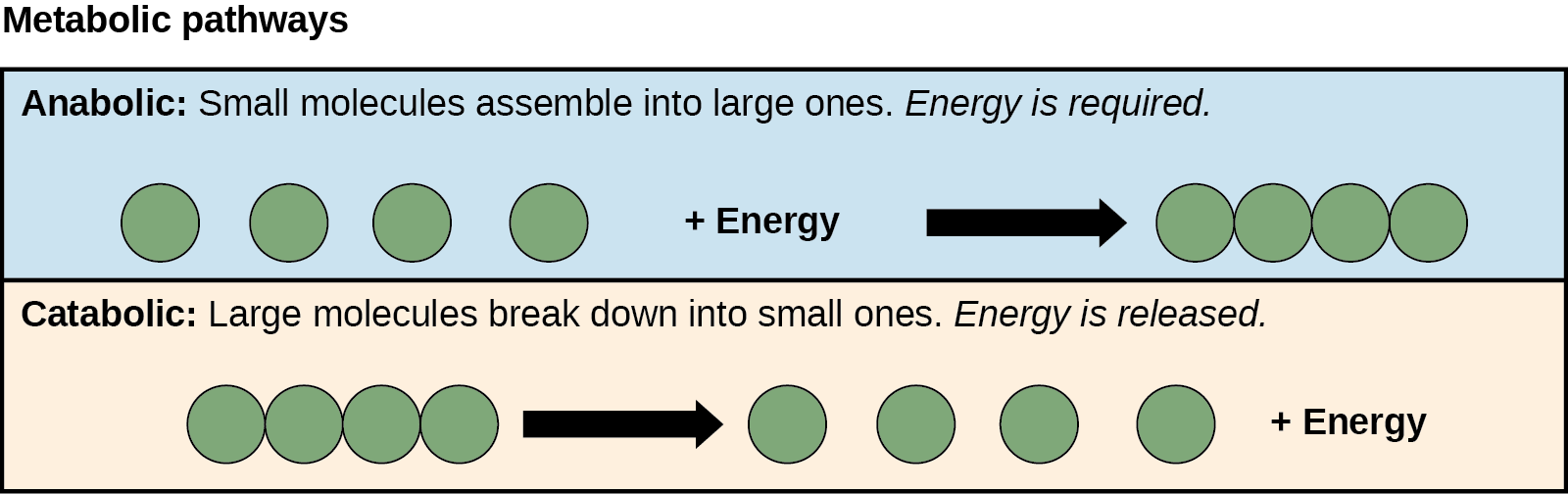

Figure 6.5図 6.5
Anabolic pathways are those that require energy to synthesize larger molecules. Catabolic pathways are those that generate energy by breaking down larger molecules. Both types of pathways are required for maintaining the cell’s energy balance.
同化経路は、より大きな分子を合成するためにエネルギーを必要とする経路である。異化経路は、大きな分子を分解してエネルギーを生み出す経路である。細胞のエネルギーの釣り合いを保つには、両方が必要である。
Section Summaryこの節のまとめ
Cells perform the functions of life through various chemical reactions. A cell’s metabolism refers to the chemical reactions that take place within it. There are metabolic reactions that involve breaking down complex chemicals into simpler ones, such as breaking down large macromolecules. Scientists refer to this process as catabolism, and we associate such reactions an energy release. On the other end of the spectrum, anabolism refers to metabolic processes that build complex molecules out of simpler ones, such as macromolecule synthesis. Anabolic processes require energy. Glucose synthesis and glucose breakdown are examples of anabolic and catabolic pathways, respectively.
英語のヒント
細胞は、さまざまな化学反応を通じて生命の機能を実行する。細胞の代謝とは、その内部で起こる化学反応をいう。大きな高分子の分解のように、複雑な化学物質を単純なものへ分解する代謝反応を異化といい、エネルギーの放出と結びついている。反対に同化とは、高分子の合成のように、単純な分子から複雑な分子を作る代謝過程であり、エネルギーを必要とする。グルコースの合成と分解は、それぞれ同化経路と異化経路の例である。