第6章代謝
Free Energy自由エネルギー
After learning that chemical reactions release energy when energy-storing bonds break, an important next question is how do we quantify and express the chemical reactions with the associated energy? How can we compare the energy that releases from one reaction to that of another reaction? We use a measurement of free energy to quantitate these energy transfers. Scientists call this free energy Gibbs free energy (abbreviated with the letter G) after Josiah Willard Gibbs, the scientist who developed the measurement. According to the second law of thermodynamics, all energy transfers involve losing some energy in an unusable form such as heat, resulting in entropy. Gibbs free energy specifically refers to the energy that takes place with a chemical reaction that is available after we account for entropy. In other words, Gibbs free energy is usable energy, or energy that is available to do work.
英語のヒント
エネルギーを蓄えた結合が切れると化学反応がエネルギーを放出することを学んだ。次に重要なのは、そのエネルギーを伴う化学反応を、どのように数量化して表すかという問題である。ある反応が放出するエネルギーを、別の反応とどう比較すればよいだろうか。このエネルギー移動を定量化するために、自由エネルギーを測る。この自由エネルギーは、測定法を発展させたジョサイア・ウィラード・ギブズにちなみ、ギブズ自由エネルギーと呼ばれ、Gで表される。熱力学第2法則によれば、すべてのエネルギー移動では、熱のような利用できない形で一部のエネルギーが失われ、エントロピーが生じる。ギブズ自由エネルギーは、化学反応に伴うエネルギーのうち、エントロピーを考慮した後に利用できる部分を指す。言い換えれば、仕事をするために使えるエネルギーである。
Every chemical reaction involves a change in free energy, called delta G (∆G). We can calculate the change in free energy for any system that undergoes such a change, such as a chemical reaction. To calculate ∆G, subtract the amount of energy lost to entropy (denoted as ∆S) from the system's total energy change. The total energy in the system is enthalpy and we denote it as ∆H. The formula for calculating ∆G is as follows, where the symbol T refers to absolute temperature in Kelvin (degrees Celsius + 273):
英語のヒント
すべての化学反応には、デルタG(∆G)と呼ばれる自由エネルギーの変化が伴う。化学反応のような変化を起こすどの系についても、自由エネルギーの変化を計算できる。∆Gを計算するには、系全体のエネルギー変化から、エントロピーに失われるエネルギー量(∆Sと表す)を引く。系の全エネルギーをエンタルピーといい、∆Hと表す。∆Gを求める式は次のとおりである。Tは、ケルビンで表した絶対温度(摂氏温度+273)を示す。
We express a chemical reaction's standard free energy change as an amount of energy per mole of the reaction product (either in kilojoules or kilocalories, kJ/mol or kcal/mol; 1 kJ = 0.239 kcal) under standard pH, temperature, and pressure conditions. We generally calculate standard pH, temperature, and pressure conditions at pH 7.0 in biological systems, 25 degrees Celsius, and 100 kilopascals (1 atm pressure), respectively. Note that cellular conditions vary considerably from these standard conditions, and so standard calculated ∆G values for biological reactions will be different inside the cell.
英語のヒント
化学反応の標準自由エネルギー変化は、標準のpH、温度、圧力の条件下で、反応生成物1モル当たりのエネルギー量として表す。単位はkJ/molまたはkcal/molで、1 kJ=0.239 kcalである。生体系で一般に用いる標準条件は、pH 7.0、摂氏25度、100キロパスカル(1気圧)である。ただし細胞内の条件はこれらの標準条件と大きく異なるため、標準条件で計算した生物学的反応の∆G値は、細胞内では異なることに注意しよう。
Endergonic Reactions and Exergonic Reactions吸エルゴン反応と発エルゴン反応
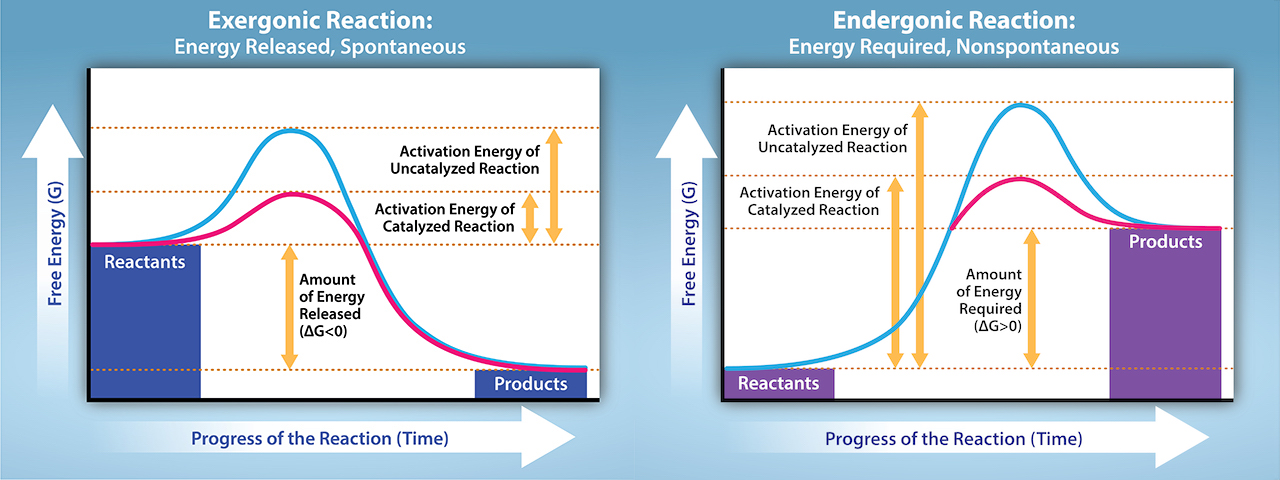
If energy releases during a chemical reaction, then the resulting value from the above equation will be a negative number. In other words, reactions that release energy have a ∆G < 0. A negative ∆G also means that the reaction's products have less free energy than the reactants, because they gave off some free energy during the reaction. Scientists call reactions that have a negative ∆G and consequently release free energy exergonic reactions. Think: exergonic means energy is exiting the system. We also refer to these reactions as spontaneous reactions, because they can occur without adding energy into the system. Understanding which chemical reactions are spontaneous and release free energy is extremely useful for biologists, because these reactions can be harnessed to perform work inside the cell. We must draw an important distinction between the term spontaneous and the idea of a chemical reaction that occurs immediately. Contrary to the everyday use of the term, a spontaneous reaction is not one that suddenly or quickly occurs. Rusting iron is an example of a spontaneous reaction that occurs slowly, little by little, over time.
英語のヒント
化学反応中にエネルギーが放出されるなら、上の式から得られる値は負になる。つまり、エネルギーを放出する反応では ∆G < 0 である。∆G が負であることは、反応中に自由エネルギーの一部を放出したため、生成物の自由エネルギーが反応物より小さいことも意味する。∆G が負で、その結果として自由エネルギーを放出する反応を、発エルゴン反応という。exergonic はエネルギーが系から出ていく、と考えよ。これらは系にエネルギーを加えなくても起こりうるので、自発反応とも呼ばれる。どの化学反応が自発的で、自由エネルギーを放出するのかを理解することは、生物学者にとって非常に有用である。そうした反応を、細胞内で仕事を行うために利用できるからである。「自発的」という用語と、化学反応が直ちに起こるという考えは、明確に区別しなければならない。日常的な語の使い方とは異なり、自発反応とは突然、あるいは速やかに起こる反応のことではない。鉄がさびるのは、時間をかけて少しずつゆっくり起こる自発反応の例である。
If a chemical reaction requires an energy input rather than releasing energy, then the ∆G for that reaction will be a positive value. In this case, the products have more free energy than the reactants. Thus, we can think of the reactions' products as energy-storing molecules. We call these chemical reactions endergonic reactions, and they are non-spontaneous. An endergonic reaction will not take place on its own without adding free energy.
英語のヒント
化学反応がエネルギーを放出するのでなく、その投入を必要とする場合、その反応の ∆G は正の値になる。この場合、生成物は反応物より多くの自由エネルギーをもつ。したがって、生成物をエネルギーを蓄える分子と考えることができる。こうした化学反応を吸エルゴン反応といい、非自発的である。自由エネルギーを加えなければ、吸エルゴン反応はひとりでには起こらない。
Let’s revisit the example of the synthesis and breakdown of the food molecule, glucose. Remember that building complex molecules, such as sugars, from simpler ones is an anabolic process and requires energy. Therefore, the chemical reactions involved in anabolic processes are endergonic reactions. Alternatively the catabolic process of breaking sugar down into simpler molecules releases energy in a series of exergonic reactions. Like the rust example above, the sugar breakdown involves spontaneous reactions, but these reactions do not occur instantaneously. Figure 6.8 shows some other examples of endergonic and exergonic reactions. Later sections will provide more information about what else is required to make even spontaneous reactions happen more efficiently.
英語のヒント
栄養分子であるグルコースの合成と分解の例に戻ろう。糖のような複雑な分子を、より単純な分子から組み立てるのは同化過程であり、エネルギーを必要とすることを思い出せ。したがって、同化過程に関わる化学反応は吸エルゴン反応である。それに対し、糖をより単純な分子へ分解する異化過程では、一連の発エルゴン反応を通じてエネルギーが放出される。先のさびの例と同じく、糖の分解にも自発反応が関わるが、それらは瞬時に起こるわけではない。図6.8に、吸エルゴン反応と発エルゴン反応の別の例を示す。自発反応であっても、より効率よく起こすにはほかに何が必要なのか、後の節で詳しく説明する。
An important concept in studying metabolism and energy is that of chemical equilibrium. Most chemical reactions are reversible. They can proceed in both directions, releasing energy into their environment in one direction, and absorbing it from the environment in the other direction (Figure 6.9). The same is true for the chemical reactions involved in cell metabolism, such as the breaking down and building up of proteins into and from individual amino acids, respectively. Reactants within a closed system will undergo chemical reactions in both directions until they reach a state of equilibrium, which is one of the lowest possible free energy and a state of maximal entropy. To push the reactants and products away from a state of equilibrium requires energy. Either reactants or products must be added, removed, or changed. If a cell were a closed system, its chemical reactions would reach equilibrium, and it would die because there would be insufficient free energy left to perform the necessary work to maintain life. In a living cell, chemical reactions are constantly moving towards equilibrium, but never reach it. This is because a living cell is an open system. Materials pass in and out, the cell recycles the products of certain chemical reactions into other reactions, and there is never chemical equilibrium. In this way, living organisms are in a constant energy-requiring, uphill battle against equilibrium and entropy. This constant energy supply ultimately comes from sunlight, which produces nutrients in the photosynthesis process.
英語のヒント
代謝とエネルギーを学ぶうえで重要なのが、化学平衡という概念である。ほとんどの化学反応は可逆的である。両方向へ進むことができ、一方向では周囲へエネルギーを放出し、反対方向では周囲からエネルギーを吸収する(図6.9)。細胞の代謝に関わる化学反応にも同じことが当てはまる。たとえば、タンパク質を個々のアミノ酸へ分解する反応と、個々のアミノ酸からタンパク質を組み立てる反応である。閉鎖系の反応物は、平衡状態に達するまで両方向の化学反応を続ける。平衡は、可能な限り自由エネルギーが低く、エントロピーが最大となる状態の一つである。反応物や生成物を平衡状態から遠ざけるにはエネルギーが必要である。反応物か生成物を加える、取り除く、または変化させる必要がある。もし細胞が閉鎖系なら、化学反応は平衡に達し、生命を維持するための仕事に必要な自由エネルギーが足りなくなって、細胞は死んでしまう。生きた細胞の化学反応は絶えず平衡へ向かっているが、平衡には決して達しない。生きた細胞は開放系だからである。物質が出入りし、ある化学反応の生成物が別の反応に再利用されるため、化学平衡は成立しない。このように、生物はエネルギーを必要とし続けながら、平衡とエントロピーに抗する困難な闘いを続けている。この絶え間ないエネルギー供給は、最終的には光合成によって栄養物質を生み出す太陽光に由来する。
OpenStax, Rice University; Biology 2e. Credit: Tag, A., Rao, A., Fletcher, S. and Ryan, A. Department of Biology, Texas A&M University. · CC BY 4.0 · Source出典

Figure 6.9図 6.9
Exergonic and endergonic reactions result in changes in Gibbs free energy (G). Exergonic reactions have a net release of energy and are spontaneous reactions. Endergonic reactions require an input of energy to proceed and are nonspontaneous reactions. Both Exergonic and endergonic reactions require initial activation energy for the reaction to occur.Credit: Tag, A., Rao, A., Fletcher, S. and Ryan, A. Department of Biology, Texas A&M University.
発エルゴン反応と吸エルゴン反応では、ギブズ自由エネルギー(G)が変化する。発エルゴン反応では正味のエネルギー放出が起こり、反応は自発的である。吸エルゴン反応が進むにはエネルギーの投入が必要で、非自発的な反応である。どちらの反応も、起こるためには最初に活性化エネルギーが必要になる。出典:Tag, A.、Rao, A.、Fletcher, S.、Ryan, A.、テキサスA&M大学生物学部。