第6章代謝
6.1 Energy and Metabolism6.1 エネルギーと代謝
Learning Objectives学習目標
By the end of this section, you will be able to do the following:
この節を学ぶと、次のことができるようになる。
- Explain metabolic pathways and describe the two major types代謝経路を説明し、二つの主要な種類を述べる。
- Discuss how chemical reactions play a role in energy transfer化学反応がエネルギー移動に果たす役割を論じる。
Scientists use the term bioenergetics to discuss the concept of energy flow (Figure 6.2) through living systems, such as cells. Cellular processes such as building and breaking down complex molecules occur through stepwise chemical reactions. Some of these chemical reactions are spontaneous and release energy; whereas, others require energy to proceed. Just as living things must continually consume food to replenish what they have used, cells must continually obtain more energy to replenish that which the many energy-requiring chemical reactions that constantly take place use. All of the chemical reactions that transpire inside cells, including those that use and release energy, are the cell’s metabolism.
英語のヒント
細胞などの生体系を通るエネルギーの流れ(図6.2)を論じるとき、生体エネルギー学という用語が使われる。複雑な分子の構築や分解といった細胞内の過程は、段階的な化学反応によって起こる。自発的に進んでエネルギーを放出する反応もあれば、進むためにエネルギーを必要とする反応もある。生物が使った分を補うために食物を絶えず摂取する必要があるのと同じく、細胞も、常に起こる多くの化学反応が消費するエネルギーを補うため、さらにエネルギーを得続けなければならない。エネルギーを使うものも放出するものも含め、細胞内で起こるすべての化学反応が、その細胞の代謝である。
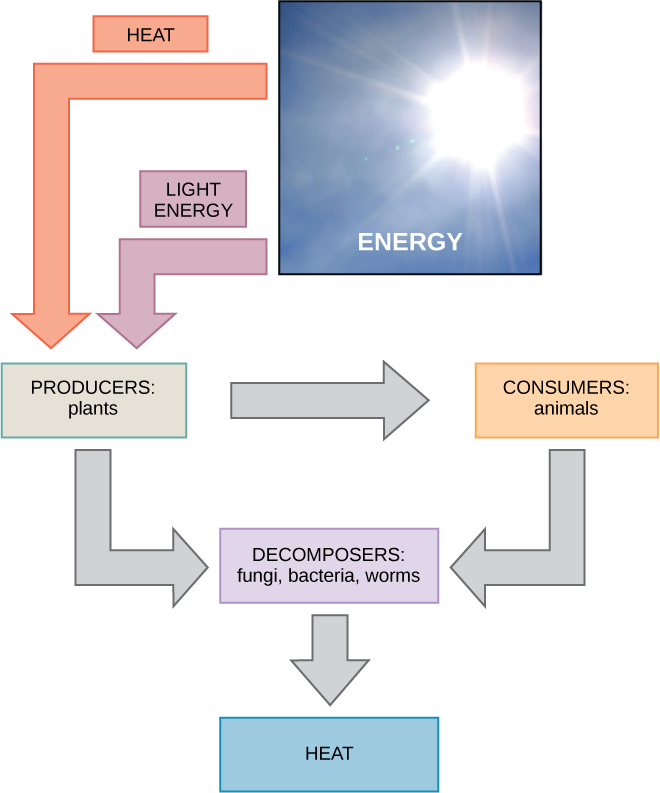

Figure 6.2図 6.2
Most life forms on earth obtain their energy from the sun. Plants use photosynthesis to capture sunlight, and herbivores eat those plants to obtain energy. Carnivores eat the herbivores, and decomposers digest plant and animal matter.
地球上の大部分の生物は、太陽からエネルギーを得る。植物は光合成で太陽光を取り込み、草食動物は植物を食べてエネルギーを得る。肉食動物は草食動物を食べ、分解者は植物や動物の物質を消化する。
Carbohydrate Metabolism糖質の代謝
Sugar (a simple carbohydrate) metabolism (chemical reactions) is a classic example of the many cellular processes that use and produce energy. Living things consume sugar as a major energy source, because sugar molecules have considerable energy stored within their bonds. The following equation describes the breakdown of glucose, a simple sugar:
英語のヒント
糖(単純な糖質)の代謝、つまりその化学反応は、エネルギーを使い、作り出す多くの細胞内過程の典型例である。糖分子の結合には多くのエネルギーが蓄えられているため、生物は糖を主要なエネルギー源として消費する。単糖であるグルコースの分解は、次の式で表せる。
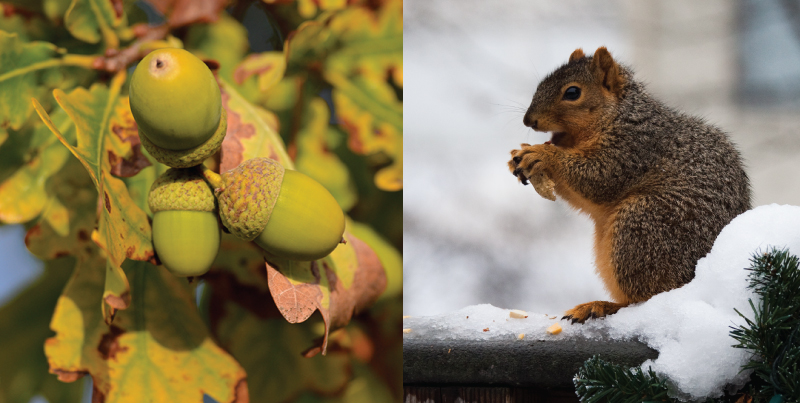
Consumed carbohydrates have their origins in photosynthesizing organisms like plants (Figure 6.3). During photosynthesis, plants use the energy of sunlight to convert carbon dioxide gas (CO2) into sugar molecules, like glucose (C6H12O6). Because this process involves synthesizing a larger, energy-storing molecule, it requires an energy input to proceed. The following equation (notice that it is the reverse of the previous equation) describes the synthesis of glucose:
英語のヒント
摂取される糖質は、植物のような光合成生物に由来する(図6.3)。植物は光合成の際に、太陽光のエネルギーを使い、二酸化炭素ガス(CO2)を、グルコース(C6H12O6)などの糖分子へ変える。この過程では、より大きく、エネルギーを蓄える分子を合成するため、進行にはエネルギーの入力が必要である。グルコースの合成を表す次の式が、前の式の逆になっていることに注目しよう。
During photosynthesis chemical reactions, energy is in the form of a very high-energy molecule scientists call ATP, or adenosine triphosphate. This is the primary energy currency of all cells. Just as the dollar is the currency we use to buy goods, cells use ATP molecules as energy currency to perform immediate work. The sugar (glucose) is stored as starch or glycogen. Energy-storing polymers like these break down into glucose to supply ATP molecules.
英語のヒント
光合成の化学反応の間、エネルギーはATP、すなわちアデノシン三リン酸という、非常に高エネルギーの分子の形をとる。これは、すべての細胞の主要なエネルギー通貨である。ドルを通貨として品物を買うのと同じように、細胞はATP分子をエネルギー通貨として、すぐに必要な仕事を行う。糖であるグルコースは、デンプンやグリコーゲンとして蓄えられる。このようなエネルギー貯蔵用の高分子は、グルコースに分解され、ATP分子を供給する。
Solar energy is required to synthesize a glucose molecule during the photosynthesis reactions. In photosynthesis, light energy from the sun initially transforms into chemical energy that temporally stores itself in the energy carrier molecules ATP and NADPH (nicotinamide adenine dinucleotide phosphate). Photosynthesis later uses the stored energy in ATP and NADPH to build one glucose molecule from six molecules of CO2. This process is analogous to eating breakfast in the morning to acquire energy for your body that you can use later in the day. Under ideal conditions, energy from 18 molecules of ATP is required to synthesize one glucose molecule during photosynthesis reactions. Glucose molecules can also combine with and convert into other sugar types. When an organism consumes sugars, glucose molecules eventually make their way into each organism's living cell. Inside the cell, each sugar molecule breaks down through a complex series of chemical reactions. The goal of these reactions is to harvest the energy stored inside the sugar molecules. The harvested energy makes high-energy ATP molecules, which perform work, powering many chemical reactions in the cell. The amount of energy needed to make one glucose molecule from six carbon dioxide molecules is 18 ATP molecules and 12 NADPH molecules (each one of which is energetically equivalent to three ATP molecules), or a total of 54 molecule equivalents required for synthesizing one glucose molecule. This process is a fundamental and efficient way for cells to generate the molecular energy that they require.
英語のヒント
光合成反応でグルコース1分子を合成するには、太陽エネルギーが必要である。まず太陽の光エネルギーが化学エネルギーに変換され、エネルギー運搬分子ATPとNADPH(ニコチンアミドアデニンジヌクレオチドリン酸)に一時的に蓄えられる。その後、ATPとNADPHに蓄えたエネルギーを使い、CO26分子からグルコース1分子を作る。これは朝食を食べて、その日の後に使えるエネルギーを体に得ることに似ている。理想的な条件では、光合成でグルコース1分子を合成するのにATP18分子分のエネルギーが必要である。グルコース分子は、ほかの糖と結合したり、別の種類の糖へ変換されたりすることもある。生物が糖を消費すると、グルコース分子はやがて生物の生きた各細胞へ届く。細胞内では、各糖分子が複雑な一連の化学反応で分解される。その目的は、糖分子の中に蓄えられたエネルギーを取り出すことである。取り出したエネルギーで高エネルギーのATPを作り、それが仕事をして、細胞内の多くの化学反応を駆動する。二酸化炭素6分子からグルコース1分子を作るのに必要なのは、ATP18分子とNADPH12分子である。NADPH1分子はエネルギー的にATP3分子に相当するため、合計ではATP54分子相当が必要となる。これは、細胞が必要な分子エネルギーを生み出す基本的で効率的な方法である。
OpenStax, Rice University; Biology 2e. (credit “acorn”: modification of work by Noel Reynolds; credit “squirrel”: modification of work by Dawn Huczek) · CC BY 4.0 · Source出典

Figure 6.3図 6.3
Plants, like this oak tree and acorn, use energy from sunlight to make sugar and other organic molecules. Both plants and animals (like this squirrel) use cellular respiration to derive energy from the organic molecules that plants originally produced. (credit “acorn”: modification of work by Noel Reynolds; credit “squirrel”: modification of work by Dawn Huczek)
このオークの木やドングリのように、植物は太陽光のエネルギーを使い、糖などの有機分子を作る。植物も、このリスのような動物も、細胞呼吸によって、もとは植物が作った有機分子からエネルギーを得る。(「ドングリ」のクレジット:Noel Reynoldsの作品を改変。「リス」のクレジット:Dawn Huczekの作品を改変)