第6章代謝
Metabolism Control Through Enzyme Regulation酵素の調節による代謝の制御
It would seem ideal to have a scenario in which all the encoded enzymes in an organism’s genome existed in abundant supply and functioned optimally under all cellular conditions, in all cells, at all times. In reality, this is far from the case. A variety of mechanisms ensure that this does not happen. Cellular needs and conditions vary from cell to cell, and change within individual cells over time. The required enzymes and energetic demands of stomach cells are different from those of fat storage cells, skin cells, blood cells, and nerve cells. Furthermore, a digestive cell works much harder to process and break down nutrients during the time that closely follows a meal compared with many hours after a meal. As these cellular demands and conditions vary, so do the amounts and functionality of different enzymes.
英語のヒント
生物のゲノムにコードされている酵素がすべて豊富に存在し、すべての細胞で、あらゆる細胞内条件のもと、常に最適に働くなら、理想的に思えるかもしれない。現実はまったく違う。さまざまな仕組みによって、そうならないようになっている。細胞の必要とするものや条件は細胞ごとに異なり、一つの細胞の中でも時間とともに変化する。胃の細胞で必要な酵素やエネルギー需要は、脂肪を蓄える細胞、皮膚細胞、血球、神経細胞とは異なる。また、消化を行う細胞は、食後何時間もたった時よりも、食事の直後のほうが栄養物質の処理と分解に忙しく働く。このように細胞の需要や条件が変わると、各酵素の量と機能も変化する。
Since the rates of biochemical reactions are controlled by activation energy, and enzymes lower and determine activation energies for chemical reactions, the relative amounts and functioning of the variety of enzymes within a cell ultimately determine which reactions will proceed and at which rates. This determination is tightly controlled. In certain cellular environments, environmental factors like pH and temperature partly control enzyme activity. There are other mechanisms through which cells control enzyme activity and determine the rates at which various biochemical reactions will occur.
英語のヒント
生化学反応の速度は活性化エネルギーによって制御され、酵素はその活性化エネルギーを下げて決定する。したがって、細胞内の各種酵素の相対量と働きが、どの反応がどの速度で進むかを最終的に決める。この決定は厳密に制御されている。ある細胞内環境では、pHや温度などの環境要因が酵素活性を部分的に制御する。細胞が酵素活性を制御し、さまざまな生化学反応の速度を決める仕組みは、ほかにもある。
Molecular Regulation of Enzymes分子による酵素の調節
Enzymes can be regulated in ways that either promote or reduce their activity. There are many different kinds of molecules that inhibit or promote enzyme function, and various mechanisms exist for doing so. For example, in some cases of enzyme inhibition, an inhibitor molecule is similar enough to a substrate that it can bind to the active site and simply block the substrate from binding. When this happens, the enzyme is inhibited through competitive inhibition, because an inhibitor molecule competes with the substrate for active site binding (Figure 6.17). On the other hand, in noncompetitive inhibition, an inhibitor molecule binds to the enzyme in a location other than the active site, called an allosteric site, but still manages to prevent substrate binding to the active site. Some inhibitor molecules bind to enzymes in a location where their binding induces a conformational change that reduces the enzyme activity as it no longer effectively catalyzes the conversion of the substrate to product.
英語のヒント
酵素は、その活性を促進する方向にも低下させる方向にも調節できる。酵素の働きを阻害したり促進したりする分子には多くの種類があり、仕組みもさまざまである。たとえば酵素阻害の中には、阻害剤の分子が基質によく似ているため、活性部位へ結合し、基質の結合を直接妨げるものがある。この場合、阻害剤が活性部位への結合を基質と競うので、競争阻害によって酵素が阻害される(図6.17)。一方、非競争阻害では、阻害剤は活性部位以外の、アロステリック部位と呼ばれる場所に結合するが、それでも活性部位への基質結合を妨げる。ある種の阻害剤は、結合すると酵素の立体構造を変化させる場所に結合する。その結果、基質から生成物への変換を効果的に触媒できなくなり、酵素活性が低下する。
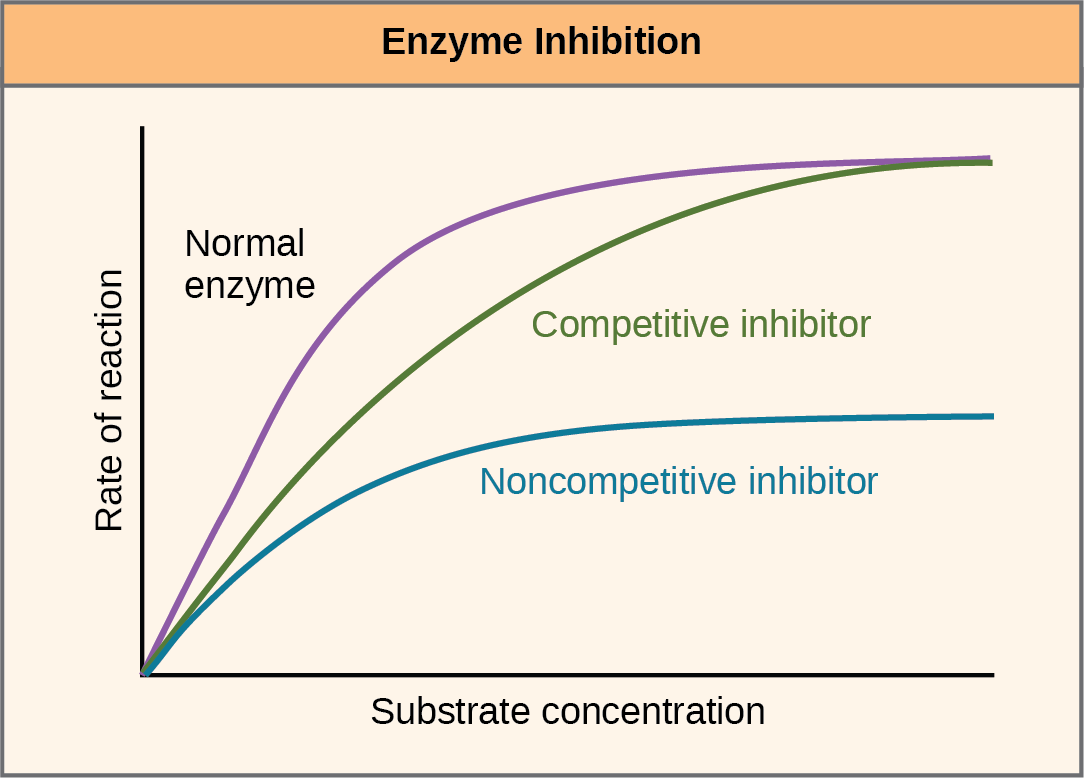
Figure 6.17図 6.17
Competitive and noncompetitive inhibition affect the reaction's rate differently. Competitive inhibitors affect the initial rate but do not affect the maximal rate; whereas, noncompetitive inhibitors affect the maximal rate.
競争阻害と非競争阻害は、反応速度に異なる影響を与える。競争阻害剤は初速度に影響するが、最大速度には影響しない。それに対し、非競争阻害剤は最大速度に影響する。
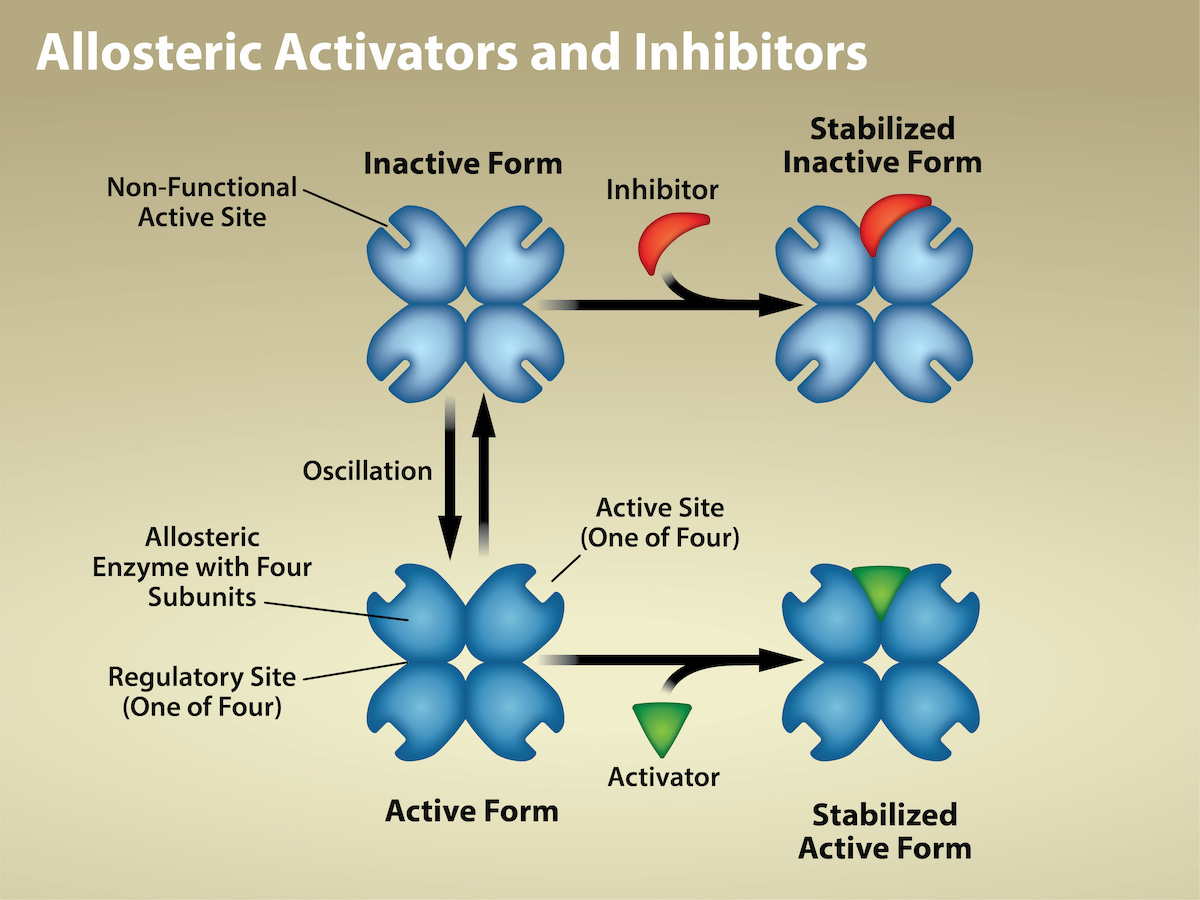
Some inhibitor molecules bind to enzymes in a location where their binding induces a conformational change that reduces the enzyme's affinity for its substrate. This type of inhibition is an allosteric inhibition (Figure 6.18). More than one polypeptide comprise most allosterically regulated enzymes, meaning that they have more than one protein subunit. When an allosteric inhibitor binds to an enzyme, all active sites on the protein subunits change slightly such that they bind their substrates with less efficiency. There are allosteric activators as well as inhibitors. Allosteric activators bind to locations on an enzyme away from the active site, inducing a conformational change that increases the affinity of the enzyme’s active site(s) for its substrate(s).
英語のヒント
ある種の阻害剤は、結合すると立体構造の変化を引き起こし、基質への親和性を低下させる場所に結合する。この型の阻害をアロステリック阻害という(図6.18)。アロステリックに調節される酵素の多くは、複数のポリペプチドからできている。つまり、複数のタンパク質サブユニットをもっている。アロステリック阻害剤が酵素へ結合すると、各サブユニットのすべての活性部位がわずかに変化し、基質への結合効率が低下する。アロステリックな分子には、阻害剤だけでなく活性化因子もある。活性化因子は、酵素の活性部位から離れた位置に結合して立体構造変化を起こし、活性部位の基質への親和性を高める。
OpenStax, Rice University; Biology 2e. Credit: Rao, A., Hawkins, A., Fletcher, S. and Tag, A. Department of Biology, Texas A&M University. · CC BY 4.0 · Source出典
Figure 6.18図 6.18
Allosteric inhibitors modify the enzyme's active site so that substrate binding is reduced or prevented. In contrast, allosteric activators modify the enzyme's active site so that the affinity for the substrate increases. Credit: Rao, A., Hawkins, A., Fletcher, S. and Tag, A. Department of Biology, Texas A&M University.
アロステリック阻害剤は酵素の活性部位を変え、基質の結合を減らすか妨げる。それに対し、アロステリック活性化因子は、基質への親和性が増すように活性部位を変える。出典:Rao, A.、Hawkins, A.、Fletcher, S.、Tag, A.、テキサスA&M大学生物学部。
Many enzymes don’t work optimally, or even at all, unless bound to other specific non-protein helper molecules, either temporarily through ionic or hydrogen bonds or permanently through stronger covalent bonds. Two types of helper molecules are cofactors and coenzymes. Binding to these molecules promotes optimal conformation and function for their respective enzymes. Cofactors are inorganic ions such as iron (Fe++) and magnesium (Mg++). One example of an enzyme that requires a metal ion as a cofactor is the enzyme that builds DNA molecules, DNA polymerase, which requires a bound zinc ion (Zn++) to function. Coenzymes are organic helper molecules, with a basic atomic structure comprised of carbon and hydrogen, which are required for enzyme action. The most common sources of coenzymes are dietary vitamins (Figure 6.20). Some vitamins are precursors to coenzymes and others act directly as coenzymes. Vitamin C is a coenzyme for multiple enzymes that take part in building the important connective tissue component, collagen. An important step in breaking down glucose to yield energy is catalysis by a multi-enzyme complex scientists call pyruvate dehydrogenase. Pyruvate dehydrogenase is a complex of several enzymes that actually requires one cofactor (a magnesium ion) and five different organic coenzymes to catalyze its specific chemical reaction. Therefore, enzyme function is, in part, regulated by an abundance of various cofactors and coenzymes, which the diets of most organisms supply.
英語のヒント
多くの酵素は、タンパク質ではない特定の補助分子と結合しなければ、最適には働かず、まったく働かないことさえある。この結合は、イオン結合や水素結合による一時的なものの場合も、より強い共有結合による恒久的なものの場合もある。補助分子には、補因子と補酵素の二種類がある。それらの結合は、対応する酵素の最適な立体構造と機能を促す。補因子は、鉄(Fe++)やマグネシウム(Mg++)などの無機イオンである。金属イオンを補因子として必要とする酵素の一例は、DNA分子をつくるDNAポリメラーゼで、働くために亜鉛イオン(Zn++)の結合を必要とする。補酵素は、炭素と水素を基本骨格とする有機性の補助分子で、酵素の働きに必要である。補酵素の最も一般的な供給源は、食事中のビタミンである(図6.20)。あるビタミンは補酵素の前駆体となり、別のビタミンは直接補酵素として働く。ビタミンCは、結合組織の重要な成分であるコラーゲンの構築に関わる複数の酵素の補酵素である。グルコースを分解してエネルギーを得る重要な段階の一つは、ピルビン酸デヒドロゲナーゼと呼ばれる多酵素複合体によって触媒される。これは複数の酵素からなる複合体で、特有の化学反応を触媒するために、一つの補因子(マグネシウムイオン)と、5種類の有機性補酵素を必要とする。このように、酵素の機能は、ほとんどの生物が食物から得る各種の補因子と補酵素の豊富さによって、部分的に調節されている。
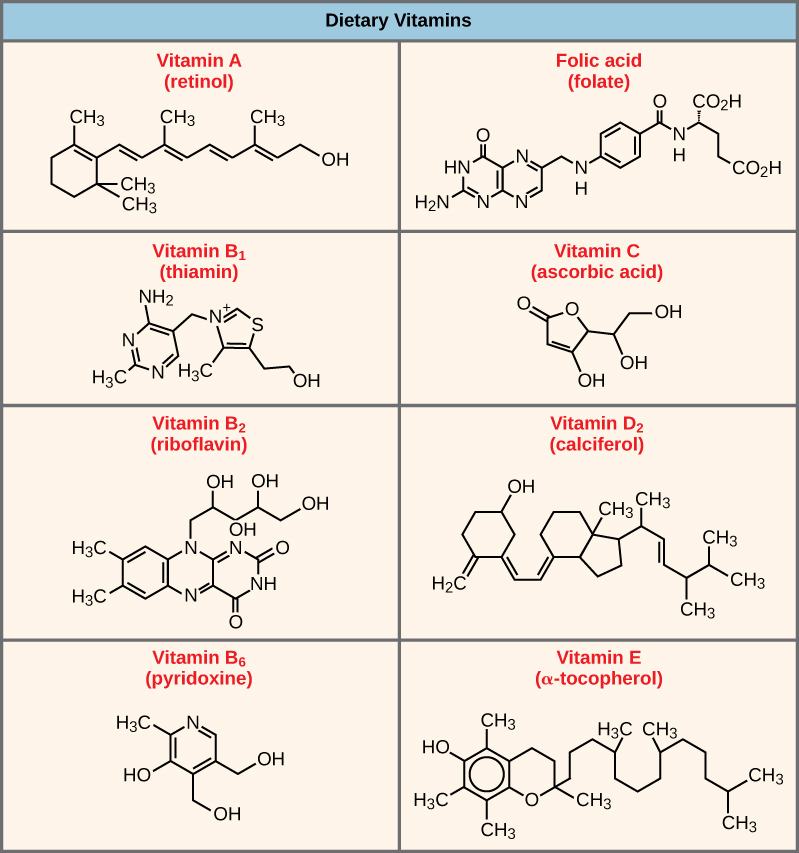


Figure 6.20図 6.20
Vitamins are important coenzymes or precursors of coenzymes, and are required for enzymes to function properly. Multivitamin capsules usually contain mixtures of all the vitamins at different percentages.
ビタミンは重要な補酵素、または補酵素の前駆体であり、酵素が正常に働くために必要である。総合ビタミンのカプセルには、通常、すべてのビタミンが異なる割合で混合されている。