第6章代謝
6.4 ATP: Adenosine Triphosphate6.4 ATP:アデノシン三リン酸
Learning Objectives学習目標
By the end of this section, you will be able to do the following:
この節を学び終えると、次のことができるようになる。
- Explain ATP's role as the cellular energy currency細胞のエネルギー通貨としてのATPの役割を説明する。
- Describe how energy releases through ATP hydrolysisATPの加水分解によってエネルギーがどのように放出されるかを説明する。
Even exergonic, energy-releasing reactions require a small amount of activation energy in order to proceed. However, consider endergonic reactions, which require much more energy input, because their products have more free energy than their reactants. Within the cell, from where does energy to power such reactions come? The answer lies with an energy-supplying molecule scientists call adenosine triphosphate, or ATP. This is a small, relatively simple molecule (Figure 6.13), but within some of its bonds, it contains the potential for a quick burst of energy that can be harnessed to perform cellular work. Think of this molecule as the cells' primary energy currency in much the same way that money is the currency that people exchange for things they need. ATP powers the majority of energy-requiring cellular reactions.
英語のヒント
エネルギーを放出する発エルゴン反応であっても、進行には少量の活性化エネルギーが必要である。では、生成物が反応物より多くの自由エネルギーをもち、さらに多くのエネルギー投入を必要とする吸エルゴン反応について考えよう。細胞内で、こうした反応を動かすエネルギーはどこから来るのだろうか。答えは、アデノシン三リン酸、すなわちATPと呼ばれるエネルギー供給分子にある。ATPは小さく、比較的単純な分子であるが(図6.13)、その一部の結合には、細胞の仕事に利用できるエネルギーを短時間で放出する可能性が秘められている。人が必要な物を得るために交換する通貨がお金であるように、ATPを細胞の主要なエネルギー通貨と考えよ。ATPは、エネルギーを必要とする細胞反応の大部分に動力を与える。
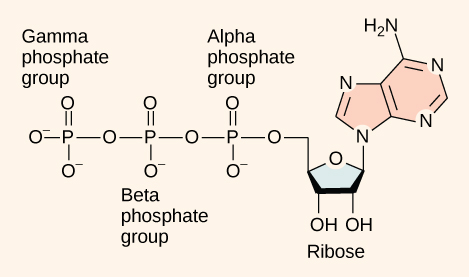

Figure 6.13図 6.13
ATP is the cell's primary energy currency. It has an adenosine backbone with three phosphate groups attached.
ATPは細胞の主要なエネルギー通貨である。アデノシンの骨格に三つのリン酸基が結合している。
As its name suggests, adenosine triphosphate is comprised of adenosine bound to three phosphate groups (Figure 6.13). Adenosine is a nucleoside consisting of the nitrogenous base adenine and a five-carbon sugar, ribose. The three phosphate groups, in order of closest to furthest from the ribose sugar, are alpha, beta, and gamma. Together, these chemical groups constitute an energy powerhouse. However, not all bonds within this molecule exist in a particularly high-energy state. Both bonds that link the phosphates are equally high-energy bonds (phosphoanhydride bonds) that, when broken, during chemical reactions can release sufficient energy to power a variety of cellular reactions and processes. These high-energy bonds are the bonds between the second and third (or beta and gamma) phosphate groups and between the first and second phosphate groups. These bonds are “high-energy” because the products of hydrolysis—adenosine diphosphate (ADP) and one inorganic phosphate group (Pi)—have considerably lower free energy than the reactants: ATP and a water molecule. In other words, ATP hydrolyzes into ADP in the following reaction:
英語のヒント
名前が示すように、アデノシン三リン酸は、アデノシンに三つのリン酸基が結合したものである(図6.13)。アデノシンは、窒素を含む塩基アデニンと、五炭糖のリボースからなるヌクレオシドである。三つのリン酸基を、リボースに近いほうから順にα、β、γと呼ぶ。これらの化学基が一体となって、エネルギー供給の中心を構成している。ただし、この分子内のすべての結合が特に高いエネルギー状態にあるわけではない。リン酸同士をつなぐ二つの結合はいずれも同じように高エネルギーの結合(リン酸無水結合)で、化学反応で切れると、さまざまな細胞反応や過程を進めるのに十分なエネルギーを放出できる。それは、第2と第3(βとγ)のリン酸基の間、および第1と第2のリン酸基の間の結合である。これらを「高エネルギー」結合というのは、加水分解の生成物であるアデノシン二リン酸(ADP)と一つの無機リン酸基(Pi)の自由エネルギーが、反応物であるATPと水分子よりかなり低いからである。つまり、ATPは次の反応でADPへ加水分解される。
Like most chemical reactions, ATP to ADP hydrolysis is reversible. The reverse reaction regenerates ATP from ADP + Pi. Cells rely on ATP regeneration just as people rely on regenerating spent money through some sort of income. Since ATP hydrolysis releases energy, ATP regeneration must require an input of free energy. This equation expresses ATP formation:
英語のヒント
大半の化学反応と同様に、ATPからADPへの加水分解は可逆的である。逆反応は、ADP + Pi からATPを再生する。人が使ったお金を何らかの収入で補うことに頼るように、細胞はATPの再生に頼っている。ATPの加水分解でエネルギーが放出される以上、ATPを再生するには自由エネルギーの投入が必要である。ATPの生成は次の式で表される。
Two prominent questions remain with regard to using ATP as an energy source. Exactly how much free energy releases with ATP hydrolysis, and how does that free energy do cellular work? The calculated ∆G for the hydrolysis of one ATP mole into ADP and Pi is −7.3 kcal/mole (−30.5 kJ/mol). Since this calculation is true under standard conditions, one would expect a different value exists under cellular conditions. In fact, the ∆G for one ATP mole's hydrolysis in a living cell is almost double the value at standard conditions: –14 kcal/mol (−57 kJ/mol).
英語のヒント
ATPをエネルギー源として利用することについて、二つの大きな疑問が残る。ATPの加水分解では正確にどれだけの自由エネルギーが放出されるのか、そしてその自由エネルギーはどのように細胞の仕事を行うのか、という疑問である。ATP1モルがADPとPiに加水分解されるときの ∆G の計算値は、−7.3 kcal/mol(−30.5 kJ/mol)である。これは標準条件での計算値なので、細胞内の条件では異なる値になると考えられる。実際、生細胞内でATP1モルが加水分解されるときの ∆G は、標準条件のほぼ2倍で、−14 kcal/mol(−57 kJ/mol)である。
ATP is a highly unstable molecule. Unless quickly used to perform work, ATP spontaneously dissociates into ADP + Pi, and the free energy released during this process is lost as heat. The second question we posed above discusses how ATP hydrolysis energy release performs work inside the cell. This depends on a strategy scientists call energy coupling. Cells couple the ATP hydrolysis' exergonic reaction allowing them to proceed. One example of energy coupling using ATP involves a transmembrane ion pump that is extremely important for cellular function. This sodium-potassium pump (Na+/K+ pump) drives sodium out of the cell and potassium into the cell (Figure 6.14). A large percentage of a cell’s ATP powers this pump, because cellular processes bring a considerable amount of sodium into the cell and potassium out of it. The pump works constantly to stabilize cellular concentrations of sodium and potassium. In order for the pump to turn one cycle (exporting three Na+ ions and importing two K+ ions), one ATP molecule must hydrolyze. When ATP hydrolyzes, its gamma phosphate does not simply float away, but it actually transfers onto the pump protein. Scientists call this process of a phosphate group binding to a molecule phosphorylation. As with most ATP hydrolysis cases, a phosphate from ATP transfers onto another molecule. In a phosphorylated state, the Na+/K+ pump has more free energy and is triggered to undergo a conformational change. This change allows it to release Na+ to the cell's outside. It then binds extracellular K+, which, through another conformational change, causes the phosphate to detach from the pump. This phosphate release triggers the K+ to release to the cell's inside. Essentially, the energy released from the ATP hydrolysis couples with the energy required to power the pump and transport Na+ and K+ ions. Once again, the ATP hydrolysis releases energy used for phosphorylation of another molecule, creating an unstable intermediate that powers the conformational change. In this way, ATP performs cellular work using this basic form of energy coupling through phosphorylation.
英語のヒント
ATPは非常に不安定な分子である。すぐに仕事へ利用されなければ、自発的に ADP + Pi へ解離し、この過程で放出された自由エネルギーは熱として失われる。先ほどの二つ目の疑問は、ATPの加水分解で放出されたエネルギーが、細胞内でどのように仕事をするのか、というものであった。これは、エネルギー共役と呼ばれる仕組みに依存する。細胞はATP加水分解の発エルゴン反応を共役させ、反応を進める。ATPを使うエネルギー共役の一例に、細胞機能に極めて重要な膜貫通イオンポンプがある。このナトリウム–カリウムポンプ(Na+/K+ポンプ)は、ナトリウムを細胞外へ、カリウムを細胞内へ運ぶ(図6.14)。細胞内の過程によって相当量のナトリウムが中へ入り、カリウムが外へ出るため、細胞のATPの大きな割合がこのポンプを動かすのに使われる。ポンプは、細胞内のナトリウムとカリウムの濃度を安定させるため、絶えず働いている。ポンプが一巡するには、すなわちNa+イオン3個を外へ出し、K+イオン2個を取り込むには、ATP1分子が加水分解されなければならない。ATPの加水分解に伴い、γリン酸はそのまま離れて漂うのではなく、ポンプのタンパク質へ移される。このようにリン酸基が分子に結合する過程を、リン酸化という。ATP加水分解の多くの場合と同じく、ATPのリン酸が別の分子へ移されるのである。リン酸化したNa+/K+ポンプは、より多くの自由エネルギーをもち、それをきっかけに立体構造を変える。この変化によって、Na+を細胞外へ放出できるようになる。次に細胞外のK+が結合すると、別の立体構造変化を通じてリン酸がポンプから離れる。リン酸の離脱は、K+の細胞内への放出を引き起こす。つまり、ATPの加水分解で放出されるエネルギーが、ポンプを動かしてNa+とK+イオンを運ぶのに必要なエネルギーと共役している。ここでもATPの加水分解が放出するエネルギーは別の分子のリン酸化に使われ、不安定な中間体をつくって立体構造変化を駆動する。このように、ATPはリン酸化を通じた基本的なエネルギー共役を利用して、細胞の仕事を行う。
Often during cellular metabolic reactions, such as nutrient synthesis and breakdown, certain molecules must alter slightly in their conformation to become substrates for the next step in the reaction series. One example is during the very first steps of cellular respiration, when a sugar glucose molecule breaks down in the process of glycolysis. In the first step, ATP is required to phosphorylate glucose, creating a high-energy but unstable intermediate. This phosphorylation reaction powers a conformational change that allows the phosphorylated glucose molecule to convert to the phosphorylated sugar fructose. Fructose is a necessary intermediate for glycolysis to move forward. Here, ATP hydrolysis' exergonic reaction couples with the endergonic reaction of converting glucose into a phosphorylated intermediate in the pathway. Once again, the energy released by breaking a phosphate bond within ATP was used for phosphorylyzing another molecule, creating an unstable intermediate and powering an important conformational change.
英語のヒント
栄養物質の合成や分解など、細胞の代謝反応では、ある分子が一連の反応の次の段階の基質になるために、立体構造をわずかに変える必要がしばしばある。一例が細胞呼吸の最初の段階で、糖であるグルコース分子が解糖系の過程で分解される。最初の段階では、ATPによってグルコースがリン酸化され、高エネルギーで不安定な中間体が生じる。このリン酸化反応が立体構造変化を駆動し、リン酸化されたグルコース分子が、リン酸化されたフルクトースへ変換できるようになる。フルクトースは解糖系を先へ進めるために必要な中間体である。ここでは、ATP加水分解という発エルゴン反応が、経路内でグルコースをリン酸化中間体へ変える吸エルゴン反応と共役している。ここでも、ATP内のリン酸結合が切れて放出されるエネルギーが、別の分子のリン酸化に使われ、不安定な中間体を生み出し、重要な立体構造変化を駆動するのである。