第6章代謝
6.3 The Laws of Thermodynamics6.3 熱力学の法則
Learning Objectives学習目標
By the end of this section, you will be able to do the following:
この節を学び終えると、次のことができるようになる。
- Discuss the concept of entropyエントロピーの概念を論じる。
- Explain the first and second laws of thermodynamics熱力学第一法則と第二法則を説明する。
Thermodynamics refers to the study of energy and energy transfer involving physical matter. The matter and its environment relevant to a particular case of energy transfer are classified as a system, and everything outside that system is the surroundings. For instance, when heating a pot of water on the stove, the system includes the stove, the pot, and the water. Energy transfers within the system (between the stove, pot, and water). There are two types of systems: open and closed. An open system is one in which energy and matter can transfer between the system and its surroundings. The stovetop system is open because it can lose heat into the air. A closed system is one that can transfer energy but not matter to its surroundings.
英語のヒント
熱力学とは、物質に関わるエネルギーと、その移動を研究する分野である。あるエネルギー移動に関係する物質とその環境を系と呼び、その系の外側にあるすべてを外界と呼ぶ。たとえばコンロで鍋の水を加熱する場合、系にはコンロ、鍋、水が含まれる。エネルギーは、系の内部でコンロ、鍋、水の間を移動する。系には開放系と閉鎖系の二つがある。開放系は、系と外界の間をエネルギーと物質が移動できる系である。コンロ上の系は、熱が空気中へ逃げるので開放系である。閉鎖系は、外界との間でエネルギーは移動できるが、物質は移動できない系である。
Biological organisms are open systems. Energy exchanges between them and their surroundings, as they consume energy-storing molecules and release energy to the environment by doing work. Like all things in the physical world, energy is subject to the laws of physics. The laws of thermodynamics govern the transfer of energy in and among all systems in the universe.
英語のヒント
生物は開放系である。エネルギーを蓄えた分子を消費し、仕事をして環境へエネルギーを放出することで、周囲との間でエネルギーを交換する。物理世界のあらゆるものと同様に、エネルギーも物理法則に従う。宇宙のすべての系の内部や系同士の間で起こるエネルギー移動を支配するのが、熱力学の法則である。
The First Law of Thermodynamics熱力学第一法則
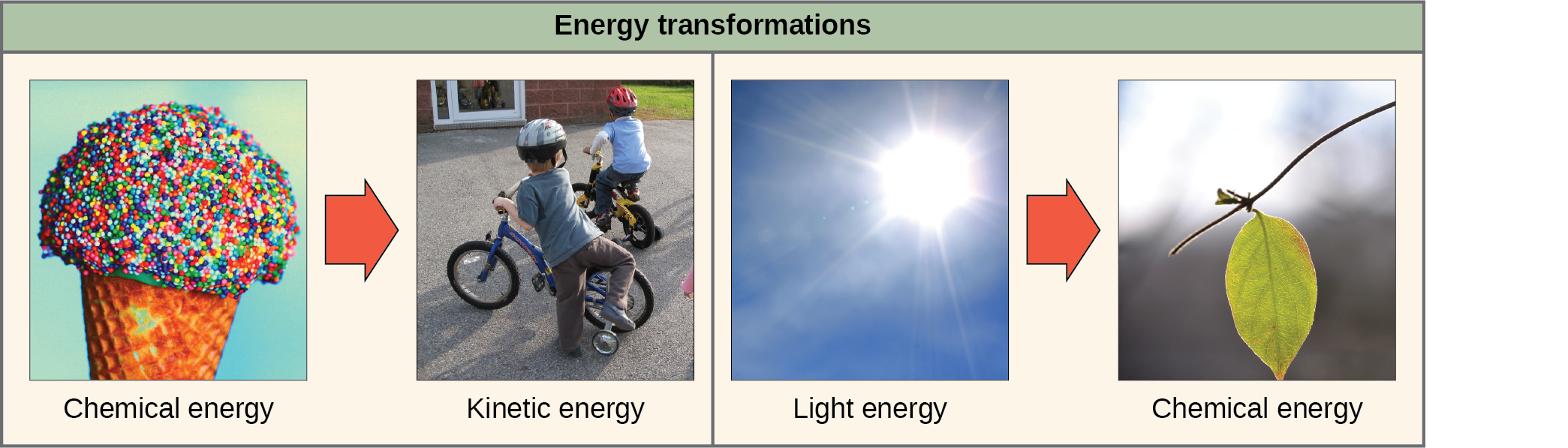
The first law of thermodynamics deals with the total amount of energy in the universe. It states that this total amount of energy is constant. In other words, there has always been, and always will be, exactly the same amount of energy in the universe. Energy exists in many different forms. According to the first law of thermodynamics, energy may transfer from place to place or transform into different forms, but it cannot be created or destroyed. The transfers and transformations of energy take place around us all the time. Light bulbs transform electrical energy into light energy. Gas stoves transform chemical energy from natural gas into heat energy. Plants perform one of the most biologically useful energy transformations on earth: that of converting sunlight energy into the chemical energy stored within organic molecules (Figure 6.2). Figure 6.11 examples of energy transformations.
英語のヒント
熱力学第一法則は、宇宙のエネルギー総量に関する法則である。この総量は一定だと述べている。言い換えれば、宇宙には過去も未来も、まったく同じ量のエネルギーが存在するということである。エネルギーは多くの異なる形で存在する。第一法則によれば、エネルギーは場所を移動したり、別の形へ変わったりするが、生み出したり消し去ったりすることはできない。エネルギーの移動と変換は、身の回りで常に起きている。電球は電気エネルギーを光エネルギーへ変える。ガスコンロは天然ガスの化学エネルギーを熱エネルギーへ変える。植物は、地球上で生物にとって特に有用なエネルギー変換、すなわち太陽光のエネルギーを有機分子に蓄えられた化学エネルギーへ変える働きを行う(図6.2)。図6.11に、エネルギー変換の例を示す。
The challenge for all living organisms is to obtain energy from their surroundings in forms that they can transfer or transform into usable energy to do work. Living cells have evolved to meet this challenge very well. Chemical energy stored within organic molecules such as sugars and fats transforms through a series of cellular chemical reactions into energy within ATP molecules. Energy in ATP molecules is easily accessible to do work. Examples of the types of work that cells need to do include building complex molecules, transporting materials, powering the beating motion of cilia or flagella, contracting muscle fibers to create movement, and reproduction.
英語のヒント
すべての生物にとっての課題は、仕事に使えるエネルギーへ移動・変換できる形で、周囲からエネルギーを得ることである。生きた細胞は、この課題にうまく対応できるよう進化してきた。糖や脂肪などの有機分子に蓄えられた化学エネルギーは、一連の細胞内の化学反応を通じて、ATP分子内のエネルギーへ変換される。ATP分子のエネルギーは、仕事に容易に利用できる。細胞が行う必要のある仕事には、複雑な分子の構築、物質の輸送、繊毛や鞭毛の拍動、筋線維を収縮させて運動を生むこと、そして生殖がある。
OpenStax, Rice University; Biology 2e. (credit “ice cream”: modification of work by D. Sharon Pruitt; credit “kids on bikes”: modification of work by Michelle Riggen-Ransom; credit “leaf”: modification of work by Cory Zanker) · CC BY 4.0 · Source出典
Figure 6.11図 6.11
Here are two examples of energy transferring from one system to another and transformed from one form to another. Humans can convert the chemical energy in food, like this ice cream cone, into kinetic energy (the energy of movement to ride a bicycle). Plants can convert electromagnetic radiation (light energy) from the sun into chemical energy. (credit “ice cream”: modification of work by D. Sharon Pruitt; credit “kids on bikes”: modification of work by Michelle Riggen-Ransom; credit “leaf”: modification of work by Cory Zanker)
エネルギーが一つの系から別の系へ移り、ある形から別の形へ変わる二つの例。ヒトは、このアイスクリームのような食物に含まれる化学エネルギーを、運動エネルギー(自転車をこぐ運動のエネルギー)へ変換できる。植物は、太陽からの電磁放射(光エネルギー)を化学エネルギーへ変換できる。(出典「アイスクリーム」:D. Sharon Pruittの作品を改変、「自転車に乗る子どもたち」:Michelle Riggen-Ransomの作品を改変、「葉」:Cory Zankerの作品を改変)
The Second Law of Thermodynamics熱力学第二法則
A living cell’s primary tasks of obtaining, transforming, and using energy to do work may seem simple. However, the second law of thermodynamics explains why these tasks are harder than they appear. None of the energy transfers that we have discussed, along with all energy transfers and transformations in the universe, is completely efficient. In every energy transfer, some amount of energy is lost in a form that is unusable. In most cases, this form is heat energy. Thermodynamically, scientists define heat energy as energy that transfers from one system to another that is not doing work. For example, when an airplane flies through the air, it loses some of its energy as heat energy due to friction with the surrounding air. This friction actually heats the air by temporarily increasing air molecule speed. Likewise, some energy is lost as heat energy during cellular metabolic reactions. This is good for warm-blooded creatures like us, because heat energy helps to maintain our body temperature. Strictly speaking, no energy transfer is completely efficient, because some energy is lost in an unusable form.
英語のヒント
生きた細胞の基本的な仕事、すなわちエネルギーを得て変換し、仕事に利用することは、一見すると単純かもしれない。しかし、熱力学第二法則は、それが見た目より難しい理由を説明する。これまでに扱ったエネルギー移動も、宇宙で起こるほかのすべての移動・変換も、完全に効率的なものはない。どのエネルギー移動でも、一部のエネルギーは利用できない形で失われる。多くの場合、それは熱エネルギーである。熱力学では、仕事を伴わずに系から系へ移動するエネルギーを、熱エネルギーと定義する。たとえば飛行機が空中を飛ぶとき、周囲の空気との摩擦によってエネルギーの一部が熱として失われる。この摩擦は、空気分子の速度を一時的に増加させ、実際に空気を温める。同じように、細胞の代謝反応でも一部のエネルギーが熱として失われる。私たちのような恒温動物には、熱が体温維持に役立つので好都合である。厳密にいえば、エネルギーの一部は利用不能な形で失われるため、完全に効率的なエネルギー移動は存在しない。
An important concept in physical systems is that of order and disorder (or randomness). The more energy that a system loses to its surroundings, the less ordered and more random the system. Scientists refer to the measure of randomness or disorder within a system as entropy. High entropy means high disorder and low energy (Figure 6.12). To better understand entropy, think of a student’s bedroom. If no energy or work were put into it, the room would quickly become messy. It would exist in a very disordered state, one of high entropy. Energy must be put into the system, in the form of the student doing work and putting everything away, in order to bring the room back to a state of cleanliness and order. This state is one of low entropy. Similarly, a car or house must be constantly maintained with work in order to keep it in an ordered state. Left alone, a house's or car's entropy gradually increases through rust and degradation. Molecules and chemical reactions have varying amounts of entropy as well. For example, as chemical reactions reach a state of equilibrium, entropy increases, and as molecules at a high concentration in one place diffuse and spread out, entropy also increases.
英語のヒント
物理的な系では、秩序と無秩序(または無作為さ)という概念が重要である。系が周囲へ多くのエネルギーを失うほど、その系は秩序が低下し、無作為さが増す。系の無作為さや無秩序さの尺度をエントロピーと呼ぶ。高いエントロピーは、大きな無秩序さと低いエネルギーを意味する(図6.12)。エントロピーを理解するため、学生の寝室を考えてみよう。エネルギーや仕事を投入しなければ、部屋はすぐに散らかる。非常に無秩序で、エントロピーの高い状態になるのである。部屋を清潔で整った状態へ戻すには、学生が仕事をして物を片づけるという形で、系へエネルギーを投入しなければならない。この整った状態は、エントロピーの低い状態である。同じように、自動車や家も、秩序ある状態を保つには絶えず手入れの仕事が必要である。放置すれば、さびや劣化によってエントロピーは徐々に増加する。分子や化学反応にも、さまざまな量のエントロピーがある。たとえば、化学反応が平衡状態へ近づくとエントロピーが増加する。また、一か所に高濃度で集まった分子が拡散して広がるときにも、エントロピーが増加する。
Think of all physical systems in this way: Living things are highly ordered, requiring constant energy input to maintain themselves in a state of low entropy. As living systems take in energy-storing molecules and transform them through chemical reactions, they lose some amount of usable energy in the process, because no reaction is completely efficient. They also produce waste and by-products that are not useful energy sources. This process increases the entropy of the system’s surroundings. Since all energy transfers result in losing some usable energy, the second law of thermodynamics states that every energy transfer or transformation increases the universe's entropy. Even though living things are highly ordered and maintain a state of low entropy, the universe's entropy in total is constantly increasing due to losing usable energy with each energy transfer that occurs. Essentially, living things are in a continuous uphill battle against this constant increase in universal entropy.
英語のヒント
すべての物理的な系を、このように考えてみよう。生物は非常に秩序立っており、低エントロピーの状態を保つには、絶えずエネルギーを投入する必要がある。生命の系はエネルギーを蓄えた分子を取り込み、化学反応で変換するが、完全に効率的な反応はないため、その過程で利用可能なエネルギーの一部を失う。また、有用なエネルギー源にならない老廃物や副産物も生み出す。この過程は、系の周囲のエントロピーを増加させる。すべてのエネルギー移動では利用可能なエネルギーの一部が失われるため、熱力学第二法則は、エネルギーの移動や変換のたびに宇宙のエントロピーが増加すると述べている。生物が高度な秩序と低エントロピーの状態を維持していても、エネルギー移動のたびに利用可能なエネルギーが失われるため、宇宙全体のエントロピーは増え続けている。生物は本質的に、宇宙のエントロピーの絶え間ない増加に抗する困難な闘いを続けているのである。
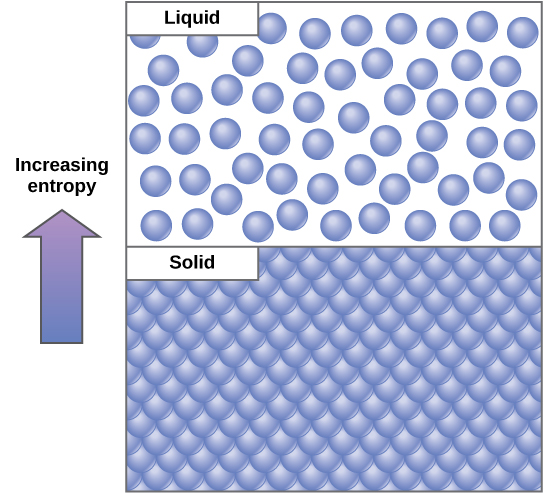


Figure 6.12図 6.12
Entropy is a measure of randomness or disorder in a system. Gases have higher entropy than liquids, and liquids have higher entropy than solids.
エントロピーは、系の無作為さや無秩序さの尺度である。気体は液体より、液体は固体よりエントロピーが高い。