第5章細胞膜の構造と機能
5.4 Bulk Transport5.4 大きな物質の輸送
Learning Objectives学習目標
By the end of this section, you will be able to do the following:
この節を学ぶと、次のことができるようになる。
- Describe endocytosis, including phagocytosis, pinocytosis, and receptor-mediated endocytosis食作用、飲作用、受容体介在性エンドサイトーシスを含む、エンドサイトーシスを説明する。
- Understand the process of exocytosisエキソサイトーシスの過程を理解する。
In addition to moving small ions and molecules through the membrane, cells also need to remove and take in larger molecules and particles (see Table 5.2 for examples). Some cells are even capable of engulfing entire unicellular microorganisms. You might have correctly hypothesized that when a cell uptakes and releases large particles, it requires energy. A large particle, however, cannot pass through the membrane, even with energy that the cell supplies.
英語のヒント
細胞は、小さなイオンや分子を膜の向こうへ動かすだけでなく、より大きな分子や粒子を取り込んだり排出したりする必要もある(例は表5.2)。単細胞の微生物を丸ごと包み込める細胞さえある。細胞が大きな粒子を取り込んだり放出したりするにはエネルギーが必要だ、と予想したなら正しい。しかし、大きな粒子は、細胞がエネルギーを供給しても、膜をそのまま通り抜けることはできない。
Endocytosisエンドサイトーシス
Endocytosis is a type of active transport that moves particles, such as large molecules, parts of cells, and even whole cells, into a cell. There are different endocytosis variations, but all share a common characteristic: the cell's plasma membrane invaginates, forming a pocket around the target particle. The pocket pinches off, resulting in the particle containing itself in a newly created intracellular vesicle formed from the plasma membrane.
英語のヒント
エンドサイトーシスは、大きな分子、細胞の一部、さらには細胞全体などの粒子を、細胞内へ運ぶ能動輸送の一種である。いくつかの型があるが、共通して、細胞膜が内側にくぼみ、標的の粒子の周囲にポケットを作る。このポケットがくびれ切れることで、粒子は細胞膜から新たに作られた細胞内の小胞に包まれる。
Phagocytosis食作用
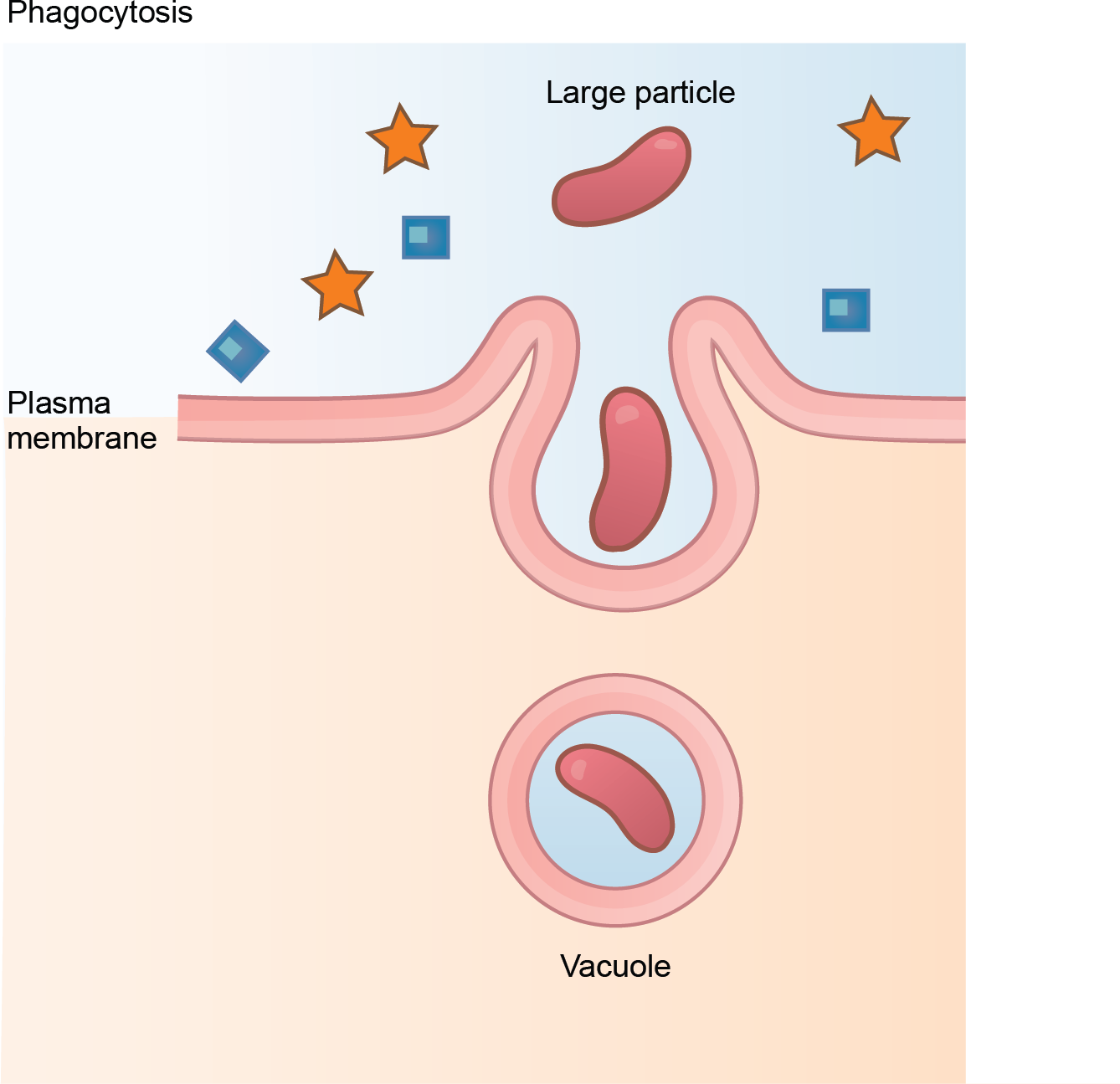
Phagocytosis (the condition of “cell eating”) is the process by which a cell takes in large particles, such as other cells or relatively large particles. For example, when microorganisms invade the human body, a type of white blood cell, a neutrophil, will remove the invaders through this process, surrounding and engulfing the microorganism, which the neutrophil then destroys (Figure 5.21).
英語のヒント
食作用は「細胞が食べること」を意味し、細胞が、ほかの細胞や比較的大きな粒子を取り込む過程である。例えば、微生物が人体に侵入すると、白血球の一種である好中球が、この過程によって侵入者を除く。好中球は微生物を囲んで包み込み、その後に破壊する(図5.21)。
OpenStax, Rice University; Biology 2e. (credit: modification of work by Mariana Ruiz Villareal) · CC BY 4.0 · Source出典

Figure 5.21図 5.21
In phagocytosis, the cell membrane surrounds the particle and engulfs it. (credit: modification of work by Mariana Ruiz Villareal)
食作用では、細胞膜が粒子を囲んで包み込む。(クレジット:Mariana Ruiz Villarealの作品を改変)
In preparation for phagocytosis, a portion of the plasma membrane's inward-facing surface becomes coated with the protein clathrin, which stabilizes this membrane's section. The membrane's coated portion then extends from the cell's body and surrounds the particle, eventually enclosing it. Once the vesicle containing the particle is enclosed within the cell, the clathrin disengages from the membrane and the vesicle merges with a lysosome for breaking down the material in the newly formed compartment (endosome). When accessible nutrients from the vesicular contents' degradation have been extracted, the newly formed endosome merges with the plasma membrane and releases its contents into the extracellular fluid. The endosomal membrane again becomes part of the plasma membrane.
英語のヒント
食作用の準備として、細胞膜の内向きの表面の一部が、クラスリンというタンパク質で覆われる。クラスリンは、その膜の部分を安定させる。覆われた部分は細胞本体から伸びて粒子を囲み、やがて包み込む。粒子を含む小胞が細胞内に収まると、クラスリンは膜から外れる。小胞はリソソームと融合し、新しくできた区画であるエンドソーム内の物質が分解される。小胞内容物の分解によって利用可能な栄養素が取り出されると、新たに形成されたエンドソームは細胞膜と融合し、内容物を細胞外液へ放出する。エンドソームの膜は、再び細胞膜の一部になる。
Pinocytosis飲作用
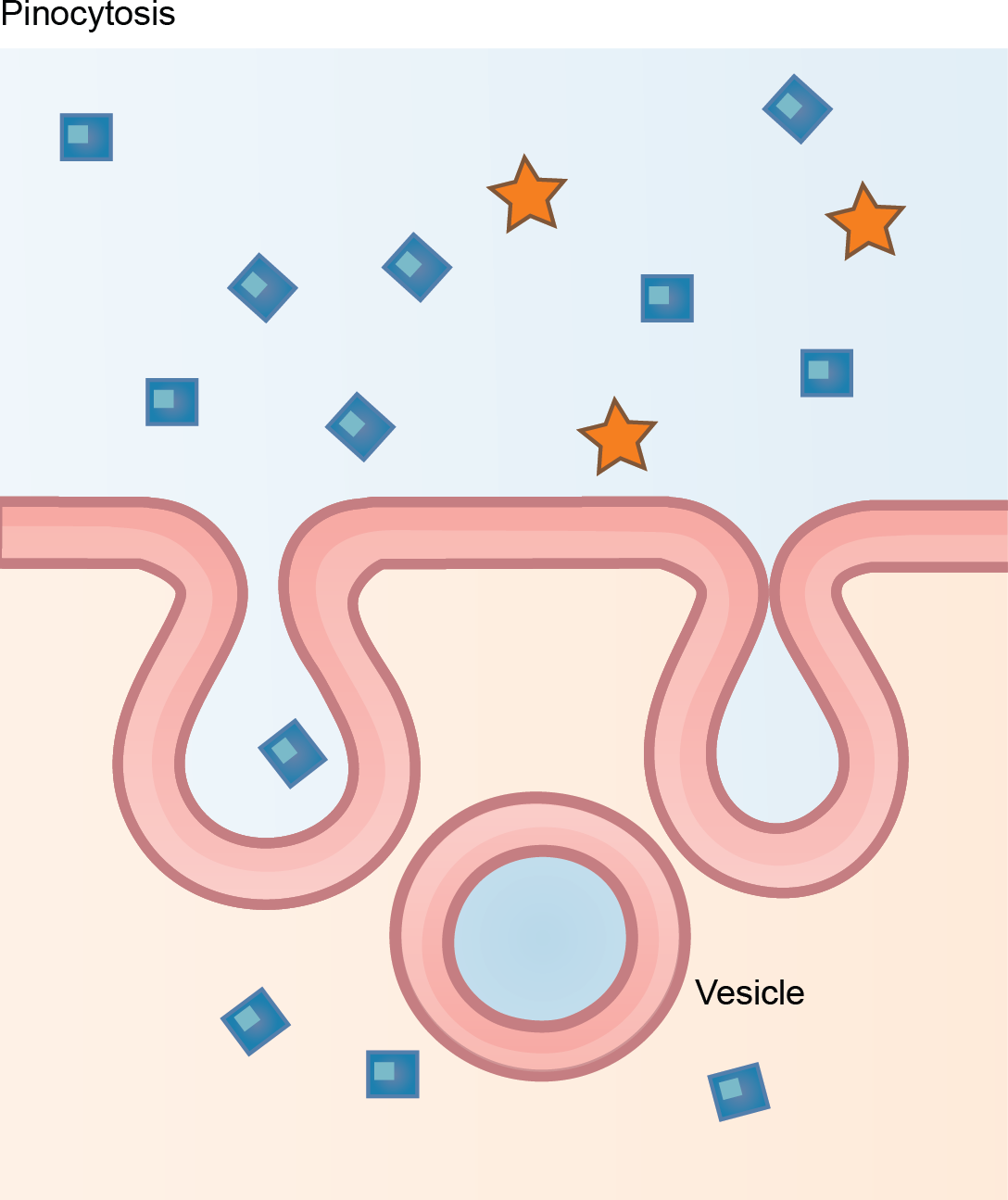
A variation of endocytosis is pinocytosis. This literally means “cell drinking”. Discovered by Warren Lewis in 1929, this American embryologist and cell biologist described a process whereby he assumed that the cell was purposefully taking in extracellular fluid. In reality, this is a process that takes in molecules, including water, which the cell needs from the extracellular fluid. Pinocytosis results in a much smaller vesicle than does phagocytosis, and the vesicle does not need to merge with a lysosome (Figure 5.22).
英語のヒント
エンドサイトーシスの一形態に、飲作用がある。これは文字どおり「細胞が飲むこと」を意味する。1929年に発見した米国の発生学者・細胞生物学者ウォーレン・ルイスは、細胞が目的をもって細胞外液を取り込むと考え、その過程を記載した。実際には、細胞が必要とする水などの分子を細胞外液から取り込む過程である。飲作用でできる小胞は食作用の場合よりはるかに小さく、リソソームと融合する必要はない(図5.22)。
OpenStax, Rice University; Biology 2e. (credit: modification of work by Mariana Ruiz Villareal) · CC BY 4.0 · Source出典

Figure 5.22図 5.22
In pinocytosis, the cell membrane invaginates, surrounds a small volume of fluid, and pinches off. (credit: modification of work by Mariana Ruiz Villareal)
飲作用では、細胞膜が内側にくぼみ、少量の液体を囲んでからくびれ切れる。(クレジット:Mariana Ruiz Villarealの作品を改変)
A variation of pinocytosis is potocytosis. This process uses a coating protein, caveolin, on the plasma membrane's cytoplasmic side, which performs a similar function to clathrin. The cavities in the plasma membrane that form the vacuoles have membrane receptors and lipid rafts in addition to caveolin. The vacuoles or vesicles formed in caveolae (singular caveola) are smaller than those in pinocytosis. Potocytosis brings small molecules into the cell and transports them through the cell for their release on the other side, a process we call transcytosis. In some cases, the caveolae deliver their cargo to membranous organelles like the ER.
英語のヒント
飲作用の一形態に、ポトサイトーシスがある。この過程では、細胞膜の細胞質側にカベオリンという被覆タンパク質を使う。これはクラスリンに似た働きをする。液胞を作る細胞膜のくぼみには、カベオリンに加え、膜受容体と脂質ラフトがある。カベオラ(複数形caveolae、単数形caveola)でできる液胞や小胞は、飲作用でできるものより小さい。ポトサイトーシスは小分子を細胞に取り込み、細胞内を通して反対側へ運び、放出する。この過程をトランスサイトーシスという。場合によっては、カベオラが小胞体などの膜性細胞小器官へ積み荷を届ける。
Receptor-mediated Endocytosis受容体介在性エンドサイトーシス
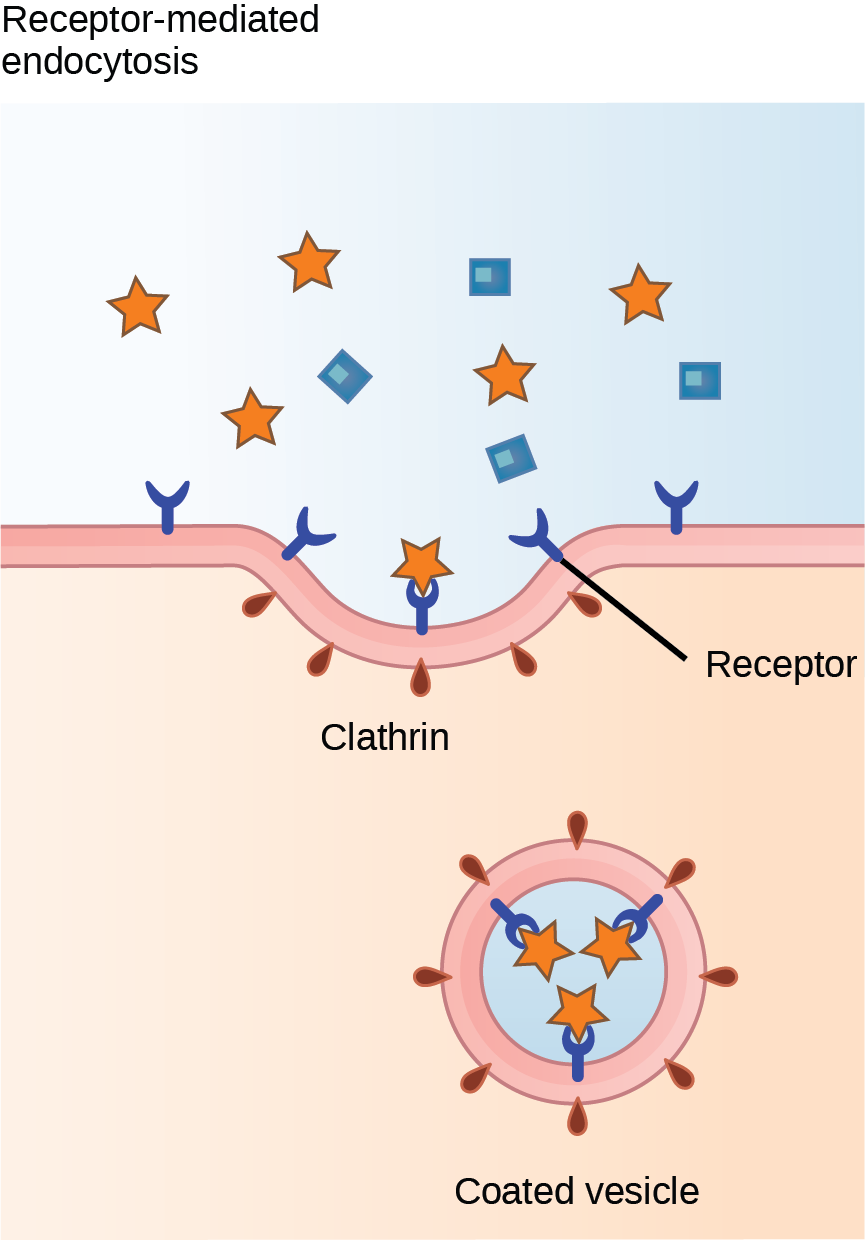
A targeted variation of endocytosis employs receptor proteins in the plasma membrane that have a specific binding affinity for certain substances (Figure 5.23).
英語のヒント
標的を定める型のエンドサイトーシスでは、特定の物質への特異的な結合親和性をもつ、細胞膜の受容体タンパク質を用いる(図5.23)。
OpenStax, Rice University; Biology 2e. (credit: modification of work by Mariana Ruiz Villareal) · CC BY 4.0 · Source出典

Figure 5.23図 5.23
In receptor-mediated endocytosis, the cell's uptake of substances targets a single type of substance that binds to the receptor on the cell membrane's external surface. (credit: modification of work by Mariana Ruiz Villareal)
受容体介在性エンドサイトーシスでは、細胞膜の外側表面の受容体に結合する、特定の1種類の物質を狙って取り込む。(クレジット:Mariana Ruiz Villarealの作品を改変)
In receptor-mediated endocytosis, as in phagocytosis, clathrin attaches to the plasma membrane's cytoplasmic side. If a compound's uptake is dependent on receptor-mediated endocytosis and the process is ineffective, the material will not be removed from the tissue fluids or blood. Instead, it will stay in those fluids and increase in concentration. The failure of receptor-mediated endocytosis causes some human diseases. For example, receptor mediated endocytosis removes low density lipoprotein or LDL (or "bad" cholesterol) from the blood. In the human genetic disease familial hypercholesterolemia, the LDL receptors are defective or missing entirely. People with this condition have life-threatening levels of cholesterol in their blood, because their cells cannot clear LDL particles.
英語のヒント
受容体介在性エンドサイトーシスでは、食作用と同じく、クラスリンが細胞膜の細胞質側に付着する。ある化合物の取り込みがこの過程に依存し、それが有効に働かなければ、物質は組織液や血液から除かれない。そのまま残り、濃度が高くなる。受容体介在性エンドサイトーシスの不具合は、ヒトの病気の原因になる。例えば、この過程は低密度リポタンパク質LDL、いわゆる「悪玉」コレステロールを血液から除く。遺伝性疾患である家族性高コレステロール血症では、LDL受容体に欠陥があるか、完全に欠けている。この病気の人は、細胞がLDL粒子を除けないため、血中コレステロールが生命を脅かす濃度になる。
Although receptor-mediated endocytosis is designed to bring specific substances that are normally in the extracellular fluid into the cell, other substances may gain entry into the cell at the same site. Flu viruses, diphtheria, and cholera toxin all have sites that cross-react with normal receptor-binding sites and gain entry into cells.
英語のヒント
受容体介在性エンドサイトーシスは、通常細胞外液にある特定の物質を細胞内へ取り込む仕組みだが、ほかの物質が同じ部位から侵入することもある。インフルエンザウイルス、ジフテリア、コレラ毒素はいずれも、通常の受容体結合部位と交差反応する部位をもち、細胞内へ入る。