第5章細胞膜の構造と機能
Phospholipidsリン脂質
The membrane's main fabric comprises amphiphilic, phospholipid molecules. The hydrophilic or “water-loving” areas of these molecules (which look like a collection of balls in an artist’s rendition of the model) (Figure 5.2) are in contact with the aqueous fluid both inside and outside the cell. Hydrophobic, or water-hating molecules, tend to be non-polar. They interact with other non-polar molecules in chemical reactions, but generally do not interact with polar molecules. When placed in water, hydrophobic molecules tend to form a ball or cluster. The phospholipids' hydrophilic regions form hydrogen bonds with water and other polar molecules on both the cell's exterior and interior. Thus, the membrane surfaces that face the cell's interior and exterior are hydrophilic. In contrast, the cell membrane's interior is hydrophobic and will not interact with water. Therefore, phospholipids form an excellent two-layer cell membrane that separates fluid within the cell from the fluid outside the cell.
英語のヒント
膜の主要な土台は、両親媒性のリン脂質分子からなる。これらの分子の親水性、つまり「水を好む」部分は、モデル図では球の集まりのように描かれ(図5.2)、細胞の内側と外側の両方で水性の液体に接している。疎水性、つまり水を嫌う分子は、無極性であることが多い。化学反応ではほかの無極性分子と相互作用するが、一般に極性分子とは相互作用しない。水に入れると、疎水性分子は球や集団を作りやすい。リン脂質の親水性部分は、細胞の外側と内側の両方で、水やほかの極性分子と水素結合を作る。そのため、細胞の内外に面する膜の表面は親水性である。一方、細胞膜そのものの内部は疎水性で、水とは相互作用しない。こうしてリン脂質は、細胞内の液体と細胞外の液体を隔てる、優れた二層構造の細胞膜を作る。
A phospholipid molecule (Figure 5.3) consists of a three-carbon glycerol backbone with two fatty acid molecules attached to carbons 1 and 2, and a phosphate-containing group attached to the third carbon. This arrangement gives the overall molecule a head area (the phosphate-containing group), which has a polar character or negative charge, and a tail area (the fatty acids), which has no charge. The head can form hydrogen bonds, but the tail cannot. Scientists call a molecule with a positively or negatively charged area and an uncharged, or non-polar, area amphiphilic or “dual-loving.”
英語のヒント
リン脂質分子は、炭素を三つもつグリセロールを骨格とし、1番目と2番目の炭素に二つの脂肪酸分子、3番目の炭素にリン酸を含む基が結合した構造をもつ(図5.3)。この配置によって、分子全体に、極性または負電荷をもつ頭部(リン酸を含む基)と、電荷をもたない尾部(脂肪酸)ができる。頭部は水素結合を作れるが、尾部は作れない。正または負に帯電した部分と、電荷をもたない無極性の部分をあわせもつ分子を、両親媒性、つまり「両方を好む」という。
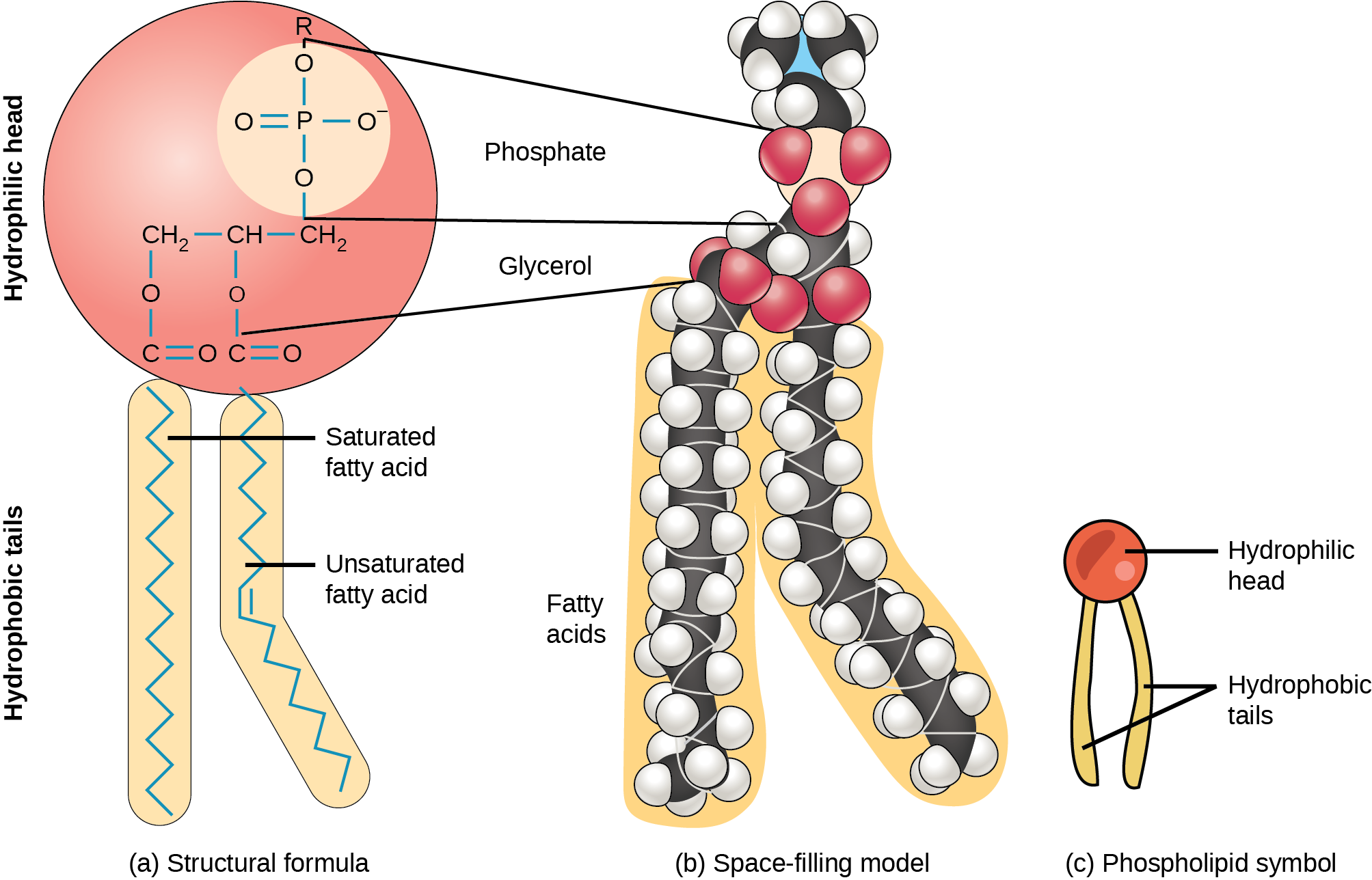
Figure 5.3図 5.3
A hydrophilic head and two hydrophobic tails comprise this phospholipid molecule. The hydrophilic head group consists of a phosphate-containing group attached to a glycerol molecule. The hydrophobic tails, each containing either a saturated or an unsaturated fatty acid, are long hydrocarbon chains.
このリン脂質分子は、親水性の頭部と2本の疎水性の尾部からなる。親水性頭部は、グリセロール分子につながった、リン酸を含む基からできている。疎水性の尾部は長い炭化水素鎖で、それぞれ飽和脂肪酸または不飽和脂肪酸を含む。
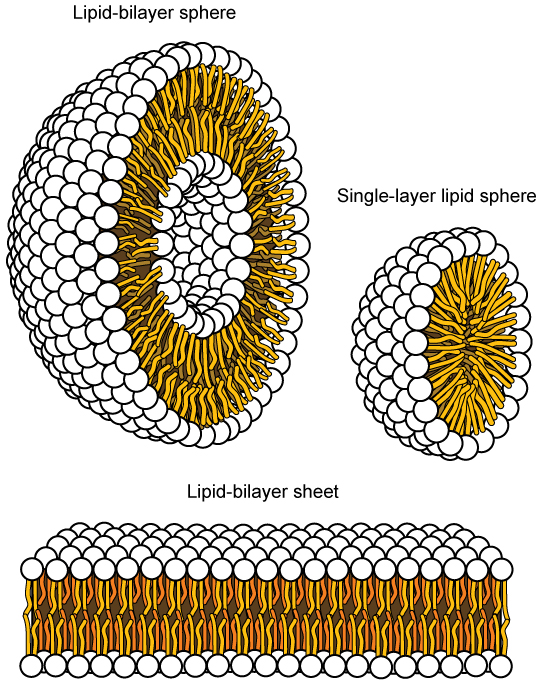
This characteristic is vital to the plasma membrane's structure because, in water, phospholipids arrange themselves with their hydrophobic tails facing each other and their hydrophilic heads facing out. In this way, they form a lipid bilayer—a double layered phospholipid barrier that separates the water and other materials on one side from the water and other materials on the other side. Phospholipids heated in an aqueous solution usually spontaneously form small spheres or droplets (micelles or liposomes), with their hydrophilic heads forming the exterior and their hydrophobic tails on the inside (Figure 5.4).
英語のヒント
この性質は、細胞膜の構造に不可欠である。水中ではリン脂質が、疎水性の尾部を互いに向け、親水性の頭部を外向きにして並ぶからである。こうして、一方の水や物質を他方の水や物質から隔てる、二重のリン脂質の障壁、すなわち脂質二重層を作る。水溶液中で加熱されたリン脂質は、通常、自発的に小さな球や滴(ミセルまたはリポソーム)を形成する。その外側を親水性頭部が作り、疎水性の尾部が内側に収まる(図5.4)。
OpenStax, Rice University; Biology 2e. (credit: modification of work by Mariana Ruiz Villareal) · CC BY 4.0 · Source出典
Figure 5.4図 5.4
In an aqueous solution, phospholipids usually arrange themselves with their polar heads facing outward and their hydrophobic tails facing inward. (credit: modification of work by Mariana Ruiz Villareal)
水溶液中では、リン脂質は通常、極性の頭部を外向き、疎水性の尾部を内向きにして並ぶ。(クレジット:Mariana Ruiz Villarealの作品を改変)
Proteinsタンパク質
Proteins comprise the plasma membranes' second major component. Integral proteins, or integrins, as their name suggests, integrate completely into the membrane structure, and their hydrophobic membrane-spanning regions interact with the phospholipid bilayer's hydrophobic region (Figure 5.2). Single-pass integral membrane proteins usually have a hydrophobic transmembrane segment that consists of 20–25 amino acids. Some span only part of the membrane—associating with a single layer—while others stretch from one side to the other, and are exposed on either side. Up to 12 single protein segments comprise some complex proteins, which are extensively folded and embedded in the membrane (Figure 5.5). This protein type has a hydrophilic region or regions, and one or several mildly hydrophobic regions. This arrangement of protein regions orients the protein alongside the phospholipids, with the protein's hydrophobic region adjacent to the phospholipids' tails and the protein's hydrophilic region or regions protruding from the membrane and in contact with the cytosol or extracellular fluid.
英語のヒント
タンパク質は細胞膜の第2の主要成分である。内在性タンパク質、すなわちインテグリンは、その名のとおり膜構造に完全に組み込まれ、膜を貫く疎水性領域がリン脂質二重層の疎水性領域と相互作用する(図5.2)。1回膜貫通型の内在性膜タンパク質は、通常20〜25個のアミノ酸からなる疎水性の膜貫通部をもつ。膜の一部分だけを占めて一方の層と結びつくものもあれば、片側から反対側まで貫き、両側に露出するものもある。複雑なタンパク質の中には、最大12個のタンパク質部分からなり、大きく折り畳まれて膜に埋め込まれるものもある(図5.5)。この種類のタンパク質は、一つ以上の親水性領域と、一つまたは複数のやや疎水性の領域をもつ。この領域の配置によって、タンパク質はリン脂質に沿って向きを定める。疎水性領域はリン脂質の尾部に隣接し、親水性領域は膜から突き出て、細胞質基質または細胞外液に接する。
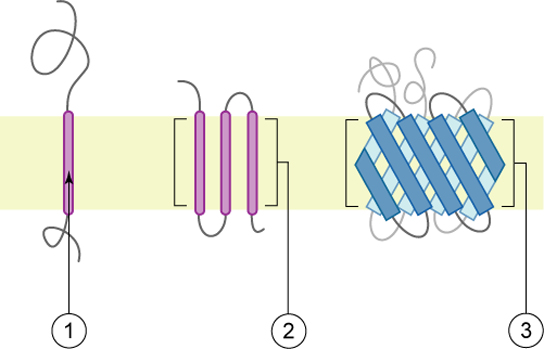


Figure 5.5図 5.5
Integral membrane proteins may have one or more alpha-helices that span the membrane (examples 1 and 2), or they may have beta-sheets that span the membrane (example 3). (credit: “Foobar”/Wikimedia Commons)
内在性膜タンパク質には、膜を貫くαヘリックスを一つ以上もつもの(例1、2)や、膜を貫くβシートをもつもの(例3)がある。(クレジット:「Foobar」/ウィキメディア・コモンズ)
Peripheral proteins are on the membranes' exterior and interior surfaces, attached either to integral proteins or to phospholipids. Peripheral proteins, along with integral proteins, may serve as enzymes, as structural attachments for the cytoskeleton's fibers, or as part of the cell’s recognition sites. Scientists sometimes refer to these as “cell-specific” proteins. The body recognizes its own proteins and attacks foreign proteins associated with invasive pathogens.
英語のヒント
周辺性タンパク質は膜の外側と内側の表面にあり、内在性タンパク質またはリン脂質に付着している。周辺性タンパク質は、内在性タンパク質とともに、酵素、細胞骨格の繊維を構造的につなぐ部分、あるいは細胞の認識部位の一部として働くことがある。これらは「細胞特異的」タンパク質と呼ばれることもある。体は自分自身のタンパク質を認識し、侵入する病原体に付随する異物のタンパク質を攻撃する。