第5章細胞膜の構造と機能
5.3 Active Transport5.3 能動輸送
Learning Objectives学習目標
By the end of this section, you will be able to do the following:
この節を学ぶと、次のことができるようになる。
- Understand how electrochemical gradients affect ions電気化学勾配がイオンに与える影響を理解する。
- Distinguish between primary active transport and secondary active transport一次能動輸送と二次能動輸送を区別する。
Active transport mechanisms require the cell’s energy, usually in the form of adenosine triphosphate (ATP). If a substance must move into the cell against its concentration gradient—that is, if the substance's concentration inside the cell is greater than its concentration in the extracellular fluid (and vice versa)—the cell must use energy to move the substance. Some active transport mechanisms move small-molecular weight materials, such as ions, through the membrane. Other mechanisms transport much larger molecules.
英語のヒント
能動輸送には細胞のエネルギーが必要で、通常はアデノシン三リン酸(ATP)の形で供給される。物質が濃度勾配に逆らって細胞へ入らなければならない場合、つまり細胞内濃度が細胞外液中より高い場合、細胞はその移動にエネルギーを使わなければならない。逆向きの場合も同様である。イオンなどの低分子量の物質を膜の向こうへ動かす能動輸送の仕組みもあれば、はるかに大きな分子を運ぶ仕組みもある。
Electrochemical Gradient電気化学勾配
We have discussed simple concentration gradients—a substance's differential concentrations across a space or a membrane—but in living systems, gradients are more complex. Because ions move into and out of cells and because cells contain proteins that do not move across the membrane and are mostly negatively charged, there is also an electrical gradient, a difference of charge, across the plasma membrane. The interior of living cells is electrically negative with respect to the extracellular fluid in which they are bathed, and at the same time, cells have higher concentrations of potassium (K+) and lower concentrations of sodium (Na+) than the extracellular fluid. Thus in a living cell, the concentration gradient of Na+ tends to drive it into the cell, and its electrical gradient (a positive ion) also drives it inward to the negatively charged interior. However, the situation is more complex for other elements such as potassium. The electrical gradient of K+, a positive ion, also drives it into the cell, but the concentration gradient of K+ drives K+ out of the cell (Figure 5.16). We call the combined concentration gradient and electrical charge that affects an ion its electrochemical gradient.
英語のヒント
これまでは、空間や膜を隔てた物質濃度の違いという、単純な濃度勾配を扱ってきた。しかし、生体系の勾配はもっと複雑である。イオンが細胞に出入りし、さらに細胞には、膜を越えて移動せず、大部分が負に帯電したタンパク質が含まれるため、細胞膜の両側には電荷の違い、すなわち電気的勾配もある。生きた細胞の内部は、周囲の細胞外液に比べて電気的に負である。同時に、細胞内は細胞外液よりカリウム(K+)濃度が高く、ナトリウム(Na+)濃度が低い。そのため、生きた細胞ではNa+の濃度勾配が細胞内への移動を促し、正イオンとして受ける電気的勾配も、負に帯電した内部への移動を促す。しかし、カリウムなどのほかの元素では、事情がより複雑である。正イオンK+の電気的勾配は細胞内へ向かわせるが、K+の濃度勾配はK+を細胞外へ向かわせる(図5.16)。イオンに影響する濃度勾配と電荷の作用を合わせて、電気化学勾配という。
OpenStax, Rice University; Biology 2e. Credit: Rao, A. Tag, A. and Ryan, K. Department of Biology, Texas A&M University. · CC BY 4.0 · Source出典

Figure 5.17図 5.17
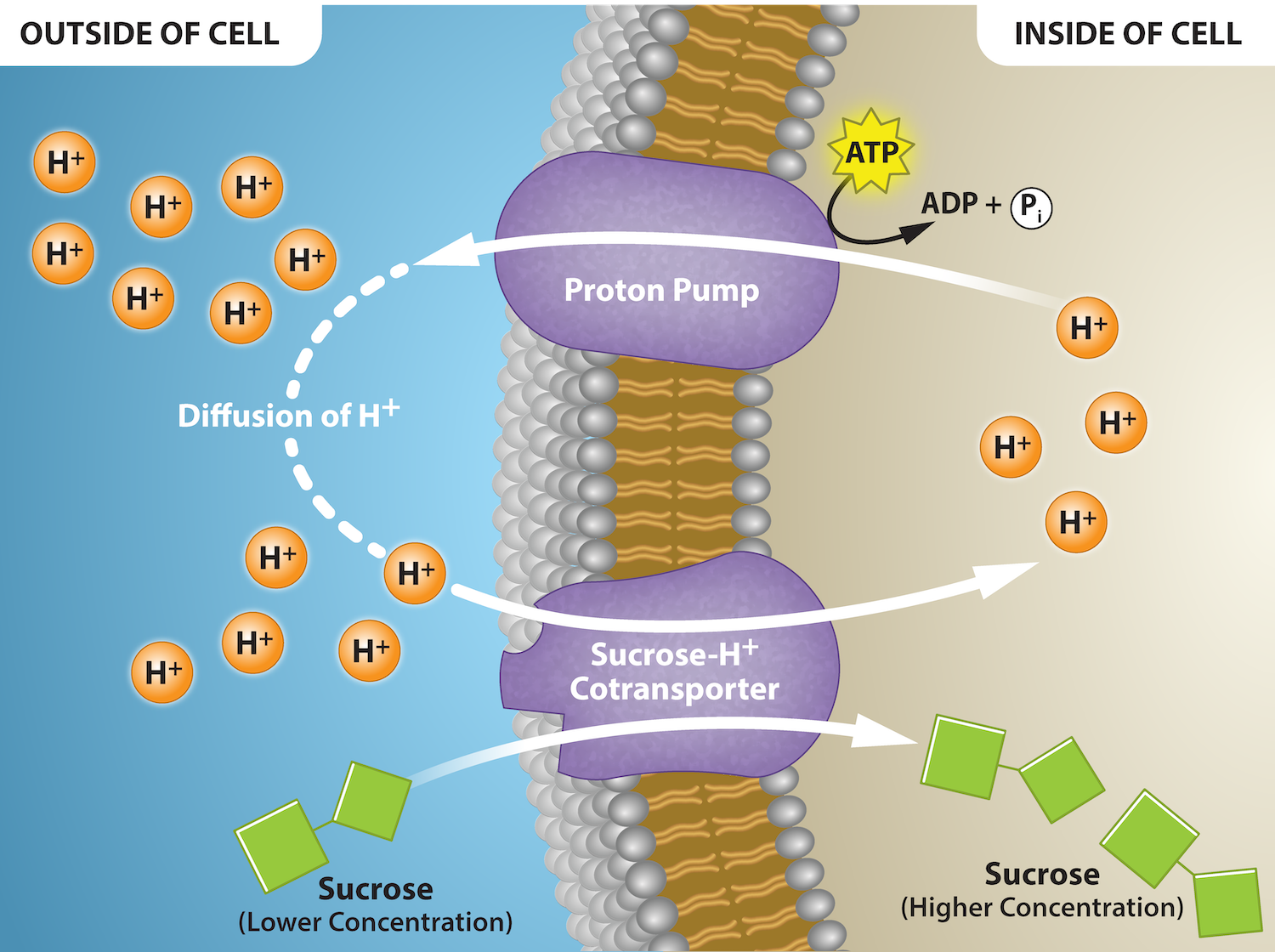
Proton Gradient provides energy for a secondary active transporter. The proton pump creates an electrochemical gradient of protons (hydrogen ions, H+) using ATP to drive primary active transport. This gradient allows for cotransport/secondary transport of sucrose against its concentration gradient as protons come down their concentration gradient via their membrane cotransporter protein. Credit: Rao, A. Tag, A. and Ryan, K. Department of Biology, Texas A&M University.
プロトン勾配は二次能動輸送体にエネルギーを与える。プロトンポンプはATPを使って一次能動輸送を駆動し、プロトン(水素イオンH+)の電気化学勾配を作る。プロトンが膜の共輸送体タンパク質を通って濃度勾配を下ると、この勾配を利用して、スクロースをその濃度勾配に逆らって共輸送、すなわち二次輸送できる。クレジット:A. Rao、A. Tag、K. Ryan、テキサスA&M大学生物学科。
Moving Against a Gradient勾配に逆らう移動
To move substances against a concentration or electrochemical gradient, the cell must use energy. This energy comes from ATP generated through the cell’s metabolism. Active transport mechanisms, or pumps, work against electrochemical gradients. Small substances constantly pass through plasma membranes. Active transport maintains concentrations of ions and other substances that living cells require in the face of these passive movements. A cell may spend much of its metabolic energy supply maintaining these processes. (A red blood cell uses most of its metabolic energy to maintain the imbalance between exterior and interior sodium and potassium levels that the cell requires.) Because active transport mechanisms depend on a cell’s metabolism for energy, they are sensitive to many metabolic poisons that interfere with the ATP supply.
英語のヒント
濃度勾配や電気化学勾配に逆らって物質を動かすには、細胞はエネルギーを使わなければならない。そのエネルギーは、細胞の代謝で作られたATPから得られる。能動輸送の仕組み、つまりポンプは、電気化学勾配に逆らって働く。小さな物質は、常に細胞膜を通過している。能動輸送は、そのような受動的な移動がある中でも、生細胞に必要なイオンやほかの物質の濃度を保つ。細胞は、この過程の維持に代謝エネルギーの多くを費やすことがある。例えば赤血球は、必要なナトリウムとカリウムの内外の濃度差を保つために、代謝エネルギーの大部分を使う。能動輸送の仕組みはエネルギーを細胞の代謝に依存するため、ATP供給を妨げる多くの代謝毒に影響されやすい。
Two mechanisms exist for transporting small-molecular weight material and small molecules. Primary active transport moves ions across a membrane and creates a difference in charge across that membrane, which is directly dependent on ATP. Secondary active transport does not directly require ATP: instead, it is the movement of material due to the electrochemical gradient established by primary active transport (Figure 5.19).
英語のヒント
低分子量の物質や小分子を運ぶ仕組みには二つある。一次能動輸送は、膜を越えてイオンを動かし、膜の両側に電荷の差を作る。この過程はATPに直接依存する。二次能動輸送はATPを直接必要とはせず、一次能動輸送が作った電気化学勾配によって物質が移動する(図5.19)。