第5章細胞膜の構造と機能
Osmosis浸透
Osmosis is the movement of free water molecules through a semipermeable membrane according to the water's concentration gradient across the membrane, which is inversely proportional to the solutes' concentration. While diffusion transports material across membranes and within cells, osmosis transports only water across a membrane and the membrane limits the solutes' diffusion in the water. Not surprisingly, the aquaporins that facilitate water movement play a large role in osmosis, most prominently in red blood cells and the membranes of kidney tubules.
英語のヒント
浸透とは、膜を隔てた水の濃度勾配に従い、自由な水分子が半透膜を通って移動することである。この勾配は、溶質濃度に反比例する。拡散では物質が膜を越えたり細胞内を移動したりするが、浸透で膜を越えて運ばれるのは水だけであり、膜は水中の溶質の拡散を制限する。水の移動を促進するアクアポリンが浸透で大きな役割を果たすのは当然で、特に赤血球や尿細管の膜で顕著である。
Mechanism仕組み
Osmosis is a special case of diffusion. Water, like other substances, moves from an area of high concentration of free water molecules to one of low free water molecule concentration. An obvious question is what makes water move at all? Imagine a beaker with a semipermeable membrane separating the two sides or halves (Figure 5.11). On both sides of the membrane the water level is the same, but there are different dissolved substance concentrations, or solute, that cannot cross the membrane (otherwise the solute crossing the membrane would balance concentrations on each side). If the solution's volume on both sides of the membrane is the same, but the solute's concentrations are different, then there are different amounts of water, the solvent, on either side of the membrane.
英語のヒント
浸透は拡散の特別な場合である。水もほかの物質と同じく、自由な水分子の濃度が高い領域から低い領域へ移動する。では、そもそも何が水を動かすのだろうか。半透膜で左右二つに仕切られたビーカーを想像しよう(図5.11)。膜の両側で水面の高さは同じだが、膜を通れない溶けた物質、つまり溶質の濃度が異なる。もし溶質が膜を通れるなら、移動して両側の濃度を均等にするだろう。膜の両側の溶液の体積が同じでも、溶質濃度が違えば、溶媒である水の量は両側で異なる。
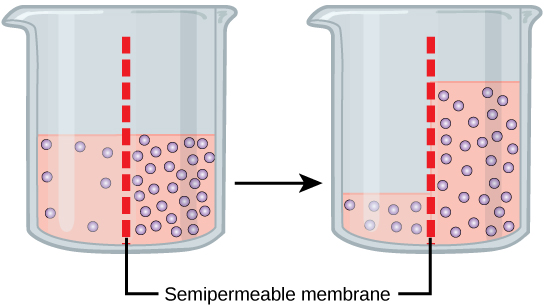

Figure 5.11図 5.11
In osmosis, water always moves from an area of higher water concentration to one of lower concentration. In the diagram, the solute cannot pass through the selectively permeable membrane, but the water can.
浸透では、水は常に水の濃度が高い領域から低い領域へ移動する。図では、溶質は選択的透過性の膜を通れないが、水は通れる。
To illustrate this, imagine two full water glasses. One has a single teaspoon of sugar in it; whereas, the second one contains one-quarter cup of sugar. If the total volume of the solutions in both cups is the same, which cup contains more water? Because the large sugar amount in the second cup takes up much more space than the teaspoon of sugar in the first cup, the first cup has more water in it.
英語のヒント
説明のため、水で満たした二つのコップを想像しよう。一方には小さじ1杯の砂糖、もう一方には4分の1カップの砂糖が入っている。両方の溶液の全体積が同じなら、どちらにより多くの水があるだろうか。2杯目の多量の砂糖は、1杯目の小さじ1杯の砂糖よりはるかに大きな空間を占めるため、水が多いのは1杯目である。
Returning to the beaker example, recall that it has a solute mixture on either side of the membrane. A principle of diffusion is that the molecules move around and will spread evenly throughout the medium if they can. However, only the material capable of getting through the membrane will diffuse through it. In this example, the solute cannot diffuse through the membrane, but the water can. Water has a concentration gradient in this system. Thus, water will diffuse down its concentration gradient, crossing the membrane to the side where it is less concentrated. This diffusion of water through the membrane—osmosis—will continue until the water's concentration gradient goes to zero or until the water's hydrostatic pressure balances the osmotic pressure. Osmosis proceeds constantly in living systems.
英語のヒント
ビーカーの例に戻ろう。膜のどちら側にも溶質の混合物がある。拡散の原理の一つは、分子が動き回り、可能なら媒体全体に均等に広がるということである。しかし、膜を越えて拡散できるのは、その膜を通れる物質だけである。この例では溶質は膜を通れないが、水は通れる。この系には水の濃度勾配があるため、水は自分の濃度勾配を下り、膜を越えて水の濃度が低い側へ拡散する。この膜を通る水の拡散、すなわち浸透は、水の濃度勾配がゼロになるか、水の静水圧が浸透圧と釣り合うまで続く。浸透は、生体系の中で絶えず進んでいる。
Tonicity張度
Tonicity describes how an extracellular solution can change a cell's volume by affecting osmosis. A solution's tonicity often directly correlates with the solution's osmolarity. Osmolarity describes the solution's total solute concentration. A solution with low osmolarity has a greater number of water molecules relative to the number of solute particles. A solution with high osmolarity has fewer water molecules with respect to solute particles. In a situation in which a membrane permeable to water, though not to the solute separates two different osmolarities, water will move from the membrane's side with lower osmolarity (and more water) to the side with higher osmolarity (and less water). This effect makes sense if you remember that the solute cannot move across the membrane, and thus the only component in the system that can move—the water—moves along its own concentration gradient. An important distinction that concerns living systems is that osmolarity measures the number of particles (which may be molecules) in a solution. Therefore, a solution that is cloudy with cells may have a lower osmolarity than a solution that is clear, if the second solution contains more dissolved molecules than there are cells.
英語のヒント
張度は、細胞外の溶液が浸透に影響して、細胞の体積をどう変えるかを表す。溶液の張度は、多くの場合、その浸透モル濃度と直接関係する。浸透モル濃度は、溶液中の溶質の総濃度を表す。低い溶液では溶質粒子数に対して水分子が多く、高い溶液では水分子が少ない。浸透モル濃度が異なる二つの溶液を、水は通すが溶質は通さない膜で隔てると、水は浸透モル濃度の低い側(水が多い側)から高い側(水が少ない側)へ移動する。溶質は膜を通れず、移動できる唯一の成分である水が自身の濃度勾配に従うと考えれば、この作用を理解できる。生体系では、浸透モル濃度が溶液中の粒子数を測るという区別が重要である。粒子は分子の場合もある。したがって、細胞で濁った溶液よりも、透明な溶液のほうが、溶けた分子の数が細胞数より多ければ、浸透モル濃度が高いことがある。
Hypotonic Solutions低張液
Scientists use three terms—hypotonic, isotonic, and hypertonic—to relate the cell's osmolarity to the extracellular fluid's osmolarity that contains the cells. In a hypotonic situation, the extracellular fluid has lower osmolarity than the fluid inside the cell, and water enters the cell. (In living systems, the point of reference is always the cytoplasm, so the prefix hypo- means that the extracellular fluid has a lower solute concentration, or a lower osmolarity, than the cell cytoplasm.) It also means that the extracellular fluid has a higher water concentration in the solution than does the cell. In this situation, water will follow its concentration gradient and enter the cell.
英語のヒント
細胞と、その細胞を取り巻く細胞外液の浸透モル濃度の関係を表すために、低張、等張、高張という三つの用語を使う。低張の場合、細胞外液は細胞内液より浸透モル濃度が低く、水が細胞内へ入る。生体系では、比較の基準は常に細胞質である。そのためhypo-という接頭辞は、細胞外液の溶質濃度、すなわち浸透モル濃度が、細胞質より低いことを意味する。同時に、細胞外液は細胞内より水の濃度が高いことも意味する。この状況では、水は濃度勾配に従って細胞内へ入る。