第5章細胞膜の構造と機能
5.2 Passive Transport5.2 受動輸送
Learning Objectives学習目標
By the end of this section, you will be able to do the following:
この節を学ぶと、次のことができるようになる。
- Explain why and how passive transport occurs受動輸送がなぜ、どのように起こるか説明する。
- Understand the osmosis and diffusion processes浸透と拡散の過程を理解する。
- Define tonicity and its relevance to passive transport張度を定義し、受動輸送との関係を説明する。
Plasma membranes must allow certain substances to enter and leave a cell, and prevent some harmful materials from entering and some essential materials from leaving. In other words, plasma membranes are selectively permeable (semipermeable)—they allow some substances to pass through, but not others. If they were to lose this selectivity, the cell would no longer be able to sustain itself, and it would be destroyed. Some cells require larger amounts of specific substances. They must have a way of obtaining these materials from extracellular fluids. This may happen passively, as certain materials move back and forth, or the cell may have special mechanisms that facilitate transport. Some materials are so important to a cell that it spends some of its energy, hydrolyzing adenosine triphosphate (ATP), to obtain these materials. Red blood cells use some of their energy doing just that. Most cells spend the majority of their energy to maintain an imbalance of sodium and potassium ions between the cell's interior and exterior, as well as on protein synthesis.
英語のヒント
細胞膜は、特定の物質を細胞に出入りさせる一方、有害な物質の侵入や、必要な物質の流出を防がなければならない。言い換えれば、細胞膜は選択的透過性(半透性)をもち、通す物質と通さない物質がある。この選択性を失えば、細胞は自身を維持できなくなり、壊れてしまう。特定の物質を多く必要とする細胞もある。そのような細胞は、細胞外液から必要な物質を得る手段をもたなければならない。物質が行き来することで受動的に取り込まれる場合もあれば、輸送を助ける特別な仕組みがある場合もある。一部の物質は細胞にとって非常に重要なので、アデノシン三リン酸(ATP)を加水分解し、エネルギーの一部を費やしてでも取り込む。赤血球もそのようにエネルギーの一部を使っている。ほとんどの細胞は、タンパク質合成と、細胞の内外でナトリウムイオンとカリウムイオンの不均衡を保つことに、エネルギーの大部分を使う。
The most direct forms of membrane transport are passive. Passive transport is a naturally occurring phenomenon and does not require the cell to exert any of its energy to accomplish the movement. In passive transport, substances move from an area of higher concentration to an area of lower concentration. A physical space in which there is a single substance concentration range has a concentration gradient.
英語のヒント
最も直接的な膜輸送の形は、受動的なものである。受動輸送は自然に起こる現象であり、移動を実現するために細胞がエネルギーを費やす必要はない。受動輸送では、物質は濃度の高い領域から低い領域へ移動する。一つの物質の濃度に幅がある空間には、濃度勾配が存在する。
Selective Permeability選択的透過性
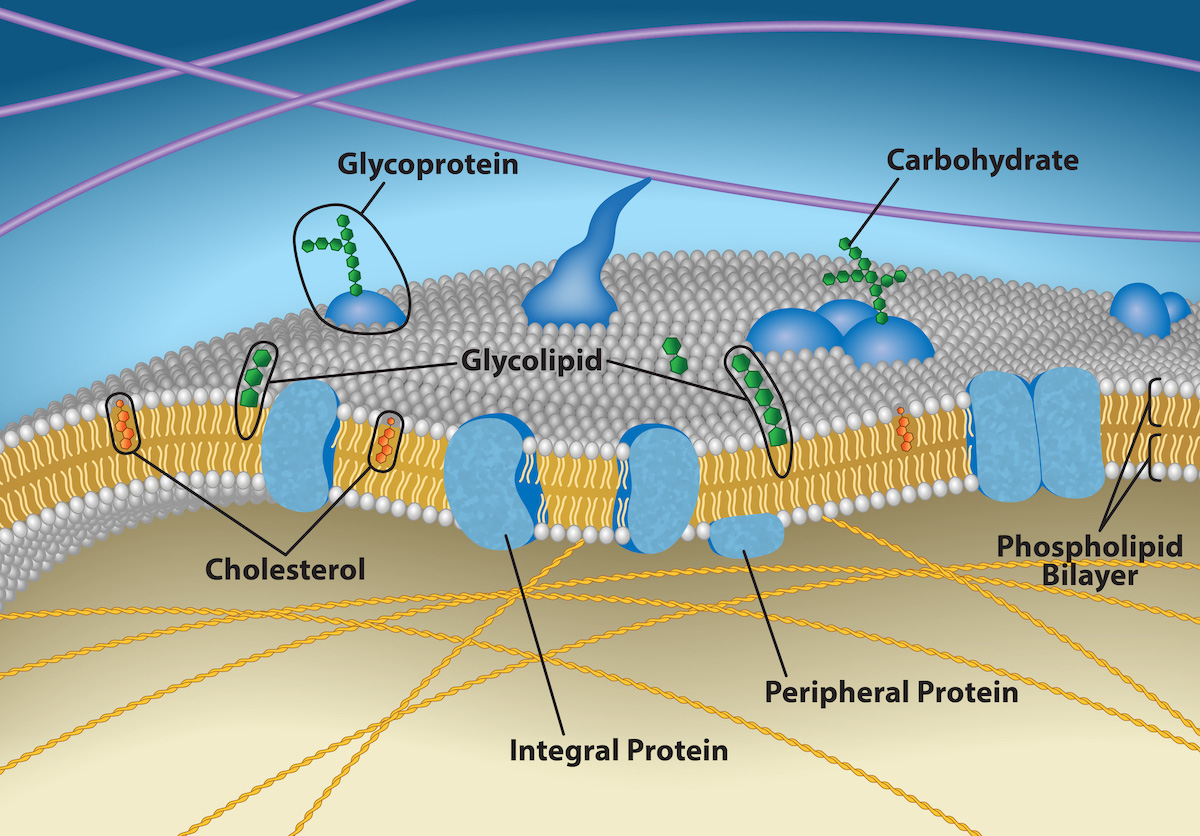
Plasma membranes are asymmetric: the membrane's interior is not identical to its exterior. There is a considerable difference between the array of phospholipids and proteins between the two leaflets that form a membrane. On the membrane's interior, some proteins serve to anchor the membrane to cytoskeleton's fibers. There are peripheral proteins on the membrane's exterior that bind extracellular matrix elements. Carbohydrates, attached to lipids or proteins, are also on the plasma membrane's exterior surface. These carbohydrate complexes help the cell bind required substances in the extracellular fluid. This adds considerably to plasma membrane's selective nature (Figure 5.7).
英語のヒント
細胞膜は非対称であり、内側と外側は同じではない。膜を作る二つの層では、リン脂質とタンパク質の並びに大きな違いがある。膜の内側では、一部のタンパク質が膜を細胞骨格の繊維につなぎ留める。外側には、細胞外マトリックスの構成要素に結合する周辺性タンパク質がある。脂質やタンパク質に結合した糖質も、細胞膜の外側表面にある。これらの糖質複合体は、細胞外液中の必要な物質を細胞が結合するのを助ける。このことは、細胞膜の選択的な性質を大きく高める(図5.7)。
OpenStax, Rice University; Biology 2e. Credit: Rao, A., Ryan, K., Fletcher, S., Hawkins, A. and Tag, A. Department of Biology, Texas A&M University. · CC BY 4.0 · Source出典

Figure 5.7図 5.7
The plasma membrane's exterior surface is not identical to its interior surface. Credit: Rao, A., Ryan, K., Fletcher, S., Hawkins, A. and Tag, A. Department of Biology, Texas A&M University.
細胞膜の外側表面と内側表面は同じではない。クレジット:A. Rao、K. Ryan、S. Fletcher、A. Hawkins、A. Tag、テキサスA&M大学生物学科。
Recall that plasma membranes are amphiphilic: They have hydrophilic and hydrophobic regions. This characteristic helps move some materials through the membrane and hinders the movement of others. Non-polar and lipid-soluble material with a low molecular weight can easily slip through the membrane's hydrophobic lipid core. Substances such as the fat-soluble vitamins A, D, E, and K readily pass through the plasma membranes in the digestive tract and other tissues. Fat-soluble drugs and hormones also gain easy entry into cells and readily transport themselves into the body’s tissues and organs. Oxygen and carbon dioxide molecules have no charge and pass through membranes by simple diffusion.
英語のヒント
細胞膜は両親媒性であり、親水性領域と疎水性領域をもつことを思い出そう。この性質は、ある物質の膜通過を助ける一方、別の物質の移動を妨げる。分子量が小さく、無極性で脂溶性の物質は、膜の疎水性の脂質中心部を容易に通り抜けられる。脂溶性ビタミンA、D、E、Kなどの物質は、消化管などの組織の細胞膜を容易に通過する。脂溶性の薬物やホルモンも細胞に入りやすく、体の組織や器官に運ばれやすい。酸素分子と二酸化炭素分子は電荷をもたず、単純拡散によって膜を通過する。
Polar substances present problems for the membrane. While some polar molecules connect easily with the cell's outside, they cannot readily pass through the plasma membrane's lipid core. Additionally, while small ions could easily slip through the spaces in the membrane's mosaic, their charge prevents them from doing so. Ions such as sodium, potassium, calcium, and chloride must have special means of penetrating plasma membranes. Simple sugars and amino acids also need the help of various transmembrane proteins (channels) to transport themselves across plasma membranes.
英語のヒント
極性物質の場合、膜の通過は難しくなる。一部の極性分子は細胞の外側には容易に結びつくが、細胞膜の脂質中心部を容易には通過できない。また、小さなイオンは膜のモザイクの隙間をすり抜けられる大きさでも、電荷があるためそうできない。ナトリウム、カリウム、カルシウム、塩化物などのイオンが細胞膜を通るには、特別な手段が必要である。単糖やアミノ酸も、細胞膜を越えて運ばれるには、さまざまな膜貫通タンパク質(チャネル)の助けを必要とする。
Diffusion拡散
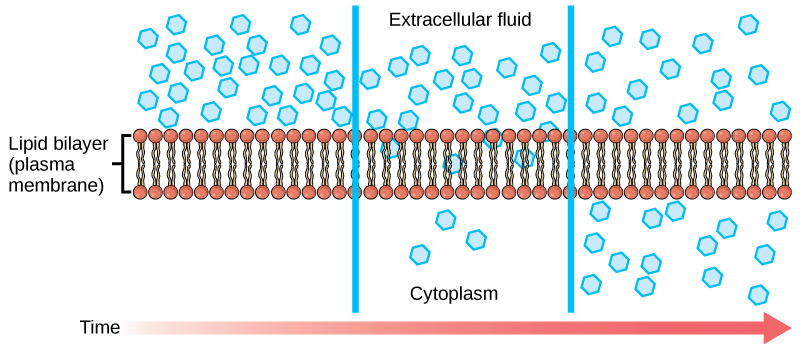
Diffusion is a passive process of transport. A single substance moves from a high concentration to a low concentration area until the concentration is equal across a space. You are familiar with diffusion of substances through the air. For example, think about someone opening a bottle of ammonia in a room filled with people. The ammonia gas is at its highest concentration in the bottle. Its lowest concentration is at the room's edges. The ammonia vapor will diffuse, or spread away, from the bottle, and gradually, increasingly more people will smell the ammonia as it spreads. Materials move within the cell’s cytosol by diffusion, and certain materials move through the plasma membrane by diffusion (Figure 5.8). Diffusion expends no energy. On the contrary, concentration gradients are a form of potential energy, which dissipates as the gradient is eliminated.
英語のヒント
拡散は、受動的な輸送過程である。ある物質は、空間全体で濃度が等しくなるまで、高濃度の領域から低濃度の領域へ移動する。空気中での物質の拡散は、身近な現象である。例えば、人のいる部屋で誰かがアンモニアの瓶を開けたとしよう。アンモニアガスの濃度は瓶の中で最も高く、部屋の端で最も低い。アンモニアの蒸気は瓶から拡散、つまり広がっていき、それにつれて、次第に多くの人がにおいを感じる。物質は拡散によって細胞質基質の中を移動し、一部の物質は拡散で細胞膜を通過する(図5.8)。拡散はエネルギーを費やさない。むしろ濃度勾配は位置エネルギーの一形態であり、勾配がなくなるにつれて、そのエネルギーが散逸する。
OpenStax, Rice University; Biology 2e. (credit: modification of work by Mariana Ruiz Villareal) · CC BY 4.0 · Source出典

Figure 5.8図 5.8
Diffusion through a permeable membrane moves a substance from a high concentration area (extracellular fluid, in this case) down its concentration gradient (into the cytoplasm). (credit: modification of work by Mariana Ruiz Villareal)
透過性の膜を通る拡散により、物質は高濃度の領域(この場合は細胞外液)から、濃度勾配を下る方向(細胞質内)へ移動する。(クレジット:Mariana Ruiz Villarealの作品を改変)
Each separate substance in a medium, such as the extracellular fluid, has its own concentration gradient, independent of other materials' concentration gradients. In addition, each substance will diffuse according to that gradient. Within a system, there will be different diffusion rates of various substances in the medium.
英語のヒント
細胞外液のような媒体では、それぞれの物質が、ほかの物質の濃度勾配とは独立した独自の濃度勾配をもつ。また、各物質はその勾配に従って拡散する。一つの系の中でも、媒体中のさまざまな物質の拡散速度は異なる。