第5章細胞膜の構造と機能
Exocytosisエキソサイトーシス
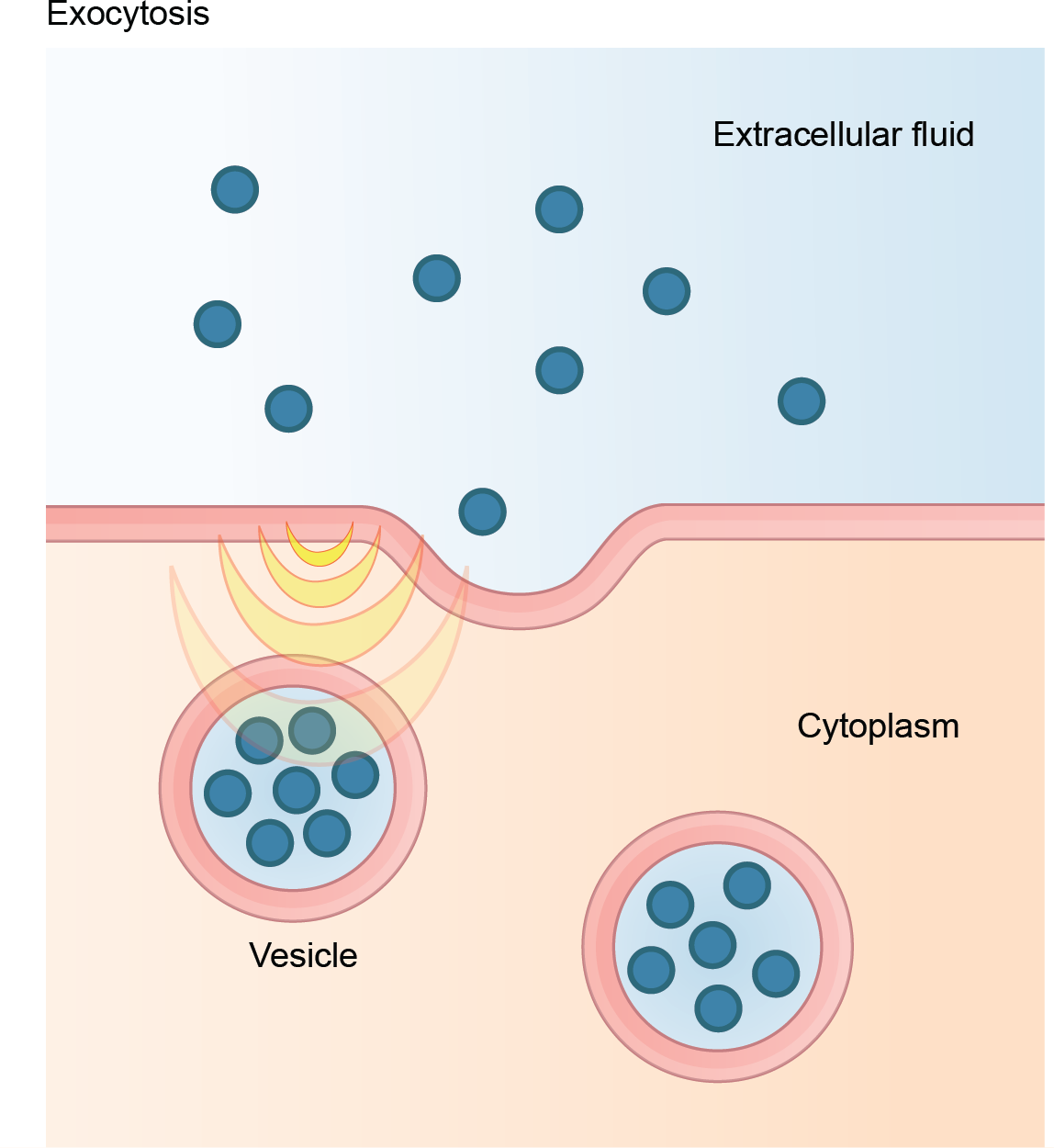
The reverse process of moving material into a cell is the process of exocytosis. Exocytosis is the opposite of the processes we discussed above in that its purpose is to expel material from the cell into the extracellular fluid. Waste material is enveloped in a membrane and fuses with the plasma membrane's interior. This fusion opens the membranous envelope on the cell's exterior, and the waste material expels into the extracellular space (Figure 5.24). Other examples of cells releasing molecules via exocytosis include extracellular matrix protein secretion and neurotransmitter secretion into the synaptic cleft by synaptic vesicles.
英語のヒント
物質を細胞内へ取り込む過程の逆が、エキソサイトーシスである。物質を細胞から細胞外液へ排出することを目的とする点で、これまで述べた過程と逆になる。老廃物は膜に包まれ、その膜が細胞膜の内側と融合する。融合によって膜の包みが細胞外側に開き、老廃物が細胞外空間へ排出される(図5.24)。エキソサイトーシスによる分子放出のほかの例には、細胞外マトリックスのタンパク質の分泌や、シナプス小胞からシナプス間隙への神経伝達物質の分泌がある。
OpenStax, Rice University; Biology 2e. (credit: modification of work by Mariana Ruiz Villareal) · CC BY 4.0 · Source出典

Figure 5.24図 5.24
In exocytosis, vesicles containing substances fuse with the plasma membrane. The contents then release to the cell's exterior. (credit: modification of work by Mariana Ruiz Villareal)
エキソサイトーシスでは、物質を含む小胞が細胞膜と融合する。その後、内容物が細胞外へ放出される。(クレジット:Mariana Ruiz Villarealの作品を改変)
Methods of Transport, Energy Requirements, and Types of Transported Material 輸送方法、エネルギーの必要性、運ばれる物質の種類 |
||
|---|---|---|
Transport Method 輸送方法 |
Active/Passive 能動/受動 |
Material Transported 運ばれる物質 |
Diffusion 拡散 |
Passive 受動 |
Small-molecular weight material 低分子量の物質 |
Osmosis 浸透 |
Passive 受動 |
Water 水 |
Facilitated transport/diffusion 促進輸送/促進拡散 |
Passive 受動 |
Sodium, potassium, calcium, glucose ナトリウム、カリウム、カルシウム、グルコース |
Primary active transport 一次能動輸送 |
Active 能動 |
Sodium, potassium, calcium ナトリウム、カリウム、カルシウム |
Secondary active transport 二次能動輸送 |
Active 能動 |
Amino acids, lactose アミノ酸、ラクトース |
Phagocytosis 食作用 |
Active 能動 |
Large macromolecules, whole cells, or cellular structures 大きな高分子、細胞全体、細胞構造 |
Pinocytosis and potocytosis 飲作用とポトサイトーシス |
Active 能動 |
Small molecules (liquids/water) 小分子(液体/水) |
Receptor-mediated endocytosis 受容体介在性エンドサイトーシス |
Active 能動 |
Large quantities of macromolecules 大量の高分子 |
Section Summaryこの節のまとめ
Active transport methods require directly using ATP to fuel the transport. In a process scientists call phagocytosis, other cells can engulf large particles, such as macromolecules, cell parts, or whole cells. In phagocytosis, a portion of the membrane invaginates and flows around the particle, eventually pinching off and leaving the particle entirely enclosed by a plasma membrane's envelope. The cell breaks down vesicle contents, with the particles either used as food or dispatched. Pinocytosis is a similar process on a smaller scale. The plasma membrane invaginates and pinches off, producing a small envelope of fluid from outside the cell. Pinocytosis imports substances that the cell needs from the extracellular fluid. The cell expels waste in a similar but reverse manner. It pushes a membranous vacuole to the plasma membrane, allowing the vacuole to fuse with the membrane and incorporate itself into the membrane structure, releasing its contents to the exterior.
能動輸送の方法は、輸送のエネルギーとしてATPを直接使うことを必要とする。食作用では、細胞は高分子、細胞の一部、細胞全体など、大きな粒子を包み込める。膜の一部が内側にくぼみ、粒子の周囲を流れるように囲んでから、くびれ切れる。粒子は細胞膜の包みに完全に囲まれる。細胞は小胞内容物を分解し、粒子は栄養として使われるか、処分される。飲作用は、これに似た、より小さい規模の過程である。細胞膜が内側にくぼんでくびれ切れ、細胞外の液体を小さな包みとして取り込む。細胞に必要な物質が細胞外液から入る。細胞は、同様だが逆向きの方法で老廃物を排出する。膜で囲まれた液胞を細胞膜へ押しつけると、液胞が融合し、その膜は細胞膜構造に組み込まれ、内容物が外へ放出される。
Review Questions確認問題
Exercises 27–32練習問題 27–32
Exercise 27問題 27
What happens to the membrane of a vesicle after exocytosis?
エキソサイトーシスの後、小胞の膜はどうなるか。
- It leaves the cell.細胞から出ていく。
- It is disassembled by the cell.細胞によって分解される。
- It fuses with and becomes part of the plasma membrane.細胞膜と融合し、その一部になる。
- It is used again in another exocytosis event.別のエキソサイトーシスで再利用される。
Solution解き方
C
C
Exercise 28問題 28
Which transport mechanism can bring whole cells into a cell?
細胞を丸ごと別の細胞内へ取り込める輸送機構はどれか。
- pinocytosis飲作用
- phagocytosis食作用
- facilitated transport促進輸送
- primary active transport一次能動輸送
Solution解き方
B
B
Exercise 29問題 29
In what important way does receptor-mediated endocytosis differ from phagocytosis?
受容体介在性エンドサイトーシスと食作用の重要な違いはどれか。
- It transports only small amounts of fluid.少量の液体だけを運ぶ。
- It does not involve the pinching off of membrane.膜のくびれ切れを伴わない。
- It brings in only a specifically targeted substance.特定の標的物質だけを取り込む。
- It brings substances into the cell, while phagocytosis removes substances.物質を細胞内へ取り込むのに対し、食作用は物質を排出する。
Solution解き方
C
C
Exercise 30問題 30
Many viruses enter host cells through receptor-mediated endocytosis. What is an advantage of this entry strategy?
多くのウイルスは、受容体介在性エンドサイトーシスによって宿主細胞に入る。この侵入方法には、どのような利点があるか。
- The virus directly enters the cytoplasm of the cell.ウイルスが細胞質に直接入る。
- The virus is protected from recognition by white blood cells.ウイルスが白血球に認識されないよう保護される。
- The virus only enters its target host cell type.標的とする種類の宿主細胞だけに入る。
- The virus can directly inject its genome into the cell’s nucleus.ウイルスが自分のゲノムを細胞の核に直接注入できる。
Solution解き方
C
C
Exercise 31問題 31
Which of the following organelles relies on exocytosis to complete its function?
次のうち、機能を完了するためにエキソサイトーシスに依存する細胞小器官はどれか。
- Golgi apparatusゴルジ体
- vacuole液胞
- mitochondriaミトコンドリア
- endoplasmic reticulum小胞体
Solution解き方
A
A
Exercise 32問題 32
Imagine a cell can perform exocytosis, but only minimal endocytosis. What would happen to the cell?
エキソサイトーシスは行えるが、エンドサイトーシスはごくわずかしか行えない細胞を考えよう。細胞はどうなるか。
- The cell would secrete all its intracellular proteins.細胞内のすべてのタンパク質を分泌する。
- The plasma membrane would increase in size over time.細胞膜の大きさが時間とともに増す。
- The cell would stop expressing integral receptor proteins in its plasma membrane.細胞膜内の内在性受容体タンパク質を発現しなくなる。
- The cell would lyse.細胞が溶解する。
Solution解き方
B
B
Critical Thinking Questions考察問題
Exercises 33–34練習問題 33–34
Exercise 33問題 33
Why is it important that there are different types of proteins in plasma membranes for the transport of materials into and out of a cell?
細胞内外への物質輸送のために、細胞膜に異なる種類のタンパク質があることは、なぜ重要なのか。
Solution解き方
The proteins allow a cell to select what compound will be transported, meeting the needs of the cell and not bringing in anything else.
タンパク質によって、細胞は運ぶ化合物を選べる。それにより、細胞の必要を満たし、ほかのものを取り込まずに済む。
Exercise 34問題 34
Why do ions have a difficult time getting through plasma membranes despite their small size?
イオンは小さいのに、なぜ細胞膜を通りにくいのか。
Solution解き方
Ions are charged, and consequently, they are hydrophilic and cannot associate with the lipid portion of the membrane. Ions must be transported by carrier proteins or ion channels.
イオンは電荷をもち、そのため親水性なので、膜の脂質部分となじまない。担体タンパク質やイオンチャネルによって運ばれなければならない。
caveolin
カベオリン
protein that coats the plasma membrane's cytoplasmic side and participates in the liquid uptake process by potocytosis
細胞膜の細胞質側を覆い、ポトサイトーシスによる液体の取り込みに関わるタンパク質
clathrin
クラスリン
protein that coats the plasma membrane's inward-facing surface and assists in forming specialized structures, like coated pits, for phagocytosis
細胞膜の内向きの表面を覆い、食作用のための被覆ピットなど、特殊な構造の形成を助けるタンパク質
endocytosis
エンドサイトーシス
type of active transport that moves substances, including fluids and particles, into a cell
液体や粒子を含む物質を細胞内へ運ぶ能動輸送の一種
exocytosis
エキソサイトーシス
process of passing bulk material out of a cell
まとまった量の物質を細胞外へ出す過程
pinocytosis
飲作用
a variation of endocytosis that imports macromolecules that the cell needs from the extracellular fluid
細胞に必要な高分子を細胞外液から取り込む、エンドサイトーシスの一形態
potocytosis
ポトサイトーシス
variation of pinocytosis that uses a different coating protein (caveolin) on the plasma membrane's cytoplasmic side
細胞膜の細胞質側に、別の被覆タンパク質であるカベオリンを用いる飲作用の一形態
receptor-mediated endocytosis
受容体介在性エンドサイトーシス
variation of endocytosis that involves using specific binding proteins in the plasma membrane for specific molecules or particles, and clathrin-coated pits that become clathrin-coated vesicles
特定の分子や粒子に対する細胞膜の特異的結合タンパク質と、クラスリン被覆小胞になるクラスリン被覆ピットを利用するエンドサイトーシスの一形態