第5章細胞膜の構造と機能
Hypertonic Solutions高張液
As for a hypertonic solution, the prefix hyper- refers to the extracellular fluid having a higher osmolarity than the cell’s cytoplasm; therefore, the fluid contains less water than the cell does. Because the cell has a relatively higher water concentration, water will leave the cell.
英語のヒント
高張液では、hyper-という接頭辞は、細胞外液の浸透モル濃度が細胞質より高いことを示す。したがって、細胞外液に含まれる水は細胞内より少ない。細胞内の水の濃度が相対的に高いため、水は細胞から出ていく。
Isotonic Solutions等張液
In an isotonic solution, the extracellular fluid has the same osmolarity as the cell. If the cell's osmolarity matches that of the extracellular fluid, there will be no net movement of water into or out of the cell, although water will still move in and out. Blood cells and plant cells in hypertonic, isotonic, and hypotonic solutions take on characteristic appearances (Figure 5.12).
英語のヒント
等張液では、細胞外液の浸透モル濃度は細胞内と同じである。両者が一致すれば、水は出入りし続けるものの、正味の流入や流出はなくなる。血球や植物細胞は、高張液、等張液、低張液の中で、それぞれ特徴的な外観になる(図5.12)。
Tonicity in Living Systems生体系における張度
In a hypotonic environment, water enters a cell, and the cell swells. In an isotonic condition, the relative solute and solvent concentrations are equal on both membrane sides. There is no net water movement; therefore, there is no change in the cell's size. In a hypertonic solution, water leaves a cell and the cell shrinks. If either the hypo- or hyper- condition goes to excess, the cell’s functions become compromised, and the cell may be destroyed.
英語のヒント
低張の環境では、水が細胞に入り、細胞は膨らむ。等張の条件では、膜の両側で溶質と溶媒の相対濃度が等しく、水の正味の移動がないため、細胞の大きさも変わらない。高張液では、水が細胞から出て細胞が縮む。低張でも高張でも、程度が過剰になると細胞の機能が損なわれ、細胞が壊れることがある。
A red blood cell will burst, or lyse, when it swells beyond the plasma membrane’s capability to expand. Remember, the membrane resembles a mosaic, with discrete spaces between the molecules comprising it. If the cell swells, and the spaces between the lipids and proteins become too large, the cell will break apart.
英語のヒント
赤血球は、細胞膜が伸びられる限界を超えて膨らむと、破裂、すなわち溶血する。膜はモザイクに似ており、構成分子の間に個々の隙間があることを思い出そう。細胞が膨らみ、脂質やタンパク質の間の隙間が大きくなりすぎると、細胞は壊れる。
In contrast, when excessive water amounts leave a red blood cell, the cell shrinks, or crenates. This has the effect of concentrating the solutes left in the cell, making the cytosol denser and interfering with diffusion within the cell. The cell’s ability to function will be compromised and may also result in the cell's death.
英語のヒント
逆に、赤血球から過剰な水が出ると、細胞は縮み、しわが寄る。これにより、細胞内に残る溶質が濃縮され、細胞質基質の密度が高まり、内部の拡散が妨げられる。細胞が機能する能力が損なわれ、細胞死に至ることもある。
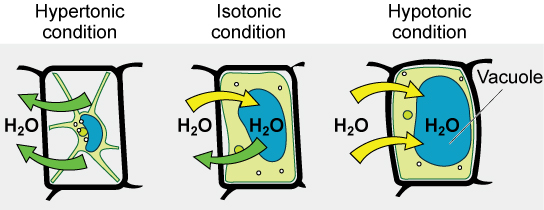
Various living things have ways of controlling the effects of osmosis—a mechanism we call osmoregulation. Some organisms, such as plants, fungi, bacteria, and some protists, have cell walls that surround the plasma membrane and prevent cell lysis in a hypotonic solution. The plasma membrane can only expand to the cell wall's limit, so the cell will not lyse. The cytoplasm in plants is always slightly hypertonic to the cellular environment, and water will always enter a cell if water is available. This water inflow produces turgor pressure, which stiffens the plant's cell walls (Figure 5.13). In nonwoody plants, turgor pressure supports the plant. Conversely, if you do not water the plant, the extracellular fluid will become hypertonic, causing water to leave the cell. In this condition, the cell does not shrink because the cell wall is not flexible. However, the cell membrane detaches from the wall and constricts the cytoplasm. We call this plasmolysis. Plants lose turgor pressure in this condition and wilt (Figure 5.14).
英語のヒント
さまざまな生物は、浸透の作用を制御する方法をもつ。この仕組みを浸透圧調節という。植物、菌類、細菌、一部の原生生物などは、細胞膜を囲む細胞壁をもち、低張液中での細胞の溶解を防ぐ。細胞膜は細胞壁の限界までしか膨らめないため、細胞は溶解しない。植物の細胞質は周囲に対して常にやや高張であり、水があれば常に細胞内へ入る。この流入は膨圧を生み、植物の細胞壁を張らせる(図5.13)。木質化していない植物は、膨圧によって支えられる。反対に、水を与えないと細胞外液が高張になり、水が細胞から出る。この場合、細胞壁は柔軟でないため、細胞自体は縮まない。しかし、細胞膜は壁から離れて細胞質を縮める。これを原形質分離という。この状態では植物は膨圧を失い、しおれる(図5.14)。
OpenStax, Rice University; Biology 2e. (credit: modification of work by Mariana Ruiz Villareal) · CC BY 4.0 · Source出典
Figure 5.13図 5.13
The turgor pressure within a plant cell depends on the solution's tonicity in which it is bathed. (credit: modification of work by Mariana Ruiz Villareal)
植物細胞内の膨圧は、その細胞を浸している溶液の張度によって決まる。(クレジット:Mariana Ruiz Villarealの作品を改変)
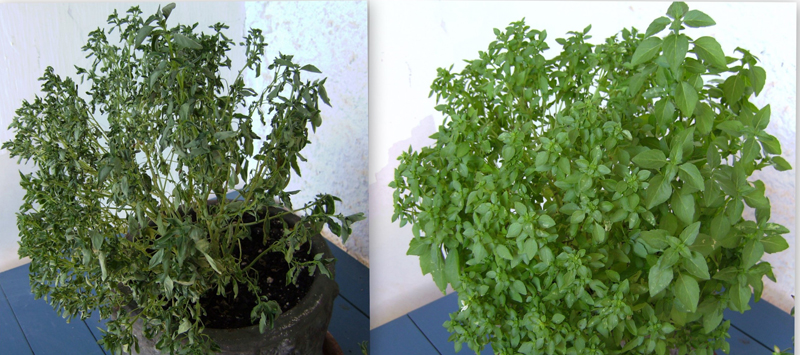


Figure 5.14図 5.14
Without adequate water, the plant on the left has lost turgor pressure, visible in its wilting. Watering the plant (right) will restore the turgor pressure. (credit: Victor M. Vicente Selvas)
左の植物は水が足りず、膨圧を失ってしおれている。水を与えると(右)、膨圧が回復する。(クレジット:Victor M. Vicente Selvas)
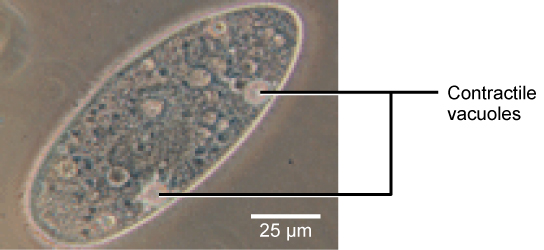
Tonicity is a concern for all living things. For example, paramecia and amoebas, which are protists that lack cell walls, have contractile vacuoles. This vesicle collects excess water from the cell and pumps it out, keeping the cell from lysing as it takes on water from its environment (Figure 5.15).
英語のヒント
張度はすべての生物に関わる。例えば、細胞壁をもたない原生生物であるゾウリムシやアメーバには、収縮胞がある。この小胞は細胞内の余分な水を集めて外へくみ出し、環境から水を取り込む細胞が溶解しないようにする(図5.15)。
OpenStax, Rice University; Biology 2e. (credit: modification of work by NIH; scale-bar data from Matt Russell) · CC BY 4.0 · Source出典

Figure 5.15図 5.15
A paramecium’s contractile vacuole, here visualized using bright field light microscopy at 480x magnification, continuously pumps water out of the organism’s body to keep it from bursting in a hypotonic medium. (credit: modification of work by NIH; scale-bar data from Matt Russell)
倍率480倍の明視野光学顕微鏡で見たゾウリムシの収縮胞。低張の媒体中で体が破裂しないよう、絶えず水を体外へくみ出す。(クレジット:NIHの作品を改変。スケールバーのデータ:Matt Russell)
Many marine invertebrates have internal salt levels matched to their environments, making them isotonic with the water in which they live. Fish, however, must spend approximately five percent of their metabolic energy maintaining osmotic homeostasis. Freshwater fish live in an environment that is hypotonic to their cells. These fish actively take in salt through their gills and excrete diluted urine to rid themselves of excess water. Saltwater fish live in the reverse environment, which is hypertonic to their cells, and they secrete salt through their gills and excrete highly concentrated urine.
英語のヒント
多くの海産無脊椎動物は、体内の塩分濃度を環境とそろえ、生息する水と等張になっている。しかし魚類は、浸透圧の恒常性を保つために、代謝エネルギーの約5パーセントを使わなければならない。淡水魚は、自分の細胞に対して低張の環境に暮らす。えらから塩類を能動的に取り込み、薄い尿を排出して余分な水を除く。海水魚は逆に、細胞に対して高張の環境に暮らし、えらから塩類を分泌して、濃く濃縮された尿を排出する。
In vertebrates, the kidneys regulate the water amount in the body. Osmoreceptors are specialized cells in the brain that monitor solute concentration in the blood. If the solute levels increase beyond a certain range, a hormone releases that slows water loss through the kidney and dilutes the blood to safer levels. Animals also have high albumin concentrations, which the liver produces, in their blood. This protein is too large to pass easily through plasma membranes and is a major factor in controlling the osmotic pressures applied to tissues.
英語のヒント
脊椎動物では、腎臓が体内の水の量を調節する。浸透圧受容器は脳内の特殊化した細胞で、血液中の溶質濃度を監視する。溶質濃度が一定の範囲を超えて上がると、ホルモンが放出され、腎臓を介した水の喪失を遅らせ、血液をより安全な濃度まで薄める。動物の血液には、肝臓が作るアルブミンも高濃度に含まれる。このタンパク質は大きすぎて細胞膜を容易には通れず、組織にかかる浸透圧を調節する主要な要因となる。