第30章政府予算と財政政策
30.6 Practical Problems with Discretionary Fiscal Policy30.6 裁量的財政政策の実施上の問題
Learning Objectives学習目標
Learning Objectives学習目標
By the end of this section, you will be able to:
英語のヒント
この節を学ぶと、次のことができるようになる。
- Understand how fiscal policy and monetary policy are interconnected
英語のヒント
財政政策と金融政策の相互のつながりを理解する - Explain the three lag times that often occur when solving economic problems
英語のヒント
経済問題を解決する際に、しばしば生じる三つの時間の遅れを説明する - Identify the legal and political challenges of responding to an economic problem
英語のヒント
経済問題への対応における、法的・政治的な課題を明らかにする
In the early 1960s, many leading economists believed that the problem of the business cycle, and the swings between cyclical unemployment and inflation, were a thing of the past. On the cover of its December 31, 1965, issue, Time magazine, then the premier news magazine in the United States, ran a picture of John Maynard Keynes, and the story inside identified Keynesian theories as “the prime influence on the world’s economies.” The article reported that policymakers have “used Keynesian principles not only to avoid the violent [business] cycles of prewar days but to produce phenomenal economic growth and to achieve remarkably stable prices.”
英語のヒント
1960年代初頭、多くの有力な経済学者は、景気循環の問題や、循環的失業とインフレの間を揺れ動く問題は、過去のものになったと信じていた。当時アメリカの代表的なニュース雑誌だった『タイム』は、1965年12月31日号の表紙にジョン・メイナード・ケインズの絵を載せ、記事の中でケインズ理論を「世界の経済に対する第一の影響力」と位置づけた。記事は、政策担当者が「ケインズの原理を用い、戦前の激しい〔景気〕循環を避けるだけでなく、驚異的な経済成長を生み、著しく安定した物価を実現した」と報じた。
This happy consensus, however, did not last. The U.S. economy suffered one recession from December 1969 to November 1970, a deeper recession from November 1973 to March 1975, and then double-dip recessions from January to June 1980 and from July 1981 to November 1982. At various times, inflation and unemployment both soared. Clearly, the problems of macroeconomic policy had not been completely solved. As economists began to consider what had gone wrong, they identified a number of issues that make discretionary fiscal policy more difficult than it had seemed in the rosy optimism of the mid-1960s.
英語のヒント
しかし、この幸福な合意は長続きしなかった。アメリカ経済は、1969年12月から1970年11月の景気後退、1973年11月から1975年3月のより深い景気後退、さらに1980年1~6月と1981年7月~1982年11月の二番底の景気後退を経験した。さまざまな時期に、インフレも失業も急上昇した。明らかに、マクロ経済政策の問題は完全には解決していなかった。経済学者は何がうまくいかなかったかを考え始め、1960年代半ばのばら色の楽観の中で思われていたより、裁量的財政政策を難しくする多くの問題を見いだした。
Fiscal Policy and Interest Rates財政政策と金利
Because fiscal policy affects the quantity that the government borrows in financial capital markets, it not only affects aggregate demand—it can also affect interest rates. In Figure 30.14, the original equilibrium (E0) in the financial capital market occurs at a quantity of $800 billion and an interest rate of 6%. However, an increase in government budget deficits shifts the demand for financial capital from D0 to D1. The new equilibrium (E1) occurs at a quantity of $900 billion and an interest rate of 7%.
英語のヒント
財政政策は、政府が金融資本市場で借りる量に影響するため、総需要に影響するだけでなく、金利にも影響しうる。図30.14では、金融資本市場のもとの均衡(E0)は、数量8,000億ドル、金利6%のところにある。しかし、政府の財政赤字が増えると、金融資本への需要はD0からD1へ移動する。新しい均衡(E1)は、数量9,000億ドル、金利7%のところに生じる。
A consensus estimate based on a number of studies is that an increase in budget deficits (or a fall in budget surplus) by 1% of GDP will cause an increase of 0.5–1.0% in the long-term interest rate.
英語のヒント
複数の研究に基づく合意的な推定では、財政赤字がGDPの1%分増加する、または財政黒字がGDPの1%分減少すると、長期金利が0.5~1.0%上がる。
Fiscal Policy and Interest Rates財政政策と金利
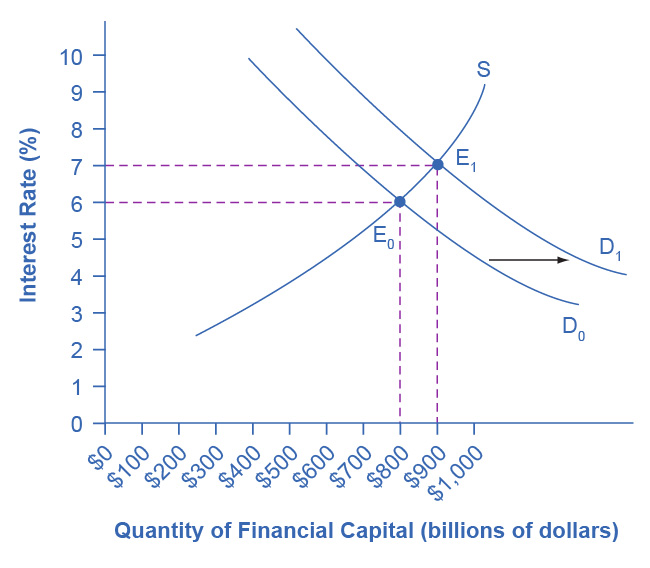

Figure 30.14図 30.14
When a government borrows money in the financial capital market, it causes a shift in the demand for financial capital from D0 to D1. As the equilibrium moves from E0 to E1, the equilibrium interest rate rises from 6% to 7% in this example. In this way, an expansionary fiscal policy intended to shift aggregate demand to the right can also lead to a higher interest rate, which has the effect of shifting aggregate demand back to the left.
英語のヒント
政府が金融資本市場で資金を借りると、金融資本への需要がD0からD1へ移動する。均衡がE0からE1へ移ると、この例では均衡金利が6%から7%へ上がる。このように、総需要を右へ移すことを意図した拡張的財政政策は、金利上昇ももたらしうる。それは、総需要を左へ戻す効果を持つ。
A problem arises here. An expansionary fiscal policy, with tax cuts or spending increases, is intended to increase aggregate demand. If an expansionary fiscal policy also causes higher interest rates, then firms and households are discouraged from borrowing and spending (as occurs with tight monetary policy), thus reducing aggregate demand. Even if the direct effect of expansionary fiscal policy on increasing demand is not totally offset by lower aggregate demand from higher interest rates, fiscal policy can end up less powerful than was originally expected. We refer to this as crowding out, where government borrowing and spending results in higher interest rates, which reduces business investment and household consumption.
英語のヒント
ここで問題が生じる。減税や支出増を伴う拡張的財政政策は、総需要を増やすことを意図している。ところが、拡張的財政政策が金利上昇も引き起こすと、金融引締め政策の場合と同様に、企業や家計の借入れと支出が抑制され、総需要が減る。金利上昇による総需要の低下が、拡張的財政政策の需要増加への直接効果を完全に相殺しないとしても、財政政策の力は当初の予想より弱くなりうる。これをクラウディング・アウトという。政府の借入れと支出が金利上昇をもたらし、それによって企業投資と家計消費が減ることである。
The broader lesson is that the government must coordinate fiscal and monetary policy. If expansionary fiscal policy is to work well, then the central bank can also reduce or keep short-term interest rates low. Conversely, monetary policy can also help to ensure that contractionary fiscal policy does not lead to a recession.
英語のヒント
より広い教訓は、政府が財政政策と金融政策を協調させなければならないということである。拡張的財政政策がうまく働くようにするには、中央銀行も短期金利を下げるか、低く保つことができる。逆に、金融政策は、引締め的財政政策が景気後退につながらないようにする助けにもなる。
Long and Variable Time Lags長く一定しない時間の遅れ
The government can change monetary policy several times each year, but it takes much longer to enact fiscal policy. Imagine that the economy starts to slow down. It often takes some months before the economic statistics signal clearly that a downturn has started, and a few months more to confirm that it is truly a recession and not just a one- or two-month blip. Economists often call the time it takes to determine that a recession has occurred the recognition lag. After this lag, policymakers become aware of the problem and propose fiscal policy bills. The bills go into various congressional committees for hearings, negotiations, votes, and then, if passed, eventually for the president’s signature. Many fiscal policy bills about spending or taxes propose changes that would start in the next budget year or would be phased in gradually over time. Economists often refer to the time it takes to pass a bill as the legislative lag. Finally, once the government passes the bill it takes some time to disperse the funds to the appropriate agencies to implement the programs. Economists call the time it takes to start the projects the implementation lag.
英語のヒント
政府は年に何度も金融政策を変えられるが、財政政策の法制化には、ずっと長い時間がかかる。経済が減速し始めたと想像しよう。景気の下降が始まったことを経済統計が明確に示すまで、しばしば数か月かかる。さらに、それが1~2か月の一時的な変動ではなく、本当に景気後退であると確認するまで、あと数か月かかる。経済学者は、景気後退が起きたと判断するまでの時間を、認知の遅れと呼ぶことが多い。この遅れの後、政策担当者は問題を認識し、財政政策の法案を提案する。法案は議会のさまざまな委員会へ送られ、公聴会、交渉、採決を経て、可決されれば最終的に大統領の署名へ進む。支出や税に関する財政政策法案の多くは、次の予算年度から始まる変更、または時間をかけて段階的に導入する変更を提案する。経済学者は、法案を成立させるまでの時間を、立法の遅れと呼ぶことが多い。最後に、政府が法案を成立させても、制度を実施する適切な機関へ資金を配分するまで、いくらか時間がかかる。経済学者は、事業を始めるまでの時間を、実施の遅れという。
Moreover, the exact level of fiscal policy that the government should implement is never completely clear. Should it increase the budget deficit by 0.5% of GDP? By 1% of GDP? By 2% of GDP? In an AD/AS diagram, it is straightforward to sketch an aggregate demand curve shifting to the potential GDP level of output. In the real world, we only know roughly, not precisely, the actual level of potential output, and exactly how a spending cut or tax increase will affect aggregate demand is always somewhat controversial. Also unknown is the state of the economy at any point in time. During the early days of the Obama administration, for example, no one knew the true extent of the economy's deficit. During the 2008-2009 financial crisis, the rapid collapse of the banking system and automotive sector made it difficult to assess how quickly the economy was collapsing.
英語のヒント
さらに、政府が実施すべき財政政策の正確な規模は、決して完全には明らかにならない。財政赤字をGDPの0.5%分増やすべきか。1%分か。2%分か。AD–AS図では、総需要曲線を潜在GDPの生産水準へ移す図を描くのは簡単である。現実の世界では、実際の潜在生産水準についてわかるのは、おおよその値だけで、正確な値ではない。また、支出削減や増税が総需要に具体的にどのように影響するかには、常に多少の論争がある。ある時点での経済の状態も、わかっていない。たとえばオバマ政権の初期には、経済の赤字の本当の規模を誰も知らなかった。2008~2009年の金融危機では、銀行制度と自動車部門が急速に崩れたため、経済がどれほど速く崩壊しているかを評価するのは難しかった。
Thus, it can take many months or even more than a year to begin an expansionary fiscal policy after a recession has started—and even then, uncertainty will remain over exactly how much to expand or contract taxes and spending. When politicians attempt to use countercyclical fiscal policy to fight recession or inflation, they run the risk of responding to the macroeconomic situation of two or three years ago, in a way that may be exactly wrong for the economy at that time. George P. Schultz, a professor of economics, former Secretary of the Treasury, and Director of the Office of Management and Budget, once wrote: “While the economist is accustomed to the concept of lags, the politician likes instant results. The tension comes because, as I have seen on many occasions, the economist’s lag is the politician’s nightmare.”
英語のヒント
したがって、景気後退の開始から拡張的財政政策を始めるまでには、何か月も、ときには1年を超える時間がかかる。それでも、税や支出を正確にどれだけ拡大または縮小すべきかについて、不確実性が残る。政治家が反循環的財政政策で景気後退やインフレと闘おうとすると、2~3年前のマクロ経済状況に対応してしまい、実施時点の経済にはまったく誤った対応になる危険を冒す。経済学教授で、財務長官や行政管理予算局長も務めたジョージ・P・シュルツは、かつてこう書いた。「経済学者は遅れという概念に慣れているが、政治家は即座の結果を好む。私が何度も見たように、経済学者の遅れは政治家の悪夢だからこそ、緊張が生じるのである。」